
Most applicants misunderstand pre‑match offers—and that costs them leverage.
Let me break this down specifically: a pre‑match offer from a brand‑new program is not the same species as a pre‑match offer from a 30‑year established powerhouse. The letterhead might look similar. The risk profile, signaling, and strategy absolutely do not.
You are not just choosing a contract. You are choosing:
- The level of risk you are willing to tolerate.
- The kind of training environment you will grow in.
- How much control you want over your Match outcome.
If you treat all pre‑match offers as “golden tickets,” you will make bad decisions. I have watched it happen. People locked into unstable programs, or walked away from excellent early offers because they misread what they had in front of them.
Let’s make sure you are not one of them.
1. What a Pre‑Match Offer Actually Is (Not the Fantasy Version)
A pre‑match offer is essentially an early, binding commitment outside or ahead of the NRMP algorithm (depending on country/system). Structure varies by geography (US, Texas, many international systems), but the core decision is the same:
“You sign with us now, we are off the market for each other later.”
Strip away the romance. Ignore the “we felt you were a great fit” language. Functionally, pre‑match offers serve three interests:
- Programs want to secure talent before competitors see your full application or before the Rank Order chaos.
- Applicants want certainty and a safety net in a brutally competitive process.
- Both sides want to reduce uncertainty at the cost of optionality.
The line you must hold in your head: certainty always costs you something. Usually flexibility, sometimes training quality, occasionally your sanity.
2. New vs Established Programs: The Hidden Differences Behind the Offer
The phrase “We’re a new program, building something special” sounds inspiring on interview day. On paper, both new and established programs can hand you a “pre‑match offer.” In reality, they are extremely different propositions.
| Factor | New Program | Established Program |
|---|---|---|
| Track record | None or minimal | Years of data, alumni network |
| Accreditation risk | Higher | Lower |
| Curriculum stability | Still evolving | Standardized and tested |
| Call structure | Often in flux | Known, prior resident feedback |
| Fellowship pipeline | Weak/unknown | Documented outcomes |
| Reputation with PDs | Variable, often low initially | Known and predictable |
New programs: what is really happening
New (or very young) residency programs are under pressure. They need residents to:
- Maintain accreditation or initial approval.
- Staff clinical services (yes, this is real; service needs often drive urgency).
- Demonstrate viability to their institution and accrediting body.
So when a new program gives you a pre‑match offer, it is often more about their survival than uniquely recognizing your brilliance. That does not mean it is bad. It means you interpret it with clear eyes.
Typical features of new program pre‑match offers:
- Aggressive recruiting. “We want to lock you in now.”
- Less competition for spots (fewer applicants willing to risk unknowns).
- Sometimes better lifestyle or salary perks to compensate for uncertainty.
- Higher risk of:
- Weak teaching culture.
- Chaotic workflows.
- Service-heavy, education-light schedules until the program matures.
Established programs: different pressure, different motives
Established programs usually offer pre‑match in specific contexts:
- They have identified you as an unusually strong fit (language skills, research niche, local ties).
- They anticipate competition from top programs and want to secure you before others move.
- Some systems (e.g., certain states / pathways) are structurally set up to offer pre‑match routinely.
Here, urgency is less about institutional survival, more about talent capture. When a well‑known, stable program offers early, it usually means: “We really want you and do not want to risk losing you in the Match shuffle.”
The big takeaway:
A pre‑match from a strong established program is often a vote of confidence in your application.
A pre‑match from a brand‑new program is often a vote of necessity in their development.
You navigate those differently.
3. Risk Matrix: Where You Actually Stand
You have to be brutally honest about how competitive you are. Not in some vague “I think my letters are good” way. I mean score ranges, red flags, actual probability of matching.
Let me quantify it.
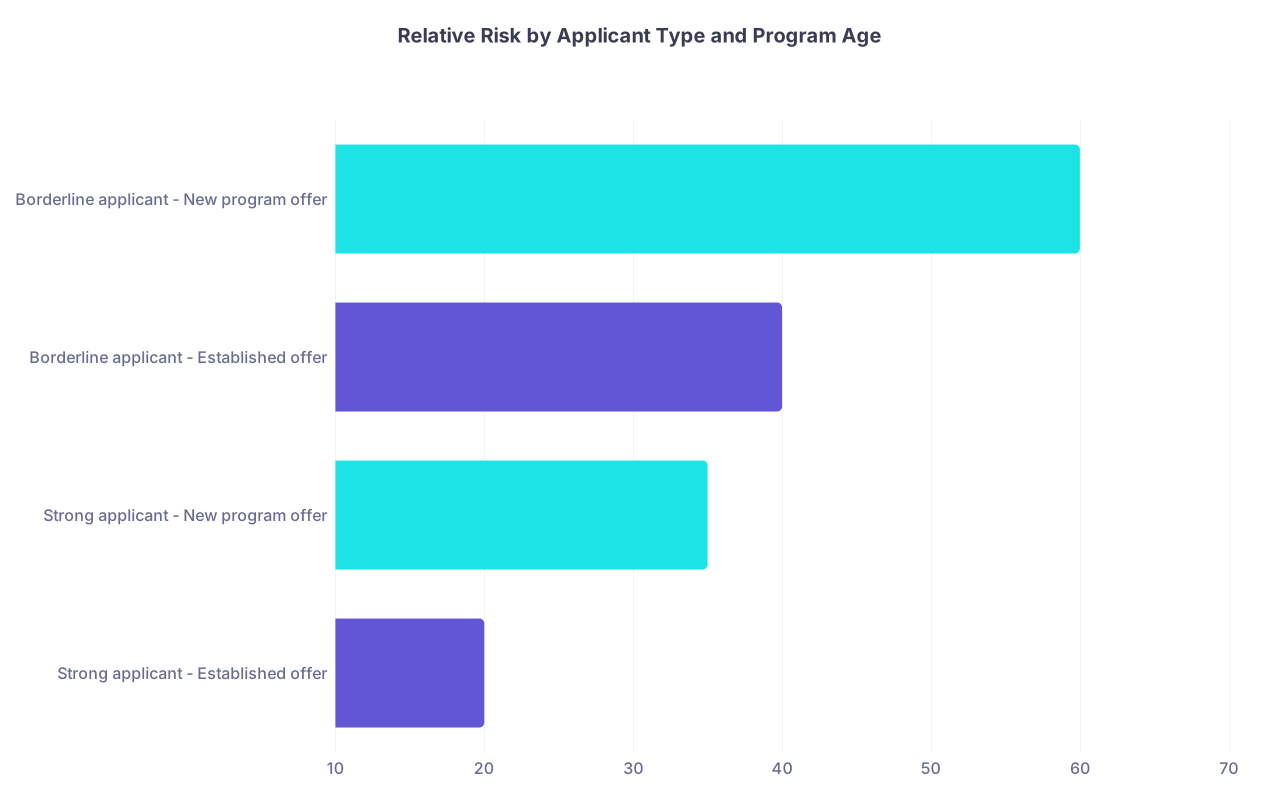
| Category | Value |
|---|---|
| Strong applicant - Established offer | 20 |
| Strong applicant - New program offer | 35 |
| Borderline applicant - Established offer | 40 |
| Borderline applicant - New program offer | 60 |
Think of “risk score” like this: higher means more potential downside if you decline and rely on the Match.
- Strong applicant + established pre‑match: low risk to decline.
- Strong applicant + new program pre‑match: moderate risk to decline (depends on specialty competitiveness).
- Borderline applicant + established pre‑match: moderate–high risk to decline.
- Borderline applicant + new program pre‑match: very high risk to decline in certain specialties.
If you are a borderline candidate in a competitive specialty and an established program offers you pre‑match? Walking away is often foolish unless your backup plan is extremely clear and realistic.
4. How to Read the Signals in a Pre‑Match Offer
Not all pre‑match offers are equally strong, even from the same type of program. Here is what I look at when residents send me their emails and contracts.
1. Timing of the offer
Early (before most interviews) vs late (after interview season peak):
- Early offer from an established program:
They really want you. You are high on their internal rank list. - Early offer from a new program:
They may be offering early to many people, trying to fill quickly. - Late offer from an established program:
Could mean you are solid but not their top option, or they had earlier declines. Still can be fine. - Late offer from a new program:
Often means they are struggling to fill. That should raise your questions, not just your ego.
2. Specific language used
Boilerplate vs tailored.
Boilerplate:
“We were very impressed with your application and would like to extend you a position in our program…”
Tailored:
“We were particularly impressed with your experience in X community clinic and your interest in Y subspecialty, which aligns with Dr. Z’s work here…”
Generic language alone does not kill the offer—but highly tailored, specific language from an established program is a stronger signal that:
- Your fit is real.
- You are likely to be supported and mentored once you arrive.
New programs often use generic language because they do not know what “fit” looks like yet.
3. Clarify the terms, explicitly
Do not guess. Ask:
- Is this binding outside of the Match / NRMP?
- Will you still be listed in NRMP, or do they withdraw you once you accept?
- What is the exact start date, salary, and benefits?
- Are there contingencies (Step 2 score thresholds, visa status resolution, graduation requirements)?
Any hesitation or vague answers from a new program here are a problem.
5. Due Diligence: What You Must Investigate Before Saying Yes
You are not just evaluating the email. You are evaluating the system you will live inside for 3–7 years.
Here is the minimum due diligence I expect from a serious applicant.

| Step | Description |
|---|---|
| Step 1 | Receive Pre Match Offer |
| Step 2 | Investigate Accreditation and Stability |
| Step 3 | Check Outcomes and Fit |
| Step 4 | Compare With Match Options |
| Step 5 | Decline Offer |
| Step 6 | Accept Offer |
| Step 7 | Proceed to Match |
| Step 8 | New or Established Program |
| Step 9 | Risk Acceptable |
| Step 10 | Better Than Likely Match |
For new programs
Ask current residents (if any) and faculty, very specifically:
- How many resident classes are currently in the program?
- Has the program had any citations from the accrediting body (ACGME or equivalent)?
- What does didactic teaching actually look like week to week?
- How many clinics / rotations are staffed predominantly by residents with minimal attending presence?
- Have any residents left or transferred? Why?
You want concrete, not vague reassurance. “We’re building as we go” is honest but risky. “We have weekly board review, protected didactic half‑days, and 3 full‑time core faculty with dedicated teaching time” is more reassuring.
Find out hospital volume:
- Are there enough patients and complexity to train you properly?
- Are there competing learners (NP/PA students, other specialties) who will siphon procedures and clinic exposure?
For established programs
Here I care about:
- Board pass rates.
- Fellowship match lists (for IM, peds, etc).
- Job placement for those who do not subspecialize.
- Culture: malignant vs supportive, micromanagement vs autonomy.
Talk to current residents off‑script. Not the hand‑picked “resident panel” that the program trots out. People always leak the truth in DMs: “You’ll get great training, but call is brutal and PD is inflexible,” or “Honestly, PD is amazing, faculty care, but research support is limited.”
You use that to decide if an early offer is worth binding yourself to.
6. Strategy: When to Accept, When to Hold, When to Walk Away
Now we get to the actual playbook. Let me break this into concrete scenarios.

Scenario A: Strong applicant, established program, pre‑match offer
Profile: Step scores above program mean, solid letters, maybe home‑institution advantage, or niche experience. You have (or will have) multiple interviews at comparable programs.
My take:
- If the program is top‑tier or perfectly fits your geographic/personal priorities: strongly consider accepting.
- If the program is solid but not among your top realistic options: you can safely wait for the Match.
Key question:
“Is this program clearly in the top 3 of realistic places I could end up?”
If yes, an early offer is worth serious consideration.
Scenario B: Strong applicant, new program, pre‑match offer
Profile: You are clearly above their baseline resident profile. They are excited because you would be a “founder.”
Reality check:
- You will likely match somewhere decent even if you decline.
- Your biggest risk is not matching your dream specialty, not failing to match at all (assuming you applied smartly).
My recommendation:
- Do not accept out of flattery.
- Only take this if the program is:
- In your absolute must‑live location, or
- Attached to a very strong institution building a new program (e.g., large academic center expanding).
If the hospital is small, unknown, and the program is brand new, yet you are a strong candidate? You are often better off riding the Match unless you have major geographic constraints.
Scenario C: Borderline applicant, established program, pre‑match offer
Profile: Average or below‑average scores, maybe a repeat attempt, or visa issues. You know your file has weaknesses. This established program is mid‑tier but stable.
Here’s the hard truth:
This might be your best realistic shot at a stable training environment.
In many cases, I tell people in this scenario to accept unless:
- They have already secured multiple interviews at programs clearly better aligned with their priorities, and
- They are prepared to stomach the possibility of going unmatched.
You do not get extra points for gambling and losing.
Scenario D: Borderline applicant, new program, pre‑match offer
Profile: Red flags, limited interviews, maybe changing specialties. This new program is offering you a lifeline.
Risk is high in both directions:
- Accepting: You lock yourself into a potentially unstable training environment that might struggle with accreditation, structure, or support.
- Declining: You might go unmatched.
My recommendation is pragmatic:
- If this is your only or one of very few serious options, and the program passes basic due diligence (no obvious disaster signs, leadership seems committed, hospital volume adequate), accepting can be rational.
- But you must walk in knowing you will be doing more “building” and less “coasting” than your peers in long‑standing programs.
7. Negotiating and Communicating Around Pre‑Match Offers
Most applicants act like they have no agency. That is not true. You have some room, especially with new programs.
What you can reasonably ask
You can ask:
- “How long do I have to decide?” (Get a concrete date.)
- “Will I still be eligible for other interview invitations while this offer is pending?”
- “Can I see the resident contract and benefits in writing before deciding?”
- “If I accept, what is the next step with NRMP / our national match system?”
New programs are often more flexible on decision deadlines because they are eager to fill. Use that. Buy yourself 1–2 weeks to think, compare, and talk with mentors.
What you should not do
- Do not lie and say you already accepted somewhere else when you have not. Word travels.
- Do not try to use a shaky new program offer to “pressure” an established program (“If you don’t pre‑match me, I’ll accept X”). That usually backfires.
- Do not ghost. Decline respectfully if you are sure. Future PDs sometimes move institutions; you do not want to be the unprofessional applicant they still remember.
8. The Special Case: Programs in Transition (Not Quite New, Not Fully Established)
Some programs are 3–5 years old. They are technically “established,” but not mature. These require nuance.
Red flags in “young but not brand new” programs:
- High resident turnover in early classes.
- Repeated changes in PD or core faculty.
- Multiple site changes or shifting primary hospital locations.
- Reports of residents doing excessive non‑educational tasks (transporting patients, phlebotomy not linked to learning, constant scut).
Green flags:
- Clear evidence of institutional backing (new clinic spaces, committed funding, multiple faculty hires).
- Transparent acknowledgement of early challenges and specific improvements made.
- Residents speaking candidly about both pros and cons.
In these in‑between programs, a pre‑match offer is neither obviously great nor obviously terrible. You really need current residents’ unfiltered opinions. If they are cautiously optimistic and can point to year‑over‑year improvements, risk is more acceptable.
9. Emotional Traps That Ruin Pre‑Match Decisions
Let’s talk psychology, because I have watched smart people sabotage themselves here.
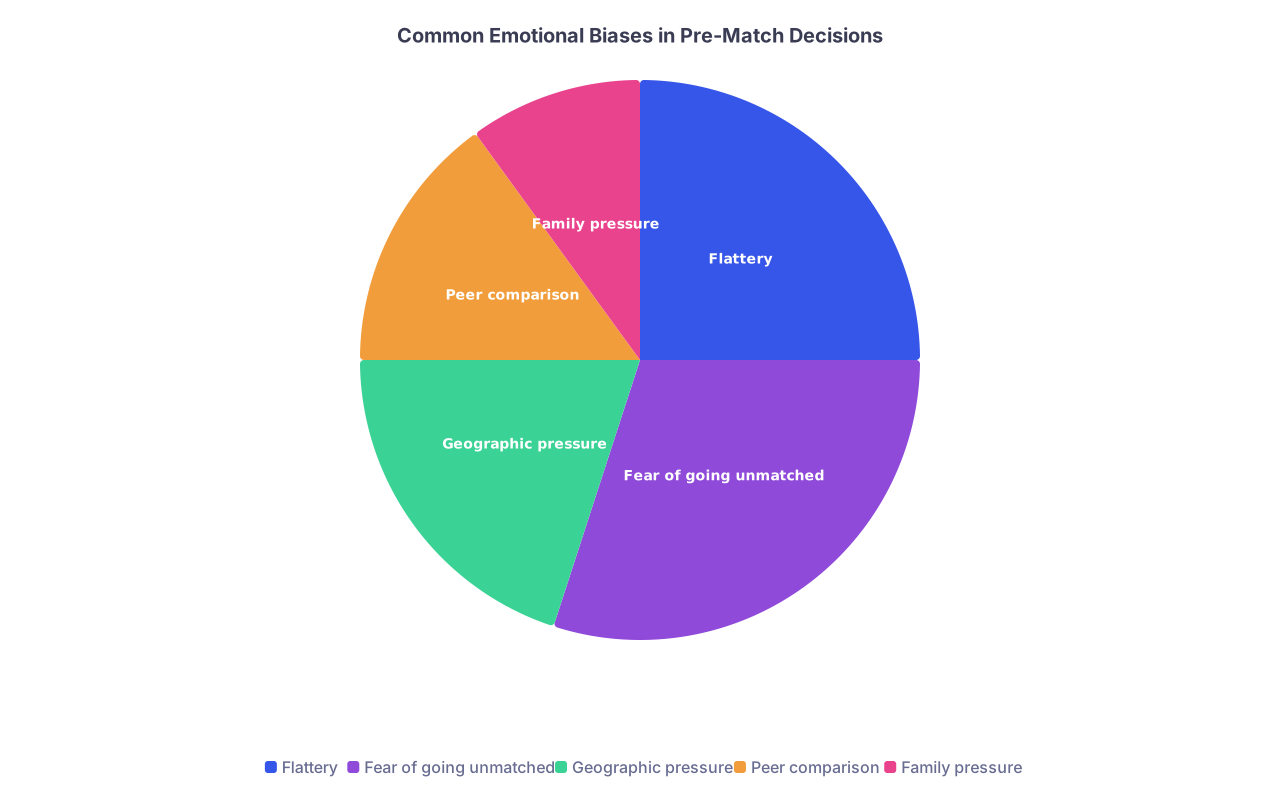
| Category | Value |
|---|---|
| Flattery | 25 |
| Fear of going unmatched | 30 |
| Geographic pressure | 20 |
| Peer comparison | 15 |
| Family pressure | 10 |
The big traps:
Flattery bias.
“They singled me out, so I must take it.”
No. Programs have quotas and mandates. Attraction is not the same as alignment.Anchoring on the first offer.
The first pre‑match you get suddenly feels like the “standard” you compare everything to. It is just the first data point, not the benchmark.Comparison with peers.
Your classmate posts on social media they “signed early.” Panic sets in. You accept something misaligned because you do not want to be the last without a plan.Family / geographic guilt.
“My family wants me to be close, so I should take this local new program, even though the training looks shaky.”
Geography matters, yes. But so does competent training that will set up the rest of your career.
None of these are inherently bad motivations. They just cannot be the only drivers.
10. A Simple Framework to Make Your Decision
Let me give you a blunt, usable checklist. Score each from 1 (terrible) to 5 (excellent):
- Accreditation and stability (3–5 is acceptable, below 3 is concerning).
- Training quality (volume, faculty, board pass support).
- Fit with your career goals (fellowship, community practice, location).
- Culture and support (resident well‑being, PD accessibility).
- Realistic alternative options in the Match (how many, how strong).
Add them up.
- 21–25: This is a very strong offer. Pre‑match acceptance is likely wise.
- 16–20: Solid but not perfect. Compare carefully with your realistic Match prospects.
- 10–15: High uncertainty. Only accept if your Match chances are genuinely poor.
- <10: This is probably a lifeboat. Do not climb in unless you are sure you are sinking.
Write your numbers down. Show them to a mentor who is not emotionally wrapped up in your life. It forces you to get out of pure emotion and into structured thinking.

FAQ (Exactly 6 Questions)
1. If I accept a pre‑match offer, can I still participate in the NRMP Match?
Often no, at least not for that specialty or program, but the exact rules depend on your country and specific system. In many NRMP‑participating environments, accepting a binding contract outside the Match violates rules. You must clarify with the program and check your Match organization’s policies before signing anything.
2. Is a pre‑match from a new program always a bad idea?
No. A new program attached to a strong academic medical center, with committed leadership and clear institutional support, can be an excellent opportunity. The risk is higher because there is no track record, but that risk is sometimes acceptable if the fundamentals (hospital volume, faculty quality, institutional stability) are solid.
3. Can I ask for more time to decide on a pre‑match offer?
Yes, and you should. Most programs will give you at least a few days, many will allow 1–2 weeks. Be professional: thank them, express genuine interest, and ask for a specific deadline. If a program refuses any reasonable time to think, that is mildly concerning about their culture.
4. How do I know if I am “strong” or “borderline” as an applicant?
Look at objective metrics: board scores relative to national means, number and quality of interviews, presence of red flags (failed exams, gaps, professionalism issues), and feedback from mentors who actually know recent Match cycles. If you have only a handful of interviews in a competitive specialty, you are not a “strong” applicant regardless of how good your personal statement feels.
5. Should I tell other programs that I received a pre‑match offer?
Generally no, unless you are in a system where signaling such offers is common and explicitly appropriate. Most established programs will not suddenly pre‑match you just because someone else did. They already have an internal rank view of you. Trying to “leverage” offers can look manipulative if done poorly.
6. What if I accept a pre‑match from a new program and later the program struggles or closes?
That is the nightmare scenario, and it does happen occasionally. Accrediting bodies usually try to place displaced residents into other programs, but you lose control of geography and sometimes specialty. This is why you must vet the institution’s broader stability, not just the residency brand. Large, reputable health systems rarely let their brand‑new programs completely collapse; small, unstable hospitals are a different story.
Key points, no fluff:
- A pre‑match offer from a new program and one from an established program are fundamentally different risk propositions; treat them accordingly.
- Your own competitiveness and backup options matter more than your ego; a “safe” established offer is sometimes the smartest move you will ever make.
- Do structured due diligence—talk to residents, examine stability, and score the program—before trading your Match flexibility for early certainty.