Understanding Pre-Match Communication in Neurosurgery
Pre-match communication is one of the most confusing—and anxiety-provoking—parts of applying for neurosurgery residency. As an MD graduate from an allopathic medical school, you are operating in a particularly competitive environment: neurosurgery residency positions are limited, expectations are high, and every email or phone call feels like it could make or break your chances.
This article explains how to approach pre-match communication for neurosurgery, especially if you are an MD graduate targeting a U.S. allopathic medical school match. You’ll learn:
- What pre-match communication is (and what it is not)
- How it works specifically in neurosurgery (including why “pre-match offers” and “early commitment” are so rare)
- When and how to contact programs before and after interviews
- How to express genuine interest without crossing ethical lines
- How to decode and respond to language from programs
- Sample email templates you can adapt
Throughout, the focus will be on professionalism, clarity, and strategy—all essential traits for a future neurosurgeon.
1. The Landscape: Why Pre-Match Communication Matters in Neurosurgery
Neurosurgery is one of the most competitive specialties in the NRMP. That leads many applicants to ask whether pre-match offers, early commitment, and aggressive program communication before match can improve their chances.
1.1. The NRMP Rules: No True “Pre-Match Offers” for Most MD Graduates
For U.S. MD graduates applying to ACGME-accredited neurosurgery programs through the NRMP:
- Programs cannot make binding offers outside the Match.
- Applicants cannot commit to a program outside the Match.
- Any attempt to circumvent this is a violation of NRMP rules and can have serious consequences for both the applicant and the program.
The phrase "pre-match offers" is sometimes still used informally by applicants, but true contractual pre-match offers are essentially not part of the standard NRMP allopathic medical school match for neurosurgery residency. Instead, what exists is:
- Pre-match communication of interest
- Signals, indications of rank intentions, or “you’re ranked to match” messages
- Discussion of fit and mutual interest, but not guaranteed positions
For MD graduates, especially from U.S. allopathic medical schools, your strategy should be built around ethical, transparent communication—not attempts to secure early contractual commitments.
1.2. Why Neurosurgery Programs Care About Communication
Neurosurgery residency is long (typically 7 years), intense, and heavily team-oriented. Programs are looking for:
- Professionalism and maturity
- Clear communication skills
- Reliability and integrity
- Ability to handle complex, high-stakes situations
Pre-match communication is both:
- A signal of your interest, and
- A mini-audition of your professionalism
How you email, call, and respond to faculty or coordinators can strengthen or weaken the impression you made during interviews.
1.3. Goals of Pre-Match Communication
Your communication before the Match should aim to:
- Signal genuine interest in specific programs, especially your top choices.
- Clarify key questions that could affect your rank list (case volume, research expectations, fellowship placement, etc.).
- Maintain or deepen connections with mentors, program directors (PDs), assistant program directors (APDs), and faculty.
- Avoid any perception of dishonesty, pressure, or violation of NRMP rules.
2. Types of Pre-Match Communication in Neurosurgery
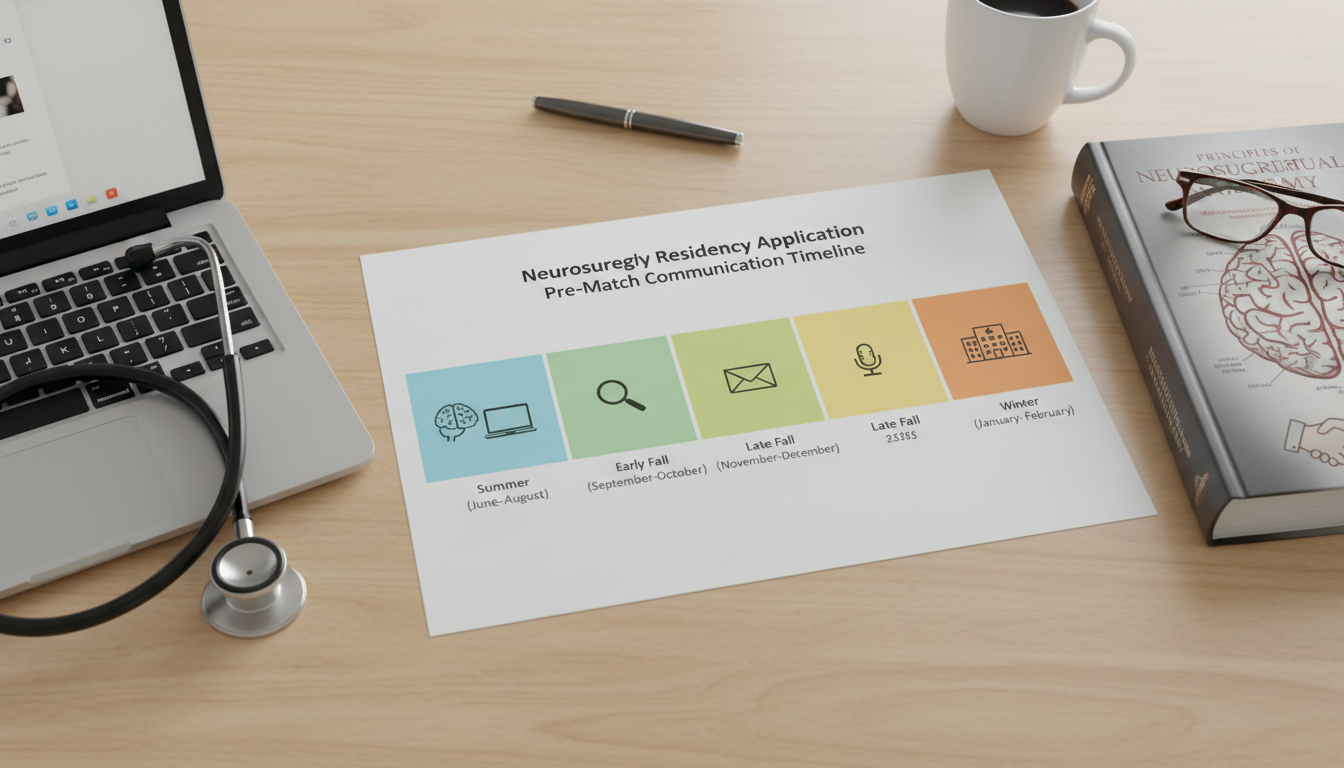
Pre-match communication can be organized into several phases in the neurosurgery residency process:
- Before interview offers
- After receiving interview invitations (pre-interview)
- After the interview but before rank list certification
- Communication from programs to applicants
Each phase has its own norms and best practices.
2.1. Before Interview Offers
This is the period after ERAS submission but before you start getting neurosurgery residency interview invitations.
What’s common:
- Short, courteous emails to programs where:
- You completed a sub-internship
- You have a strong connection (home program, geographic ties)
- You are particularly interested and want them aware of that interest
What these emails can include:
- Brief introduction (name, school, that you applied to neurosurgery residency at their program)
- A specific tie: away rotation, research collaboration, geographic reason, or mentorship ties
- A short statement of why you’re especially interested in them (e.g., strong brain tumor program, functional neurosurgery opportunities, early OR exposure)
- A brief FYI if new information has emerged after application submission (e.g., new publication, Step 2 CK score, award)
What to avoid:
- Repeated “checking in” emails asking if you will get an interview
- Overly long letters repeating your entire application
- Attachments they didn’t ask for (letters, updated CVs) unless truly important and recent
- Implied pressure (“This is my top choice” before even interviewing)
2.2. After Receiving Interview Invitations (Before the Interview)
Once you have an interview scheduled with a neurosurgery program, your primary job is to prepare thoroughly and confirm logistics. Extra pre-interview communication is usually minimal and should have a purpose.
Appropriate reasons to email:
- Clarify interview format, schedule, or technical issues (especially for virtual interviews)
- Ask logistical questions (travel, parking, accommodations)
- Request a schedule adjustment if you have conflicting interviews (and do this early, courteously, and with flexibility)
In neurosurgery, over-communicating before the interview can create an impression of neediness or poor judgment. Be concise and professional.
2.3. After the Interview: Thank-You Notes and Follow-Up
This is the most important phase for pre-match communication.
Thank-You Emails
Most neurosurgery PDs and faculty are extremely busy, but thoughtful, concise thank-you emails are generally appreciated. They can:
- Reinforce your interest in the program
- Highlight something memorable from your conversation
- Demonstrate professionalism and follow-through
Who to email:
- Program Director (almost always)
- Assistant/Associate PDs you interviewed with
- Faculty you had extended conversations with
- Sometimes residents, if you had especially strong or unique interactions
Timing:
- Within 24–72 hours after the interview
Core structure:
- Subject: “Thank you – [Your Name], [Neurosurgery Interview Date]”
- A brief thank you for their time and for learning about the program
- One or two specific points that stood out (e.g., robust brain surgery residency case volume, structured research time, resident culture)
- A brief closing line reaffirming your interest
Avoid long essays; 1–2 short paragraphs are sufficient.
3. Ethical Boundaries and “Love Letters”: What You Can and Cannot Say
As an MD graduate aiming for an allopathic medical school match, you must understand the ethical and NRMP boundaries of pre-match communication.
3.1. NRMP Communication Rules (Simplified)
In the context of neurosurgery residency:
- Programs and applicants may express interest, but
- They may not ask each other how they will rank them
- They may not require or solicit statements like “I will rank you first”
- They may not make or request any guarantee of ranking or matching
You are allowed to voluntarily tell a program that they are your first choice or that you intend to rank them very highly. However:
- You must be completely honest.
- You should not tell multiple programs they are each your “#1” if that is not true. This is dishonest and violates professional ethics, even if not formally policed by NRMP.
3.2. Expressing Interest Without Overpromising
Neurosurgery PDs and faculty have seen every kind of email. They can distinguish between genuine, specific enthusiasm and generic or manipulative messages.
Useful phrases when you genuinely like a program but do not want to overstate:
- “Your program is one of my top choices.”
- “I plan to rank your program very highly.”
- “I could very easily see myself training there.”
- “Your program aligns strongly with my career goals in functional neurosurgery / brain tumor / spine / research, etc.”
Reserve the stronger, more specific language—such as “Your program will be ranked as my #1 choice”—for only one program, and only when you are fully committed to that statement.
3.3. How Program Directors Interpret Communication
Program directors in neurosurgery are (by necessity) pragmatic. They know:
- Many applicants send similar emails.
- Some applicants are not fully honest.
- They should not rely solely on “love letters” to build their rank list.
Yet, communication still matters, particularly in borderline cases or when deciding how to rank among similarly strong applicants. Clear signals of strong interest can:
- Help differentiate you from others with similar metrics
- Nudge a program to rank you slightly higher
- Especially matter if you are from a less well-known medical school or region
4. Specific Strategies and Examples for Pre-Match Communication
This section turns the principles into concrete actions and templates tailored for neurosurgery residency applicants.

4.1. Emailing Before Interviews (Interest and Updates)
When to consider this:
- You completed a sub-I at the program.
- It is your home neurosurgery department.
- You have strong geographic or personal ties to the region.
- You have a meaningful update not listed in ERAS (new publication, award, Step 2 CK score).
Sample template – Pre-interview interest/update email:
Subject: Application to [Program Name] Neurosurgery – [Your Name, MD]
Dear Dr. [Last Name] / Dear Program Director,
I hope this message finds you well. My name is [Your Full Name], an MD graduate from [Your Medical School], and I have applied to the [Program Name] neurosurgery residency program this cycle.
Having [completed a sub-internship at your institution / worked with Dr. X on Y project / grown up in City/State], I have developed a strong interest in your program’s approach to [research, early operative exposure, subspecialty strength, resident education, etc.]. In particular, I was impressed by [brief, specific detail].
Since submitting my ERAS application, I wanted to share a brief update: [new publication / Step 2 CK score / award], which I believe further reflects my commitment to a career in neurosurgery.
Thank you for your time and consideration of my application. I would be honored to interview at [Program Name] and learn more about your training environment.
Sincerely,
[Your Full Name], MD
AAMC ID: [#######]
[Email] | [Phone]
Use this sparingly and only when you have a genuine tie or meaningful update.
4.2. Post-Interview Thank-You Email
Sample template – PD thank-you email:
Subject: Thank you – [Your Name], Interview on [Date]
Dear Dr. [Last Name],
Thank you for the opportunity to interview with the [Program Name] neurosurgery residency on [date]. I appreciated learning more about your program’s emphasis on [e.g., early operative autonomy, complex spine, brain tumor research, global neurosurgery, etc.], and especially enjoyed our discussion about [specific detail you discussed].
Speaking with you, the faculty, and residents reinforced my impression that [Program Name] offers exceptional clinical training and a supportive environment that would prepare me well for a career in [academic / academic-clinician / subspecialty] neurosurgery.
I am very enthusiastic about the possibility of joining your team and would be honored to train at [Program Name].
Sincerely,
[Your Full Name], MD
You can send shorter, slightly modified versions to other faculty you met.
4.3. Declaring a Program as Your #1 Choice
If you decide that one program is truly your top choice in neurosurgery residency, it is acceptable—and often beneficial—to clearly communicate that.
Considerations before sending:
- Be 100% certain. Once you say this, you should not change your mind.
- Only say it to one program.
- Send it after you have completed all or most of your interviews, when your preferences are stable.
Sample “#1 choice” email:
Subject: Expression of Strong Interest – [Your Name], Neurosurgery Applicant
Dear Dr. [Last Name],
I wanted to thank you again for the opportunity to interview at [Program Name] and to learn more about your neurosurgery residency. After completing my interviews and carefully considering my options, I have decided that [Program Name] will be ranked as my #1 choice on my rank list.
The combination of [specific features: operative volume, subspecialty strengths, resident culture, mentorship, research environment, etc.] aligns exactly with the training environment I am seeking. I strongly believe that I would thrive in your program and contribute meaningfully to your team.
Regardless of the outcome of the Match, I am grateful for the chance to have met you and your residents, and I appreciate your consideration of my application.
Sincerely,
[Your Full Name], MD
Programs may or may not respond explicitly; some will acknowledge, others will not. Either way, you will have acted professionally and ethically.
4.4. Responding to Program Communication Before the Match
You may receive emails from neurosurgery programs stating things like:
- “We were very impressed with your application.”
- “You will be ranked highly on our list.”
- “We hope to see you here next year.”
- Occasionally, “We intend to rank you in a position where you are likely to match.”
These are not pre-match offers in the formal sense, and they are not guaranteed. Programs must fill entire classes, and ranking is dynamic.
How to respond:
- Thank them for their message and consideration.
- Reaffirm your interest honestly.
- Do not feel pressured to disclose your rank order if you are not comfortable.
Sample response:
Dear Dr. [Last Name],
Thank you very much for your kind note and for your consideration of my application. I truly enjoyed my interview day at [Program Name] and was very impressed by [specific program feature or interaction].
I remain very interested in your program and appreciate your time and support during this process.
Sincerely,
[Your Full Name], MD
If the program you plan to rank #1 sends such a message, you may consider using that reply to explicitly confirm they are your top choice, if you have not already done so.
5. Special Considerations for MD Graduates in Neurosurgery
As an MD graduate, you may be applying:
- Directly from an allopathic medical school
- After a research fellowship or additional degree (e.g., PhD, MPH)
- As a re-applicant
These nuances influence your strategy for pre-match communication.
5.1. MD Graduate from U.S. Allopathic Medical School
For most U.S. MD graduates:
- Neurosurgery PDs are very familiar with your training context.
- The priority is building genuine connections, particularly through sub-Is, home program mentors, and research collaborations.
- Pre-match communication can reinforce your story and your niche (e.g., brain tumor research, functional neurosurgery, spine deformity).
5.2. MD Graduate with a Research Year or Gap
If you took a dedicated research year in neurosurgery:
- Highlight how that experience deepened your commitment to a brain surgery residency career.
- Ask your research mentors to advocate for you via direct PD-to-PD communication; this kind of “behind the scenes” communication is extremely influential and fully appropriate.
- In your own emails, emphasize specifics: projects, presentations, and your role in the lab.
5.3. Re-Applicants to Neurosurgery
If you are re-applying:
- Own your story honestly and briefly.
- Use pre-match communication to highlight growth: new publications, improved exam scores, stronger letters, additional operative exposure.
- Programs are especially interested in applicants who show resilience, maturity, and clear self-improvement.
Strategic email example:
“Since my last application cycle, I have completed a dedicated neurosurgery research year at [Institution], leading to [X publications, presentations]. This experience has further solidified my commitment to pursue a neurosurgery residency and reinforced my interest in training at a program like yours.”
6. Practical Tips, Pitfalls, and Final Checklist
6.1. Practical Communication Tips
- Use a professional email address (usually your school or a simple Gmail variant).
- Signature line: include MD, AAMC ID, and contact info.
- Proofread carefully; neurosurgery values precision.
- Keep a simple tracking document:
- Date of interview
- Faculty you met
- Whether you sent thank-you notes (and when)
- Any responses received
6.2. Common Pitfalls to Avoid
- Mass, generic emails to many programs at once.
- Overly frequent follow-ups or “checking in” messages—especially before interview invitations.
- Dishonest statements about ranking (e.g., telling multiple programs they’re #1).
- Emotional or frustrated emails if you haven’t heard back.
- Sharing or requesting inside information about rank lists, which can approach NRMP violations.
6.3. Final Pre-Match Communication Checklist
In the weeks leading up to the rank list deadline:
- Have I identified my true top program and, if I choose to, sent one clear, honest message stating they are #1?
- Have I sent thank-you emails to PDs and key faculty at programs I care most about?
- Have I responded professionally and promptly to any program communication before match (including expressions of interest)?
- Have I avoided any communication that could appear pressuring, manipulative, or dishonest?
- Does my communication style reflect the kind of colleague and neurosurgeon I intend to be?
If you can answer “yes” to these, you’ve handled pre-match communication about as well as it can be handled in a field as competitive as neurosurgery.
FAQs: Pre-Match Communication for Neurosurgery MD Graduates
1. Can a neurosurgery residency program give me a true pre-match offer or early commitment?
For MD graduates participating in the standard allopathic medical school match through NRMP, programs cannot make binding pre-match offers. What you may see are strong expressions of interest, not contractual early commitments. Any attempt to secure or accept a formal pre-match position in this context would violate NRMP rules.
2. Should I tell a program they are my #1 choice? Does it really help?
If you have a clear, honest #1 neurosurgery program, it is reasonable and often beneficial to tell them so. It can positively influence your position on their rank list, especially if they view you as a strong fit. However, this is not a guarantee, and you must only tell one program and be fully truthful.
3. How many follow-up emails are appropriate if I don’t get a response?
Generally, one well-timed email is sufficient in most situations. For example, a thank-you email does not require a reply. If you contact a program about logistics or an important update and hear nothing after 1–2 weeks, you may send one brief follow-up. Beyond that, repeated messages risk appearing unprofessional.
4. Does pre-match communication matter more in neurosurgery than in other specialties?
Because neurosurgery is small and highly relationship-driven, professional, authentic communication does matter—especially when faculty know each other across institutions and share impressions. Still, it is only one component among many: performance on neurosurgery rotations, letters of recommendation, clinical excellence, research, and interview performance typically carry more weight than any single email.
Handled thoughtfully, pre-match communication won’t “game” the system—but it can strengthen genuine connections, signal your enthusiasm for neurosurgery, and help align you with a program where you will thrive as a future brain surgeon.