
Most applicants have no idea how messy and political pre-match ranking really is.
You think there’s a neat formula. Score + LORs + interview = offer. That’s not how it works in most programs doing pre-match contracts. Let me walk you through what actually happens in the back room before that offer email or call hits your phone.
I’m going to talk largely from the perspective of IM/FM/psych and some surgical prelims at community and mid-tier university programs in states where pre-match has historically been common (Texas, some New York, some community-heavy regions). The exact mechanics differ, but the internal logic is the same almost everywhere.
The Reality: Two Rank Lists, Not One
Here’s the first thing people on the outside almost never understand: programs doing pre-match are usually maintaining two parallel rank systems.
- An internal, unofficial “pre-match board”
- The formal NRMP rank list (what you think is happening)
For most of the fall and early winter, what PDs and coordinators are staring at is that internal board, not the NRMP list.
On the wall, whiteboard, or giant Excel sheet, there’s usually something like four rough tiers:
- Must-get / pre-match targets
- Would love to have, but okay if they go to the Match
- Safe, solid rank-list fillers
- Backup names in case everyone above bails
Nobody says it that bluntly in the meeting, but that’s exactly the mental framework.
The NRMP list is usually not finalized until much later. But the pre-match board starts forming as soon as the first few strong interviewees come through September–October.
You’re not thinking “Will I match?”
They’re thinking “Is this someone we should lock down early before another program steals them?”
The Hidden Criteria: What Actually Gets You on the “Pre-Match Board”
Let me be direct: it’s not just score and CV. It’s “predictability” and “control.”
Pre-match is a control move by the program. They commit early to you, but they want something back: a high probability that you’ll actually come and that you won’t be a future headache.
Here’s what matters way more than applicants think.
1. Institutional and geographic loyalty
If you’re from their own med school or a major feeder school, you get an automatic boost. Why? Because PDs and chiefs feel they “know your kind.” They know your dean, your culture, your usual performance.
This is the order I’ve seen in actual committee discussions:
- Our own students / rotators
- Regionally tied students (same state, same city, or same hospital system)
- US MD/DO from anywhere with strong signals you’ll stay
- IMGs with strong ties + proven commitment
If you’re an IMG without US ties and no rotation with them, you’re rarely on the pre-match short list unless they’re chronically struggling to fill.
2. Clinical performance with them beats everything
Let me tell you what really happens when you did a rotation or sub-I at their site.
There’s usually an informal list kept by chiefs or the PD’s right-hand faculty. It’s often some version of:
- “Hire immediately”
- “Trainable, seems solid”
- “Fine but bland”
- “Absolutely not”
If you did a month with them and ended in that top bucket, you jump way over someone with slightly higher scores but no rotation.
I’ve sat in those meetings and heard:
“Her Step is 220, but she crushed wards here. Residents loved her. I’d rather pre-match her than the 245 who was robotic on interview day.”
The rotation is a month-long audition. If you impressed them, your name moves to the top of that internal sheet, often marked with stars or color-coding. Those are the people they discuss for pre-match first.
3. Risk profile: they want low-risk early commits
PDs are not gamblers. Pre-match offers are chips they only spend on people they feel sure about.
Low-risk to them means:
- No professionalism flags
- No unexplained gaps
- No vague stories about “needed time off” with no specifics
- No strange behavior on interview day
I’ve seen someone completely removed from all consideration because they were rude to a coordinator. PDs will literally say: “If they’re like this when they’re trying to impress us, how will they be at 3 a.m. on call?”
If they sense even a hint of instability, you may stay ranked but you’re not getting a pre-match offer.
4. Their perception of your “yield”
This one hurts, but you need to hear it.
If they think you’re way out of their league, you’ll almost never see a pre-match offer. They assume you’re using them as a backup and will disappear on Match Day.
How do they judge this?
- Your school brand vs their program’s reputation
- Your scores compared to their usual residents
- How “prestige oriented” you sound on interview day
- Whether you did away rotations at stronger programs
I’ve heard these lines more than once:
“She’s from a top-10 MD and applied to derm prelims too. She’s ranking us as a backup.”
“His Step is 260, heavy research, and his personal statement screams academics. We’re not his first choice.”
So even if you’re an elite applicant, you may not get a pre-match offer because they’re convinced they won’t yield you. They’ll just stick you high on the NRMP list and hope.
You want a pre-match? You have to look like someone who might actually sign it.
The Timeline: When Your Fate Is Really Being Decided
To prepare properly, you need to understand the internal timeline. The official ERAS and NRMP calendars are not what’s driving their pre-match thinking.
Let me break down what PDs are actually doing behind closed doors.
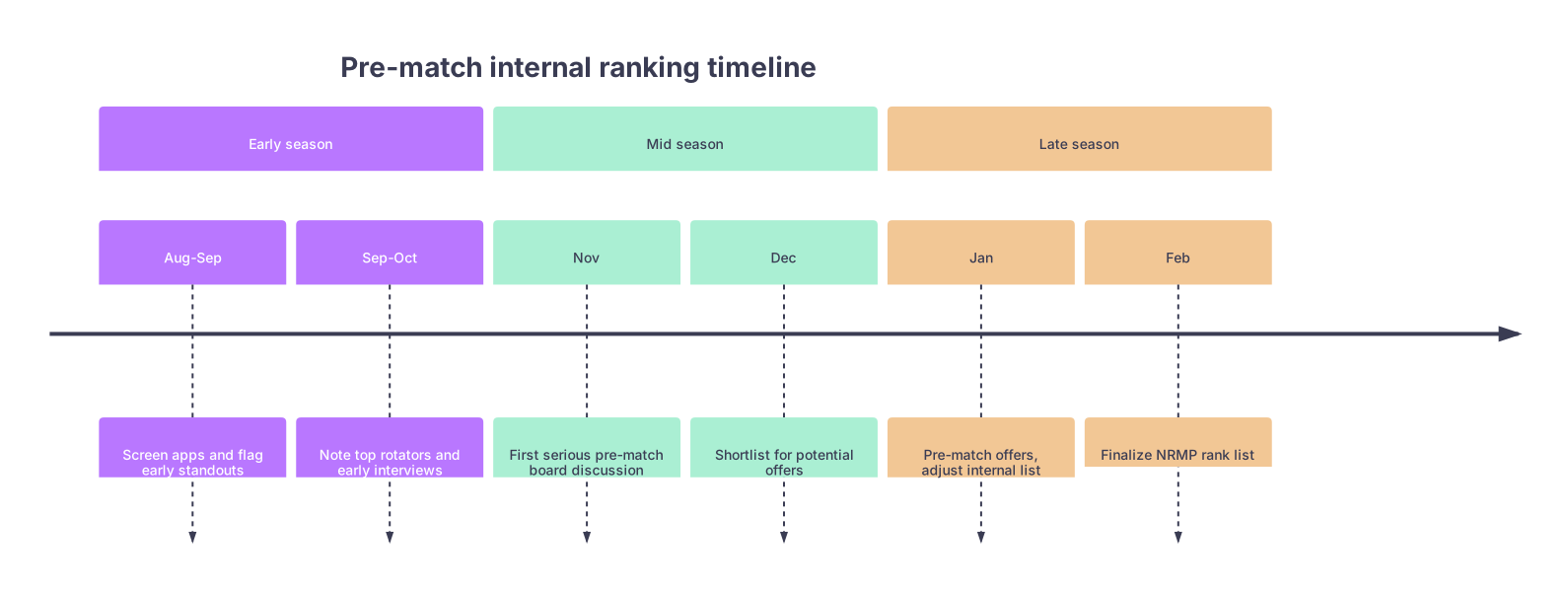
| Period | Event |
|---|---|
| Early season - Aug-Sep | Screen apps and flag early standouts |
| Early season - Sep-Oct | Note top rotators and early interviews |
| Mid season - Nov | First serious pre-match board discussion |
| Mid season - Dec | Shortlist for potential offers |
| Late season - Jan | Pre-match offers, adjust internal list |
| Late season - Feb | Finalize NRMP rank list |
Early interview season (Sept–Oct)
At this stage, nobody’s making offers yet. But they are doing this:
- Starring names of outstanding rotators
- Flagging surprisingly strong interviews (especially with local ties)
- Making informal “we should try to keep this one” comments
You may walk out of an October interview thinking nothing is decided. But I’ve heard PDs say in the hallway right after:
“If she wants to come here, I’d pre-match her.”
Your performance here sets whether you’ll even be in the conversation later.
Mid-season (Nov–early Dec): the real sorting begins
This is where the internal list gets serious.
Usually it’s:
- PD
- APDs
- Program coordinator
- Sometimes chief residents
They’ll go through the early batch of strong candidates and start grouping:
- “If we pre-match, who would we be comfortable with committing now?”
- “Who do we need more data on?”
- “Who is Match-only no matter what?”
This is also when your follow-up communication starts mattering. Strong, clear, specific expressions of interest can bump you from “just rank them” to “consider for pre-match.”
Late season (mid-Dec–Jan): offer decisions
At this point, they’ve got a sense of:
- How many great applicants they’re realistically in the running for
- How many spots they can afford to commit outside the Match
- Which candidates seem most likely to sign an early contract
The PD will sit with the list and have conversations like:
“We have 8 categorical spots. I’m comfortable pre-matching 2–3 max. If we offer 2 and both say yes, we still have 6 for the Match.”
Candidates chosen for those 2–3 spots are not always the “best” on paper. They’re the ones with the best mix of quality + loyalty + reliability.
How They Actually Compare Two Pre-Match Candidates
Let me show you the real logic with a simplified table. This is what those conversations sound like when comparing direct pre-match targets.
| Factor | Candidate A | Candidate B |
|---|---|---|
| School/rotation | Did sub-I at program | No rotation, out of state |
| Exams | Step 1: 220, Step 2: 233 | Step 1: 237, Step 2: 245 |
| Fit on interview | Residents loved, easygoing | Quiet, reserved, hard to read |
| Ties | Local, family in city | No clear ties |
| Interest signals | Thank-you, genuine “top choice” email | Generic emails only |
| Risk | Clean record | Minor professionalism note |
Every time I’ve been in that room, Candidate A wins the pre-match offer. Even with lower scores. Every. Time.
Because the pre-match calculation is not:
“Who is objectively the better candidate?”
It’s:
“Who will perform well here and is most likely to say yes if we commit early?”
What PDs Look For On Interview Day Specifically For Pre-Match
Interview day behavior matters more than you think, but not in the generic “be yourself” way.
There are a few specific things that track very closely with pre-match likelihood in the PD’s mind.
1. Do you fit the resident culture?
Programs are protective of their resident group dynamic. They’ll ask residents after each interview session:
“Could you see yourself working nights with them?”
“Any flags?”
If the feedback is: “Yes, they’d fit right in,” your name moves upward.
If feedback is: “Smart but standoffish” or “Seemed disinterested,” you drop into “fine to rank, not to pre-match.”
2. How you answer “Why this program?” – they actually care
PDs are listening for:
- Have you done your homework beyond the website?
- Do you understand their patient population and structure?
- Are you naming specific reasons that distinguish them from the 30 others?
If your answer sounds like a template, you’ve basically told them:
“Do not waste a pre-match offer on me. I’m not that into you.”
If your answer is deeply tailored and you reference residents you met, cases you saw on your rotation, or their specific curriculum—they hear: “High chance this person would actually sign.”
3. Your reaction to red-flag questions
When they ask:
- “Any concerns about working here?”
- “You’re couples matching?”
- “Where else did you rotate/interview?”
They’re assessing risk. If your answers suggest:
- You’re mainly chasing geography elsewhere
- You’re clearly using them as backup
- You’re laser-focused on a different type of program (e.g., big-name academic vs their community setting)
You might still be ranked well. But you’re off the pre-match target list.
How You Can Deliberately Make Yourself Pre-Match Material
Here’s what you actually control.
1. Stack the deck before interview day
If you want a pre-match offer from a specific program:
- Do a rotation there if at all possible. Be relentlessly reliable and pleasant. Show up early. Take ownership. Ask for feedback and apply it the next day.
- Get at least one strong letter from someone internal who actually knows your work. PDs trust internal letters more than some random big-name from another institution.
Pre-match targets are often already “known quantities” by the time interview season starts. You want to be in that bucket.
2. Make your interest obvious—but credible
PDs are not dumb. They can smell fake “You’re my #1” emails from miles away.
What actually works:
Very specific, short emails: “After interviewing at X, Y, and Z, your program stands out because of [specific curriculum / culture / patient population]. I’d be genuinely excited to train here and would strongly consider any early opportunity to commit.”
Consistency: what you say on the interview, in your thank-you email, and in any follow-up should all match. No whiplash.
If you’re applying in a region where pre-match is common and you’d truly sign early, it’s okay to hint that you would. PDs look for that line between eager and desperate. Aim for clear, not clingy.
3. Don’t accidentally talk yourself out of a pre-match
I’ve seen otherwise strong candidates kill their pre-match chances with poorly thought-out answers.
Examples:
- Announcing you “definitely want a big academic center for fellowship” while interviewing at a community program that struggles to keep people.
- Emphasizing you want to be in a totally different region long-term.
- Overly hyping another program in the same city that they know is “above” them.
You can be honest without broadcasting that they’re your safety. Talk about what this program offers you that actually fits your goals—teaching style, autonomy, patient mix, etc.
Behind the Scenes: How Many Pre-Match Offers They’re Willing to Risk
Programs don’t pre-match blindly. There’s a very calculated internal game about how many spots they’re willing to lock before the Match.
It usually sounds like this in the room:
“We have 10 spots. Historically, we fill 8 in the Match easily. Last year we lost our top 5 to bigger names. If we pre-match 3 this year, and worst case scenario we only fill 5 in the Match, can we handle scrambling for 2?”
They look at:
- Historical fill rates
- How competitive their current season’s pool looks
- Whether there’s institutional pressure to keep more home graduates
- How painful last year’s SOAP/scramble was
Programs that got burned recently (big unfilled holes) become more pre-match aggressive. Programs that over-committed and got some poor fits pull back the next year.
Your chances of a pre-match offer are partly tied to stuff that has nothing to do with you: their institutional memory and anxiety level from prior cycles.
What Happens After They Decide to Pre-Match You
You don’t see the chaos that happens on their side.
Once they decide you’re pre-match material, there’s a sequence:
- PD confirms with faculty and often gets informal chief input: “Everyone comfortable if we lock in this person?”
- Coordinator checks if there are any administrative issues (visa, licensing, etc.)
- PD times the offer—often after a cluster of interviews to see full context
- Someone (PD or APD) reaches out—usually by email first, sometimes phone—feeling you out:
- “We were very impressed with you and are considering offering you a pre-match position. Would you be interested in that?”
Here’s the part applicants underestimate: your response speed and clarity matter.
If you:
- Take 5 days to respond
- Sound lukewarm
- Start negotiating like you’re picking a hotel
They immediately think: “If we commit this spot, we might get burned.” I’ve seen offers rescinded before being made formal when a candidate played too coy.
If you’re truly interested in pre-match, you need to have thought through ahead of time:
- What’s your threshold for saying yes immediately?
- Which programs you’d be ready to commit to on short notice?
Because the PD doesn’t want a week-long dance. They want a high yield on that offer.
If You Don’t Get a Pre-Match Offer: What It Actually Means
People catastrophize this.
Not getting a pre-match offer does not mean:
- You’re not ranked
- They hated you
- You’re out of the running
It often means:
- They think you’re strong enough to match normally
- They weren’t sure you’d sign early
- They had limited spots they were comfortable pre-matching and prioritized people with clearer ties
I’ve seen plenty of candidates who did not get pre-match offers from a program end up matching there at the top of the NRMP list.
You prepare for pre-match strategically, but you don’t panic if it doesn’t happen. The Match still runs the show.
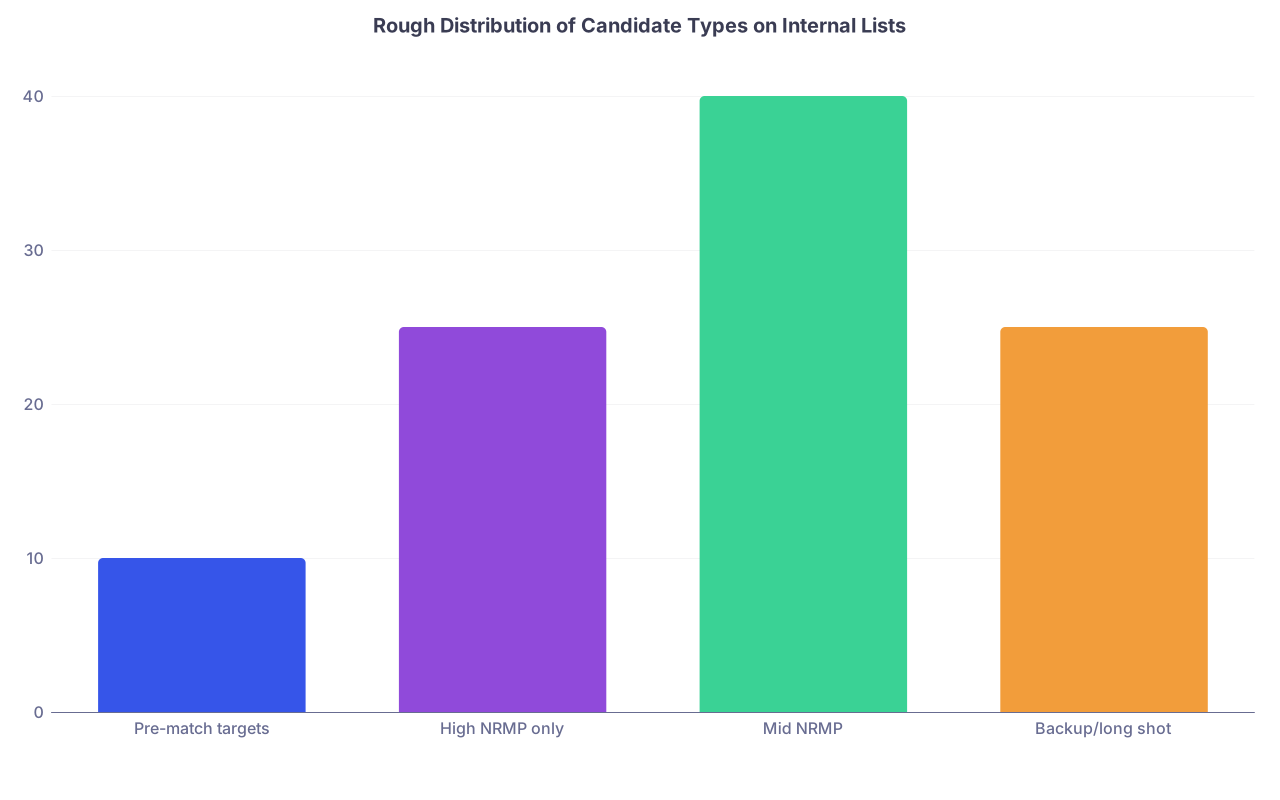
| Category | Value |
|---|---|
| Pre-match targets | 10 |
| High NRMP only | 25 |
| Mid NRMP | 40 |
| Backup/long shot | 25 |
How To Prepare Now If You Want Pre-Match Options
If you’re heading into a cycle where pre-match is common and you want to give yourself that option, your preparation should reflect what PDs actually value.
Choose your rotations strategically. One or two months at true target programs is vastly more powerful than five random away rotations. Be excellent there. Not just competent. Memorable in a good way.
Build real relationships with residents and at least one faculty member who will advocate. A single strong internal advocate on the selection committee is more powerful than perfect board scores.
Clean up your story. Anything that can be misread as “risk” (gaps, failures, leaves) needs a tight, calm, honest explanation that reassures, not raises more questions.
Decide in advance: if program X offers you a pre-match, are you actually willing to sign and withdraw? Because if the honest answer is no, avoid over-signaling interest. PDs remember when they feel played.

| Step | Description |
|---|---|
| Step 1 | Interview Complete |
| Step 2 | Signal strong interest |
| Step 3 | Keep interest moderate |
| Step 4 | Prompt, clear response if contacted |
| Step 5 | Focus on NRMP Match |
| Step 6 | Would I sign a pre-match here? |
FAQs
1. If a program pre-matches, does that mean they rank lower candidates in the Match?
Internally, yes, the dynamic shifts. Once they’ve locked 2–4 people with pre-match, they feel slightly less pressure with the NRMP list and may take more “swings” on slightly riskier or more competitive candidates they assume might not actually come. But they almost never intentionally rank “worse” candidates; they just recalibrate how aggressive they can be.
2. Should I tell a program they’re my top choice if I’d only come if I don’t get a better offer?
No. That’s how bridges get burned. PDs talk. If you present a place as “my top choice” and then word gets back you told three other programs the same thing, it damages your reputation. You can express strong interest without lying. Use language like “very highly on my list” unless you truly mean #1.
3. Does a thank-you email really affect pre-match decisions?
The content does, not the mere existence. A generic “Thank you, loved the program” goes nowhere. A concise, specific email that shows you understood their strengths and can see yourself training there absolutely can nudge you from “rank” to “consider for pre-match,” especially at community and mid-tier programs.
4. I’m an IMG without US rotations at my target program. Do I realistically have pre-match chances there?
You’re fighting uphill, but not impossible. Your best bet is: strong US clinical experience elsewhere with recognizable faculty, spotless professionalism, clear geographic or family ties, and very tailored communication expressing long-term commitment to that region/program type. But internally, you should be realistic: your primary plan should still be a strong NRMP strategy, with pre-match as a bonus, not the expectation.
Key takeaways:
PDs use pre-match offers to lock down reliable, loyal, low-risk candidates they believe will actually come—not just the shiniest CVs. Rotations, internal advocacy, and clear, credible interest move you onto that internal pre-match board far more than a 10-point Step difference. And if you’re going to play the pre-match game, decide in advance which programs you’d truly commit to so you can respond decisively when that “we’d like to offer you a pre-match spot” message finally lands.