
It’s late October. You’re refreshing your email between patients on medicine, watching classmates post in the GroupMe:
“Got a pre-match from [Big Name IM Program]!!!” “Pre-match from community program in Dallas!” “I think my chair letter finally hit—invites suddenly picked up.”
You? Silence.
Same Step scores. Same class rank. Same number of honors. But some people are getting early calls and back-channel “we’d love to have you here” conversations. You’re not even sure your chair knows your name.
Here’s the part nobody tells you openly: in pre-match heavy specialties and states, chair letters are quiet power. They shape who gets offered early spots, who gets flagged for “priority,” and who’s just another ERAS download.
Let me walk you through what really happens behind closed doors when chairs and program directors talk—and what you can still do about it.
1. What a Chair Letter Really Is (Not the Fluffy Version You Heard)
If you’re in a school that does formal “Chair letters” (typical in Internal Medicine, Surgery, Psych, OB, sometimes Neuro), you’ve probably been told:
“It’s a summary of your application from the department, contextualizing you among your peers.”
Cute. That’s the brochure version.
What the letter really is: a semi-coded, semi-political ranking document that programs treat as a filtered, department-approved signal about whether to invest in you. Especially for pre-match.
Programs know your personal statement is marketing. LORs from individual attendings can be hit-or-miss. Step scores are now partly neutered. But the chair letter? That’s the department sticking its neck out. Or not.
Behind the scenes, chairs use language and structure that program directors have learned to “read” fluently over years. Two candidates with similar metrics can look wildly different once the chair letter arrives.
And in some systems, that letter is the difference between:
“We should consider pre-matching her”
vs
“Solid applicant, fine for rank list, not worth an early contract.”
2. How Programs Actually Use Chair Letters for Pre-Match Decisions
Let me be blunt. For pre-match offers, program directors and associate PDs are not reading your entire ERAS like a novel. They triage. Hard.
The process often looks like this.
A. Early signal list from the chair
Common scenario in pre-match-heavy markets (Texas, some community-heavy states, certain IM and Psych programs):
Program director sends:
“Can you send us your top 10–15 candidates interested in us this year?”
Your department sends:
- A short list (explicitly ranked or strongly implied)
- Chair letters attached or forthcoming
- Sometimes an email with one-sentence “translation” per student
You are either:
- On that list, near the top → you get prioritized
- On that list, lower down → maybe an interview, maybe just on file
- Not on that list → you’re just “another ERAS applicant”
B. Chair letter as pre-screen for early offers
For pre-match, programs want to minimize risk. They want people who:
- Will actually come
- Will not blow up professionally
- Will represent the program well
The chair letter acts as:
- Character vetting
- Performance summary
- Department confidence vote
I’ve sat in meetings where someone said:
“Her scores are great, but the chair letter is lukewarm. I wouldn’t burn a pre-match on her.”
That one page killed an early offer that the ERAS metrics alone would’ve supported.
C. Chair language that triggers “pre-match candidate”
There are phrases that instantly elevate someone into “pre-match consideration” for programs that use it.
Stuff like:
- “One of the strongest students to come through our department in recent years.”
- “We will be disappointed not to recruit him to our own residency program.”
- “I recommend her without any reservation and at the highest level.”
- “He ranks among the top X% of students I have worked with in my career.”
Versus death-by-faint-praise language:
- “She will be a solid addition to any residency program.”
- “He should perform adequately in residency with appropriate support.”
- “I am pleased to recommend her for training in your program.” (And nothing else.)
Same CV. Very different interpretation.
3. What Chairs REALLY Care About When They Write These
You probably think it’s Step scores and grades. That’s part of it. But that’s not what separates “generic summary” from “this is someone I will go to bat for.”
Here’s what chairs actually anchor on when they decide how hard they’ll push you:
A. How many people in your year are going into this specialty
If there are 3 of you going into Psych? The chair can probably go strong on everyone.
If there are 18 people shooting for IM from a big med school? Now it’s triage.
You’re being compared not to the entire country, but to the other faces the chair sees every week. And they will not burn their credibility telling 18 programs they have “one of the best students I’ve ever worked with” 18 times. They know who their real top 5 are.
B. Face time and familiarity
Reality: the student who showed up to grand rounds, did an AI on the home service, sat in the front row of noon conference, and met with the chair once or twice—gets a stronger letter.
Not always because they’re objectively better. But because the chair can attach a narrative to them.
“I’ve watched him mature from his third-year rotation to his sub-I, and he consistently demonstrates…”
That narrative sells much better than:
“I know her primarily from departmental evaluations and am told she has performed well.”
Chairs don’t like putting their name on total strangers. So they don’t.
C. Quiet reputation factors
You know the thing you did on night float that “only the residents know about”?
Yeah. The residents told the chief. The chief told the clerkship director. The clerkship director told the chair.
By the time your letter is written, there’s often a baked-in narrative about you that’s never written in your file:
- Reliable vs flaky
- Team player vs complaint magnet
- Teachable vs defensive
- Humble vs grandiose
If your name comes with a sigh in resident rooms, your chair letter is not going to glow.
And in the pre-match world, programs are almost paranoid about problem personalities, because firing someone after a pre-match is a mess.
4. The “Hidden Code” Inside Chair Letters
Let me decode some of the language you’ll never be explicitly taught. Program directors are fluent in this. You should be too.

Strength of endorsement scale (informal but very real)
Program directors mentally map phrases onto a 1–5 scale. Roughly like this:
| Signal Level | Typical Phrases | PD Interpretation |
|---|---|---|
| 5 - Strongest | "Among the best___", "In my career", "Top 5%", "Highest recommendation" | Serious pre-match / top of rank list |
| 4 - Strong | "Outstanding", "Top tier of this class", "Without reservation" | High on rank list, possible pre-match if local/fit |
| 3 - Solid | "Very good", "Strong candidate", "Will excel in the right environment" | Normal interview, mid-to-high list |
| 2 - Lukewarm | "Will do well with support", "Should perform adequately", "Pleasure to work with" | Might rank, unlikely pre-match |
| 1 - Red flag | "Has grown from early challenges", "With appropriate structure", "I support his decision to pursue" | Do not pre-match |
Programs combine this with what they know about the chair. Some chairs are notorious for overpraising, others are stingy. PDs calibrate.
But here’s the key: your chair letter can silently drop you from “maybe early offer” to “definitely not,” with a single shift in tone.
5. How Chair Letters Feed Into Pre-Match Shortlists
Let’s talk mechanics of pre-match, because that’s where this really bites.
In a program that uses pre-match offers, the workflow often looks like this:
- Applications arrive.
- PDs skim: scores, school, home vs away, basic red flags.
- Chair letters arrive or are requested for “serious” candidates.
- Committee creates a shortlist: maybe 10–20 names for 3–6 pre-match slots.
- They go back and look very, very closely at chair letters, home program support, and any back-channel communication.
When I’ve been in those rooms, the criteria separating “offer” vs “wait for the match” are usually:
- Strength of chair letter language
- Whether the chair or program leadership directly reached out (“We’d really love to place her with you”)
- Perceived likelihood the applicant will accept a pre-match
That last one is important. Chairs sometimes signal this overtly:
- “He has a strong geographic preference for your region and would be delighted to train at your institution.”
- “She has family in [city] and expressed to me that your program is among her top choices.”
That’s a nudge. It tells the program, “A pre-match offer here will probably stick.”
6. How to Influence Your Chair Letter Before It’s Written
You can’t sit next to your chair while they type. But you’re not powerless, unless you act like it.
Here’s what the students who quietly get the strongest letters usually did months earlier.
A. Get on their radar early (and purposefully)
No, not by sending a random “Dear Dr. Smith, I want to go into IM” email two days before letters are due.
I mean:
- Do an AI/sub-I on the department’s flagship service.
- Show up regularly at grand rounds, not just when someone took attendance.
- Ask to meet with the clerkship director or vice chair to discuss your goals.
The strongest chair letters I’ve seen were written about students the chair could picture, not a name plus a Step score.
B. Give them a story, not just a CV
When you meet with them (and you should), bring:
- A 1-page summary: scores, honors, research, leadership, unique points.
- A short paragraph on your “why this specialty” and your career direction.
- A realistic target list of programs and regions.
Chairs are busy and frankly, forgetful. If you give them a coherent storyline, they’re far more likely to write things like:
“Given her strong interest in academic general internal medicine and prior research in outcomes and quality improvement, she is particularly well suited for programs like…”
That’s the kind of line that tilts pre-match conversations in your favor.
C. Be honest about your competitiveness and goals
If you’re a mid-tier applicant asking for a letter that says “top 5% in my career,” you’re just annoying people.
What works better is:
“I know I’m not at the top of the class numerically, but I’ve really grown and I think my strongest attributes are work ethic and team leadership. I’m aiming for solid university-affiliated and strong community programs in [state/region].”
Chairs respond better to accurate self-assessment than delusion. They’ll protect you from overreaching and sometimes will do extra behind-the-scenes work to get you into places that fit you.
7. What You Can Do If Your Chair Hardly Knows You
This is the nightmare scenario I see every year: smart, hardworking student, quiet on the radar, then in September realizes, “Uh, my chair doesn’t know me at all.”
If that’s you, stop spiraling. Do damage control.
| Category | Value |
|---|---|
| M3 early | 90 |
| M3 late | 75 |
| M4 July | 55 |
| M4 September | 35 |
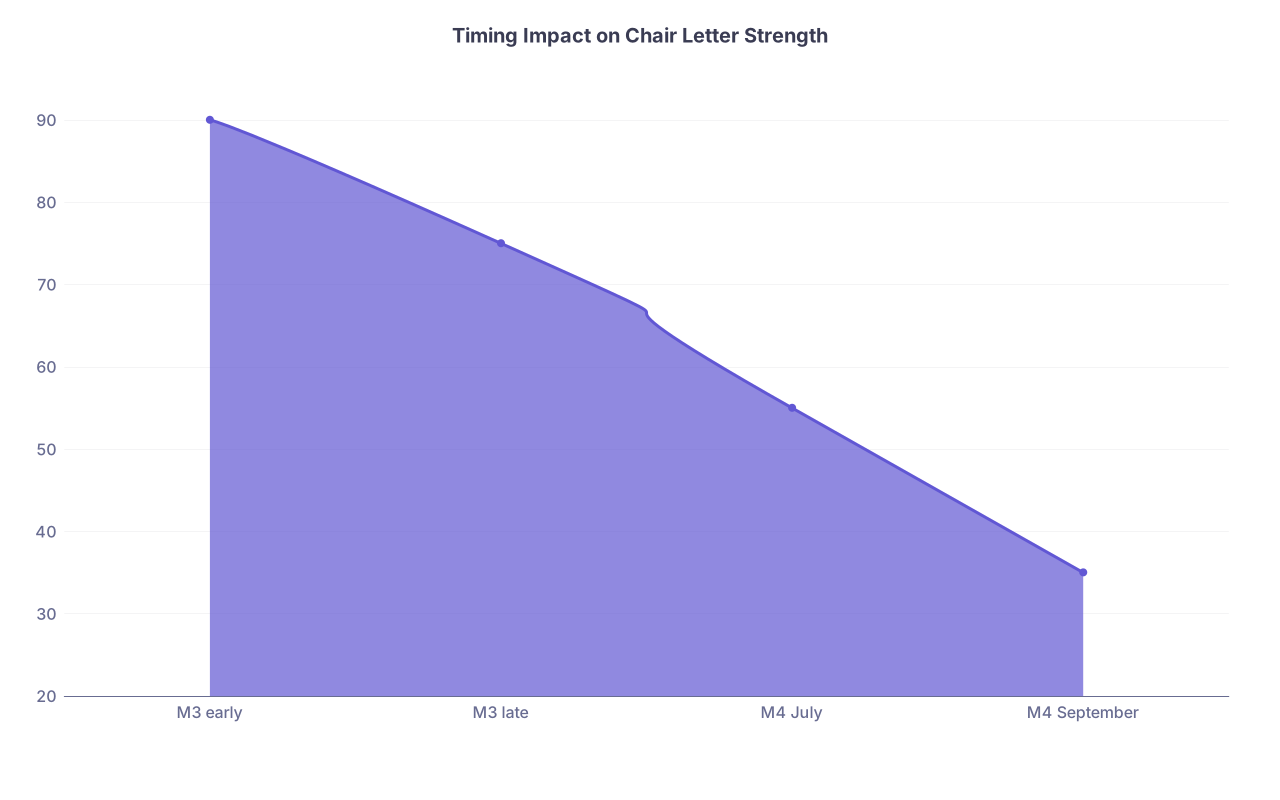
That chart is roughly how I’d quantify the “maximum strength potential” of your chair letter based on when you first seriously engaged them. Earlier is better. But even late isn’t hopeless; the ceiling is just lower.
Here’s what you do:
- Request a meeting. Not an email dump. A 15–20 minute face-to-face or video.
- Come prepared with: CV, personal statement draft, program list, any updates.
- During the meeting, briefly walk them through who you are, what you’ve done, and where you realistically hope to match.
- Explicitly say: “I know we haven’t worked together closely, but I’d really appreciate any advocacy you feel comfortable offering, especially with [specific region/program type].”
You are giving them both context and permission to advocate. Chairs are more likely to push your name to colleagues if they feel like you understand the game.
Will this transform you into “top of my career”? No. But it can move you out of “generic template letter” territory, which is where pre-match dreams go to die.
8. The Back-Channel: Calls and Emails You Never Hear About
Here’s the part applicants almost never see, but it absolutely happens.

| Step | Description |
|---|---|
| Step 1 | Student meets chair |
| Step 2 | Chair writes letter |
| Step 3 | Program reviews file |
| Step 4 | Chair receives call or email |
| Step 5 | Chair gives verbal endorsement |
| Step 6 | Program decides on pre-match offer |
| Step 7 | Pre-match candidate? |
Phone calls and quick emails are far more influential than a PDF upload, especially in small specialties or regions.
Examples I’ve either sent, received, or seen:
- “We have 3 spots likely to go pre-match. Are any of your students a particularly good fit for us?”
- “I saw you have two of our students interviewing. Between the two, I’d say [Name] would thrive more in your environment.”
- “She’s not the most numbers-heavy on paper, but I’d go to war with a resident like her. If you have a pre-match slot, she’ll exceed expectations.”
You never see any of this. You just see: Offer. Or silence.
What triggers those calls?
- Chair personally impressed by you.
- You trained or rotated at that program’s site.
- Longstanding institutional relationship (e.g., your med school sends them strong residents regularly).
- Your chair genuinely likes you and thinks you’re being slightly under-ranked by the market.
This is why your reputation on the wards and your relationships with leadership can sometimes outweigh a 5–10 point Step differential when pre-match offers go out.
9. Strategic Moves If You’re Targeting Pre-Match Programs
Not every program pre-matches, and not every specialty relies on it. But if you’re in a pre-match ecosystem (Texas IM, some community programs in other states, certain Psych and FM programs), you need to play the game intentionally.
| Category | Value |
|---|---|
| Big-name university | 10 |
| Mid-tier university | 35 |
| Community academic hybrid | 60 |
| Pure community | 70 |
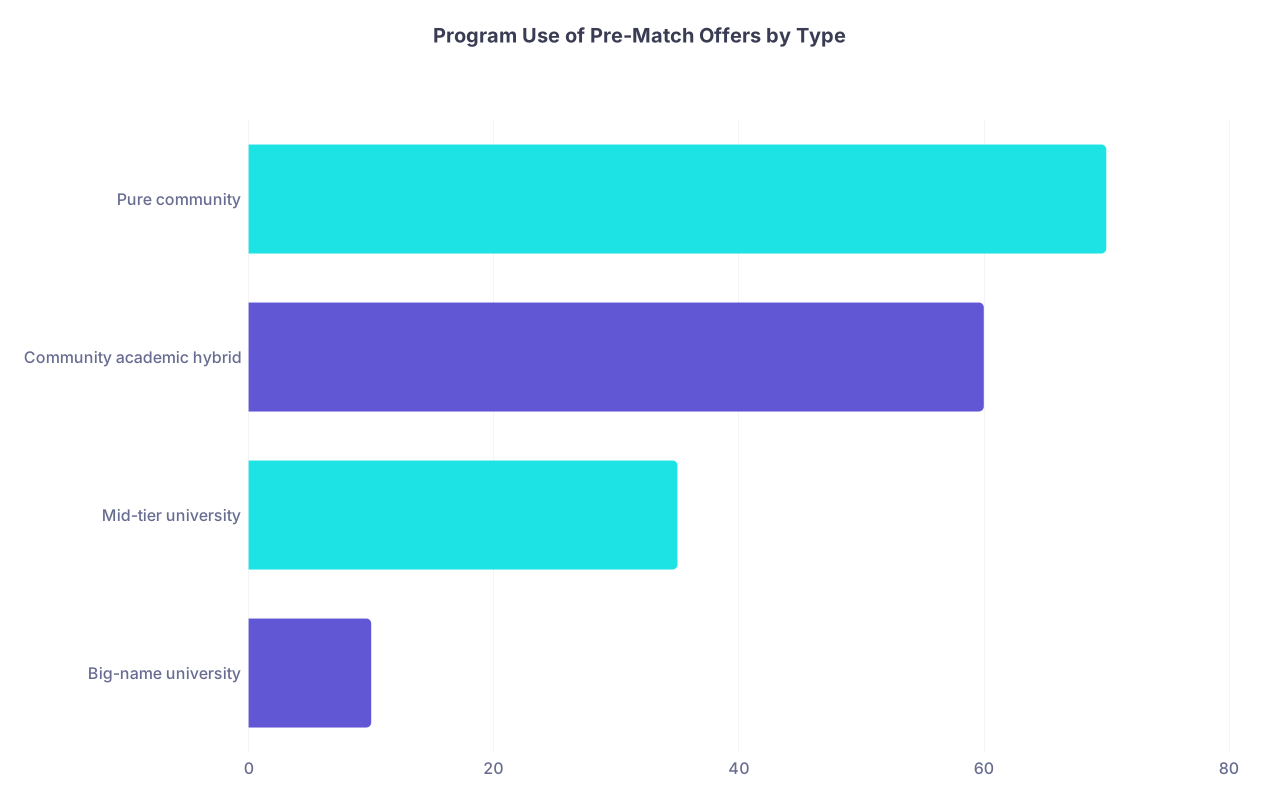
That’s roughly the pattern: the more community and less nationally branded the program, the more likely pre-match is part of their strategy.
Here’s how to leverage chair letters in that world:
Tell your chair which programs are pre-match heavy. You should know this. They often don’t track it as closely.
Be explicit about your willingness to accept a pre-match in certain places. Something like:
“If [Program X, Y, or Z] offered me a pre-match, I’d be strongly inclined to accept.”
That gives the chair honest ammo in conversations.Ask your chair (or clerkship director) directly:
“Are there programs you think match my profile where your call or email actually moves the needle for pre-match?”
You’d be surprised how honest some will be:
“We have a strong connection with [Program A and B]. If you’re interested, I can reach out.”Align your aways with your department’s relationships.
Rotating at a pre-match heavy program where your chair already has a pipeline dramatically raises your odds of an early offer, especially if your chair’s letter backs up how you performed there.
10. If You Suspect Your Chair Letter Was Weak
You won’t see it at most schools. But sometimes you can tell.
Clues:
- Programs you’re clearly competitive for are quiet.
- Program feedback (from mentors, alumni, back-channel) is “you’re solid, but nothing jumped off the page.”
- Your home program interviews you but treats you like any external candidate—no extra warmth, no, “We’d love to keep you here.”
If you’re already in that situation, here’s what you can still do during pre-match season:
- Lean heavily on strong individual letters (sub-I attendings, research mentors, away supervisors).
- Use post-interview thank you emails to reinforce: “Your program is one of my top choices, and I would be very excited to train there” without sounding like you’re blanket-selling everyone.
- Ask a mentor who has credibility (not necessarily the chair) if they’re willing to send a targeted advocacy email to one or two programs you care about.
A powerful, targeted email from a respected faculty member who actually knows you well can partially offset a bland chair letter. Not always, but enough that I’ve seen pre-match offers go to “borderline” applicants because a trusted voice vouched for them hard.
FAQ (4 Questions)
1. Do programs always wait for the chair letter before offering a pre-match?
No. Some will move early if they know you well from an away or if you’re a home student with a known reputation. But for external candidates—especially from unfamiliar schools—they often want that chair letter or at least a quick email from your department before burning a pre-match slot.
2. Is it ever worth asking to see or edit your chair letter?
At most U.S. schools, no. The culture is that chair letters are confidential. Pushing to see or edit it annoys people and can backfire. Your play is before it’s written: shaping what they know about you, giving them organized material, and having an honest conversation about your goals.
3. If my chair barely knows me, should I ask someone else to write a “chair-type” letter?
No. Programs can tell the difference between a true departmental chair letter and a random “equivalent” letter. You still get the official chair letter as required. What you can and should do is stack your file with two or three very strong clinical letters from people who actually know you, and ask them to advocate selectively by email for key programs.
4. I’m not targeting pre-match programs. Do chair letters still matter?
Yes, but differently. They’re less about triggering early offers and more about giving programs comfort to rank you aggressively. A strong chair letter can move you up the list at match-driven programs, especially if they trust your department. But the leverage is softer. For pure NRMP match programs, they’ll care slightly less about the chair letter and more about your interview, other letters, and overall fit.
Key points to walk away with:
- Chair letters are not neutral summaries; they’re coded endorsements that programs read as a strength-of-support signal, especially for pre-match.
- Your visibility, relationships, and honesty with your department leadership months before ERAS do more to shape that letter than any last-minute CV email.
- Quiet back-channel calls and emails built on that letter often decide who sees a pre-match offer—and who just never hears from the program at all.