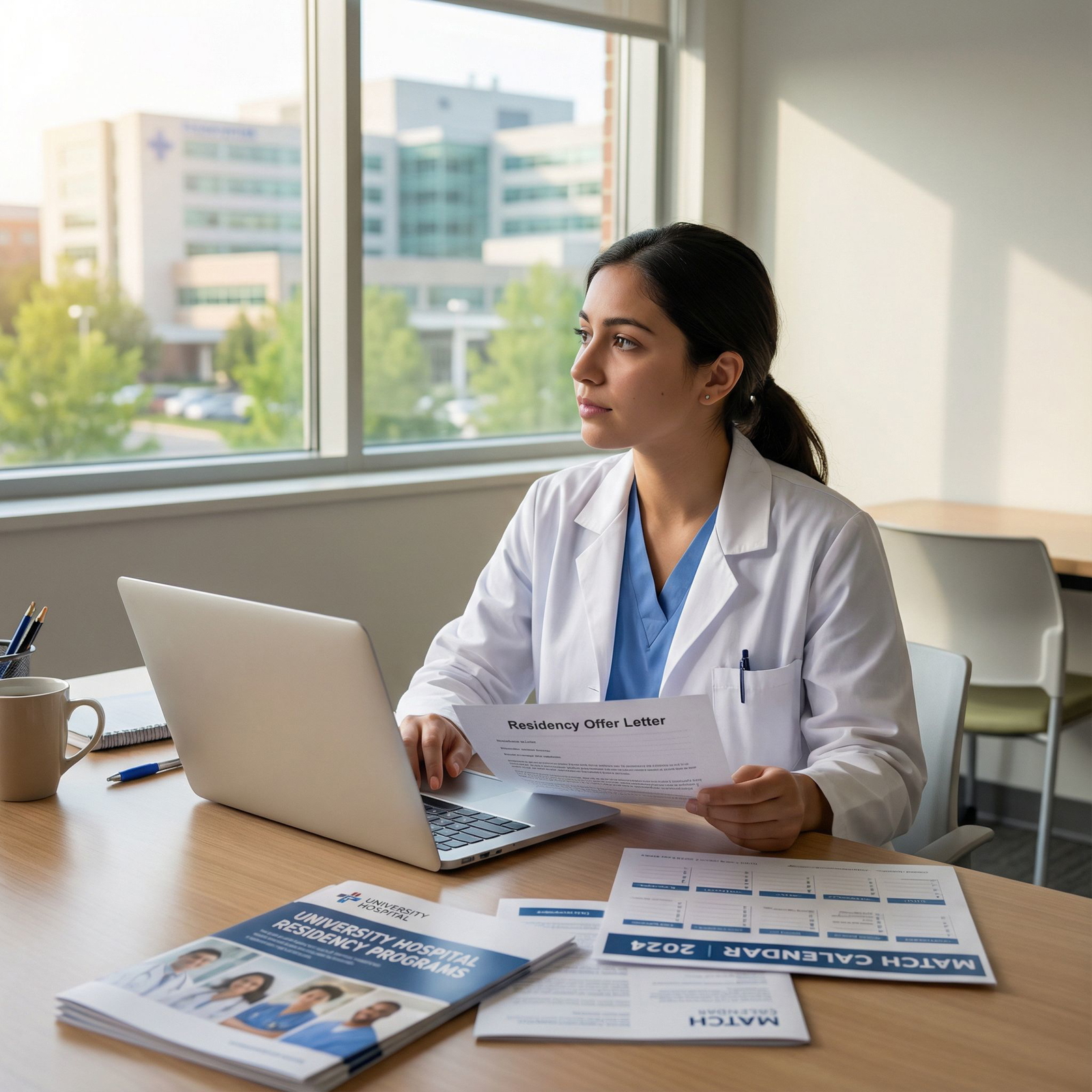
Understanding Pre-Match Communication in Urology
For a Caribbean IMG targeting urology, pre-match communication can strongly influence how programs perceive you and, in some situations, whether you are considered for pre-match offers or ranked highly. Urology is competitive and small; nearly every interaction is remembered. As a Caribbean medical school residency applicant, you have less margin for error and more to gain from deliberate, professional communication.
In this context, “pre-match communication” means any interaction with a residency program before the rank list deadline (or, in non-ERAS jurisdictions, before a binding offer is made). This includes:
- Emails to program directors (PDs), program coordinators, and faculty
- Phone calls or virtual meetings with faculty or residents
- In-person interaction during away rotations, SGU residency match fairs, or open houses
- Thank-you notes after interviews
- Updates about new publications, Step scores, or visa status
- Any expressed interest, including signals of early commitment or receptiveness to pre-match offers
As a Caribbean IMG, especially if you attended a large school like SGU, AUC, or Ross, you are part of a well-known pipeline of applicants. That helps—programs know your curriculum—but it also means you must stand out through professional, strategic, and authentic communication.
This article focuses on how to handle pre-match communication in urology specifically, with examples, templates, and practical advice tailored to Caribbean IMGs.
The Urology Match Landscape for Caribbean IMGs
Why Urology Is Different
Urology has some unique features compared with other specialties:
- Historically, it used a separate match (through the AUA), often earlier than the NRMP; the timelines and rules may feel different year to year, so you must check current AUA/AAMC guidance.
- Programs are small: often 1–3 residents per year. That means every spot—and every email—matters.
- Faculty and PDs tend to know one another nationwide; your reputation can spread quickly.
- Interest and commitment to urology carry significant weight; programs want people who know the field’s demands and culture.
For Caribbean IMGs, earning a urology residency spot is absolutely possible, but more challenging than many other specialties. A standout SGU residency match outcome or a similar success from another Caribbean school usually reflects not just strong scores but also excellent networking, clear communication, and thoughtful pre-match strategy.
Why Pre-Match Communication Matters More for Caribbean IMGs
As a Caribbean medical school residency applicant, you may face:
- Limited home-institution connections to urology departments in the U.S. or Canada
- Bias—implicit or explicit—about international training
- Visa considerations and concerns about clinical readiness
Pre-match communication gives you the chance to:
- Demonstrate genuine, mature interest in urology beyond “just applying widely”
- Show professionalism and communication skills (critical in surgery and urology)
- Clarify your story: why Caribbean school, why urology, and why that specific program
- Highlight US clinical experience, strong letters, or research that might not be obvious at first glance
Handled well, communication can move your application from “uncertain” to “worth an interview,” and from “middle of the rank list” to “we really know this applicant.”
Core Principles of Effective Pre-Match Communication
1. Respect the Match Rules and Program Policies
Before writing any messages, understand the governing rules for your application cycle. These change, so always:
- Review current AUA and NRMP policies about contact and pre-match behavior
- Check each program’s website for explicit communication rules (e.g., “No post-interview communication will be considered”)
- Follow any directions given during interview days or in follow-up emails
If a program says they do not want additional communication, respect that. Violating this can hurt your reputation, not just at one institution but across the small urology community.
2. Quality Over Quantity
Sending dozens of generic emails is counterproductive. Instead:
- Identify a core list of programs where you have a realistic shot and genuine interest
- Invest time to learn each program’s strengths, case mix, and culture
- Send fewer, highly personalized, thoughtful messages
Decision-makers can easily spot template emails with copy-pasted lines. Program coordinators sometimes share stories of “mass-blast” messages; these rarely help and can hurt your chances.
3. Be Clear, Concise, and Professional
Every email or conversation should reflect how you will communicate as a resident:
- Use a clear subject line (e.g., “Prospective Applicant – [Your Name], Caribbean IMG Interested in Urology”)
- Keep emails focused (short paragraphs, no rambling narratives)
- Use a professional tone and correct grammar
- Avoid emotional pressure (“urology is my dream and my only hope”)
Your goal isn’t to convince them you “want it the most,” but that you are mature, reliable, and aligned with the program’s values.
4. Showcase Specific Alignment
Programs are more receptive when you clearly articulate why their program fits you:
- Mention specific faculty interests that match your research or goals
- Refer to particular clinical strengths (e.g., endourology, robotics, oncology, reconstructive urology)
- Note geographic or personal ties (family nearby, previous training in the region)
This helps them see you as a real potential colleague, not just “another Caribbean IMG applicant.”

Types of Pre-Match Communication and How to Use Them
1. Initial Outreach Before Interview Invitations
Goal: Put your name on the radar, highlight key strengths, and express genuine interest—without being pushy.
Who to contact:
- Program coordinator (PC) for logistics and application status
- Program director (PD) or associate PD selectively, especially if you have a strong connection or specific reason
- Faculty you worked with on an away rotation or research collaboration
When to send:
- Shortly after ERAS (or equivalent system) submission
- After obtaining significant new information (e.g., Step 2 CK result, new publication)
Example structure for a pre-interview email (PD or faculty):
- Brief introduction (name, medical school, current location)
- Direct statement of your interest in urology and their program
- 1–2 specific program-related reasons (curriculum, mentorship, research)
- 1–2 concise highlights that address common IMG concerns:
- Strong US clinical experience in surgery/urology
- High Step scores / solid clinical evaluations
- Research productivity
- Gentle closing that does not pressure for an invitation
Sample excerpt (shortened):
Dear Dr. [PD Last Name],
My name is [Name], a final-year student at [Caribbean School] currently completing my urology rotation at [US site]. I am applying to urology this cycle and wanted to express my strong interest in [Program Name].
I am particularly drawn to your program’s emphasis on [e.g., early operative exposure and strong mentorship in endourology], as well as the opportunity to work with faculty involved in [specific research/clinical programs].
As a Caribbean IMG, I have prioritized building a strong clinical and academic foundation in the US. I have completed [X] months of core and elective rotations in accredited US hospitals, received strong evaluations in surgery/urology, and recently [published/accepted] a manuscript on [topic] in [journal].
Thank you for considering my application. I greatly appreciate your time and the opportunity to be reviewed for interview.
Sincerely,
[Name]
Keep it under 250–300 words.
2. Communication During Away Rotations and Sub-Internships
If you rotate with a urology program, this is your biggest opportunity as a Caribbean IMG.
On-rotation communication tips:
- Show up early, stay late, and ask appropriate questions in person; you need fewer emails if your in-person presence is strong
- Ask for feedback mid-rotation: “Is there anything I can improve to be more helpful to the team?”
- Clarify interest professionally near the end: “I’m very interested in urology and strongly considering applying here; I’d be grateful for advice on how to strengthen my application.”
When you leave, a brief follow-up email can reinforce your interest:
Dear Dr. [Last Name],
Thank you again for the opportunity to rotate with your urology team in [Month]. I learned a great deal from your approach to [specific case or topic], particularly [brief example].
My experience at [Program Name] confirmed my strong interest in urology and in training in an environment that combines high operative volume with supportive mentorship. I will be applying to your program this cycle and would be honored to be considered for an interview.
Sincerely,
[Name]
Avoid pushing for a commitment; let your performance speak first.
3. Post-Interview Thank-You Notes and Updates
Most urology programs still informally expect or at least receive thank-you notes, though policies differ.
Thank-you emails:
- Send within 24–48 hours of the interview
- Keep them specific and brief: mention one meaningful aspect of the conversation or program
- Send separate messages to the PD and any interviewer with whom you made a strong connection
Content example:
Dear Dr. [Last Name],
Thank you for the opportunity to interview at [Program Name] on [Date]. I appreciated our discussion about [specific topic], particularly your insight into [brief detail].
Our conversation reinforced my impression that [Program Name] offers the combination of rigorous surgical training and close faculty mentorship I am seeking in a urology residency.
Thank you again for your time and consideration.
Sincerely,
[Name]
Update letters:
Use these when you have a substantive change:
- New Step 2 CK score, especially if strong
- New publication or podium/poster presentation in urology or surgery
- Change in visa status or eligibility that may reassure programs
- Additional strong letter from a known urologist
Keep updates focused and avoid sending more than one major update per program unless explicitly invited.
4. Signals of Interest, Early Commitment, and “Pre-Match Offers”
Urology and other competitive fields sometimes involve complex conversations around early commitment or pre-match offers, depending on the rules of your cycle.
Key points for Caribbean IMGs:
- Never request a pre-match offer if doing so would violate AUA/NRMP rules or program policies. Consult latest guidelines.
- You can clearly express that a program is your top choice, but do so honestly and only if you mean it.
- Be aware that some programs interpret strong early-commitment language as a promise; breaking such implied promises can harm future applicants from your school.
Example of strong but appropriate interest:
Based on my experiences this season, [Program Name] is my top choice for urology residency. If fortunate enough to match to your program, I would be fully committed to contributing to your team and training there.
Notice: you are not stating how you will rank other programs, and you are not asking them to rank you in any particular way.
If a program raises the possibility of early commitment, pre-match offers, or asks about how you will rank them, proceed carefully:
- Revisit official match rules before answering
- Avoid committing to statements that contradict policies
- If you are unsure, you may respond along the lines of: “I am highly interested in your program and am carefully reviewing all programs I have seen within the framework of the Match policies.”
When in doubt, seek confidential advice from your dean’s office, a trusted faculty mentor, or a knowledgeable SGU residency match advisor who has recent experience with urology.

Program Communication Before Match: Do’s, Don’ts, and Nuances
Do’s
Do follow each program’s instructions
If they say “No post-interview communication will affect our rank list,” you can still send a polite thank-you, but don’t try to influence their ranking decision.Do be transparent about your background as a Caribbean IMG
You don’t need to over-explain, but you can acknowledge your path and emphasize your preparedness: US clinical experience, strong Step 2 CK, good letters from US urologists.Do keep records of your communication
Maintain a simple spreadsheet: date, program, contact, purpose, and summary. This helps avoid sending conflicting messages.Do ask thoughtful questions that show you understand urology
Examples:- “How does your program ensure progressive operative autonomy?”
- “What opportunities exist for resident involvement in outcomes research or quality improvement?”
Do leverage connections professionally
If a mentor knows the PD, it can help to have them send a brief note of support, especially to counter any concerns about Caribbean training.
Don’ts
Don’t misrepresent your intentions
Do not tell more than one program that it is your unequivocal #1 if that isn’t true. The urology community is small; word spreads.Don’t send emotionally charged or desperate messages
Avoid phrases like “I will not be able to become a urologist unless I match with you” or “I beg you to consider me.” This undermines professionalism.Don’t over-communicate
Multiple emails with no new information can be irritating. If you’ve thanked them and sent one substantial update, further messages should be rare or in reply to their outreach.Don’t argue with or pressure programs
If you are not invited to interview, you may send one polite inquiry early in the season, but not repeated requests. If you are rejected, do not respond with debate or emotion.Don’t violate confidentiality
Never share details of internal ranking, other programs’ communications, or anything you’ve been told in confidence. This is both unprofessional and risky.
Putting It All Together: A Strategy for Caribbean IMGs Targeting Urology
Step 1: Prepare Your “Communication Assets”
Before the season opens, assemble:
- A polished, 2–3 line professional introduction (for emails and informal networking)
- A short paragraph explaining your path: Caribbean school → US clinical training → urology interest
- A brief explanation of your career goals (e.g., academic urology, community practice with high surgical volume)
- A spreadsheet of programs with key details and any connections (e.g., alumni, faculty, research ties)
Practice a concise, confident way to answer: “Tell me about your training and why urology?” in under one minute.
Step 2: Identify Priority Programs
Using your performance, research, and geography:
- Flag 5–10 “high-priority” programs where your profile and interests align well
- Flag a broader group of “realistic” programs where Caribbean IMGs have previously matched or where your mentors have connections
These are where pre-match communication is most worthwhile.
Step 3: Execute a Timed Communication Plan
Early season (pre-interview):
- Send targeted introduction emails to a modest number of programs where you have strong alignment and/or connections
- Reach out to mentors and ask whether they can advocate on your behalf to specific PDs or faculty
Mid-season (interview window):
- Use your interviews to gather insight about each program’s communication expectations
- Send precise thank-you notes within 1–2 days
- If you have not heard from a program you rotated at, you may send one polite inquiry (coordinated with your attending or mentor if appropriate)
Late season (post-interview, pre-rank):
- Decide honestly which programs you would be happy to train at and in what order
- If allowed by rules and program policies, send one “top choice” message to the single program that genuinely ranks first on your list
- Send limited update letters to programs where new information significantly strengthens your profile
Step 4: Manage Anxiety and Expectations
The urology match is competitive. As a Caribbean medical school residency applicant, you may receive fewer interviews than US MD seniors. Focus on what you can control:
- Professional, consistent communication
- Strong performance on away rotations
- Thoughtful letters and realistic program list
- Backup planning (e.g., preliminary surgery or research year if needed)
Avoid constant program communication to alleviate anxiety; it rarely changes rank decisions, but can risk negative impressions.
FAQs: Pre-Match Communication for Caribbean IMGs in Urology
1. As a Caribbean IMG, should I send more emails to compensate for bias?
No. You should send better emails, not more. A few targeted, well-crafted messages that show insight into the program and your fit are far more effective than repeated generic outreach. Over-communication can reinforce negative stereotypes rather than overcoming them.
2. Is it appropriate to tell a program they are my top choice in the urology match?
Yes, if three conditions are met:
- It does not violate AUA/NRMP rules or stated program policies.
- You genuinely intend to rank them first.
- You do not make the same statement to multiple programs.
Phrase your commitment professionally and avoid asking them directly how they will rank you.
3. Can pre-match offers still happen in urology, and how should I respond?
Policies evolve, and many systems now discourage or prohibit binding pre-match offers. If a program hints at an early commitment, you must:
- Review current match rules immediately
- Seek confidential advice from your dean’s office or a trusted mentor
- Respond professionally, emphasizing your strong interest and your obligation to follow official match guidelines
Never agree to anything that conflicts with official policies; this can jeopardize your match and your professional credibility.
4. How important are thank-you notes and update letters in the urology match for Caribbean IMGs?
They are rarely decisive by themselves but can:
- Reinforce positive impressions
- Clarify your interest in a program
- Highlight substantive improvements to your application
For a Caribbean IMG, thoughtful, professional messages can help counter uncertainty and show that you understand both urology culture and the expectations of a US residency.
By approaching pre-match communication with intention—respecting rules, writing with clarity, and showcasing authentic interest—you can significantly strengthen your position as a Caribbean IMG in the urology match. Your goal is not to “game” the system, but to demonstrate that you are exactly the kind of thoughtful, reliable, and committed colleague programs want in their operating rooms and clinics.