
The idea that accepting a pre‑match offer kills your chances at an academic career is nonsense. Not “overstated.” Not “partially true.” Just wrong.
The real problem is that most of the loudest voices warning you about pre‑match contracts have never sat on a promotions committee, never hired a junior faculty member, and never looked at actual career outcome data. They’re recycling hallway gossip as if it’s gospel.
Let’s dismantle that.
What People Think a Pre‑Match Does to Your Career
The myth usually shows up in some version of this:
- “If you pre‑match at a community program, you’ll never get a fellowship.”
- “Academic medicine only takes people from big-name categorical programs.”
- “Signing early means you’ve ‘settled’ and top places will hold it against you.”
- “Real academics go through The Match like everyone else.”
I’ve heard these lines from MS4s, PGY1s, even attendings who finished training in a totally different era and are still giving 1990s career advice.
Here’s the blunt version: fellowship directors and academic hiring committees do not care whether you matched on a Monday in March or signed a contract in November. They care about:
- your clinical skills and reputation
- your research productivity and academic potential
- your letters of recommendation
- how you show up when people actually work with you
Everything else is noise.
Is there indirect risk in some pre‑match situations? Sure. But it’s not because of the pre‑match itself. It’s because of what comes with that specific contract: the program’s resources, research environment, case mix, and your own complacency if you think early security means you can coast.
The pre‑match is the medium. You’re still the message.
What the Data and Real Careers Actually Show
Nobody publishes a paper titled “Prematch vs NRMP Outcome and Odds of Tenure Track.” But we do have enough reality checks to call out the myth.
Look at who fills academic positions and competitive fellowships:
Plenty of faculty at big‑name institutions trained at:
- community programs
- mid‑tier university hospitals
- osteopathic programs
- international programs that never even heard of your state’s pre‑match drama
Fellowship classes at places like MGH, UCSF, or MD Anderson are a mix of:
- “top‑tier academic” residency grads
- solid, mid‑tier residency grads who crushed research and got superstar letters
- occasional “off‑pedigree” applicants who have a killer niche or technical skill
You know what’s not listed on their CV? “Matched via SOAP,” “Prematched at PGY-1 level,” or “Signed outside the NRMP.” No one cares.
What does map to academic jobs?
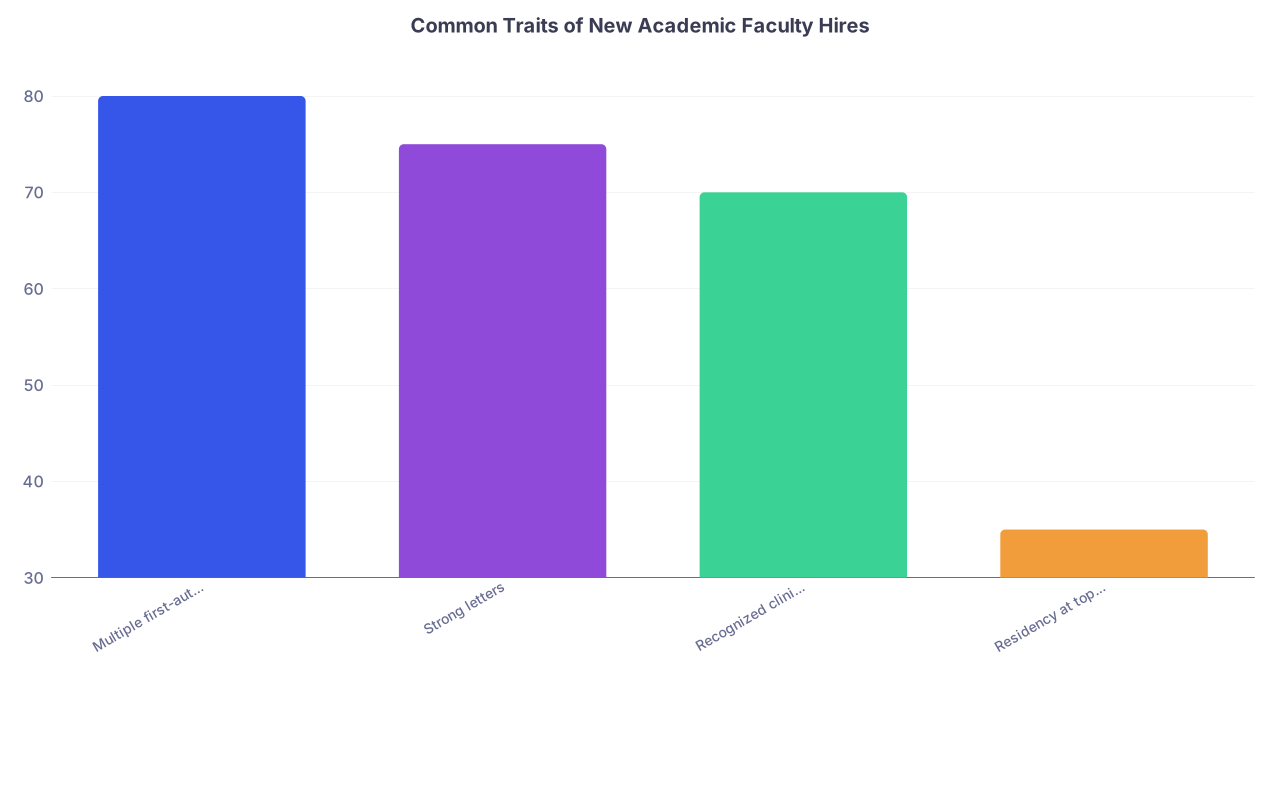
| Category | Value |
|---|---|
| Multiple first-author papers | 80 |
| Strong letters | 75 |
| Recognized clinical skill | 70 |
| Residency at top-10 name brand | 35 |
Those numbers aren’t from a single study; they reflect what repeatedly shows up in faculty CVs and selection priorities:
- Most new academic hires have at least a few meaningful publications.
- Letters from respected people in the field carry huge weight.
- A reputation as the “go‑to” resident for complex cases or teaching gets you noticed.
- A fancy program name helps, but it’s far from universal. Lots of faculty don’t have it.
Notice what’s missing: “Didn’t accept a pre‑match.”
So the fear is misplaced. The binary isn’t “pre‑match vs academic career.” The real questions are:
- What does this program let me become over the next 3–7 years?
- Will I have the tools to be competitive for the career I want?
When a Pre‑Match Can Hurt You (Indirectly)
Now for the nuance. There are situations where accepting a pre‑match can box you in. But again, it’s not the mechanism; it’s the context.
Here are the real ways a pre‑match path can limit you:
Weak research infrastructure
If the program:
- has no established researchers in your field of interest
- doesn’t support conference travel or protected time
- has no grant-writing or mentorship culture
then you’ll be paddling upstream. You can still make it, but it’s harder.
Narrow clinical exposure
Some small community or rural programs:
- send complex cases out to tertiary centers
- offer limited subspecialty exposure
- don’t have certain electives or advanced procedures
That can matter a lot if you want a highly procedural or niche academic field.
No track record of fellowship placement
This is the big one people ignore. A program that’s never sent anyone to:
- a solid research‑oriented fellowship
- or an academic track anywhere
is going to make your path longer and steeper. You won’t be the first without paying a tax in extra work, more years, or both.
You stop pushing once you sign
The psychological trap: “I’ve got a spot; I can relax.”
Then:- you do fewer projects
- you skip national meetings
- you don’t cultivate mentors outside your local bubble
That will tank your academic potential far more reliably than any paperwork timing.
So the correct statement isn’t “pre‑match kills academia.” It’s:
A pre‑match at a program with poor academic infrastructure, no fellowship network, and a culture of complacency makes an academic path harder—unless you’re ready to hustle aggressively around those limitations.
That’s a very different claim.
How to Evaluate a Pre‑Match Offer If You Want an Academic Career
Here’s where most students screw up. They evaluate pre‑match offers on:
- location
- vibe
- whether the residents “seemed happy” on interview day
Those matter, but not for your academic future.
If you care about staying in academia, interrogate these five things ruthlessly:
- Fellowship outcomes – not rumors, receipts
Ask explicitly:
- Where did your last 5 graduates who wanted fellowship go?
- Who went into academics? Where are they now?
- Can I see a recent graduate list with destinations?
If they can’t answer clearly or dodge the question, that’s your warning label.
- Faculty doing what you want to do
You want academics? Then you need academic role models in that program or via robust external collaborations.
Look for:
- faculty with ongoing grants or multi‑center studies
- people with first/last‑author publications in the last 3–5 years
- involvement in national committees or guideline groups
If you want to do GI research and the program’s only “research” is one QI project about discharge times from 2014, don’t kid yourself.
- Resident scholarly output
Are residents actually getting work out the door? Or is everything “in progress”?
Red flag phrases:
- “We’re trying to build a research culture.”
- “We hope to grow academic opportunities in the next few years.”
- “Our residents are so busy clinically that research is tough.”
Translation: this is not a place built for you if academia is the plan.
- Protected time and support
Ask about:
- protected research time during residency/fellowship
- availability of statisticians, IRB support, and mentors
- actual conference presentations by residents (not hypotheticals)
The difference between “you can do research on your own time” and “we carve out real blocks for research and help you succeed” is enormous.
- External visibility
Do residents:
- present regularly at national meetings?
- win poster/oral presentation awards?
- get plugged into multi‑center projects?
That’s how you get known outside your zip code—and how academic doors open later.
To keep this straight, think of it like this:
| Factor | Strong for Academia | Weak for Academia |
|---|---|---|
| Recent fellowship matches | Multiple, solid sites | Rare, vague answers |
| Faculty research | Active, publishing | Minimal or none |
| Resident publications | Yearly, consistent | Rare/zero |
| Protected time | Structured blocks | “On your own time” |
| National exposure | Regular conferences | Almost never |
You do not need all five to be great. But if you strike out on four of them and still sign just because “the PD seemed nice,” you’re not a victim of pre‑match. You’re a victim of poor due diligence.
What If You Already Accepted a Pre‑Match?
Let’s say you’re reading this as a PGY‑1 who pre‑matched into a very non‑fancy place. Are you doomed?
No.
But you have to stop waiting for the program to turn you into an academic. They won’t. You’ll have to do it yourself.
Here’s how people in that position actually make it:
Find at least one mentor with a research track record, even if they’re external (via prior med school, conferences, or cold emails).
Attach yourself to ongoing projects, especially multi‑center ones, where you can:
- handle data collection
- write sections of the manuscript
- present at meetings
Use electives strategically at academic centers:
- audition rotations with heavy academic teams
- get letters from people known in your target field
- pitch a small project during those months
Publish something every year of training:
- case reports early
- retrospective reviews or QI with pre/post analysis later
- anything that shows you can move from idea to finished product
Show up at national meetings, even if it’s just a poster:
- present
- meet people
- tell them your story
That’s exactly how residents from “no‑name” programs show up later as academic fellows and junior faculty. I’ve seen this play out repeatedly.
You’re not locked out. You’re just on the “hustle harder” path.
The Silent Truth: Plenty of Academics Came from Non-Elite Paths
There’s a survivorship bias in academic medicine that nobody admits: people from fancy programs assume their pedigree is why they made it. For some, yes. For many others, it was productivity and networking.
I’ve sat in rooms where:
- fellowship directors were more excited about a resident from a lesser‑known program with 5 strong first‑author papers than a big‑name grad with none
- applicants with pre‑match backgrounds beat out “perfect” pedigrees because their letters were glowing and specific, not generic
- “off‑brand” residents had out‑hustled everyone and built relationships across institutions
And when promotions committees review a CV 10 years later, here’s what gets discussed:
- “Look at their publication trajectory.”
- “They’ve built a nice niche in X.”
- “Their teaching reviews from residents are stellar.”
No one is asking, “Was this person an NRMP purist, or did they pre‑match?”
Bottom Line: How to Think About Pre‑Match and Academic Careers
Strip away the myths and here’s what’s left:
A pre‑match contract itself does not kill your academic career.
What matters are the program’s infrastructure, your output, your mentors, and your reputation.The real danger is signing at a program that cannot support your goals—and then coasting.
That’s on you to evaluate. Ask hard questions. Demand receipts, not vague reassurances.If you already pre‑matched somewhere “non‑academic,” you’re not done—you’re just on the harder track.
Hustle for mentors, projects, and national exposure. Plenty of current faculty did exactly that.
Security early is not the enemy of academic ambition. Complacency is.