
Program directors do not pre-match you because they “love you.” They pre-match you because they are managing risk.
Let me walk you through what that really means, because the story you hear on Reddit and from your classmates is not the real one that gets told behind closed doors in the PD’s office.
I’ve been in the room when PDs decide who gets a pre-match call and who gets left to the algorithm. I’ve heard the muttering after an applicant turns down a pre-match, and I’ve watched more than one student blow a golden ticket because they misread the signal.
You want the truth? Here it is.
What a Pre-Match Offer Actually Means
Strip away the flattery and warm email wording. A pre-match offer from a program director really says three things:
- “You are valuable to us compared to our usual pool.”
- “We are not confident we can get you through the Match.”
- “We want to lock you in before someone stronger steals you.”
Note that none of those statements say: “You’re the number one applicant in the country” or “You will be treated like royalty here.” Sometimes that’s true. Often it isn’t.
There are three main contexts where pre-match offers happen:
- Certain states and specialties that still run formal pre-match pathways or contracts (e.g., some Texas programs historically, some community programs).
- Informal “we will rank you to match, will you rank us number one?” conversations.
- Direct contracts outside the NRMP (rare in mainstream specialties now, but still real in some off-the-radar or non-ACGME situations).
You asked about how to prepare and how to interpret. You cannot prepare well if you misread what they’re signaling.
Here’s what’s really going on.
The PD’s Playbook: Why They Pre-Match You
Most applicants imagine a PD sitting in their office thinking, “I adore this student, let me do them a favor.” No. That’s not how this works.
Here’s the internal logic PDs actually use.
1. They see you as “high yield” for their needs
Programs don’t recruit in a vacuum. They recruit to solve their problems: service coverage, call schedule, accreditation requirements, reputation.
I’ve heard comments like:
- “This IMG has three years of experience in our hospital as a researcher; they’ll hit the ground running.”
- “She speaks Spanish and we’re 70% Spanish-speaking patients. We cannot lose her.”
- “He’s from this town. He’s not running off to a coastal academic center. Lock him down.”
Your metrics (Step scores, grades, research) matter, but pre-match is often about fit and utility, not just raw numbers.
Common “high yield” traits that trigger pre-match consideration:
- You already rotated there and clearly functioned at an intern level.
- You fill a specific need: language, local roots, niche skill (procedures, research).
- You’re above their typical applicant profile, and they’re afraid they’ll lose you in the open market.
- You have a visa need they’re willing to sponsor but know other places won’t.
They’re not doing charity. They’re trying to secure someone who will make their life easier in July.
2. They’re worried the Match algorithm will screw them
Nobody trusts the Match completely. Especially not lower-tier or less-known programs.
At ranking meetings, someone always says some version of: “We love this person, but they’re interviewing at [Big Academic Brand]. Are we sure we’ll match them?”
If the answer is “no,” that’s when the pre-match conversation starts.
Here’s the ugly truth: in many programs, a pre-match is more common for borderline or “flight risk” candidates than for their absolute top superstar. Why?
Because for the very top people, they’ll usually gamble. They think, “We’ll rank them high and see what happens.” The risk is acceptable.
For the high-but-not-insane candidate who also seems likely to leave? Different story. They’re scared you’ll rank them low and match elsewhere, and then they’re stuck filling with people who never rotated there, don’t know the system, and might be weaker clinically.
So they pre-match you to remove the uncertainty.
3. They’re under pressure to fill early
Some programs live in constant fear of going unfilled. Usually community programs. Often in less desirable locations. Sometimes in highly competitive specialties where they’re not top tier.
Behind the scenes, the PD is getting leaned on by:
- Hospital leadership: “We can’t run this service short again next year.”
- Faculty: “We are exhausted; we need strong interns, not scramble leftovers.”
- GME: “We can’t keep missing ACGME case numbers.”
So when they see a candidate who isn’t obviously out of their league and seems persuadable, the instinct is: “Offer them now. Get a commitment. Take them off the market.”
That phone call you get isn’t just flattery. It’s program anxiety disguised as opportunity.
What They’re Not Telling You
When a PD says, “We’d love to have you here, we think you’d be a great fit,” there are a few things they will never say on the phone.
So I’ll say them for them.
1. “You are not our #1, but you’re high enough and accessible.”
I’ve heard exactly this in ranking meetings:
- “Our absolute top tier is probably going to bigger-name programs. But I think we can land this one with a pre-match.”
- “She’s great, but not Hopkins-great. Perfect for us if we can lock her in.”
Do not assume pre-match = you’re their top candidate. Sometimes yes. Many times no.
Pre-match means you’re in the band of people they’re afraid to lose, not necessarily the person they’d take over everyone else if the universe froze.
2. “We doubt you’ll do better in the open market.”
This one is harsh, but you need to hear it.
For some applicants — especially IMGs, DOs applying to very competitive specialties, or people with red flags — a pre-match is the PD’s way of saying:
“We think this is a fair deal for you. Maybe even generous. And we suspect the algorithm isn’t going to hand you 10 better options.”
They’re not going to express that bluntly. Instead, you’ll hear:
- “Given how competitive things are this year…”
- “We know the Match is stressful; this is a way to give you certainty.”
Translation: “We suspect you’re at risk of not matching at all, and we’d rather secure you before you figure that out.”
3. “If you say no, we may quietly move on.”
Once you turn down or “hedge” a pre-match offer, many programs emotionally downgrade you. They start assuming you’re leaving.
I’ve watched this happen: an applicant plays coy, hoping to negotiate for a “ranking to match” promise instead. The PD’s reaction after hanging up?
“Okay, they’re not coming. Move them down. I’m not going to chase them.”
Programs have pride. PDs have egos. They do not enjoy being strung along.
How to Prepare Before You Ever Get a Pre-Match Call
The worst time to figure out how you feel about pre-match is while a PD is literally on the phone waiting for your answer.
You prepare now. Quietly. Before interview season even starts.
Step 1: Be brutally honest about your risk profile
Forget what your classmates say. Look at your file the way a PD does:
- Are you an IMG or DO aiming for a historically competitive specialty?
- Any failures, remediation, or long gaps?
- Below-average board scores for your target programs?
- Very few interviews?
If you’re low-risk and loaded with interviews at solid places, your threshold for accepting a pre-match should be higher. You can afford to wait on the algorithm.
If you’re high-risk, few interviews, or in a narrow specialty with limited options, a pre-match may be your best — and only — real safety net.
Step 2: Rank your true priorities, not your fantasy ones
Before the calls come, you need a mental list of:
- Programs you’d absolutely accept a pre-match from.
- Programs you’d strongly consider but want to think 24–48 hours about.
- Programs you’d thank politely and decline.
This has to be based on your real life — geography, family, visa, financial situation, specialty flexibility — not just prestige.
I’ve watched people regret both directions:
- Turning down a solid pre-match thinking “I’ll do better,” then not matching at all.
- Accepting a pre-match at a toxic program out of fear, then spending 3–7 years miserable.
You reduce both risks by being clear beforehand where each program sits in your personal hierarchy.
Step 3: Decide your “floor”
There should be a point below which you will not sell your future just to match.
Examples:
- You will not accept a non-accredited spot if your career goal depends on ACGME training.
- You will not sign with a program notorious for violations, abuse, or blatant exploitation (every region has a couple; residents know who they are).
- You will not compromise on an absolutely non-negotiable personal factor (spousal job, visa type, need to be near a sick family member, etc.).
If a pre-match offer comes in below that floor, your answer is simple: no.
How to Handle the Pre-Match Conversation Like an Adult (Not a Panicked MS4)
Let me walk you through the phone call from the PD’s side.
They’ve already decided to offer. They want a yes. Preferably now. They do not want to waste time persuading someone who’s lukewarm.
So your job is to be prepared and controlled, not surprised and babbling.
When the call comes
You’ll usually get something like:
“We really enjoyed meeting you, and after discussing with the faculty, we’d like to offer you a pre-match position in our program.”
Your instincts:
- Heart rate spikes.
- You vaguely remember something from Reddit about how dangerous pre-matches are.
- You panic about committing.
Pause. Breathe. Then:
- Thank them genuinely.
- Clarify what exactly is being offered.
- Ask explicitly about timeline.
You say something like:
“Thank you so much, Dr. _____. I really enjoyed my time with your team. Just so I’m clear, is this a formal pre-match contract outside the NRMP, or is this a strong assurance of where I’d fall on the rank list? And how long do I have to give you an answer?”
You sound like a grown-up. PDs respect that.

| Step | Description |
|---|---|
| Step 1 | PD calls with pre match |
| Step 2 | Thank and clarify details |
| Step 3 | Ask for 24 to 72 hours |
| Step 4 | Accept or decline directly |
| Step 5 | Compare to other options |
| Step 6 | Final decision |
| Step 7 | Need time? |
Buying yourself time — without burning the bridge
If you truly don’t know yet, you can say:
“I’m very honored and I’m seriously considering your program. This is an important decision for me and my family. Would it be possible for me to think about this over the next 24–48 hours and get back to you by [specific day]?”
Most reasonable PDs will give you a day or two. If they sound annoyed that you’re not saying yes on the spot, that’s data about the culture right there.
Don’t drag it out for a week. You’ll sour the relationship, and they’ll assume you’re using them as leverage.
Asking the questions nobody tells you to ask
You are allowed to ask direct questions like:
- “If I accept this pre-match, what does that mean logistically? Do I withdraw from the Match entirely?”
- “If I sign with you, are there any conditions that could cause the offer to be rescinded?”
- “Can I speak with a current resident about how the program has handled pre-matched residents in the past?”
You are not begging. You are verifying that you’re not walking into a trap.
Hidden Risks and Hidden Advantages of Saying Yes
People love to dramatize pre-match as either “always a scam” or “always a lifesaver.” Both takes are lazy.
Let’s talk about what actually happens once you accept.
The real benefits
Certainty. Your classmates are grinding through interviews, sweating rank lists, and hallucinating over NRMP charts. You’re done. That’s not trivial; burnout in final year is real.
Early integration. Programs that pre-match often treat those candidates like “their” people early: more communication, more guidance, sometimes early access to housing or scheduling preferences.
Visa / life logistics. For IMGs or people with complex visa situations, a pre-match can mean months of extra time to handle paperwork, moves, spouse planning, kids’ schooling.
For some candidates, that combination is worth more than a marginally “better name” on the badge.
The real risks
Here’s what people don’t talk about:
You are off the market, and everyone knows it. Once you sign something binding, you’re done. Other programs will drop interest. You give up the chance to discover that a later interview is a perfect fit.
Power imbalance shifts. Before you sign, they’re courting you. After you sign, you’re locked in. Most programs are ethical, but the fact remains: your leverage drops to zero after commitment.
Program reality may differ from interview day. Every place looks shiny for one day. Once committed, you are discovering the truth on the inside with no easy exit.
So yes, a pre-match can save your career. It can also trap you in a place that isn’t what you thought. That’s why the prep before the call is everything.
Red Flags When a Program Tries to Pre-Match You
There are situations where a pre-match offer should make you more cautious, not more flattered.
Watch for:
Excessive pressure to decide immediately. “We need an answer in the next few hours or we’ll have to move on.” Translation: we’re desperate and possibly playing games with multiple candidates.
Vague or evasive answers about accreditation, case volume, or resident attrition. If they can’t answer basic questions directly, do not sign anything.
Bad reputation among residents in the area. If every resident you talk to at neighboring programs rolls their eyes at that program’s name, listen to them.
Non-standard contracts with weird clauses. Anything that restricts your ability to transfer, threatens penalties, or looks legally aggressive should be reviewed by someone who actually understands medical contracts.
If a pre-match offer feels like a “hard sell” from a timeshare presentation, assume they’re trying to cover for serious weaknesses.
The Quiet Upside of Saying “No”
Here’s something almost nobody tells you: you can decline a pre-match and still be ranked highly.
I’ve sat in meetings where a candidate politely declined a pre-match, said they wanted to go through the Match, and the PD still kept them high on the list because:
- They didn’t burn the bridge.
- They were honest and respectful.
- The program still liked them.
But the key is how you decline.
Something like:
“Thank you so much for the offer, Dr. ____. I truly appreciate your confidence in me and I meant it when I said I loved my experience at your program. After thinking about my situation and discussing with my family, I’ve decided to remain in the Match this year. I hope we can still keep each other in mind through the process, and I would be genuinely happy to match at your program.”
That tone preserves the relationship and respects the PD’s time and effort. You’re not saying, “You’re beneath me.” You’re saying, “I need to keep my options open, but I still value you.”
That matters.
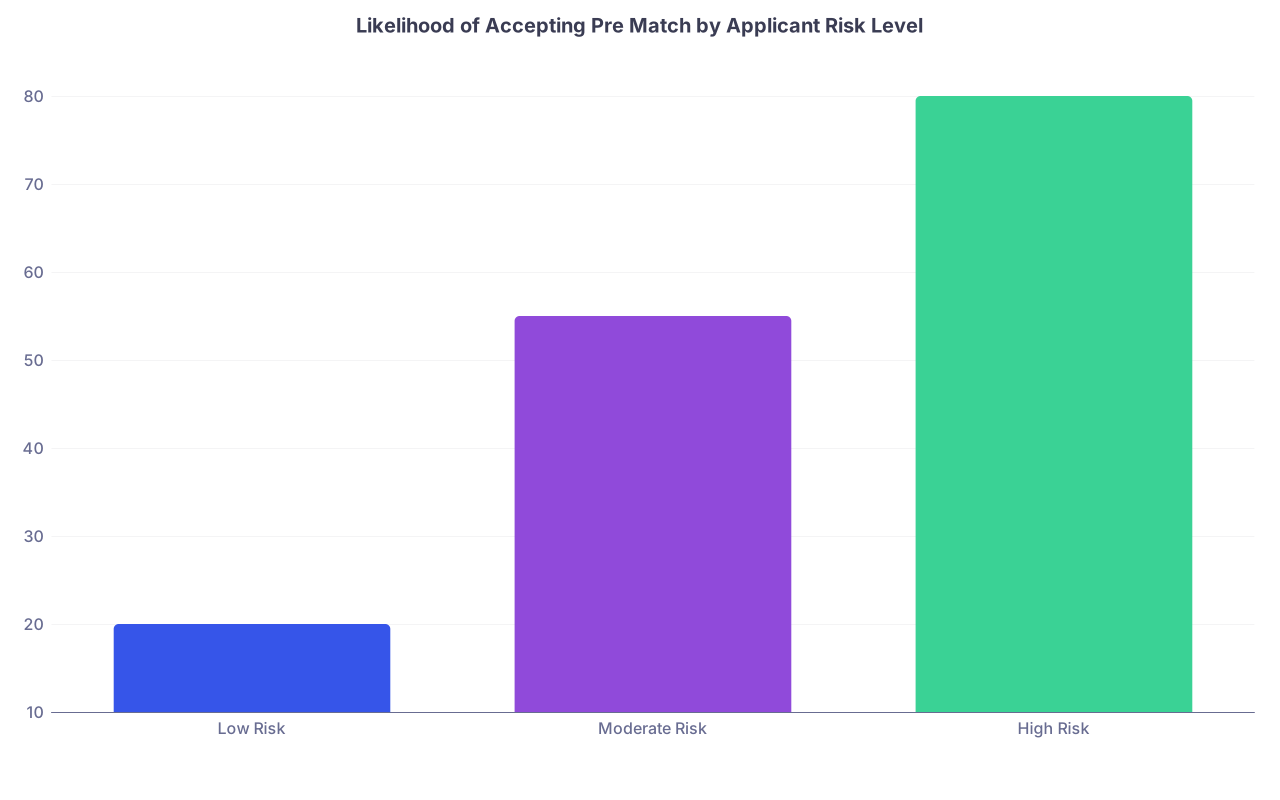
| Category | Value |
|---|---|
| Low Risk | 20 |
| Moderate Risk | 55 |
| High Risk | 80 |
Quick Reality Check by Applicant Type
Different groups should see pre-match very differently.
| Applicant Type | Pre-Match Stance |
|---|---|
| US MD, many interviews | Be selective, cautious |
| US DO, moderate interviews | Strongly consider |
| IMG, few interviews | Often accept if decent |
| Visa-dependent IMG | Pre-match is valuable |
| Red flag (failures/gaps) | May be best lifeline |
These aren’t rules. They’re patterns I’ve watched for years.
If you’re a U.S. MD with 18 interviews at solid programs? You don’t jump at the first mid-tier community place that pre-matches you unless it’s your dream location.
If you’re an IMG with 4 interviews in total and one of them offers a legitimate pre-match at a stable, accredited program? Walking away from that because you “might do better” is how people end up unmatched and scrambling.
FAQ: Pre-Match Offers, Decoded
1. If I accept a pre-match, can I still go through the Match “just to see what happens”?
No. If it’s a true, binding pre-match outside the NRMP, you are effectively out of the Match for that specialty (and usually overall). Trying to game both sides is how you end up in violation of NRMP rules and potentially reported. Do not play that game. If you’re unclear whether it’s binding, ask the PD directly and, if needed, check with your dean’s office.
2. Does accepting a pre-match hurt my fellowship chances later because the program is “lower tier”?
Not automatically. Fellowship directors care far more about your performance, letters, research, and reputation than about whether your residency was a pre-match or Match placement. I’ve seen people from modest, pre-match-heavy community programs land GI, cards, heme/onc, and competitive fellowships because they crushed it. What will hurt you is ending up somewhere toxic where you burn out, produce nothing, and get lukewarm letters.
3. Are pre-match offers always a sign the program is “bad” or desperate?
No. That’s Match urban legend. Some excellent programs pre-match selectively for specific candidates they do not want to lose — especially in regions with active pre-match cultures or with unique local pipelines (home-grown IMGs, long-term rotators, etc.). Desperation shows up in how they offer: pressure tactics, lack of transparency, shady contracts. A program that’s open, answers your questions, gives you reasonable time, and has solid resident outcomes may be using pre-match as a strategy, not a lifeline.
Key takeaways:
First, a pre-match is not a love letter; it’s a risk-management move by the program. Treat it as a business decision on both sides.
Second, your preparation before the phone call — honest risk assessment, clear priorities, defined floor — will determine whether you make a smart choice or a panicked one.
Third, how you communicate your yes or no matters almost as much as the decision itself. Be direct, respectful, and informed, and you’ll walk away with your integrity — and your future — intact.