
You can destroy your residency prospects in one conversation after a pre‑match offer. And people do it every year.
Not with the program.
With your friends.
More precisely: with anyone you talk to like a friend instead of like a potential leak. Group chats. Classmates. Co‑rotators. Even that “trusted” mentor who is a little too plugged in socially.
You think I am exaggerating. I am not. I have watched careers get reshaped—sometimes ruined—because someone could not keep their mouth shut for 48 hours.
This is the ugly side of pre‑match offers that nobody explains properly:
You are not just negotiating with programs. You are managing information warfare in a small, gossipy ecosystem.
Let me walk you through the one conversation you must avoid—and all the adjacent traps that come with it.
The Conversation That Gets People Burned
The most dangerous conversation is deceptively simple:
“So… I just got a pre‑match offer from ___.”
You say this:
- In your class GroupMe / WhatsApp
- To a co‑applicant who interviewed at the same place
- At the end of a rotation to a resident who “gets it”
- To a faculty member who loves “sharing good news”
You think you are:
- Celebrating
- Being transparent
- Getting advice
- Helping others calibrate expectations
What you are actually doing:
- Signaling your rank intentions to the entire applicant ecosystem
- Giving programs ammunition in a competitive specialty
- Increasing the odds another program labels you as “committed elsewhere”
- Risking your current offer if the rumor cycle makes you look disloyal or flaky
Why this one sentence is so destructive
Because in residency, news travels stupidly fast.
I have seen:
- A student tell one co‑rotator about a pre‑match offer
→ By evening, residents at two other programs knew. - Someone post “Big news!” in a small group chat, “just between us”
→ A screenshot landed in a PD’s phone an hour later. - A well‑meaning faculty member email, “Congrats on your offer from X!” to another PD
→ That PD quietly stopped considering that student.
This is the part people underestimate:
Programs are not just evaluating your scores. They are reading signals of commitment, loyalty, and risk.
And your loose conversation after a pre‑match offer sends the loudest signal of all.
The Real Rules of Pre‑Match Offers (That Nobody Tells You Early Enough)
Let us straighten out a few realities before you walk into the minefield.
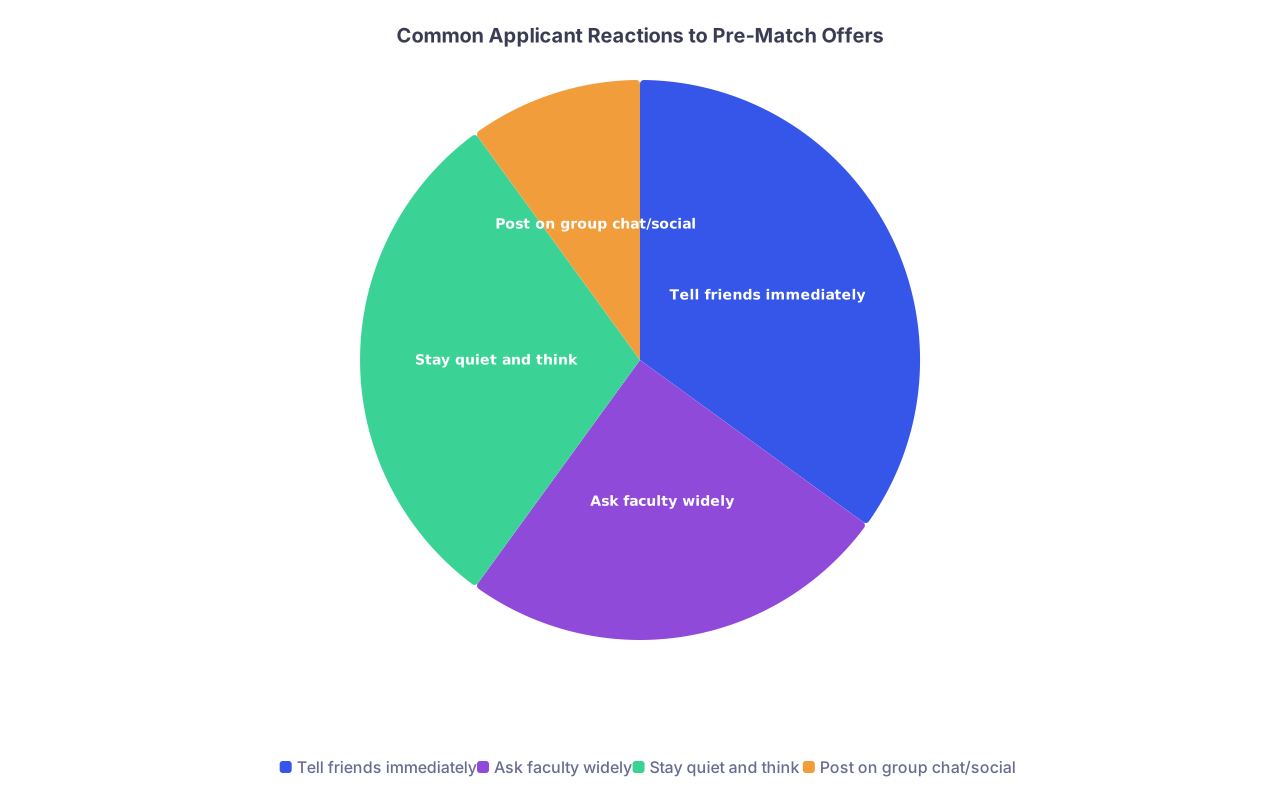
| Category | Value |
|---|---|
| Tell friends immediately | 35 |
| Ask faculty widely | 25 |
| Stay quiet and think | 30 |
| Post on group chat/social | 10 |
1. Pre‑match offers are not just “good news.” They are leverage.
You think:
“I am so happy they liked me.”
Programs think:
“We are trying to lock you down before you talk to everyone else.”
A pre‑match offer changes:
- How they see you
- How other programs see you
- How you should speak, email, and “signal”
The biggest mistake: treating a pre‑match like a random acceptance email instead of a high‑stakes contract negotiation with social surveillance attached.
2. Programs assume you leak. They act accordingly.
PDs are not naive. They know:
- Students talk
- Screenshots circulate
- Word gets “around the region” in about 24 hours
So they:
- Watch your demeanor on later interviews
- Compare notes with other PDs at conferences or on text
- Look for inconsistencies between what you told them and what they are hearing from peers and faculty
If Program A hears you took a pre‑match at Program B but you:
- Still interview at A
- Still say “You are my top choice”
- Still ask for second looks
Guess how you look?
Untrustworthy. At best, confused.
The One Conversation You Must Avoid: Case Studies of How It Blows Up
Let us talk through actual scenarios I have seen versions of.
Case 1: The Group Chat Nuclear Leak
- You get a pre‑match offer in Internal Medicine on Tuesday.
- You are excited. You drop a message in your class chat:
“Omg you guys… just got a pre‑match from Metro IM!!” - Someone in that chat:
- Is also interviewing at Metro
- Has a partner at another IM program
- Screenshots it and sends: “Look who already locked Metro”
Within 24 hours:
- Metro hears from a resident: “So that student is telling everyone they’re coming?”
- A nearby competing program hears: “I think they already signed with Metro.”
Now:
- Metro assumes you are committed and expects you to act like it.
- Other programs quietly downgrade you as “probably gone.”
Result:
You lose leverage everywhere. And you did it to yourself in one excited text.
Case 2: The “Trusted” Classmate
Conversation in a hallway after an interview day:
You: “Keep it quiet, but I just got a pre‑match from St. Luke’s.”
Them: “Wow, that is amazing! I will not tell anyone.”
(Later that day, to another friend)
Them: “Did you hear? St. Luke’s already started sending pre‑matches. They offered one to ___.”
They never meant harm. But here is what happens:
- Another applicant going to St. Luke’s next week walks in thinking,
“Well, they already pre‑matched ___, so maybe I am lower on their list.” - The vibe among students shifts. Anxiety goes up. Rumors spread like mold.
Worst‑case, it reaches:
- A resident at St. Luke’s
- Who says something like, “Oh yeah, I heard you already locked someone from your school.”
You have now changed the entire social landscape of that program’s recruitment—without meaning to.
Case 3: The Helpful Faculty Member
You email a local attending you trust:
“I just got a pre‑match offer from City General. I’m excited but not sure what to do. Could we talk?”
They are proud. The next day, they are in a meeting with a PD from another program who says:
“We are still finalizing our rank list. Any strong students you recommend from your school?”
Your attending, well‑meaning, says:
“Well, ___ already got a pre‑match at City General. They’re very strong. But if they don’t go there, you’d be lucky to have them.”
The PD hears one thing:
You. Already. Have. An. Offer.
You become “too risky” to spend energy on. Especially in competitive specialties.
What You Should Do Immediately After a Pre‑Match Offer
Here is the safer play. It is not glamorous, but it protects you.
Step 1: Shut up first. Completely.
For the first 24–48 hours:
- Do not:
- Post anywhere (even “private” groups)
- Tell classmates
- Hint on social media
- Do:
- Read the email / details carefully
- Check deadlines and expectations
- Look up your school’s match / pre‑match policies
- Book a quiet block of time to think without input
Silence is not being sneaky. It is being strategic.

| Step | Description |
|---|---|
| Step 1 | Receive pre match email |
| Step 2 | Do not tell peers |
| Step 3 | Review offer details |
| Step 4 | Check school policies |
| Step 5 | Schedule talk with neutral advisor |
| Step 6 | Confirm professionally with program |
| Step 7 | Respond politely and on time |
| Step 8 | Accept or decline? |
Step 2: Choose one or two truly neutral advisors
Neutral means:
- They are not:
- Residency leadership at your home program in the same specialty
- Best friends with a PD you are considering
- Gossipy or over‑involved in student drama
Better options:
- A career advising dean who is known to be discreet
- A mentor in a different specialty
- A senior resident you absolutely trust and who is not at the offering program
When you contact them:
- Subject line that does not scream sensitive info in case it gets forwarded:
“Quick question about residency decision making” - Keep the email bare‑bones. Save details for a call or in‑person discussion.
Step 3: Keep your story consistent across programs
If you:
- Accept the pre‑match → you are done. Stop signaling to other programs that you are open. Cancel remaining interviews unless there is a clear, policy‑safe reason not to.
- Are undecided → do not send any “You are my #1” type messages to other programs. You are not sure. So do not lie.
- Decline → keep that decision private. You do not need to broadcast that you turned someone down. It can only hurt you.
The Other High‑Risk Conversations You Should Avoid
The “I got a pre‑match!” reveal is the worst. But there are cousins you also need to shut down.

1. “Do you think I should accept?” in mixed company
If the people in the room are:
- Also applying in your specialty
- Rotating at the same programs
- Dating or close friends with others in your class
Do not workshop your decision there.
Why?
- Your ambivalence will travel
- Your comments about program quality will travel
- Your timeline will travel (“They gave me until Friday to respond”)
All of that can end up right back at the program.
2. Complaining about the offer
Lines that will come back to bite you:
- “I mean, it is my safety choice, but at least it is something.”
- “The call schedule is brutal, but it is better than not matching.”
- “I’ll take it for now and see what else I get.”
Imagine:
- A resident hears this second‑hand
- Mentions it while chatting with the PD:
“I heard ___ is treating us as their backup.”
If that PD feels you are not genuinely interested, they can:
- Pull informal support
- Stop advocating for any exceptions on your behalf
- In rare cases, reconsider the offer if it is not finalized
3. Fishing for intel from co‑applicants
Dangerous behaviors:
- Asking others if they got pre‑matches from the same program
- Trying to reconstruct the program’s rank strategy from gossip
- Comparing “who they like more” based on rumor
This does absolutely nothing to help your decision. It only:
- Pulls more people into secrecy breaches
- Raises others’ anxiety and resentment toward you
- Rotates your name into stories at other institutions
If someone tries to pull you into this, your safest line is:
“I’m trying really hard not to trade details this season. It gets messy fast.”
How Programs Actually Interpret Your Behavior
You need to think like a PD for a minute.
| Your Behavior | Typical Program Interpretation |
|---|---|
| Quiet, professional, minimal leaks | Mature, trustworthy, low drama |
| Group chat bragging / screenshots circulating | Attention-seeking, potential drama |
| Conflicting “I love you most” messages | Dishonest, lacks insight |
| Faculty calling multiple PDs about your offer | High-risk, hard to predict |
| Calm, timely decision and response | Reliable, safe investment |
Programs are risk‑averse. Not just about your board scores. About you as a human in a tight working environment.
They worry about:
- Drama
- Dishonesty
- Boundary issues
- Gossip that fractures resident cohesion
If your name keeps coming up in weird ways through the grapevine, that is a red flag. You want to be the name that never appears in the gossip channels.
What To Say When People Push You
You will get questions. You need ready scripts.
When classmates ask directly
“So, did you hear back from that place yet?”
Safe responses:
- “Things are still in progress. I’ll share more once things are settled.”
- “I’m keeping details pretty tight until after rank lists are done.”
Notice:
- You do not lie.
- You also do not answer the question.
When a resident probes
“So, any offers yet? Be honest.”
Your answer:
- “I’m still working through my options and trying to make thoughtful decisions. I really appreciated my time here.”
Residents love to “know everything.” They are also some of the fastest conduits back to PDs. Do not test that system.
When a faculty mentor pushes for details
“Tell me exactly what City General offered you. When do you have to respond?”
You can say:
- “I would be happy to talk generally about my thought process, but I’m trying not to spread specific details widely, out of respect for the programs.”
If they are offended by that boundary, they were never fully on your side.
How to Actually Evaluate a Pre‑Match Offer (Without Ruining Your Reputation)
You should still think deeply about the decision. You just do it with minimal witnesses.
Use a structured approach:
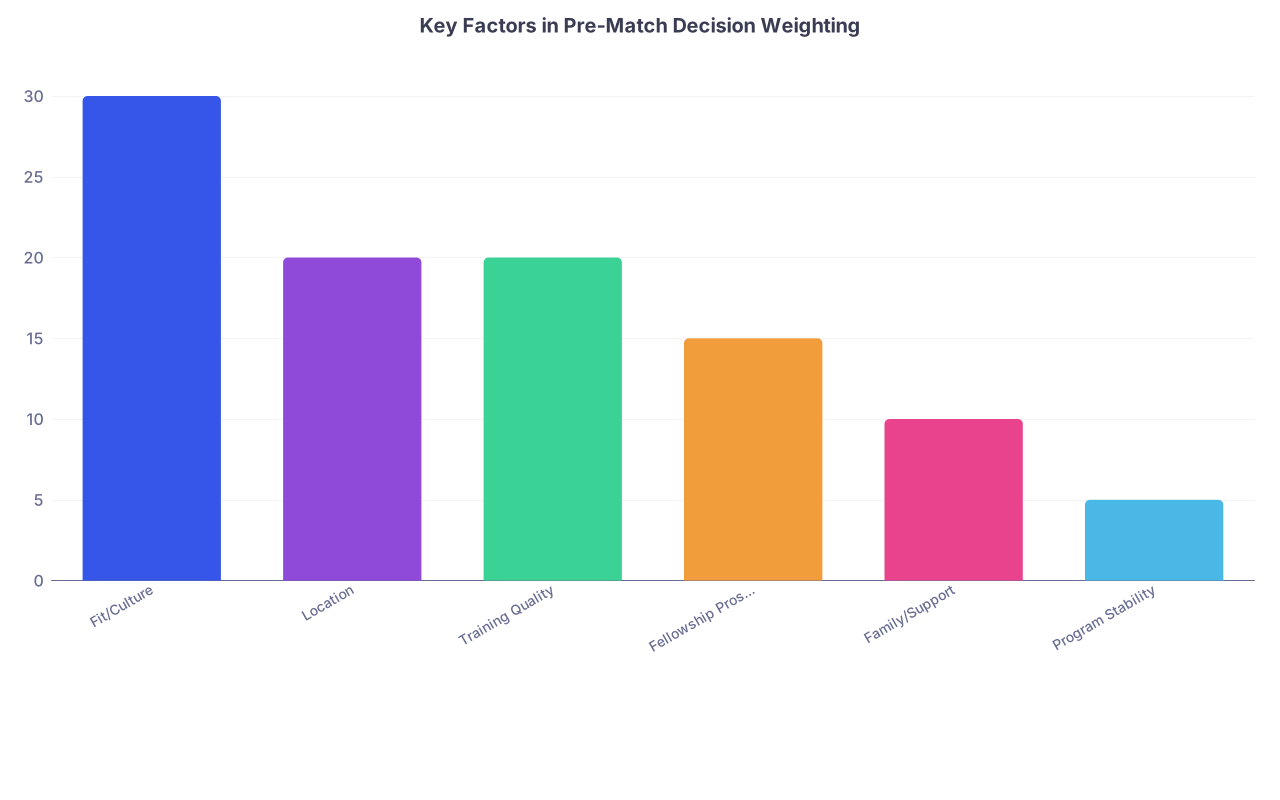
| Category | Value |
|---|---|
| Fit/Culture | 30 |
| Location | 20 |
| Training Quality | 20 |
| Fellowship Prospects | 15 |
| Family/Support | 10 |
| Program Stability | 5 |
Questions to ask yourself in private, or with one trusted advisor:
Fit and culture
- Were residents actually happy, or just performing?
- Did you feel you could be yourself there, or were you “acting” all day?
Training quality
- Will this program make you a competent, confident physician in your field?
- Are graduates matching into the fellowships or jobs you want?
Location and life
- Can you live there without hating yourself for 3–7 years?
- Cost of living, safety, support system, partner situation.
Program stability
- Any recent leadership turnover?
- ACGME warnings or accreditation issues?
- Chronic scut work complaints?
Alternatives realistically available
- Not fantasy programs. Realistic outcomes based on your application strength and the cycle so far.
Do this analysis before you let anyone’s opinions pollute your thinking. Other people project their anxieties and biases onto your situation. You do not need that.
Quick Red Flags That You Are About to Make a Dumb Move
Watch for these warning signs:
You feel an overwhelming urge to “share the news”
→ That is impulse, not strategy.You start justifying telling someone with:
“But they would never tell anyone”
→ History says otherwise.You are crafting texts or posts with phrases like “so blessed,” “big news,” “off the market”
→ You are thinking like social media, not like an applicant in a tiny professional world.You are about to say “just between us”
→ Stop. There is no such thing during residency season.
FAQ (Exactly 4 Questions)
1. Is it ever safe to tell anyone about my pre‑match offer before I decide?
Yes, but keep the circle brutally small. One or two genuinely neutral, proven‑discreet advisors. No classmates. No group chats. No residents at the offering program unless you are specifically clarifying details. And even with advisors, share details verbally, not in written form that can be forwarded.
2. If I accept a pre‑match, should I cancel all my remaining interviews?
In most cases, yes. Once you commit, you are effectively done. Continuing to interview wastes everyone’s time and can create serious ethical concerns. There are rare exceptions (complex couples match situations, shifting institutional policies), but these should only be navigated with explicit guidance from your dean’s office or an experienced advisor who understands NRMP and specialty‑specific rules.
3. What if a program asks directly whether I have any other offers? Do I have to tell them?
You do not volunteer sensitive details, but you also do not lie. If cornered, you can say: “I am still in the process of evaluating my options and making a careful decision. I am very interested in your program and focused on understanding whether this is the right fit.” Most programs know better than to explicitly demand disclosure because it can cross ethical or policy lines.
4. How do I handle it if word about my pre‑match offer has already leaked?
Do not chase every rumor. Control what you say from that point forward. If a program asks, keep it simple and professional: “I understand there may be some information circulating. I am taking this decision seriously and have not been broadcasting details; I am trying to be respectful to all programs involved.” Then tighten your circle even further. You cannot un‑leak information, but you can stop adding fuel.
Remember:
- The most dangerous move after a pre‑match offer is opening your mouth in the wrong room.
- Every word you say about that offer can be screenshotted, forwarded, or repeated. Assume it will be.
- Protect your future: stay quiet, think clearly, ask advice from almost nobody, and let your professionalism—not your group chat—shape your outcome.