Your social media can quietly kill your pre-match leverage before you ever see an offer.
Not exaggerating. I’ve watched residents walk into pre-match “negotiations” thinking they had options… while their Instagram already announced where they were going. Programs saw it. Negotiation over.
You’re in the most sensitive phase of the residency match and pre-match offers. Programs are watching more closely than you think. PDs, chiefs, coordinators, even residents you met on interview day. And they absolutely screenshot.
Let me walk you through the specific social media mistakes that can sabotage your pre-match negotiations—and how to avoid getting burned.
1. Announcing Too Much, Too Soon
This is the biggest, dumbest, most common mistake: you publicly reveal information that destroys your bargaining power.
Examples I’ve actually seen:
- A student posts: “So grateful to have my top program locked in!!” in early January.
- Another likes and comments on every post from one particular program: “Can’t wait to join the team!”
- Someone updates their LinkedIn to “Incoming Internal Medicine Resident – [Program Name]” before signing anything.
What programs see: “This person is already committed. We do not have to negotiate. At all.”
How this kills your leverage
During pre-match and the post-interview window, your only real leverage is uncertainty:
- They don’t know exactly what other offers you might get.
- They don’t know whether you’re ranking them #1.
- They’re trying to gauge how much they need to “sell” their program.
You destroy that uncertainty when you:
- Publicly declare a program as your absolute top choice.
- Signal that you’re not considering other cities/specialties.
- Announce or hint at an offer on social media.
Once that’s gone, any talk of schedule preferences, start dates, research time, or even prelim vs categorical becomes one-sided. They know you’ll say yes to almost anything.
What to do instead
You need a hard rule for this phase:
- No posts about “locking things in.”
- No “so excited to join X city/program” before contracts are real.
- No LinkedIn updates until everything is signed and uploaded.
Private joy is fine. Group chats, family texts, a quiet dinner celebration—great. Just don’t broadcast commitment while you still need leverage.
2. Emotional Venting That Makes You Look Risky

You’re exhausted. You’re anxious. Maybe you feel disrespected by a program or ignored after an interview. You open X (Twitter), Instagram, or Reddit and type:
- “Some programs really don’t value applicants as people.”
- “Just got ghosted by a supposedly ‘supportive’ IM program in [City].”
- “If you’re a PD who can’t be bothered to send rejections, you’re the problem.”
You don’t name names. You think it’s safe.
It’s not.
Medical Twitter and Instagram are tiny worlds. People connect dots quickly:
- Timing + specialty + city = likely program.
- Subtle hints like “big academic center” or “community program with a 30-bed ICU” narrow it further.
- Residents gossip. Screenshots travel.
Why this scares programs away
Program directors don’t care that you’re probably right. They care about risk:
- “If they’re this reactive as an applicant, what happens when they’re stressed as a PGY-1?”
- “Will they blast us online if they’re unhappy with a schedule or evaluation?”
- “Do I want this person representing our program on public platforms?”
Your vent might feel justified. It still labels you as a potential headache. Pre-match negotiations are largely about perceived fit and reliability. You just tanked both.
Safer outlets for your frustration
Do not:
- Post vague subtweets about “a certain program.”
- Rant in public Facebook groups or specialty forums with your real name.
- Comment under other applicants’ posts trashing a program.
Do:
- Use private, trusted group chats with close friends.
- Talk to a mentor, advisor, or resident you trust.
- Write it in a notes app and delete it after you calm down.
If your fingers are itching to post something spicy during this period, don’t. That’s the rule.
3. “Thirsty” Engagement With Programs
Here’s a subtle one that applicants underestimate: your pattern of likes, comments, and tags.
The worst offenders:
- Liking every single post from one program. For months.
- Commenting, “Dream program!” “Praying for an offer!” or “Manifesting PGY-1 here!!”
- Tagging the program in your own posts about interviews, rank lists, or “#1 choice.”
This might feel like enthusiasm. On the other side, it reads as desperation.
How this hurts your negotiation position
Desperation does three things:
- It tells them you’re unlikely to walk away, even if they offer less favorable terms.
- It makes them question your judgment and professionalism.
- It can make you look less stable—especially if you do the same thing with multiple programs.
Programs like confidence, not clinging.
You want to come across as:
- Interested, but not obsessive.
- Grateful, but not begging.
- Excited, but still evaluating.
If the PD or APD can recognize your handle instantly because you’re under every post, that’s not a good sign.
A reasonable level of engagement
Healthy patterns:
- Follow the program account(s).
- Like occasional posts, especially ones you genuinely care about (education, resident wellness, research).
- Maybe 1–3 thoughtful comments total across the whole season, if that.
When in doubt, engage less, not more. Over-engagement hardly ever helps you. It often hurts.
4. Oversharing Your Rank List and Strategy

| Step | Description |
|---|---|
| Step 1 | Applicant posts about rank list |
| Step 2 | Friends comment and share |
| Step 3 | Residents see post |
| Step 4 | PD hears about it |
| Step 5 | Leverage and trust reduced |
I’ve watched this exact sequence play out:
A student posts to Instagram close friends (which includes a few med school acquaintances they barely know):
“Final rank list!!!
- Big Name University
- City Program
- Backup Community
- Super Backup lol”
One of those “acquaintances” is friends with a resident at their #2 program. Screenshot. Forwarded. Now a PD knows they’re clearly second choice.
Does that kill your chances? Not necessarily. But it absolutely affects how much work they’ll do to sway you—or how aggressive they’ll be about a pre-match offer.
Where this backfires badly
Oversharing your strategy can cripple you when:
- You tell multiple programs they’re your #1, then post a “real” rank list elsewhere.
- You publicly talk about “safety programs” or “places I’d only go if I had to.”
- You hype up geography heavily (“Only ranking East Coast!”) then interview at a West Coast program that’s now sure they’re just filler.
In the pre-match context, this is lethal. Programs are deciding:
- Should we use a precious pre-match spot on you?
- Are you actually likely to sign if we offer?
- How much do we have to bend (schedule, electives, tracks) to win you?
If your social media answers those questions for them—and not in your favor—you lose negotiation room.
Keep your rank thoughts offline
Firm rule: your rank list does not belong on social media. Not even:
- In “close friends” stories.
- In semi-anonymous specialty groups.
- On Reddit with “throwaway” accounts while you leave in enough detail to identify yourself.
Talk strategy 1-on-1 with people who actually advise you: faculty, deans, mentors, maybe one or two trusted peers. Everyone else gets the generic line:
“I’m building a list that balances training quality, fit, and location. Grateful for my options.”
Boring. Safe. Exactly what you want.
5. Unprofessional Content That Re-Surfaces at the Worst Time

Yes, we’re going to talk about that TikTok and those “funny” night shift reels.
Not because programs are prudish. Because pre-match negotiations are when borderline content shifts from “mildly concerning” to “not worth the risk.”
Red flags that get attention:
- Drunk or blackout party photos with hospital badges visible.
- Posts mocking patients, attendings, or specific hospitals—even if you think it’s anonymized.
- Graphic rants about “toxic medicine culture” where you name or clearly imply specific institutions.
- Videos recorded in patient-care areas where ANY PHI might be seen or heard in the background.
I’ve sat with PDs while they pulled up applicant social media. They scroll. They pause. They frown at one or two posts. The applicant goes from “strong contender” to “maybe not worth a pre-match spot.”
Why timing matters
During interviews, programs are gathering data.
During pre-match discussions, they’re deciding where to spend limited offers.
At that stage, programs crave predictability. If your online presence suggests:
- You might bring drama.
- You don’t fully understand professionalism boundaries.
- You might create PR trouble with one wrong post.
They will hesitate to commit early. They’d rather let you ride the main Match algorithm and see what happens.
Clean-up checklist (do this before pre-match season heats up)
You don’t have to erase your personality. But for this phase, tighten the filters:
- Lock down privacy on anything personal.
- Remove or archive posts where:
- You’re visibly intoxicated in medical attire.
- You complain about work, rotations, or supervisors.
- You reference specific hospitals, patients, or cases in a mocking or casual way.
- Check tagged photos from friends—those often sink people.
The safest assumption: if someone at a program would be uncomfortable seeing it on a projector during grand rounds, it should not be public in pre-match season.
6. Mixed Messages Across Platforms
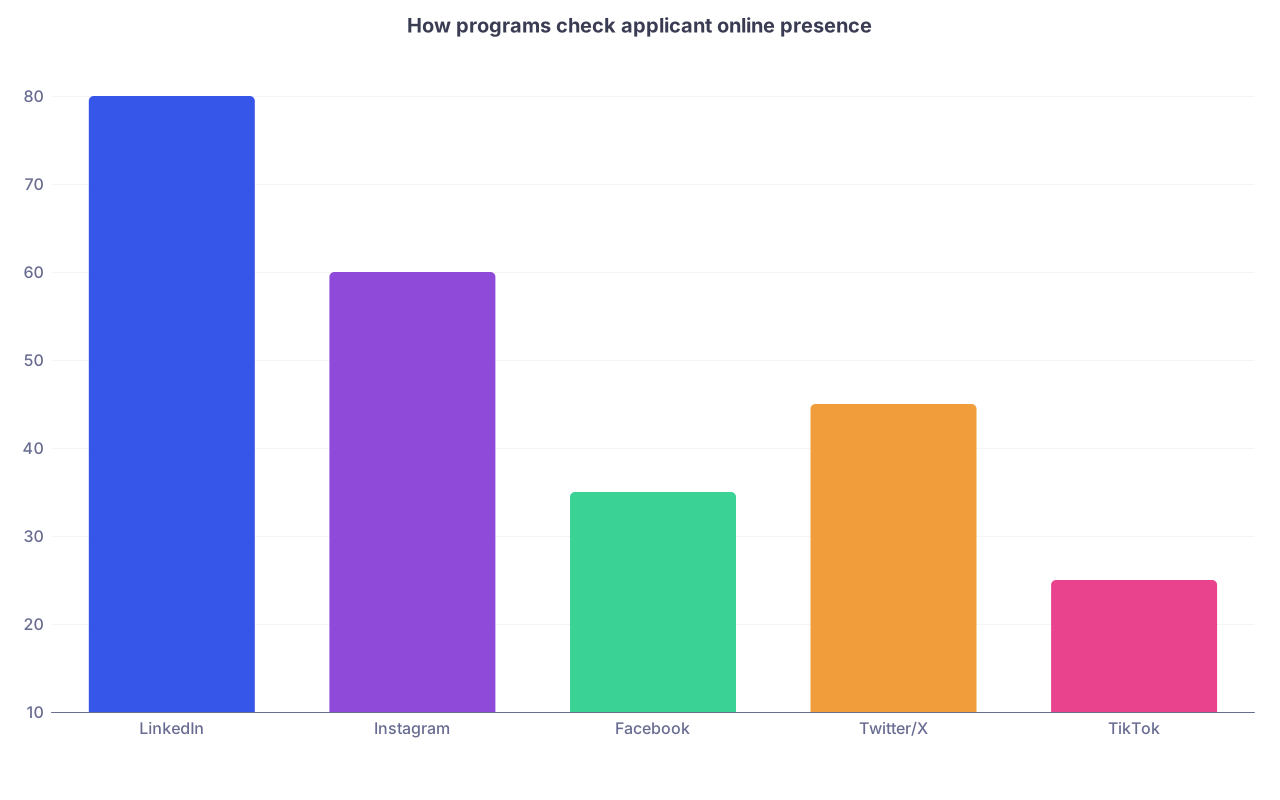
| Category | Value |
|---|---|
| 80 | |
| 60 | |
| 35 | |
| Twitter/X | 45 |
| TikTok | 25 |
Big mistake people overlook: platforms don’t exist in isolation. PDs, residents, and coordinators use multiple channels. Inconsistency makes you look slippery or dishonest.
I’ve seen this combo more than once:
- LinkedIn headline: “Future Internal Medicine Physician | Passionate about Academic Medicine”
- Instagram caption the same week: “Last chance to enjoy freedom before I sell my soul to this system lol”
- Twitter: “Honestly not sure if I even want to practice clinical medicine long term.”
Individually, each could be brushed off. Together, they create a story:
- This person says what they think people want to hear in professional spaces.
- They have a very different, more cynical internal voice.
- They may be unreliable if they commit to us now, then bail or disengage later.
That’s a problem if you’re hoping to negotiate for:
- A pre-match categorical spot.
- A preferred track (research, primary care, global health).
- Flexibility during PGY-1.
Align your public narrative
You don’t need to be robotic. But your overall presence should be coherent:
- You say you’re serious about a field? Don’t publicly make fun of that specialty’s lifestyle or patient population.
- You tell a program you’re committed to their city long-term? Don’t tweet that you “could never live here more than 3 years” with the location tagged.
- You frame yourself as mature and team-oriented? Don’t chronicle every minor annoyance with colleagues online.
Before pre-match season, quickly audit your top 2–3 visible platforms:
- Are you sending the same broad message about your goals and motivation?
- Is anything obviously in tension with what you’ve told programs?
Fix the contradictions now—before someone else points them out with a screenshot.
7. DM Disasters With Residents and Program Accounts
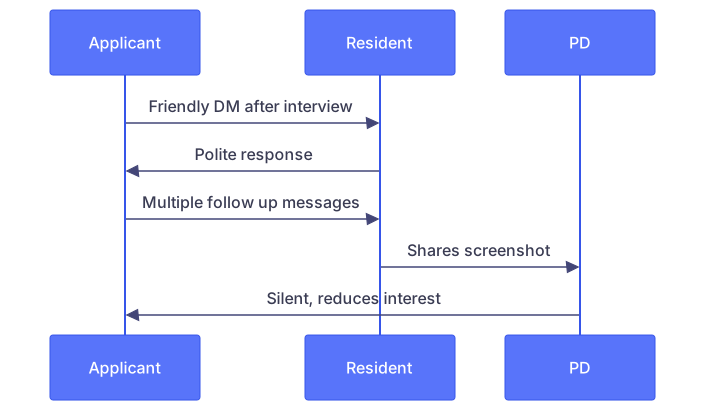
Direct messages are not private in the way you think during this phase. Residents talk. Chiefs talk. A questionable DM can be on a PD’s phone in under a minute.
Common DM mistakes:
- Sending residents long messages lobbying for a pre-match spot.
- Fishing for inside information: “Do you know where I am on your list?” “Are you guys planning to pre-match anyone?”
- Flirting or sending overly personal messages to residents you barely know from interview day.
- Pressuring: “This is my #1, and I just need to know if I can count on you guys before I turn down other opportunities.”
These messages don’t just land badly. They often get preserved as evidence of poor judgment.
Why DMs are landmines in pre-match season
Programs are hypersensitive to:
- Boundary issues.
- Applicants trying to manipulate or pressure residents for information.
- Anything that looks like gamesmanship or back-channel negotiations that violate Match guidelines (for NRMP-participating specialties).
A resident who feels awkward about your messages is not going to fight for your pre-match offer. They’re going to distance themselves.
Safe DM principles
You can send reasonable messages, like:
- A brief, sincere thank you after an interview.
- A specific follow-up question about the program that isn’t answered on the website.
- A polite check-in if a resident explicitly told you to reach out.
But keep them:
- Short
- Professional
- Non-demanding
If a message takes more than 15 seconds to read, it’s probably too long. If it sounds like you’re campaigning, negotiating, or emotionally dumping, do not send it.
8. The Myth of “Private” Accounts and Anonymous Forums
You’re not nearly as anonymous as you think.
Patterns that give you away:
- You mention your exact Step scores, specific school, and niche research topic on a Reddit account, then say, “I got a pre-match offer from a midwest university IM program, debating if I should take it.”
- You post on SDN or Discord using the same username as you use on gaming or personal accounts.
- You drop oddly specific details: small Caribbean school + specific visa status + couple’s match + niche subspecialty interest. People can triangulate that in minutes.
If you’re trashing programs, revealing too much about offers, or discussing negotiations in these spaces, don’t assume it stays there.
Students send threads to each other all the time with, “Is this you?” Imagine that landing instead in a group chat of that program’s residents.
What you absolutely should not disclose online
Anywhere, even “anonymous,” do not casually reveal:
- That a specific program gave you a pre-match offer.
- That you plan to use one program’s offer as leverage at another.
- That you told multiple programs they were your #1.
- That you’re planning to rank a program low but still extracting what you can from them now.
You may think you’re being clever. It reads as untrustworthy. And if a PD sees that, any pre-match conversation is over.
Practical Safeguards Before and During Pre-Match Season
Let’s condense this into a concrete action plan.
1. Do a 60-minute social media scrub
| Area | Action |
|---|---|
| Privacy | Lock personal accounts or limit viewers |
| Old Posts | Archive/delete risky or ranting content |
| Tags | Review and untag bad photos |
| Bios/Headlines | Remove premature titles or commitments |
| Follows | Unfollow obviously problematic accounts |
Set a timer. Be ruthless.
2. Decide your “public script” in advance
Prepare 2–3 stock responses for when people ask online:
- “How’s Match season going?”
- “Where are you thinking of going?”
- “Did you get any offers yet??”
Something like:
- “I’ve had some great interviews and I’m finalizing things. Grateful for options.”
- “Can’t share specifics yet but I’m excited about a few places.”
- “Still in the thick of it—will share when things are official.”
Boring and vague wins here.
3. Institute a posting delay rule
During the sensitive pre-match phase:
- No posts about anything related to offers or rank lists until at least 24–48 hours after you write them.
- Save as draft. Re-read with a cold brain. Most of those drafts should never see the light of day.
That one delay can save you from torpedoing a negotiation with one impulsive story.
FAQs
1. Is it ever okay to say a program is my “top choice” on social media?
Not during pre-match or before the rank list deadline. If you want to tell a program they’re your top choice, do it privately and directly, and only if it’s true. Broadcasting it publicly will only weaken your leverage and invite problems if other programs see it.
2. Can programs really see my private Instagram or close friends stories?
They probably can’t see true private content unless someone in that circle shares it—but that “someone” is exactly the risk. Close friends lists are rarely as “close” as you think. All it takes is one person screenshotting your story and sending it to a resident, and it’s effectively public. Treat anything digital as potentially forwardable.
3. Should I delete my social media entirely during Match season?
You don’t have to. But you should strip it down to either clearly professional content or locked-down personal posts that you’d be comfortable defending. Deactivation is an option if you know you’re impulsive, but for most people, a serious scrub plus strict posting discipline is enough—as long as you stick to it.
Remember:
- Don’t publicly commit or overshare strategy before contracts are signed.
- Don’t vent, beg, or negotiate in public or semi-public online spaces.
- Assume every post can be screenshot and read by a PD deciding whether to pre-match you—or pass.