
What do you say when a program director casually asks, “So, where else are you interviewing?” and you almost tell them everything?
If you are entering pre‑match season with decent stats, solid letters, and a strong shot at offers, your biggest risk is not being underqualified.
Your biggest risk is oversharing.
Not lying. Not being rude. Just… saying too much. Volunteering information that nobody asked for, or answering simple questions with a level of detail that quietly takes you from “top candidate” to “weirdly risky.”
I have watched that happen in real time. More than once. Applicant walks out smiling, convinced they “really connected” because the conversation felt honest and open. PD walks into the workroom and says, “Nice kid, but I am not sure they are coming here. Let’s hold.”
That “hold” is where strong pre‑match offers go to die.
Let me walk you through the ways applicants sabotage themselves by oversharing—and how to stop doing it before it costs you the best offer you will see all season.
The Silent Killer: Overexplaining Your Rank List and Other Programs
This is the classic one. A PD or faculty interviewer asks something vague and you turn it into a TED talk about your entire application strategy.
Common trap questions:
- “What other programs are you looking at?”
- “Are you thinking about any other cities?”
- “How are you deciding where to rank programs?”
- “Do you have a first choice yet?”
None of these are invitations to dump your entire rank list.
The mistake
I have heard applicants say versions of all of these:
- “My dream is [mega‑name program across the country]. If that does not happen, I like you guys a lot.”
- “I am mainly trying to stay in [another state]. I applied here as a backup, but I have been impressed today.”
- “Honestly, your call schedule is rough compared to [competing local program], but the research is better.”
- “I am really hoping to couples match and my partner is waiting on interviews, so I cannot commit yet.”
They think they are being transparent. Mature. Thoughtful.
What the PD hears:
- We are second choice. Or third.
- This person will rank us lower.
- We might waste a pre‑match slot on someone who will disappear in the Match.
- Risk.
Programs do not like risk. Pre‑match offers are all about risk control.
The better way to answer
You do not have to lie. But you must stop offering ammunition against yourself.
For broad questions about other programs:
- Bad: “I am also interviewing at Baylor, UT Southwestern, Vanderbilt, and Emory. Baylor is probably my top choice.”
- Safer: “I have a mix of academic and community programs in [region], but I am really focusing on finding a place with strong teaching and patient diversity. That is what stands out to me here.”
For “How are you deciding where to rank programs?”:
- Bad: “Honestly, location is the biggest thing. I need to be close to my family in Chicago, so any program outside the Midwest will probably be lower on my list.”
- Safer: “I am looking at a combination of teaching, culture, and how well the program supports residents progressing to the next step. Fit with the team is huge for me.”
For “Do you have a first choice?” before offers are on the table:
- Bad: “Yes, but it’s not fair to say yet.” (You think you sound principled. You do not.)
- Safer: “I am still early in my interview season, but this program checks a lot of boxes for me—especially [specific, genuine thing].”
You answer the spirit of the question without handing them a reason to withhold a strong offer.
Personal Life Confessions That Don’t Belong in a Pre‑Match Conversation
Some of you treat pre‑match interviews like therapy. You think if programs “really know you,” they will understand your struggles and respect your honesty.
That is not how this game works.
Residency is a workforce decision. They are hiring someone to show up at 4:45 a.m. post‑call, manage sick patients, learn fast, and not implode.
Oversharing personal instability is the fastest way to downgrade yourself.
Red‑flag disclosures that sink otherwise strong applications
I have seen applicants volunteer details like:
- “I am not sure if I am staying with my partner; long distance might be hard. We’re figuring it out.”
- “I’ve struggled off and on with burnout and depression; this year has been better, but residency will be a test.”
- “I want kids right away, probably during intern year, but I’ll make it work.”
- “My parents are older and sick, so I might need to travel back home often or even move eventually if things get worse.”
- “I am considering switching specialties after PGY‑1 if I can.”
These might be true. They might be human. They are also nuclear for pre‑match leverage.
What PDs hear:
- Unstable location plans.
- Higher chance of leave, attrition, or legal complications.
- Additional schedule burden for co‑residents.
- Extra drama.
Programs do match residents with chronic illness, mental health histories, and complex family lives every year. The absolute key is whether you present as stable and fully functional now.
You do not need to drag them through your internal debates.
What is reasonable to share—and what is not
Safe to mention, if asked directly:
- “My partner is also in medicine and we are both hoping to stay in this region.”
- “I am very close to my family, and being within a short flight is ideal, but it is not the only factor.”
- “I have good support systems in [city/region], which is part of why I am excited about this area.”
Not safe to expand into:
- Relationship uncertainty.
- Detailed fertility plans.
- Advanced play‑by‑play of family health crises.
- Long narratives about burnout, therapy, or prior accommodations.
If your situation requires discussion (for example, you will absolutely need a particular accommodation), keep it brief, solution‑focused, and late in the process—not during the interview that might lead to your only pre‑match offer.
Academic Baggage: When Explaining Too Much Looks Worse Than the Issue
You have a red flag: a failed exam, a leave of absence, bad semester, professionalism investigation. You were coached to “own it” and “be honest.”
That advice gets warped.
Instead of a short, confident explanation, you give a 12‑minute saga of every slight, unfair grading decision, and interpersonal conflict with your dean’s office.
PDs hate this.
How oversharing academic struggles backfires
The disaster pattern usually looks like this:
- PD asks: “I see you had to repeat a clerkship. Can you tell me what happened?”
- Applicant describes:
- Every detail of the rotation.
- How the attending was “difficult.”
- How the evaluation process was “biased” or “unclear.”
- How the school “didn’t support” them.
- Twenty minutes later, PD knows:
- You blame others.
- You get along poorly with authority when stressed.
- You still have unresolved resentment.
The specifics are what hurt you. Not the original event.
You think you are just “being real.” You are, in fact, painting yourself as high‑maintenance.
How to discuss red flags without oversharing
Stick to a simple structure:
- Brief factual description.
- What you learned.
- What you changed.
- Evidence that the problem has not recurred.
Example, Step failure:
- “I failed Step 1 on my first attempt. I underestimated the exam and did not test myself under realistic conditions. I changed my approach significantly—dedicated more time, used question banks earlier, and built a structured schedule. I passed on my second attempt with a score that aligns with my later performance in clerkships and on Step 2.”
Bad version (overshare):
- “I failed Step 1 because of some family stuff, plus our school changed the curriculum, and honestly the NBME questions were nothing like the real thing, and my roommate got COVID during dedicated and I had to help…”
See the difference? The second answer might be emotionally true. It sounds like you bring chaos wherever you go.
Your job is not to prove you suffered. Your job is to prove you are no longer a risk.
Salary, Contracts, and Pre‑Match Offers: Talking Money Without Tanking Yourself
Pre‑match offers are contracts. Programs expect some questions. They do not expect you to negotiate like a corporate lawyer or to treat the offer as a starting point for demands.
Oversharing here usually looks like:
- Disclosing other offers and exact figures.
- Over‑explaining your financial situation.
- Narrating every competing option in detail.
Common financial overshare mistakes
I have heard:
- “Program X offered me a pre‑match already, and their sign‑on bonus is $Y. Can you match that?”
- “I have six‑figure loans and my family cannot help, so I really need moonlighting and extra pay.”
- “I am comparing cost of living and trying to see where I get the most money for the least work, to be honest.”
- “If I do not get a better offer, I guess I will rank you higher.”
That last one? An instant turn‑off.
You can ask informed questions without showing your whole hand.
How to ask about compensation and contracts safely
Good, focused questions:
- “Is this offer consistent with what current residents receive?”
- “Are there any loan repayment or retention incentives down the line?”
- “Can you clarify whether there are any non‑compete clauses or geographic restrictions after training?”
- “What moonlighting opportunities are typically available for upper levels?”
Things you do not need to reveal:
- Exact loan balances.
- Competing offer details.
- Your full ranking strategy (“If I can get Program Y to offer, I will probably go there.”)
- "I am using this offer as leverage with other programs."
You are allowed to say:
- “I am very interested in this offer. I would like a few days to review the contract carefully before I sign.”
You are not obliged to share why you want those days.
Social Media and “Personality”: Sharing Just Enough, Not Your Entire Online History
Programs are increasingly nosy about online presence. Some will search your name before a pre‑match conversation. Some will casually ask about your hobbies, side projects, or online work.
Oversharing becomes a problem when:
- You volunteer controversial or polarizing content.
- You describe online fights, call‑outs, or activism in a way that sounds combative.
- You make your identity “online” seem bigger than your identity “as a trainee.”
Social media topics that can quietly hurt you
Examples I have seen torpedo interest:
- “I run a TikTok account where I criticize US healthcare and specific hospitals. I did a video on a case like one I saw here, actually.”
- “I tweet a lot about how toxic medical training is. Residents should refuse extra call; I post about that often.”
- “I am a big advocate online and have had some arguments with attendings who disagreed.”
- “My Instagram is private anyway; there are some wild party pics from M1 but nothing too crazy.”
That last sentence? Makes them wonder what “wild” means. Congratulations, now someone is screenshotting your profile.
Talking about advocacy, communication, or education work is fine if it is framed as:
- Professional.
- Respectful.
- Sustainable alongside residency.
What they fear:
- Public complaints.
- HIPAA risks.
- Time drain.
- Reputation management problems.
How to showcase personality without overexposing yourself
Safe ways to talk about online presence:
- “I enjoy creating educational content on [topic] aimed at premeds and medical students. I keep it de‑identified and apolitical, and my priority is always professionalism.”
- “I use LinkedIn and Twitter mainly to follow research and share publications.”
- “Outside of medicine, I am into photography and share that on Instagram.”
If you have online activism that is central to you:
- Mention values, not fights.
- “I care about health equity and have been involved in community outreach and some online campaigns, but I am careful to respect my role as a trainee.”
You do not need to list every controversial thread you have ever written.
Casual Small Talk That Isn’t Casual: When You Reveal Too Much Without Realizing
People let their guard down at:
- Dinner with residents.
- Informal meet‑and‑greets.
- Post‑interview socials (especially virtual ones where they think nobody is paying attention).
- Hallway chats with coordinators.
Here is the uncomfortable truth: anything you say to any member of the program can and often does make its way back to the selection committee.
I have heard residents say:
- “Nice applicant, but they said this place is too quiet and they would probably get bored here.”
- “They joked that they want an easy program so they can travel more.”
- “They said they are only ranking us if they do not match in [competitive specialty].”
- “They were complaining about their home institution nonstop.”
Those comments absolutely influence pre‑match decisions.
Things you think are harmless… that are not
- “I am just trying to end up somewhere chill. I am tired of grinding.”
- “Honestly, if I do not get GI eventually, I will just go into hospitalist work and enjoy life.”
- “I applied to [this specialty] too just in case.”
- “I mostly want to live in a cool city for three years.”
Residents are not naive. They remember what it felt like to be stressed and tired in residency. They do not want a classmate whose primary goal is “chill.”
You are allowed fun, travel, hobbies, even ambitious side plans. But do not frame them as competing priorities with residency.
Keep small talk light but consistent with your professional persona:
- “I love to travel, but I know intern year will be intense. I am hoping to squeeze in a trip here and there on golden weekends.”
- “I am interested in multiple paths, but right now my focus is becoming a strong intern.”
When Programs Push for Information: How to Hold the Line Without Being Awkward
Sometimes the problem is not you volunteering. It is the program fishing.
They might ask:
- “If we pre‑match you, will you accept?”
- “Tell me honestly—are we your number one?”
- “How many other offers are you expecting?”
- “Where would we rank on your list, roughly?”
You panic and overshare. Or you say something vague and then over‑explain yourself into a hole.
How to answer “If we pre‑match you, will you accept?”
What not to do:
- Promise on the spot if you are not sure.
- Dump your entire matrix of pros and cons.
- Bring up all the other programs you are waiting on.
Better structure:
- “I am very interested in this program. If you extend a pre‑match offer, I would take it extremely seriously. I would like a short window to review and discuss with my family, but I am not collecting offers just to shop around.”
If you already know you would accept:
- “Yes, if you offer me a pre‑match, I would be very happy to accept.”
Say it and stop. Do not add “…unless…” or “…as long as…” unless there is a true deal‑breaker.
How to answer “Are we your number one?”
This one is loaded. If they explicitly want a commitment and you are not ready, avoid both lying and over‑talking.
Option when you cannot commit:
- “I am very impressed by this program and it is absolutely among my top choices. I am still finishing a few more interviews, and I want to honor those commitments. But I can say that I would be genuinely happy training here.”
Then stop. Do not list the other programs.
If they push harder:
- “I respect that you need to fill your spots with people who genuinely want to be here. I can promise that if I end up here, it would be by active choice, not by default.”
Give them reassurance without giving them your entire decision tree.
Quick Reference: Oversharing That Kills Pre‑Match Momentum
| Topic Area | Dangerous Overshare Example |
|---|---|
| Other Programs | Naming first choice elsewhere, detailing rank list |
| Personal Life | Relationship instability, pregnancy timing, crises |
| Academics | Long justifications, blaming faculty or school |
| Finances | Exact debt, competing offer amounts, money priorities |
| Social Media | Controversial content, online fights, call‑outs |
| Small Talk | Wanting an "easy" program, backup specialty comments |
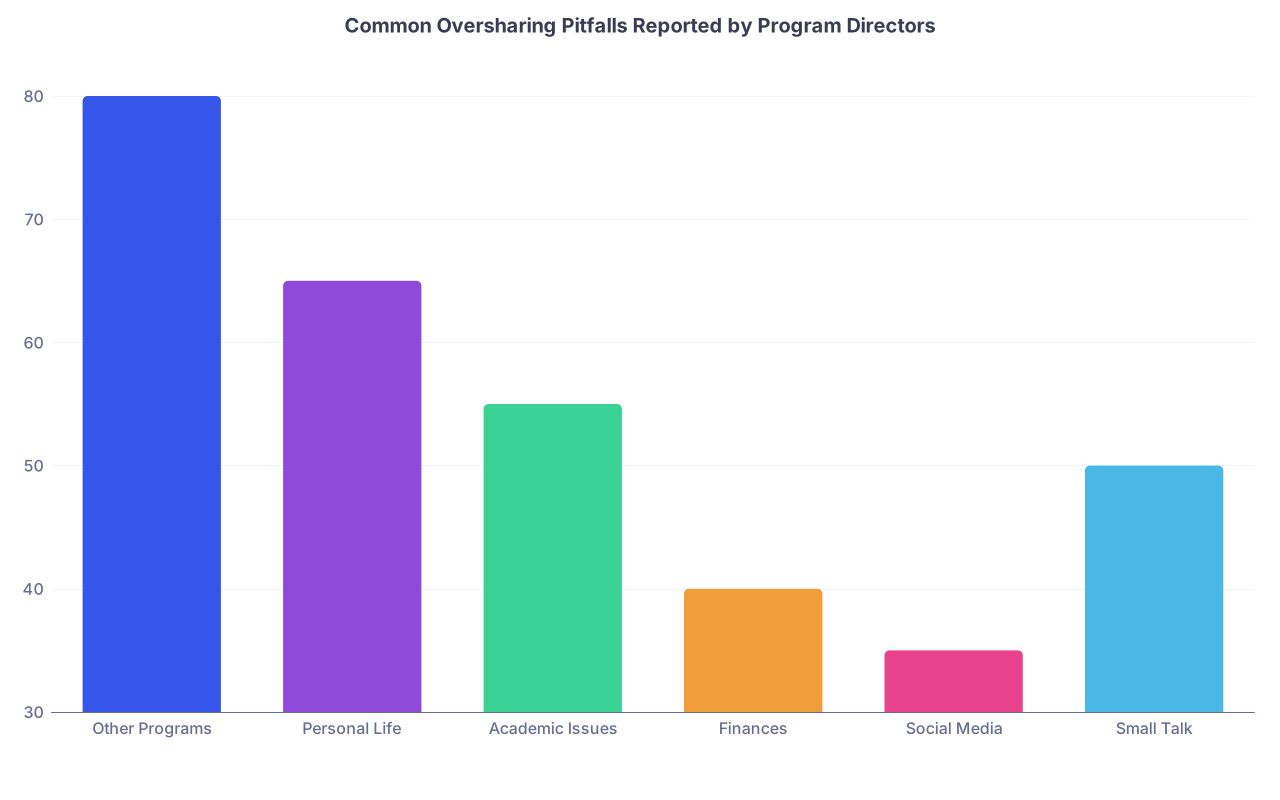
| Category | Value |
|---|---|
| Other Programs | 80 |
| Personal Life | 65 |
| Academic Issues | 55 |
| Finances | 40 |
| Social Media | 35 |
| Small Talk | 50 |

| Step | Description |
|---|---|
| Step 1 | Risky Question Asked |
| Step 2 | Give broad, value based answer |
| Step 3 | Answer directly but briefly |
| Step 4 | Stop talking |
| Step 5 | Does answer hurt leverage? |
How To Train Yourself Not To Overshare
You think you will just “be careful” on interview day. You will not. Under stress, you default to habit.
You need reps.
Three practical steps
Script your answer boundaries.
For each high‑risk topic, have a one‑to‑two sentence answer written out:- Other programs.
- Future plans.
- Academic red flags.
- Personal constraints (family, health, geography).
Then memorize them. You do not have to recite them word‑for‑word, but they give you guardrails.
Practice shutting up.
Do mock interviews with someone you trust. After each answer, force yourself to pause instead of filling the silence. Oversharers panic when there is quiet and keep talking until they say something damaging.Get comfortable with:
- Answer.
- Stop.
- Let them ask the next question.
Pre‑commit to “no live processing.”
Interviews and pre‑match calls are not the time to process out loud:- Your uncertainty about specialties.
- Your feelings about your home institution.
- Your emotional journey through medical school.
If you catch yourself starting a sentence with “Honestly…” or “To be completely transparent…”, that is your signal to tighten the answer, not expand it.
Final Thoughts: Protect Your Position
You worked too hard to lose a strong pre‑match offer because you could not stop yourself from over‑sharing in a friendly moment.
Remember these core points:
- Answer the question’s spirit, not with your entire life story or strategy.
- Avoid turning personal struggles or past issues into long narratives that make you look unstable or high‑maintenance.
- When in doubt, be brief, professional, and forward‑looking—then stop talking.