
It is mid-January. Your friends are quietly celebrating pre-match emails and contracts. Your phone has stayed stubbornly silent. No pre-match offer. You are staring at the NRMP login screen, cursor blinking over an empty rank list.
Here is the reality: you did not get a pre-match. That stings. But the real problem right now is not the past. The problem is that you are about to lock in a rank list that will determine where you live and train for the next 3–7 years, and your original strategy assumed you might already be holding an offer.
So the strategy has to change.
I am going to walk you through exactly how to recalibrate:
- What “no pre-match” actually means for your chances
- How to reassess your application with cold, objective eyes
- How to rebuild your rank list using a risk-balanced approach
- How to avoid the three mistakes that cause preventable unmatched outcomes
- What to do right now (this week) to improve your position
No fluff. Just a step-by-step fix.
1. What “No Pre-Match” Really Means (And What It Doesn't)
First point: not getting a pre-match offer is not the same as “you are not matchable.”
Programs that offer pre-match (especially in Texas and certain community systems elsewhere) behave differently than pure NRMP programs. Many of them:
- Fill only a portion of spots with pre-match
- Are extremely conservative with offers to avoid overfilling
- Prioritize internal rotators, home students, and known quantities
- Delay decisions because GME or hospital administration is slow
So, before you panic, understand what signal this actually sends.
What “no pre-match” often does mean
- You are unlikely to be in the program’s very top tier of applicants
- You may not have a strong internal advocate there (no one pounding the table for you)
- Your interview performance could have been mid-tier or inconsistent
- Your application is probably competitive but not dominant in that program’s pool
It is a yellow flag, not a skull-and-crossbones.
What it usually does not mean
- It does not mean you will not match anywhere
- It does not automatically mean your scores or CV are too weak
- It does not mean every program ranked you low
- It does not mean you should suddenly rank only safety programs out of fear
You need a precise recalibration, not a panic pivot.
2. Quick Self-Audit: Where Are You Actually Competitive?
You cannot build a smart rank list if you are lying to yourself about your competitiveness. Up or down. Both delusion and self-sabotage are dangerous.
Do a 30–45 minute self-audit. No more. This is not a three-day existential crisis exercise.
Step 1: Categorize your stats realistically
Pull out your ERAS, your Step scores, and your CV. Now classify:
| Factor | Strong | Borderline | Weak/At-Risk |
|---|---|---|---|
| Step/COMLEX scores | ≥ national mean | Slightly below | Well below |
| U.S. grad vs IMG/DO | US MD | DO | Non-US IMG |
| Clinical grades | Mostly Honors | Mostly High Pass | Many Pass/low evals |
| Research/Scholarly work | Multiple projects | 1–2 minor items | None |
| Home/institution ties | Several strong | Few | None |
Be ruthless but fair. For example:
- You are an IMG with Step 1 pass, Step 2 CK 223, and 2 observerships applying IM. That is not a strong academic profile for big-name university programs, but it is workable for many community IM spots.
- You are US MD, average scores, but weak clinical comments and some professionalism concerns? That is a real liability, even if your scores are fine.
Step 2: Classify your interview programs by tier
For each program where you interviewed, put it in one of three buckets:
- Reach – Historically higher scores, big-name academic, or hyper-competitive location (NYC/Boston/California)
- Realistic – Your stats are near their average; you looked similar to other applicants on interview day
- Safety-ish – Community-heavy, less competitive location, or programs with a reputation for taking more IMGs / lower scores
If you are guessing, you are not doing this right. Use:
- Program websites (some list average scores, some hint)
- NRMP Charting Outcomes data
- Current residents’ profiles (IMG-heavy? Heavy research?)
- Your gut sense from the interview day
If over half your interviews are “reach,” your rank strategy needs to be more conservative. If you have a healthy chunk of category 2 and 3, you have room to rank by preference with some structure.
3. The Core Recalibration: How to Build a Risk-Balanced Rank List
Here is the main rule you cannot violate:
Always rank programs in your true order of preference, within a realistic risk framework.
That means:
- You do not push a program higher just because you think they liked you (you are terrible at reading this)
- You do not bury a realistic program at the bottom out of ego
- You do not over-stack your list with reaches at the top if you lack any safety cushion
A simple structure that works
You are going to build your rank list in three layers:
- Top Layer: “Dream but plausible” – 3–5 programs
- Middle Layer: “I would be satisfied here” – 5–10 programs
- Bottom Layer: “Safe and acceptable” – as many as you reasonably have
Let me walk you through how to fill each layer after a no-pre-match season.
1. Top Layer – Controlled ambition
Pick 3–5 programs you genuinely prefer. These can be:
- More academic or bigger-name hospitals
- Strong location (family, partner job, or city preference)
- Programs where you had excellent vibes or clear connections
But here is the constraint:
Every program in this top chunk must be plausible, not fantasy.
If you are an IMG with a 215 Step 2, do not throw Mayo, Mass General, and UCSF at the top just because you “connected with the residents.” That is wishful thinking, not strategy.
Rule of thumb:
- If you have <10 total interviews, limit this tier to 2–3 programs.
- If you have 10–15 interviews, 3–5 is reasonable.
- If you have >15 interviews, you can stretch a bit.
2. Middle Layer – Meat of your match probability
This is where you win or lose.
These are programs where:
- Your objective stats fit their usual profile
- You could reasonably see yourself living there
- You would not be thrilled or devastated. Just solid training and life.
Put the majority of your interviews here. Most people end up matching in this band.
Common mistake:
People shift this entire group down their list because they are secretly ranking by “prestige” rather than “fit and actual chance of matching.” Then they act surprised in March.
Do not do that.
3. Bottom Layer – Insurance that still respects your life
These are:
- Programs in less popular locations
- Lower-profile community programs
- Institutions known to rank interviewees aggressively and fill from their list
You do not have to love them. But you must be able to tolerate living and training there for the next several years without hating your life. Do not rank anywhere you truly would not go.
You are not forced to rank every place you interviewed. But if you are coming off a no-pre-match season with marginal stats, be careful about deleting too many “less sexy” programs. The scramble/SOAP is worse.
4. Specific Adjustments If You Are in a High-Risk Category
Not all “no pre-match” applicants are equal. If you are in a riskier group, you must be more conservative.
If you are an IMG (especially non-US citizen)
You already know the stats: IMGs have lower overall match rates. No pre-match just adds friction.
Adjust like this:
- Do not stack 6–7 academic programs at the very top. Limit yourself to 2–3 at most.
- Make sure at least half of your top 10 are community or IMG-friendly programs where your profile clearly fits.
- Prefer programs where:
- A large fraction of current residents are IMGs
- The program director mentioned valuing “hardworking IMGs” out loud on interview day
- You have a letter writer or contact who knows someone there
If you have fewer than 8–10 total interviews, you are in fragile territory. You must:
- Rank every program where you could reasonably live and train
- Swallow your pride on less glamorous locations
If you had red flags (failure, professionalism issue, extended time)
No pre-match plus a red flag is not great. You cannot ignore that.
Your rank list must reflect:
- Heavy weighting toward programs that asked thoughtful, not hostile, questions about your red flag
- Extra caution about assuming academic programs “overlooked” your issue
- A deliberate emphasis on programs where:
- Faculty openly talked about supporting nontraditional or “bumpy road” trainees
- Residents seemed genuinely happy and not burned out (those programs often handle remediation better)
Bottom line – you need program cultures that accept risk and invest in people. Those are not always the most prestigious names.
5. Stop Believing You Can “Guess” Who Will Rank You High
This is where people get themselves into trouble.
After interviews, you start constructing narratives:
- “The PD said, ‘We hope to see you here in July.’ They must be ranking me high.”
- “They emailed me a holiday card. I am a lock.”
- “The coordinator told me, ‘You’re an excellent candidate.’ That means something.”
It means nothing.
Programs are explicitly limited in what they can say. Match communication rules exist for a reason. Also, humans are bad at reading subtle interpersonal cues when stressed.
Here is how to use your post-interview impressions properly:
Use them to break ties, not to overhaul your rank list.
So, if you are deciding between two similar mid-tier programs, and one:
- Followed up with a personal email from the PD
- Seemed more excited about your specific career goals
- Had residents who offered to connect you with mentors afterward
Sure. Nudge that one above the other.
But do not take a realistic mid-tier program and bury it because some sleepy faculty member did not smile enough on Zoom.
Your “I think they liked me” heuristic is unreliable. Build your rank list on:
- Fit
- Training quality
- Location realities
- Your risk profile
Not vibes.
6. Concrete Rebuild Process: Step-by-Step
Let’s put this together in a checklist you can actually execute.
Step 1 – Lay out all programs on paper or spreadsheet
Create columns:
- Program name
- Type (academic vs community)
- IMG friendliness (if relevant)
- Your stat match (Strong / Average / Weak)
- Vibe / fit (Good / Neutral / Bad)
- Location category (Preferred / Neutral / Tough)
Step 2 – Eliminate the “no” programs
Remove:
- Any program where you truly would not go even if it were your only match
- Places with unsafe environments (serious duty hour abuse, hostile culture, etc.)
- Locations that are absolutely nonviable for you due to family, visa, or personal constraints
You do not have to martyr yourself. Rank only programs you can realistically attend.
Step 3 – Assign each program a tier
Use something like:
- Tier A – I would be excited
- Tier B – I would be content
- Tier C – I would accept, not thrilled but okay
Now cross this with your risk assessment (reach / realistic / safety). This gives you a matrix.
Step 4 – Build the list from top to bottom
- Start with all Tier A + realistic programs near the top, ordered by your true preference.
- Interleave up to 2–5 Tier A + reach programs above or among them, depending on your risk tolerance and interview count.
- Then list your Tier B realistic programs. Decide order by:
- Location
- Resident culture
- Fellowship or career goals
- After that, add Tier C but realistic/safe programs. Again, only those you would actually attend.
You should end up with something like:
- Ranks 1–3: Tier A, mix of realistic and 1–2 reaches
- Ranks 4–10: Tier A/B, mostly realistic programs
- Ranks 11+: Tier B/C, realistic/safe programs
Step 5 – Sanity check based on your risk level
Use this quick check:
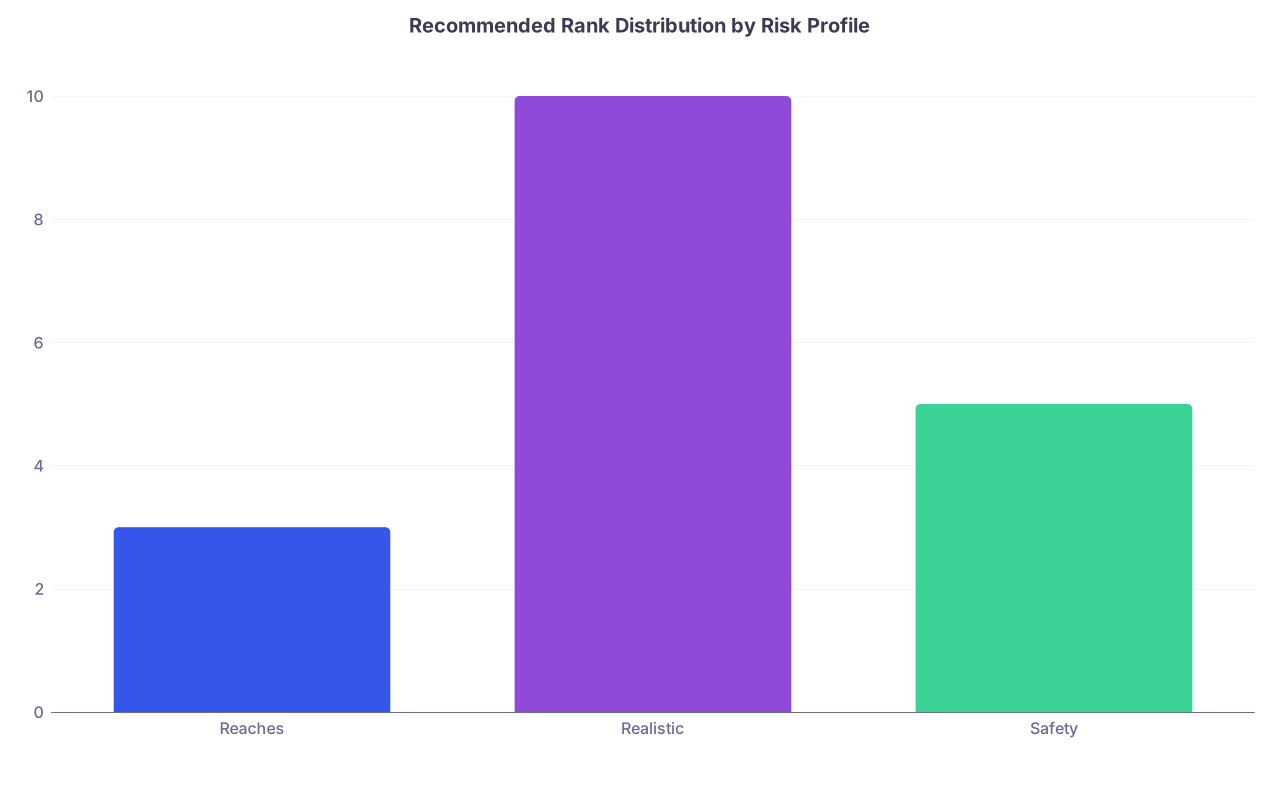
| Category | Value |
|---|---|
| Reaches | 3 |
| Realistic | 10 |
| Safety | 5 |
Then adjust:
If you have <10 interviews:
- Reaches: 0–2
- Realistic: 5+
- Safety: Rank every acceptable program
If you have 10–15 interviews:
- Reaches: 2–4
- Realistic: 6–10
- Safety: 3–5
If you have >15 interviews:
- More flexibility, but still keep realistic programs as the core
If your current draft list is top-heavy with reaches, fix it now.
7. What To Do This Week: Tactical Moves That Still Matter
Once interviews are over, your tools are limited. But not zero.
1. Targeted, honest communication (if allowed)
Some programs accept post-interview communication. Others do not. If they explicitly said “no post-interview communication,” respect that.
For the ones that allow it:
- Send a concise email to your genuine top 1–3 programs
- Reaffirm specific interest:
- Mention concrete features (curriculum structure, research in X, mentorship from Dr. Y)
- Clarify any gaps or misunderstandings from interview day if relevant
- Do not lie and tell multiple programs they are your “number one.” That gets around.
Example skeleton:
Dr. Smith,
Thank you again for the opportunity to interview at [Program]. After completing my interviews, [Program] remains one of my top choices because of [specific feature 1] and [specific feature 2]. I was especially impressed by [resident/faculty detail].
I believe my background in [X] and my goal of [Y] align strongly with your program’s strengths. I would be very enthusiastic about the opportunity to train at [Program].
Sincerely,
[Name, AAMC ID]
Short. Specific. Sincere.
2. Tighten your contingency planning (SOAP reality check)
You hope not to use SOAP. Plan anyway. It calms your brain and makes you sharper.

| Step | Description |
|---|---|
| Step 1 | No Pre Match |
| Step 2 | Reassess Competitiveness |
| Step 3 | Balanced Rank List |
| Step 4 | Conservative Ranking |
| Step 5 | Prepare SOAP Backup |
| Step 6 | Submit Rank List |
| Step 7 | Match Week |
| Step 8 | Start Residency |
| Step 9 | Enter SOAP Plan |
| Step 10 | Interviews >= 10? |
| Step 11 | Matched? |
Right now:
- Make sure you know how SOAP works logistically at your school
- Have an updated CV and personal statement ready
- Know which specialties you would pivot to if you did not match (for example: from categorical IM to prelim IM or transitional; from categorical surgery to prelim surgery)
If you never need it, great. If you do, you are not scrambling in shock.
3. Deal with your head, not just your spreadsheet
You are not a robot. Not getting a pre-match dents confidence, and a panicked brain writes bad rank lists.
Do three basic things:
- Talk to one grounded person who has seen prior match cycles (PD, advisor, older resident). Ask them to sanity-check your draft list.
- Sleep on your final version for 24 hours before certifying. Do not hit “certify” at 2 a.m. after doom-scrolling.
- Decide ahead of time that once you certify, you stop tinkering unless there is new, concrete information.
You want clarity, not obsessive micro-adjusting.
8. Example Scenarios: How Recalibration Actually Looks
A few quick composites I have seen repeatedly.
Scenario 1 – IMG, 8 interviews, no pre-match
- Step 2: 228
- 8 IM interviews: 3 academic, 5 community, mostly in the Midwest/South
- Original (bad) plan: Rank 3 academic programs at top, then a random mix
Recalibrated:
- Ranks 1–2: 1 academic + 1 strong community where he had excellent vibe and existing IMG residents
- Ranks 3–7: The remaining 4 community programs and 1 more academic, ordered by preference and realistic fit
- Rank 8: Final community program in less desirable city
Outcome: Matched at rank #4, solid community IM, happy, got fellowship later. Without recalibration, he would likely have put all 3 academic programs 1–3, then “forgotten” to protect himself with realistic community programs high enough.
Scenario 2 – US MD, mid scores, red flag, 12 interviews, no pre-match
- Step 2: 232; failed Step 1 once
- 12 IM interviews: mix of low-tier academic and community
- No offers despite decent communication
Recalibrated:
- Very cautious about programs that barely mentioned his failure vs those who actually discussed it constructively
- Top 5 ranks = places that showed maturity about remediation, strong resident support culture
- Lower ranks = places that seemed judgemental or dismissive about red flag dropped down despite prestige
Outcome: Matched mid-list at a less shiny but much healthier program. Probably dodged several bullets.
9. What Not Getting a Pre-Match Should Change — And What It Should Not
Let me be blunt.
It should change:
- How aggressively you stack reach programs at the very top
- How much you rely on “I think they loved me” as a ranking factor
- How much you discount solid, less glamorous programs that actually fit your profile
It should not change:
- Your willingness to rank programs in your genuine preference order among realistic options
- Your basic self-respect (do not suddenly decide you are “trash” and only deserve programs you actively dislike)
- Your professionalism in post-interview communication or how you talk about programs publicly
You did not get a pre-match. That is data. Not destiny.
10. Final Pass: Quick Checklist Before You Hit “Certify”
Run through this once, honestly:
- Have I removed any program I truly would not attend, even if unmatched otherwise?
- Are the majority of my top 8–10 spots realistic programs for my profile?
- Did I limit true “reach” programs to a reasonable number for my total interviews?
- Am I ranking by my actual preference (training + life), not just prestige or guessed interest from them?
- Have I asked at least one experienced advisor to look at my list if I am in a high-risk group (few interviews, IMG, red flags)?
- Do I have basic SOAP materials ready as a safeguard?
If you can answer “yes” to those, you are doing this better than a large percentage of applicants.
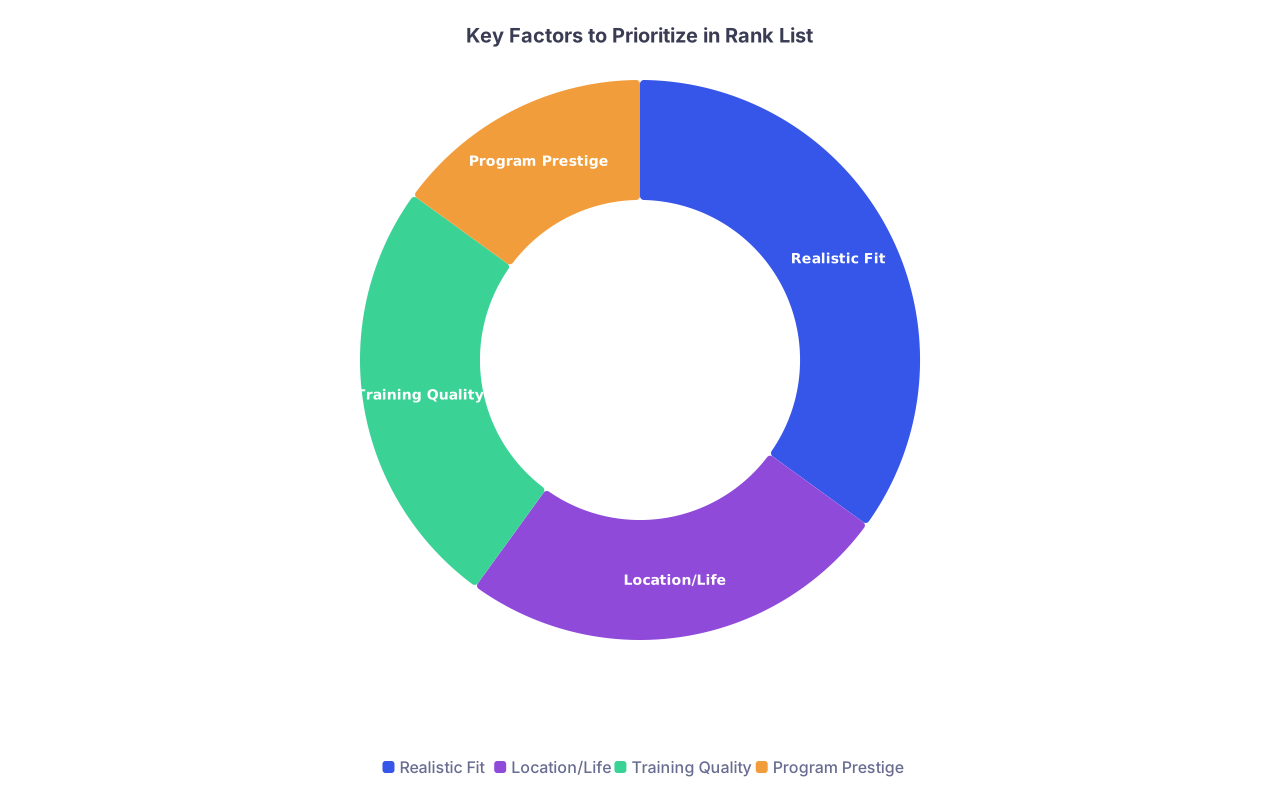
| Category | Value |
|---|---|
| Realistic Fit | 35 |
| Location/Life | 25 |
| Training Quality | 25 |
| Program Prestige | 15 |

Core Takeaways
- No pre-match is a signal, not a sentence. Use it to tighten your risk balance, not to panic.
- Build your list around realistic programs where you would actually live and train, with only a controlled number of reaches at the top.
- Rank by your true preferences within that realistic band, certify once you have sanity-checked, then stop second-guessing and let the algorithm do its job.