
The worst way to handle competing pre‑match offers is to “go with your gut.” Your gut is biased, tired, and easily impressed by a shiny new call room.
You need a system.
If you are facing two or more pre‑match offers and you are stuck, this is not a “follow your heart” moment. This is a decision with a 3–7 year lock‑in, visa implications, fellowship competitiveness, and your daily sanity on the line. Hand‑waving about “fit” is how people end up miserable by October.
I am going to give you a structured, step‑by‑step framework to break the tie. If you do this properly, you will:
- understand exactly why one program wins, and
- be able to sleep at night after you sign.
Let’s get into it.
Step 1: Get Clear On Your Non‑Negotiables (Before You Compare Anything)
Do not start by comparing programs. Start by interrogating yourself.
Open a blank page and, without looking at any offer, answer three questions:
What are my true non‑negotiables?
These are “deal‑breaker if violated” items, not preferences. For example:- Must be H‑1B sponsor (not just J‑1)
- Must have in‑house cardiology fellowship
- Must be within 1 hour of spouse’s job
- Must offer minimum PGY‑1 salary of $X due to loans/family
- Must be ACGME‑accredited categorical, not preliminary
What are my top 3–5 career goals during residency? Examples:
- Match into a competitive fellowship (cards, GI, derm, ortho, etc.)
- Stay in academics with research output
- Strong community training and get a job in that region
- Maximize procedural volume
- Maintain mental health and avoid burnout at all costs
What are my life constraints?
- Family responsibilities (kids, sick parents, dual‑career partner)
- Health issues that require particular insurance or schedule flexibility
- Immigration/visa timelines
- Financial obligations
Write this down in plain language. This becomes your filter.
Now convert that into a short “must‑have” and “strongly‑want” list:
Must‑have list (hard filter)
- [Example] ACGME‑accredited categorical IM or FM
- H‑1B or J‑1 sponsor acceptable
- Located in [X region] within 90 minutes of major airport
- At least one in‑house fellowship in my field of interest OR proven track record of matching into it
Strongly‑want list (scoring items)
- High board pass rates
- Strong fellowship match list
- Reasonable call schedule
- Supportive culture / no malignant reputation
- Affordable cost of living
If a program fails a must‑have item, remove it from serious consideration. No scoring. No “but the PD was so nice.” It is out.
Step 2: Build a Comparison Grid Before Your Brain Gets Biased
Once you know what matters to you, you need to see your offers side‑by‑side.
Create a table with programs across the top and criteria down the side. You can do this in Excel, Notion, or even on paper. Here is a template of high‑yield criteria to include.
| Category | Example Criteria |
|---|---|
| Training Quality | Board pass rate, case volume |
| Career Outcomes | Fellowship match, job placement |
| Program Culture | Resident support, malignancy reports |
| Lifestyle | Hours, call, schedule flexibility |
| Location & Cost | City, cost of living, safety |
| Visa/Contract | Visa type, contract terms, penalties |
You will customize this by adding your own must‑haves and priorities.
Then, for each program, fill in objective data first, feelings later.
What to actually put in the grid
For every offer, gather:
Training quality
- ACGME accreditation status
- Board pass rates (last 3–5 years if possible)
- Volume and diversity of cases
- Presence of subspecialty services on site (e.g., IR, EP, NICU, trauma level)
- Faculty‑to‑resident ratio
Career and fellowship outcomes
- Fellowship match list (last 3–5 years)
- Names of institutions fellows matched into (reputation matters)
- Percentage going into fellowships vs jobs
- Research opportunities: number of active projects, publications from residents, protected research time
Program culture
- Resident turnover, dismissals, or non‑renewals
- Stories from current residents (not just chief residents)
- PD/APD responsiveness during your interview / follow‑up
- Reputation on platforms like Reddit, SDN, and private WhatsApp/Telegram groups (take gossip with salt, but do not ignore consistent patterns)
Lifestyle and schedule
- Average weekly hours
- Call system (q4, night float, 24‑hour calls, home call vs in‑house)
- Vacation weeks and sick days
- Parental leave policies
- Ancillary support (nursing, phlebotomy, transport, scribes)
Location and life logistics
- City size and neighborhood safety
- Cost of living relative to salary
- Proximity to family/support network
- Commute time and requirements (owning a car vs public transit)
- School systems if you have or plan to have children
Visa, contract, and money
- Visa type offered (H‑1B vs J‑1 vs “we’ll see”)
- Contract length and renewal structure
- Moonlighting options and rules
- Overtime rules (do they pay or just “comp time” that never materializes?)
- Non‑compete clauses for post‑residency jobs in the system
- Penalties for early termination
Fill this grid before you start scoring. You are just collecting facts.
Step 3: Assign Weights Like an Engineer, Not a Romantic
Now you force yourself to be explicit about what matters more.
You are going to:
- create weighted categories, and
- score each program on each category.
3.1 Create your weighting system
Think of your decision in 4–6 main buckets, each with a weight that reflects its importance to you. Here is a realistic example:
- Training quality – 25%
- Fellowship/career outcomes – 25%
- Program culture – 20%
- Lifestyle – 15%
- Location & cost of living – 10%
- Visa/contract stability – 5%
If you are an IMG on visa, you might push Visa/contract stability up to 20%. If you have a young family, Lifestyle might go to 25–30%. Be honest about your priorities.
The key: your weights must sum to 100%.
3.2 Score each program on a 1–5 scale
For every category, score each program:
- 1 – Unacceptable / terrible
- 2 – Weak
- 3 – Acceptable / average
- 4 – Strong
- 5 – Excellent / near‑ideal
Do not overthink 4 vs 5. This is not Step 2 scoring. Approximate.
Then multiply each score by that category’s weight. Example:
- Program A – Training quality: score 4 × 0.25 = 1.00
- Program B – Training quality: score 3 × 0.25 = 0.75
Sum across all categories. You will get an overall composite score for each program like 3.65 vs 3.25.
Here is a mini example of how that looks for two programs:
| Category | Weight | Program A Score | Program B Score |
|---|---|---|---|
| Training quality | 0.25 | 4 | 3 |
| Fellowship outcomes | 0.25 | 5 | 3 |
| Program culture | 0.20 | 3 | 4 |
| Lifestyle | 0.15 | 2 | 4 |
| Location & cost | 0.10 | 2 | 5 |
| Visa/contract | 0.05 | 4 | 4 |
Multiply and sum each row for each program. Your Excel will do the math in 60 seconds.
If one program clearly wins by 0.4–0.5 points or more, you probably have your answer.
If they are within ~0.2–0.3 of each other, you are in tie‑breaker territory. That is when we move to the next steps.
Step 4: Pressure‑Test the Decision With “Future You” Scenarios
Numbers are helpful but not perfect. Now you ask: “What does my life actually look like at each place?”
I use a simple, brutal exercise with residents:
4.1 Worst‑case scenario test
For each program, imagine the following worst‑case realities:
- You do not match into your dream fellowship. You end up in a less competitive one or go straight into a job.
- You have one major burnout episode during PGY‑2.
- You have one unexpected life event: illness, pregnancy, family crisis, divorce, whatever.
Then answer:
- At which program can I survive these worst‑case scenarios with the least long‑term damage to my career and mental health?
- Where will my support system (inside and outside the hospital) be stronger when things go sideways?
If one program clearly wins this thought experiment, that matters more than a 0.2 difference in your spreadsheet.
4.2 5‑year future‑you letter
This takes 10 minutes and cuts through a lot of noise.
For each program, write 5–7 sentences as if you are yourself 5 years after finishing residency there:
- Where are you working (academic vs community, geography)?
- What kind of medicine are you practicing?
- How burned out or fulfilled do you feel?
- How do you talk about your residency to juniors? As “those were brutal years but I am grateful” or “never go there”?
Do this separately for each program, ideally on different days or at least different sessions. If one of those letters feels fake or forced, that tells you something.
Step 5: Use Calls Strategically (PDs, Residents, Fellows)
If you are still stuck, it is time to gather higher‑resolution data—not more random opinions.
5.1 Who you should actually talk to
You need three types of voices:
Current junior residents (PGY‑1 or PGY‑2)
- They will tell you what the day‑to‑day actually feels like.
- They are less filtered than chiefs and PDs.
Senior residents (PGY‑3+) who matched into or failed to match into your target fellowship or job type
- How supportive was the program in letters, schedule flexibility, research time?
- Did people match because of the program or in spite of it?
If possible, one faculty member not in formal leadership
- They can give a honest take on program direction, stability, and PD turnover.
You are not trying to become friends. You are collecting specific, comparable data.
5.2 Questions that cut through marketing fluff
Avoid vague nonsense like, “Do you like the program?”
Instead ask:
- “In the last 3 years, has anyone failed their boards? What happened for them afterward?”
- “How often do you leave on time on wards and ICU? What time do you usually get home?”
- “What is one thing you would change about this program if you could?”
- “Are there any services or rotations where you feel unsafe or unsupported?”
- “What percentage of residents trying for X fellowship actually get it?”
- “If I want to do [cards / GI / hospitalist with good schedule], how realistic is that here?”
- “Has anyone left the program or not had their contract renewed? Why?”
- “How does the PD respond to feedback that something is not working?”
For visa and contract specifics, ask program coordinators or GME office directly, in writing.
Update your grid with what you hear. Then see if your scores change.
Step 6: Understand the Time Pressure and Ethical Boundaries of Pre‑Match
Pre‑match offers are designed to pressure you. That is not paranoia—that is the system.
You can reduce the pressure if you understand the rules and the boundaries.
6.1 Clarify deadlines and consequences in writing
When you receive an offer, you need three things in an email:
- Exact deadline for accepting or declining
- Whether the offer is contingent on anything (visa approval, background checks, etc.)
- Whether they expect you to withdraw from the Match or specific services (ERAS, NRMP) upon signing
Do not rely on memory from a phone call. Ask for it clearly:
“Thank you for the offer. To ensure I understand correctly, can you please confirm the acceptance deadline and any steps you expect me to take with the Match or other programs once I sign?”
If they refuse to clarify, that is a red flag about how they will handle bigger issues later.
6.2 What you can and cannot do ethically
You must follow NRMP and local regulations. But here is the practical spine:
- Do not sign multiple binding pre‑match contracts. That is how you end up in violation of agreements and potentially reported.
- You can hold offers for the allowed period if no earlier deadline is specified, but games like “pretending to be undecided just to buy more time” can backfire if you push too far.
- Be honest but not self‑sabotaging. Saying:
“I am strongly interested, but I am also considering another offer and want to make an informed decision.”
is better than lying that “you are my top choice” to three programs.
If a program tries to pressure you with exploding offers (e.g., “you have 24 hours or it is gone”), factor that behavior into your culture score. Programs that recruit with threats often supervise with threats.
Step 7: Plug in the Visa, Money, and Contract Fine Print
Too many applicants only look at PGY‑1 salary and say “they are all around 60k; whatever.” Big mistake.
7.1 Visa reality check (for IMGs)
If you need visa sponsorship, create a mini‑framework just for this.
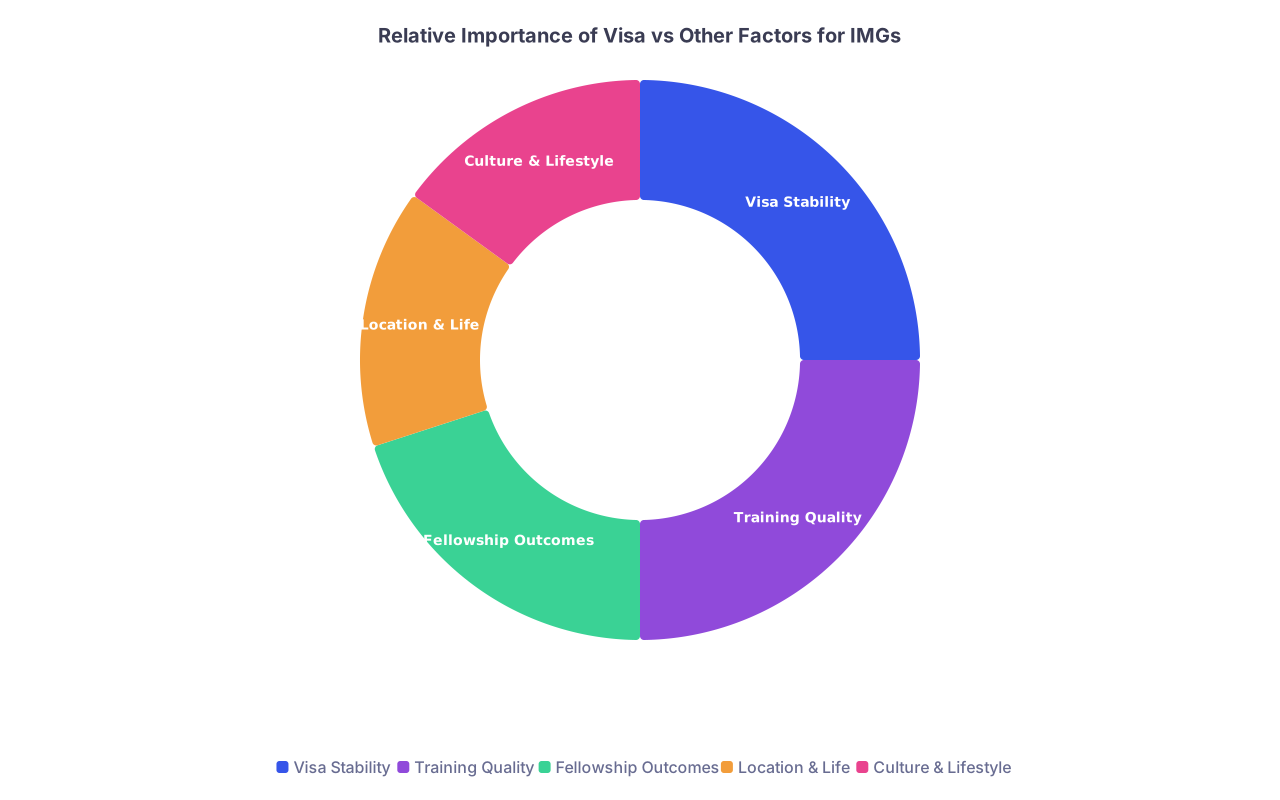
| Category | Value |
|---|---|
| Visa Stability | 25 |
| Training Quality | 25 |
| Fellowship Outcomes | 20 |
| Location & Life | 15 |
| Culture & Lifestyle | 15 |
Questions to ask explicitly:
- Do you sponsor H‑1B or only J‑1? How many H‑1B residents do you currently have?
- Any history of visa denials for residents in last 5 years?
- Do you cover visa filing fees or are residents expected to pay any part?
- Is there institutional experience with my specific visa path (e.g., J‑1 waiver, O‑1 later)?
If one program has solid, proven visa handling and the other is “still working it out,” that is not a tie. That is a risk you are either willing or not willing to absorb.
7.2 Contract and financial reality
You must actually read the contract before signing. I have watched residents discover shocking clauses three months into PGY‑1.
Look for:
Duration and termination:
- Are you signing year‑by‑year or for the entire residency?
- On what grounds can they terminate you, and how much notice is required?
Non‑compete clauses:
- Are you blocked from working in the same system/region after training? This matters if you want to stay locally.
Moonlighting:
- Allowed or not? After which year? Internal vs external?
- Pay rates and caps.
Benefits:
- Health insurance cost and coverage
- Retirement contributions (many residents ignore this but free money is free money)
- CME money, conference funding, exam fee reimbursement
Compute a basic yearly “net benefit”:
Salary – (health premiums + parking + mandatory fees) + (moonlighting potential + CME + exam reimbursements)
Two programs with a nominal 5k salary difference can swap positions once you factor in these details.
Update your scoring grid accordingly. A program that looked equal can drop quickly when you see a harsh contract.
Step 8: Make the Call – And Then Burn the Boats
At some point, your problem is not lack of data. It is fear.
You have:
- A weighted, structured comparison
- Future‑you scenarios
- Direct resident feedback
- Contract and visa clarity
Now you pick.
Use this final sequence:
- Eliminate any program that fails a must‑have. No excuses.
- Look at your weighted scores. Circle the top one or two.
- Re‑read your 5‑year future‑you letters for those.
- Ask yourself:
“If I were forced to decide in the next 10 minutes, which one would I choose?”
- That is almost always your answer. The rest is anxiety and fear of missing out.
Once you decide:
- Email the winning program, accept the offer clearly, and ask for the formal next steps and an updated contract if needed.
- Inform the other program(s) promptly that you will not be accepting. Do not ghost them. You might meet these people again.
Your email can be short and professional:
Dear Dr. [Name],
Thank you very much for the opportunity to join your residency program. After careful consideration, I have decided to accept another offer that aligns more closely with my personal circumstances and long‑term goals.
I am grateful for your time and for the chance to interview with your team. I wish the program continued success.
Best regards,
[Your Name]
That is it. No apologies. No over‑explaining.
Then stop re‑evaluating the decision every week. You can still optimize your trajectory from inside that program.
Step 9: If You Truly Cannot Decide – Use the Tie‑Breaker Protocol
Occasionally, you will end up with two programs that are genuinely close even after all of this. Equal scores, equally strong feedback, similar futures.
Here is the tie‑breaker protocol I use:
Risk profile check
- Which program has less downside risk if things go badly?
- Fewer horror stories? More stable leadership? Better visa track record?
Option value check
- Which program leaves more doors open?
- Broader fellowship match list? Larger alumni network? Stronger institutional brand?
Support network proximity
- Where will it be easier to have a life outside the hospital?
- Closer to family? Friends? Cultural community?
If it is still a tie after these three, here is the blunt truth:
You probably will be fine in either place.
At that point, pick one based on the smallest practical edge—shorter commute, slightly better pay, better gut feeling about the PD—and commit.
Visualizing Your Framework
To help you see the process as a clear path rather than chaos, here is a simple flow of the steps you should be following.

| Step | Description |
|---|---|
| Step 1 | List Non Negotiables |
| Step 2 | Build Comparison Grid |
| Step 3 | Assign Weights and Scores |
| Step 4 | Future You Scenarios |
| Step 5 | Resident and Faculty Calls |
| Step 6 | Visa and Contract Review |
| Step 7 | Accept Offer and Decline Others |
| Step 8 | Tie Breaker Protocol |
| Step 9 | Clear Winner? |
Print that out if you need to. Tape it beside your desk. Remind yourself you are following a process, not flailing.
Your Next Step Today
Do not sit and ruminate. You already lost enough time to anxiety.
Today—right now—do this:
Open a fresh document and write two lists:
- My non‑negotiables (5–10 bullet points)
- My weighted categories with percentages (4–6 items totaling 100%)
Then build a simple grid for your competing offers and fill in the objective data you already know. Even if it is incomplete.
Once those are on paper, you will feel the fog lift. You are no longer “torn between offers.” You are running a decision framework.
That is how you break the tie on pre‑match offers like an adult professional, not a panicked applicant.