Most residents botch their first pre-match offer because they try to “wing it.” That is a mistake.
You should treat pre-match communication like a procedure: scripted, deliberate, and low-drama. You are not improvising. You are executing a protocol.
I am going to give you that protocol—plus exact phrases and email templates you can copy, paste, and adjust in under five minutes.
1. Understand What That Pre-Match Email Really Means
Before you type a single word, you need to understand what just landed in your inbox.
A “pre-match offer” email usually means one of three things:
Soft interest
- “We were very impressed with your application and would love to have you here.”
- No mention of rank position, no mention of guarantees, no explicit ask from you.
Near-commitment signal
- “You will be ranked very highly on our list.”
- “We intend to rank you to match.”
- They are signaling you are in their top tier, but not promising exclusivity.
Quasi-contractual pre-match (common in some Texas programs and certain specialties/regions)
- “We would like to offer you a pre-match position in our program.”
- Often implies: if you verbally accept, you are expected to withdraw from the Match (or at least not entertain other offers). Sometimes has a specific response deadline.
Your response must match which of these you are dealing with.
Here is the simple decision flow.

| Step | Description |
|---|---|
| Step 1 | Receive pre match email |
| Step 2 | Thank them and reaffirm interest |
| Step 3 | Ask clarifying questions or accept |
| Step 4 | Thank them but keep options open |
| Step 5 | Is it an explicit offer? |
| Step 6 | Do you want this program if it was your only option? |
If you remember nothing else:
You always thank them. You always keep it professional. And you never over-promise something you might regret saying later.
2. General Rules Before You Hit Send
These are the rules I drill into students and applicants every year.
Rule 1: Reply within 24 hours
Faster is better (2–6 hours) if you can do it without sounding frantic. Silence looks disinterest or disorganization. Both are bad.
If you truly cannot respond thoughtfully yet, send a very short acknowledgment:
Dear Dr. [Last Name],
Thank you very much for this message. I am currently on a busy clinical shift but will respond more fully within the next 24 hours.
Best regards,
[Your Name]
That buys you time without looking rude.
Rule 2: Match their level of formality
- If they wrote “Dear Dr. Smith” and signed “Sincerely,” you respond the same way.
- If they wrote “Hi [First Name]” and signed with their first name, you can be slightly more relaxed, but still professional.
Err on the side of more formal. You are not texting a co-intern.
Rule 3: No binding language you cannot keep
Never write:
- “I will rank you number 1” (unless you have already decided and are prepared to stand by it).
- “I will absolutely come if offered a spot” when you are not 100% sure.
- “You are my top choice” when you are emailing three programs that same line.
Programs remember this. Attendings talk. You do not want to be the cautionary tale passed around next interview season.
Rule 4: Keep it short and clear
You are not writing an essay. 3–8 sentences is enough for 90% of these emails. Long, emotional paragraphs look insecure.
3. Templates for Different Scenarios
Now the part you actually came for: exact phrases and ready-made templates.
Scenario 1: Generic “We’re very interested in you” email
They say something like:
“We really enjoyed meeting you and think you would be an excellent fit for our program.”
Your goals:
- Thank them.
- Express genuine appreciation.
- Reaffirm interest without over-committing.
- Stay on their radar.
Template 1A – You are truly very interested
Subject: Thank you for your message
Dear Dr. [Last Name],
Thank you very much for your kind email. I greatly enjoyed my interview day at [Program Name], especially the opportunity to speak with [resident/faculty name] about the [specific clinic, track, or feature].
I remain very interested in [Program Name] and continue to see it as an excellent fit for my goals in [field/sub-interest]. I appreciate your consideration and the time you and your team have dedicated to my application.
Best regards,
[Your Full Name]
AAMC ID: [ID if relevant]
Template 1B – You are not sure yet / want to stay neutral
Subject: Thank you
Dear Dr. [Last Name],
Thank you for reaching out and for your kind words. I appreciated the opportunity to interview at [Program Name] and to learn more about your approach to [teaching/operative experience/continuity clinic/etc.].
I remain very grateful for your consideration of my application.
Sincerely,
[Your Full Name]
Notice what you are not doing: ranking promises, emotional declarations, or essays.
Scenario 2: “We will rank you highly” / “intend to rank you to match”
This is more serious. Programs sometimes phrase it as:
- “We intend to rank you to match.”
- “You will be ranked very highly on our list.”
- “We hope you will consider ranking us highly as well.”
Your goals:
- Show appreciation.
- Clarify your interest level.
- Avoid explicit statements about exact rank order (which can get shady fast).
- Stay honest.
Template 2A – They are your top choice (and you are sure)
If you know you will rank them #1, you can say it. Just do it cleanly.
Subject: Thank you
Dear Dr. [Last Name],
Thank you very much for your email and for the support of my application. I truly enjoyed my interview day at [Program Name], particularly [1–2 specific things].
I wanted to let you know that [Program Name] is my first choice, and I plan to rank your program as my top choice. I would be thrilled to train at [Program Name].
Thank you again for your consideration.
Sincerely,
[Your Full Name]
That is as clear as it gets without being melodramatic.
Template 2B – You are very interested, but not ready to promise #1
Subject: Thank you
Dear Dr. [Last Name],
Thank you for your thoughtful email and for your support of my application. I very much enjoyed learning more about [Program Name], and my interview day confirmed that it would be an outstanding place to train.
I remain highly interested in your program and will strongly consider [Program Name] near the top of my rank list. I am grateful for your consideration and the time you and your residents have devoted to this process.
Best regards,
[Your Full Name]
“Strongly consider near the top” is intentionally vague but still positive. Programs know what that means.
Template 2C – You appreciate it, but they are not top tier for you
You still reply. You still stay professional. You just avoid rank talk.
Subject: Thank you
Dear Dr. [Last Name],
Thank you very much for reaching out and for your support of my candidacy. I enjoyed meeting you and the residents at [Program Name] and appreciate the time and effort you invest in your trainees.
I am grateful for your consideration and for the opportunity to have interviewed with your program.
Sincerely,
[Your Full Name]
No lies. No promises. No bridges burned.
Scenario 3: Explicit pre-match offer (“We’d like to offer you a position”)
This one raises your blood pressure for a reason: there are real consequences.
Common versions:
- “We would like to offer you a pre-match position in our [Specialty] residency program.”
- “If you are willing to commit to us, we would like to offer you a spot outside of the Match.”
- “We are prepared to offer you a contract contingent upon your agreement to withdraw from the Match.”
First, recognize something:
This is business. Not romance.
You are allowed to think. You are allowed to ask questions. You are allowed to say no.
Here is how I tell applicants to structure their response process:

| Step | Description |
|---|---|
| Step 1 | Receive explicit offer |
| Step 2 | Check NRMP or state rules |
| Step 3 | Clarify offer details and timeline |
| Step 4 | Thank and decline or request time |
| Step 5 | Accept in writing |
| Step 6 | Request brief decision window |
| Step 7 | Know match rules for your region? |
| Step 8 | Is this program clearly acceptable if nothing else came? |
| Step 9 | Ready to commit? |
Step 1: Reply quickly, even if you are not deciding yet
Template 3A – Acknowledging the offer, asking for clarification
Subject: Thank you for the offer
Dear Dr. [Last Name],
Thank you very much for your email and for offering me a position in the [Specialty] residency program at [Program Name]. I am honored by your confidence in me and very grateful for this opportunity.
To ensure that I understand correctly, could you please clarify the following:
– Whether this is an offer to pre-match outside the NRMP Match process
– The expected timeline for a response
– Any steps I would need to take regarding NRMP registration or withdrawalI remain very interested in your program and want to make sure I fully understand the details before making a decision.
Thank you again for this generous offer.
Sincerely,
[Your Full Name]
You are not stalling. You are being responsible.
Step 2: Decide your true threshold
Ask yourself bluntly:
“If I accepted this and everything else disappeared tomorrow, would I be okay training there?”
If the answer is yes, you can reasonably consider accepting. If the answer is no, you are flirting with three to seven years of regret.
Template 3B – Accepting a pre-match offer
Once you are sure:
Subject: Acceptance of Pre-Match Offer
Dear Dr. [Last Name],
Thank you again for offering me a position in the [Specialty] residency program at [Program Name]. After careful consideration, I am delighted to accept this pre-match offer.
I am excited about the opportunity to train at [Program Name] and contribute to your program. Please let me know the next steps, including any necessary documentation or actions regarding the Match process.
Thank you for your confidence in me. I look forward to joining your team.
Sincerely,
[Your Full Name]
AAMC ID: [ID]
Then you follow their instructions. If this involves withdrawing from the Match, you actually withdraw. You do not “see what else happens.” That is how careers get stained.
Template 3C – You are interested but not ready to commit
If you are torn, ask for a short, specific time window.
Subject: Thank you for the offer
Dear Dr. [Last Name],
Thank you again for offering me a position in the [Specialty] residency program at [Program Name]. I am honored and truly appreciative of your confidence in me.
This is a significant decision, and I want to give it the thoughtful consideration it deserves. Would it be possible for me to have until [specific date, usually 3–5 days] to make a final decision?
I remain very interested in your program and am grateful for this opportunity.
Best regards,
[Your Full Name]
If they push for an answer in 24 hours, that tells you something about their culture. Take note.
Template 3D – Declining a pre-match offer
Hard, but sometimes correct.
Subject: Thank you for the offer
Dear Dr. [Last Name],
Thank you very much for offering me a position in the [Specialty] residency program at [Program Name]. I am truly honored by your confidence and grateful for the opportunity to have interviewed with your program.
After careful consideration, I have decided to continue in the NRMP Match process and will respectfully decline the pre-match offer. This was not an easy decision, as I have great respect for your program and faculty.
Thank you again for your time, consideration, and support of my application.
Sincerely,
[Your Full Name]
Is this awkward? Yes. Is it unprofessional? No. You are allowed to make the best decision for your career as long as you are honest and prompt.
Scenario 4: You already accepted somewhere else / you know you are not coming
Sometimes you get a warm “we’ll rank you highly” email from Program B after you already decided to rank Program A #1 and have told A that. Or you already pre-matched somewhere.
You still respond. You simply avoid saying anything misleading.
Template 4A – You already have a commitment elsewhere
Subject: Thank you
Dear Dr. [Last Name],
Thank you very much for your kind email and for the support of my application. I greatly appreciated the opportunity to interview at [Program Name] and to learn more about your residents and faculty.
Since my interview, I have made some decisions about my future plans and commitments. I remain very grateful for your consideration and the time you invested in my application.
Sincerely,
[Your Full Name]
You do not have to disclose where you are going or your exact rank list.
Template 4B – You know you will rank them low
Same idea: gratitude without deception.
Subject: Thank you for your consideration
Dear Dr. [Last Name],
Thank you for reaching out and for your support of my candidacy. I was impressed by the collegial environment at [Program Name] and the dedication to resident education that I saw on my interview day.
I appreciate your consideration of my application and the time you and your residents have invested in this process.
Best regards,
[Your Full Name]
4. Exact Phrases You Can Safely Use (and Phrases You Should Avoid)
Here is the quick-reference version.
| Situation | Safe Phrase | Risky Phrase |
|---|---|---|
| Strong interest | "I remain highly interested in your program." | "I will definitely come if matched." |
| Top choice | "I plan to rank your program as my top choice." | "I promise you I am coming." |
| Moderately interested | "I will strongly consider your program near the top of my list." | "You are among my top three choices." |
| Declining offer | "After careful consideration, I have decided to continue in the Match." | "I might be interested later if things change." |
| Need time | "Would it be possible to have until [date] to make a final decision?" | "I will let you know at some point." |
Phrases that work well almost everywhere:
- “Thank you very much for your email.”
- “I am honored by your confidence in me.”
- “I enjoyed meeting you and your residents.”
- “I remain very interested in your program.”
- “After careful consideration…”
Phrases that cause problems:
- “You are my number one” (if not true).
- “I guarantee I will come” (you do not control everything).
- “I am definitely matching at your program” (no, you are not psychic).
- Any emotional overshare about how lost, anxious, etc. you feel. Save that for your friends, not PDs.
5. Timing, Follow-Up, and When to Stay Quiet
When should you send follow-up emails after they write you?
Usually: you do not.
If a program has already sent you a warm “we like you” message and you have replied once, you do not need to keep “updating” them every week with minor, unimpressive news.
Send an update only if:
- You have a genuinely significant addition:
- Major publication accepted
- Significant new award
- New visa status that makes you more recruitable
- Or you have decided clearly that they are your #1 and you have not told them that yet
How late is too late to reply?
If you somehow missed the email for several days, still respond. Own it briefly without a long apology.
Dear Dr. [Last Name],
Thank you very much for your email and kind words about my application. I apologize for the delayed response; I have been on a busy stretch of clinical shifts.
[Then proceed with your normal template.]
Should you email programs that did not contact you?
That is a different topic—post-interview letters of intent and interest. Short version: you can, but you do not use the same language as responding to a pre-match offer. Do not pretend they emailed you first.
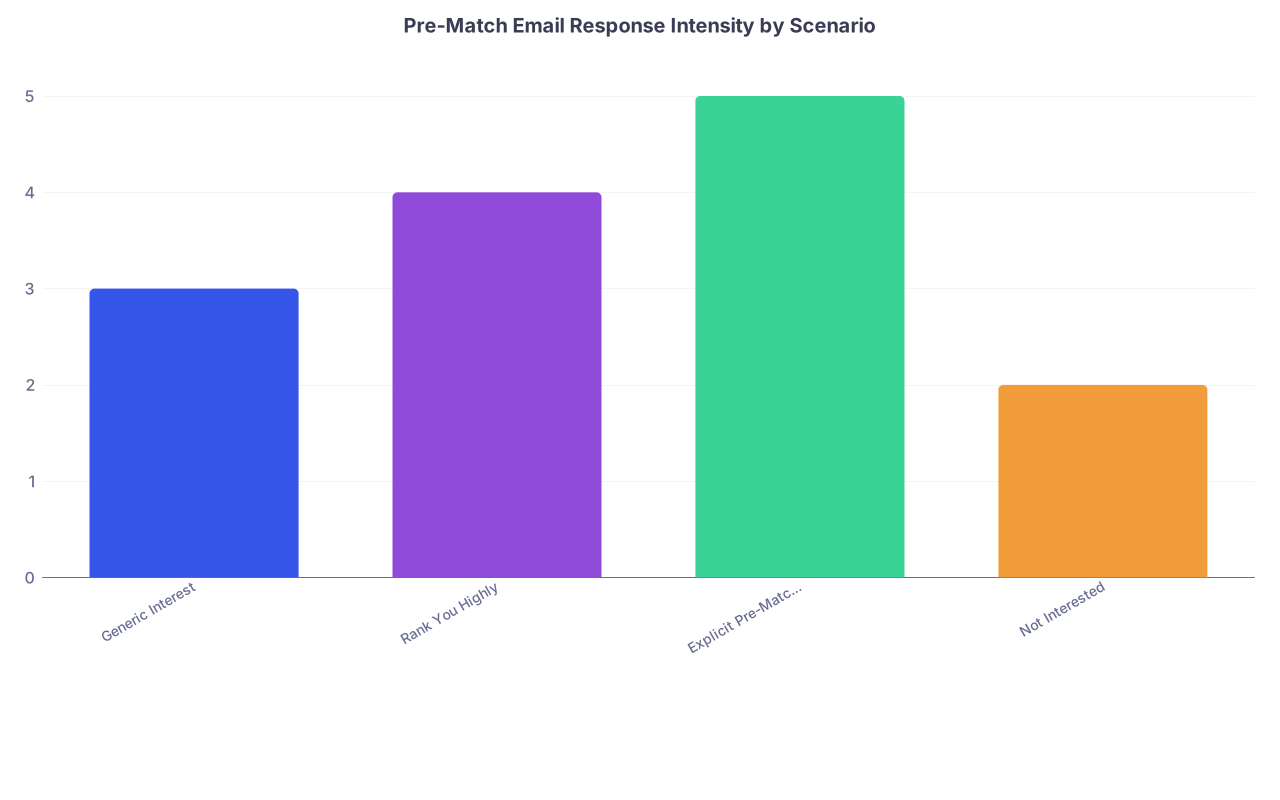
6. Quick Comparison: Response Styles by Scenario
| Category | Value |
|---|---|
| Generic Interest | 3 |
| Rank You Highly | 4 |
| Explicit Pre-Match Offer | 5 |
| Not Interested | 2 |
Scale: 1 = very minimal / neutral; 5 = detailed / decisive.
- Generic interest: brief, positive, low-drama.
- Rank you highly: clearer language about your level of interest.
- Explicit offer: most detailed; sometimes back-and-forth with questions.
- Not interested: short, polite, no details.
7. A Simple Checklist Before You Hit Send
Run through this in 30 seconds:
Name and title correct?
- “Dr. [Last Name]” spelled correctly
- Program name correct and consistent
Tone appropriate?
- No slang, no emojis
- Not overly emotional
No promises you do not mean?
- Search for “number one,” “definitely,” “guarantee,” “promise”
- Delete or soften those unless you are absolutely sure
Length controlled?
- Under ~200 words
- One clear thank-you, one clear statement of interest, optional clarification
Subject line clear?
- “Thank you” or “Thank you for your message” is enough
- Avoid clickbait or vague subjects
FAQ (Exactly 4 Questions)
1. Should I ever tell more than one program they are my “top choice”?
No. That is dishonest, and it can backfire badly. Faculty talk at conferences. Program directors move between institutions. If you want to signal strong interest to multiple programs, use softer language like “I remain highly interested in your program and will strongly consider ranking it near the top of my list,” without using “top choice” or “number one.”
2. Can programs get in trouble for making pre-match offers or asking for commitments?
Yes, depending on the rules of the NRMP or regional match system. Many programs push the boundaries with “we will rank you highly” language, which is generally tolerated. Explicit requests for rank promises or agreements to withdraw from the Match can be problematic. Your job is not to police them; your job is to respond ethically and protect your own integrity and options.
3. What if I regret accepting a pre-match offer later? Can I change my mind?
Technically, you can back out of almost anything that is not a signed contract, but doing so can damage your reputation and potentially have NRMP or institutional consequences, depending on the agreement. This is why you do not accept a pre-match offer lightly. If you are unsure, ask for time to decide. Once you accept and start the process of withdrawing from the Match, treat it as final.
4. Do programs actually care about these emails, or is it all theater?
They care. I have sat in ranking meetings where a PD says, “This applicant told us we are their top choice,” and that absolutely nudges their rank position higher. Conversely, vague or noncommittal communication rarely hurts you, but obvious insincerity or conflicting promises can. Think of these emails as small but real data points in how they see you: reliable, professional, and honest—or not.
Open your email right now and create three drafts: one for “generic interest,” one for “rank you highly,” and one for “explicit offer.” Save them as templates. The next time a pre-match message hits your inbox, you will not panic—you will just plug in the details and hit send.