
The worst decisions in medicine get made in 48-hour panic windows. A last-minute pre-match offer can either save your year—or lock you into a miserable residency you regret daily. The difference is not luck. It is process.
You do not have time for philosophy. You have 48 hours. So you need a ruthless, structured way to decide: accept, decline, or stall strategically.
This is that structure.
The Reality of a Last-Minute Pre-Match Offer
Let me be blunt. Programs use late pre-match offers for three main reasons:
- They genuinely want you and do not want to lose you in the Match.
- Their rank list is weak or at risk, and they are trying to “secure bodies.”
- They are filling unexpected gaps—someone quit, failed Step 2, or pulled out.
Your first job is to figure out which of those you are dealing with.
Your second job is to decide if you are willing to trade the uncertainty of the Match for the certainty of this specific program.
Your third job is to not blow up your entire future because you were afraid for 48 hours.
The 48-Hour Action Plan (Hour-by-Hour Framework)
You cannot “just think about it.” You need a schedule. Here is a practical timeline to keep you from spinning.
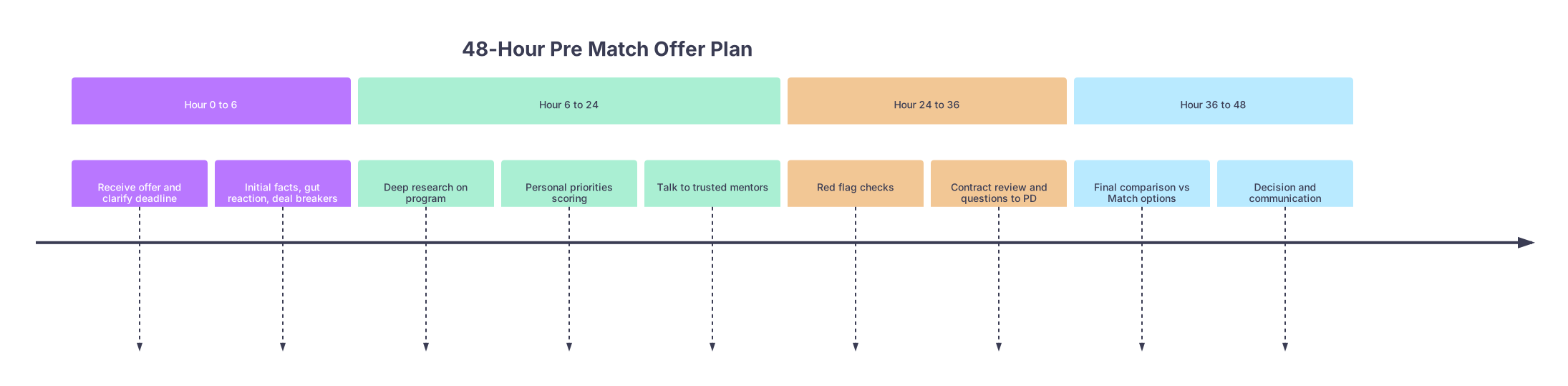
Use this as your backbone. You can compress if your deadline is shorter, but do not skip steps.
Step 1: Get Control of the Situation (Hour 0–2)
You feel rushed because the program wants you to feel rushed. You do not have to be passive here.
1. Clarify the exact terms of the offer
Before you do anything else, get specifics in writing (email is fine):
- Is this a binding pre-match contract or just a “strong intention”?
- Is it for categorical or prelim?
- For which year (PGY-1 only vs advanced position)?
- Is there visa support (if relevant) and for which type (J-1, H-1B)?
- Is this contingent on anything? Step 2 CK score, ECFMG certification, graduation?
Write back something like:
“Thank you very much for this offer. To help me make an informed and timely decision, could you please confirm in writing:
- Whether this is a binding contract outside the Match
- The position type (categorical vs prelim)
- Start date and duration
- Visa type supported (if applicable)
- Any contingencies or conditions on the offer.”
You want zero ambiguity. If they avoid answering, that is already data.
2. Confirm the real deadline
Programs love fuzzy urgency: “We really need an answer soon.” No. You need a time and date.
Ask:
“By what exact date and time do you need my final decision?”
Put that deadline in your calendar. Treat it like an exam time.
If they say “within 24 hours,” push once, professionally:
“I appreciate the offer and I am very interested. Given the importance of this decision, would it be possible to have 48 hours to review and discuss with my mentors?”
Sometimes they say yes. If they say no, you still continue the plan—just with compressed timing.
Step 2: Get Out of Panic Mode (Hour 2–4)
Fear makes you overvalue any guaranteed spot and undervalue your long-term happiness.
Sit down, no phone, and answer two questions on paper:
- If this exact program offered me a guaranteed Match spot in March, would I be happy?
- If I had no pre-match offer at all, how confident am I that I will match somewhere in this specialty?
Force yourself to write sentences, not just circle numbers. This creates a baseline to compare against later.
Now, define your hard deal-breakers. The things you cannot live with, regardless of fear:
- Location where you absolutely do not want to live (e.g., due to family, partner, visa risks)
- Visa type that is unacceptable
- Prelim-only offer when you strongly want categorical
- Known malignant culture (everyone says “run”)
- Financial / family constraints (e.g., spouse cannot work in that state)
Write them in a box at the top of your notes. If any of these are definitely true for the offer, your decision is probably already made.
Step 3: Rapid, Targeted Program Recon (Hour 4–12)
You are not doing a full background investigation. You are answering three questions:
- Is this program stable and legitimate?
- Are residents reasonably happy and supported?
- Does this program keep doors open for my future plans?
1. Quick external data
In 60–90 minutes, do this:
- Check the program’s ACGME status. Any citations? Recent probation?
- Look at their website:
- How many residents per year?
- Do they list current residents and recent grads?
- Check Doximity rankings and comments with skepticism—but pay attention to recurring themes (malignant, overworked, no teaching).
- Search “[Program Name] residency forum review” or “malignant” + program name. You will get noise, but you will also see patterns.
You are not looking for perfection. You are scanning for major red flags.
2. Contact actual residents (non-sugarcoated version)
You want at least 2–3 residents at different levels (PGY-1 and a senior). Not just the one they parade for recruitment.
Find them:
- From the program website resident list
- People you met on interview day
- Alumni network from your med school
Your message can be short:
“Hi Dr. X,
I interviewed at [Program] and just received a pre-match offer with a tight decision deadline. I would really value your honest take for 10–15 minutes by phone or Zoom, especially regarding workload, culture, and how supported you feel by leadership. I would deeply appreciate any quick insight.”
On the call, ask direct, specific questions:
- “If you could go back, would you choose this program again?”
- “How many hours do you realistically work per week? On wards? On ICU?”
- “Have any residents quit or transferred in the last 2–3 years?”
- “How does the program respond when residents struggle or make mistakes?”
- “What do people match into from here? Do many get fellowships? In what fields?”
- “How approachable is the PD in real life, not interview day PD?”
- “Is there any ‘hidden curriculum’ I should know about? Unspoken rules?”
Take notes. If they hesitate, laugh nervously, or say “Well… every program has its challenges,” push gently: “Can you give me a concrete example?”
Step 4: Score the Offer Against Your Priorities (Hour 12–18)
This is where people usually fail. They rely on vague feelings. You need a structure.
Make a quick scoring table. Something like this:
| Factor | Weight (1–5) | Program Score (1–10) | Weighted Score |
|---|---|---|---|
| Location & support | 5 | 7 | 35 |
| Program culture | 5 | 6 | 30 |
| Training quality | 4 | 8 | 32 |
| Fellowship prospects | 3 | 7 | 21 |
| Workload & wellness | 3 | 5 | 15 |
| Visa / job stability | 4 | 9 | 36 |
Steps:
- List 5–7 factors that actually matter to you (not to Instagram).
- Assign a weight 1–5 for each (how important).
- Rate the program 1–10 for each factor, based on what you learned.
- Multiply weight × score for each row, then sum the total.
Then do the same for your expected Match outcome in general:
- Not for a specific program, but for a “typical” program you realistically think you will get if you match.
This exposes your bias. Often, fear makes people massively overestimate how bad the “Match unknown” option is.
Step 5: Reality Check With Someone Who Has Seen Hundreds of Applicants (Hour 18–24)
You need one or two people who know the Match numbers and know you:
- Your home program PD or APD
- A trusted attending in your specialty
- An advisor who knows NRMP data and your specific application
Send a clear, structured email:
- Your current stats: Step scores, number of interviews, specialties, type of programs.
- The exact pre-match offer details.
- Your honest preferences (location, fellowship plans, etc.).
- A direct ask: “Given your experience, how risky would it be for me to decline this pre-match and go through the Match? What would you personally advise your own child in my situation?”
Give them a finite window: “I must decide by [date/time]. If you can share your thoughts before then, I would be very grateful.”
Then listen. Especially if they have known you for years and have seen multiple Match cycles.
Step 6: Hunt for Red Flags (Hour 24–30)
Some programs are merely average. Some are radioactive. You do not want the second group.
At this point, step back and ask:
What would have to be true for me to regret this offer in 12 months?
Look specifically for:
High attrition
Multiple residents quitting, transferring, or not being renewed. Red flag.Chronic workload abuse
PGY-1s routinely staying past 80 hours, off-the-clock charting, pressure to under-report hours.Malignant leadership
Residents describe being humiliated in front of others, punished for raising concerns, or threatened with non-renewal casually.Unstable accreditation
Recent ACGME probation, lost accreditation in a related program, or leadership turnover every 1–2 years.Opaque policies
They will not send you a written contract. They dodge questions about visa support, leave, moonlighting, or remediation.
If 2–3 of these are popping up, do not gaslight yourself. A guaranteed miserable spot is worse than a riskier but decent match.
Step 7: Actually Read the Contract Like an Adult (Hour 30–36)
Most applicants glance at contracts like they are iTunes terms and conditions. That is how people get trapped.
Key things to examine:
Is it clearly outside the Match?
Wording like “this agreement is binding and will not be subject to the NRMP Match.” If you are in an NRMP-participating specialty, you must not violate NRMP rules. Confirm the program is allowed to offer this and that you are free to accept.Term and termination
- How long is the contract? Usually 1 year, but what about renewal?
- Under what conditions can they non-renew you?
- Do they have unilateral power to end the contract “without cause”?
Visa terms (if applicable)
- Exactly which visa?
- Do they sponsor H-1B or only J-1?
- Any obligations after training? Return home, work in certain areas?
-
- Salary compared to other programs in the region.
- Health insurance coverage, parental leave, sick leave, vacation days.
- Educational funds, conference funds.
Moonlighting and outside work
- Allowed or prohibited?
- Conditions?
You do NOT need a lawyer for a standard residency contract, but if something seems unusual, or they resist sending the full document, say no.
If you have access to your school’s legal or GME office, ask for a quick red-flag scan.
Step 8: Compare Against Your Match Profile With Brutal Honesty (Hour 36–42)
You are now at the point where the emotional fog is thick. That is exactly why you now switch to numbers and scenarios.
Build two scenarios side-by-side
Scenario A – Accept Pre-Match
- Guaranteed location: [City]
- Guaranteed specialty: [X]
- Program quality: [your weighted score]
- Fellowship chances based on program’s recent grads.
- Lifestyle: approximate hours, culture, support.
Scenario B – Decline and Enter Match
Break this down into probabilities. For example:
- 70% chance: Match into a mid-tier program in desirable or neutral location.
- 20% chance: Match into less desirable location / lower-tier program.
- 10% chance: Do not match, scramble into SOAP or take a gap year.
Assign rough quality scores to each of these branches. Then compute an expected value.
Is this mathematically precise? No. Is it far better than “I feel scared so I should lock in something”? Absolutely.
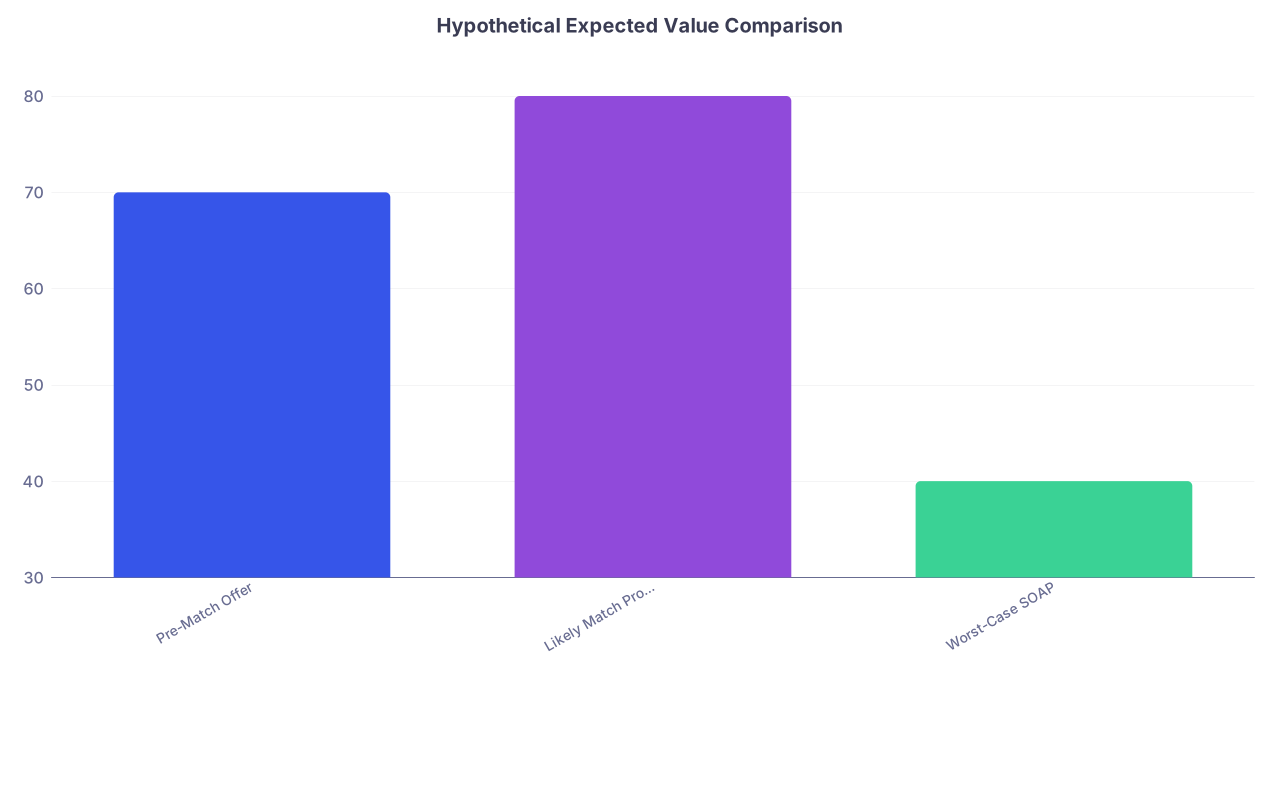
| Category | Value |
|---|---|
| Pre-Match Offer | 70 |
| Likely Match Program | 80 |
| Worst-Case SOAP | 40 |
Example interpretation:
- Pre-match program scores 70/100.
- The average program you are likely to match at scores 80.
- Worst-case SOAP option scores 40.
If you are statistically very likely to match (based on number and quality of interviews, specialty competitiveness, advisor input), you might not want to lock into a 70 when your realistic expected outcome is closer to 80.
If your application is weaker, or your number of interviews is very low for your specialty, that 70 may be a lifeline.
Step 9: Decide Your Risk Tolerance Explicitly (Hour 42–45)
This is not just about the offer. It is about who you are and how much risk you can reasonably carry.
Ask yourself:
- Would I rather definitely be in a “B–” program than have a 10–15% chance of being unmatched?
- How would I handle a SOAP year mentally and financially if that happened?
- Is this specialty non-negotiable for me, or could I live with a different specialty in the Match or SOAP?
If the idea of being unmatched is completely intolerable—and it is a realistic risk given your app—then a decent pre-match is often the safer call.
If you have 15 interviews in a moderately competitive specialty, with solid scores and strong letters, and multiple advisors say you are very likely to match, locking into a mediocre pre-match out of fear may actually be irrational.
Step 10: Communicate Your Decision Professionally (Hour 45–48)
Now you move from analysis to execution. You owe the program a clear, professional reply.
If you ACCEPT
Your reply:
“Dear Dr. [PD Name],
Thank you very much for the offer to join [Program Name] as a [PGY-1 categorical/prelim] resident beginning [start date]. After careful consideration, I would be honored to accept this offer.Please let me know the next steps and any documents I should review or sign to formalize the agreement.
Sincerely,
[Your Name]”
Then:
- Promptly sign and return any documents.
- Inform your school / dean’s office so they update your Match status and ensure you are not violating NRMP rules.
- Stop shopping. Commit mentally. Make this the best possible decision by engaging fully once you start.
If you DECLINE
Be clear, respectful, and brief. Do not write an essay or over-explain.
“Dear Dr. [PD Name],
Thank you very much for considering me for a pre-match position at [Program Name] and for the time you and your team have invested in my application. After careful consideration, I have decided to continue through the Match process this cycle and therefore must respectfully decline the pre-match offer.I remain very appreciative of the opportunity to interview with your program and the positive interactions I had with your faculty and residents.
Sincerely,
[Your Name]”
They may be disappointed. That is fine. You do not need to apologize for protecting your own career.
Special Cases: IMGs, Prelim Offers, and Visa Issues
Some situations change the risk calculation dramatically.
1. International Medical Graduates (IMGs)
If you are an IMG with:
- Few interviews
- Borderline scores
- A desire to stay in the U.S. long-term
A solid pre-match may be far more valuable than it looks on paper.
Key questions:
- How many IMGs does this program typically take?
- Do their IMG grads successfully get fellowships or decent jobs?
- Is the visa type acceptable for your long-term plans?
For many IMGs, a decent pre-match in a less popular location beats rolling the dice for “dream programs” that are unlikely to rank you highly.
2. Prelim-Only Positions
Be very cautious if the offer is prelim only and you want a categorical path.
Clarify:
- Do they tend to take their own prelims into categorical positions later?
- Is there a formal pathway or just vague “maybe” talk?
- What happened to the last 5–10 prelims?
If most of their prelims end up unmatched or scrambling into unrelated PGY-2 slots, this is not a “safe” pre-match. It is a 1-year job with another high-stress search waiting.
3. Visa-Dependent Candidates
Visa issues can override almost everything else.
If:
- You absolutely must secure a spot this year to maintain status.
- The program offers the visa type you need.
- Your Match chances are genuinely uncertain.
A pre-match with a stable visa track often becomes the rational choice—even if the program is not glamorous.
Just do not ignore abusive cultures or unsafe workloads thinking “a visa at any cost.” There are lines you should not cross.
How to Not Regret Whatever You Decide
You can do all of this perfectly and still never be completely sure. That is normal.
What you can control:
- That you gathered real data (not just vibes)
- That you aligned the decision with your actual values and risk tolerance
- That you did not let pure fear make the decision for you
Once you decide:
- Stop re-running the scenario in your head every night.
- Focus on making the most of your path—research, mentorship, performance.
- Remember that residents from community, mid-tier, and even “average” programs get great fellowships and jobs all the time if they perform well.
You are not choosing your entire life here. You are choosing your starting point.
Your Next Move (Do This Now)
Open a blank page and, right now:
- Write the program name and offer details at the top.
- List your 5–7 key priorities and assign weights 1–5.
- Score this program 1–10 for each and total it.
- Then write, in one paragraph: “If I accept, in one year I will probably feel ______. If I decline and go to the Match, in one year I will probably feel ______.”
You will feel your true answer pulling you one way.
Use the 48 hours to test that instinct against facts—not to drown in anxiety.