
The way most applicants read residency offers is backwards. They stare at salary and prestige, then skim right past the only sections that actually shape their future: conference time and clinic time.
Let me break this down specifically.
You are not just choosing a job. You are choosing how your brain will be used 60–80 hours a week for the next 3–7 years. The “education” line items in an offer—protected didactics, clinic templates, supervision ratios—are the closest thing you get to a user manual for that program.
If you do not learn how to parse them, you will get burned.
This is your guide to reading conference time and clinic structure in pre‑match offers like an attending, not a starry‑eyed MS4.
1. The Two Numbers That Quietly Predict Your Training Quality
Strip away the branding and the shiny fellowship lists. Two structural features tell you a lot about whether a program actually values education:
- How conference time is protected, structured, and enforced.
- How clinic time is scheduled, supervised, and capped.
Notice I did not say “whether they have didactics” or “whether they do continuity clinic.” Every program has those on paper. The differences live in the details: who can pull you away, how often, and for what.
Let’s start with conferences, because that is where programs either show their spine or their spin.
2. Reading Conference Time in Offers: What’s Real vs Window Dressing
When you look at a pre‑match offer (or what they tell you in pre‑match conversations), “education” usually shows up under:
- Protected didactics / conferences
- Noon conference / morning report / grand rounds
- Academic half‑day
- Simulation / skills lab
It all sounds fine. Most of it can be completely hollow.
Here is how to parse it.
2.1. Look for these exact phrases (and what they really mean)
When programs talk about didactics in emails, recruitment brochures, or slide decks, listen for these key phrases:
- “Protected educational half‑day”
- “Residents are excused from clinical duties”
- “Pages are held by attendings or fellows during conference”
- “Attendance required unless on ICU/ED/OR”
- “Compliance monitored by GME / CCC”
Compare that with the fluff:
- “We value education and resident wellness”
- “Robust conference schedule”
- “Encouraged to attend when able”
- “Typically protected” or “generally protected”
The first group represents structure and enforcement. The second group is marketing.
If your pre‑match offer email, information packet, or follow‑up call never includes the specific mechanics of protection—who covers pagers, who can pull you out, what the attendance expectation is—you should assume it is not actually protected.
2.2. Ask for a sample weekly schedule
Do not settle for “we have conferences four days a week.” Ask directly for:
- A sample PGY‑1 and PGY‑2 weekly schedule, including:
- Start/end times of rounds
- Didactic blocks
- Clinic sessions
- Call
You want to see, in writing, where education is physically carved out.
Example of a real academic half‑day in internal medicine:
- Wednesday
- 7:00–8:00: Morning report
- 8:00–12:00: Academic half‑day (all ward teams except ICU/ED excused from floor)
That is very different from:
- Wednesday
- 7:00–7:30: “Morning case conference” (often canceled)
- 12:00–1:00: Noon conference “for those not busy”
I have seen offers that proudly list “daily didactics,” and when you finally talk to a PGY‑2, they say, “We make maybe one a week because we are constantly cross‑covering.”
Red flag.
2.3. Who actually covers during conference?
Programs love to say “you are protected for conference,” but the pager has to sit somewhere.
Clarify explicitly:
On wards:
- Do attendings or upper levels cover cross‑cover and new admissions during noon conference?
- Or are interns still taking calls while sitting in the back of the room?
In ICU:
- Are ICU teams exempt from conferences entirely?
- Or do they expect “at least one resident present on the unit,” which becomes you every time?
In clinic:
- Are clinic sessions blocked during academic half‑day?
- Or do clinic patients keep being scheduled, forcing you to miss half the teaching?
When a program says “we aim to protect conference, but sometimes patient care requires flexibility,” translate that as: the culture will decide. If the culture is “never say no to an admission,” conferences will die on the vine.
2.4. Track realism: required hours vs usable hours
If a program claims “6 hours of weekly didactics” but three different residents tell you they attend 2–3 hours on a good week, believe the residents.
Do the math for yourself using concrete rules of thumb:
On a real inpatient month at a busy program, you will reliably be able to attend:
- 1 morning report + 2–3 noon conferences weekly if protection is actually enforced
- 0–1 conferences weekly if coverage is loose and there is constant triaging
On clinic or elective, you should be able to attend:
- Nearly all academic half‑days
- Most grand rounds
If your discussions with residents sound like:
“We technically have a half‑day, but often we are forced to stay back if admissions are heavy.”
That tells you everything you need to know about where education ranks compared with service.
2.5. How to press them, politely but firmly
During pre‑match calls or follow‑up Q&A, ask specific, non‑fluffy questions. Do not ask, “Do you value education?” Every program will tell you yes.
Ask:
- “For a typical ward month, how many hours of didactics do interns actually attend per week?”
- “During academic half‑day, who holds the pager?”
- “What percentage of residents attend morning report regularly?”
- “Is attendance monitored or tracked in any way?”
You want actual numbers or concrete descriptions.
If the PD answers with generalities—“Our residents are very committed to teaching,” “We rarely have issues with coverage”—and cannot describe a mechanism, assume there is no mechanism.
3. Parsing Clinic Time: Where Learning Ends and Abuse Begins
Clinic is where a lot of the hidden pain lives. And a lot of the hidden value, if done well.
Your pre‑match offer, or the follow‑up materials, will usually mention:
- “Continuity clinic 1 half‑day per week” (IM, peds, FM, psych)
- “Ambulatory blocks”
- “Subspecialty clinics”
- “Clinic templates follow ACGME guidelines”
That means very little by itself. The real questions are volume, supervision, and ownership.
3.1. Continuity clinic: the structure that actually matters
Let’s use internal medicine as an example, but the same logic applies across primary‑care‑oriented specialties.
You should be asking:
Template size:
- How many patients are booked per half‑day for a PGY‑1? PGY‑2? PGY‑3?
- New vs follow‑up ratio?
Double booking:
- Does the clinic routinely double book?
- Are overbook slots used as a band‑aid for access problems?
Precepting:
- How many residents per attending preceptor?
- How easy is it to staff quickly vs waiting in line?
Start/End times:
- What are the posted clinic hours?
- How late are residents staying beyond posted hours on average?
Let me be blunt: a PGY‑1 with 18 patients scheduled in a half‑day, double booked, with one preceptor covering 6 residents, is not “being trained.” They are being used as underpaid primary care workforce.
Contrast that with a program that starts interns at 4–6 patients per half‑day, scales up to 8–10 by PGY‑3, does not double book without warning, and caps precepting at ~3 residents per attending. That is a clinic that is actually structured as an educational space.
3.2. Ambulatory blocks and the continuity illusion
Many programs now use an “X+Y” system (for example, 4 weeks wards, 1 week clinic) and brag about how this increases continuity and education time.
Sometimes true. Sometimes not.
To read this correctly:
Ask for the exact X+Y structure:
- Is it 4+1, 6+2, 3+1?
- On Y weeks, are you only doing clinic, or still on call/coverage some days?
Ask:
- During Y weeks, how many half‑days of continuity clinic vs subspecialty clinic vs didactics?
- Is there a cap on daily patient volume during Y week, or is it jammed with 12–14 patients per half‑day?
You want a Y week with:
- Multiple structured teaching sessions (ambulatory curriculum, QI, journal club)
- Reasonable clinic load (especially early PGY‑1)
- Minimal inpatient distractions
If residents tell you, “Our Y week is when they dump all the follow‑ups, nursing home visits, phone messages, and admin work on us,” that is not an educational ambulatory block. That is deferred scut.
3.3. Supervision and ownership: the hidden variable
The offer may say nothing about this, but how clinic is supervised fundamentally changes your training.
Key things to find out, from residents if not from leadership:
Preceptor model:
- 1 preceptor for 3–4 residents, or 1 for 6–8?
- Same core preceptors over time (true continuity of teaching) vs random daily coverage?
Chart ownership:
- Are you really the PCP of record, or are attendings the PCP and you write the notes?
- Who receives inbox messages? How many daily?
Procedure opportunities in clinic:
- Are there realistic chances to do joints, biopsies, IUDs, dermatologic procedures, etc., or does everything get shifted to “procedure clinic” you rarely see?
If a program talks constantly about “resident autonomy” but residents are crushed under unresolved inboxes and overbooked templates, that autonomy is just liability wrapped in workload.
4. Reading Between the Lines: When Numbers Don’t Match Culture
Programs can technically meet ACGME requirements and still produce poorly trained, exhausted residents. You are trying to detect that gap.
4.1. Use residents’ language, not just their answers
When you ask about clinics and conferences, pay attention to word choice.
Three example responses about noon conference:
“We always go. The chiefs and attendings cover.”
→ Strong sign of real protection.“We try to make it when things are not crazy.”
→ Translation: you will miss a lot.“We are expected to be there, but if the ED is dumping on us…”
→ Service wins. Every time.
About clinic:
“Clinic is busy but manageable. I see about 8 patients a session as a PGY‑2, preceptors are very available.”
→ Busy is fine, the numbers and support matter.“Clinic is insane. I am triple booked every morning and always behind.”
→ This is a service clinic run on resident burnout.“They front‑load our templates now, so it is heavy early in the session and we usually leave late.”
→ The administration is prioritizing throughput, not your learning.
You are listening for either resignation or active pride. A little complaining is normal. Deep fatigue and eye‑rolling about clinic or didactics is not.
4.2. Alignment check: what PDs say vs what residents describe
A concrete strategy that works:
- After the PD or APD describes educational time and clinic structure, repeat the same questions to 2–3 residents. Do not tell them what leadership said.
Specifically, compare:
- Claimed conference hours vs attended hours.
- Claimed clinic caps vs actual patient counts.
- Claimed half‑day protection vs how often it is canceled or interrupted.
If the numbers are consistently off, that is not “miscommunication.” That is culture.
5. Concrete Red Flags in Educational Value
Let’s be very specific. These are patterns that show up in offers, schedules, and resident comments that should make you cautious.
5.1. Conference‑related red flags
“Conferences are held daily and residents are encouraged to attend.”
→ Encouraged = optional = will disappear when busy.“Coverage during didactics is arranged by the team.”
→ Translation: interns and juniors will cover each other; you will miss a lot.“Attendance is not mandatory; we trust residents to prioritize patient care.”
→ This sounds nice. It usually means education is optional.Frequent mention of:
- “Clinical demands sometimes require flexibility with education time”
- “We do our best to protect conference”
Repeated qualifiers like “when possible” and “typically” are not accidental.
5.2. Clinic‑related red flags
Residents report:
12 patients per half‑day as interns in primary‑care‑oriented specialties
- Routine double‑booking without resident input
- Staying 2–3 hours after posted clinic end
PDs brag about:
- “High‑volume clinic that prepares you for real‑world practice” without any mention of graduated responsibility or educational oversight.
Clinics where:
- “We rarely cancel clinic for didactics”
- “Residents are pulled from clinic for inpatient coverage all the time” (the worst of both worlds)
In X+Y programs:
- Y weeks used as catch‑up time for inpatient tasks, not true ambulatory learning
- Little to no structured didactic curriculum built into Y
If you see these patterns in multiple independent resident conversations (current PGY‑1s through PGY‑3s), assume they are stable features, not growing pains.
6. Comparing Offers: Turning Vague Promises into Concrete Data
You will likely have multiple pre‑match offers or at least multiple strong possibilities. Put them on the same grid and force them to compete on actual structure.
Here is how I would build that comparison.
| Feature | Program A | Program B | Program C |
|---|---|---|---|
| True protected didactics hrs/week | 4 | 2 | 5 |
| Academic half-day (yes/no) | Yes | No | Yes |
| Pager held during conferences | Yes | Sometimes | No |
| PGY-2 clinic patients/half-day | 8–10 | 14–16 | 6–8 |
| Residents per clinic preceptor | 3–4 | 6–7 | 3 |
You will not always get perfect numbers, but you can usually bracket reality from resident reports. The point is to translate vague language like “robust didactics” into a number you can compare: usable hours per week.
7. How To Ask These Questions During Pre‑Match Without Sounding Like Trouble
You do not want to come across as the resident who will argue about every clinic template before you have even signed. You also cannot afford to be passive.
There is a way to thread that needle.
7.1. Focus on learning, not workload
Program directors are tired of hearing, “How easy is your call schedule?” They respond better to, “How do you protect time for residents to actually learn?”
Examples you can use verbatim:
- “Can you walk me through what a typical Wednesday looks like for an intern, including when and how didactics are protected?”
- “On a typical inpatient month, how many hours of conference do residents realistically attend?”
- “In continuity clinic, how do you decide how many patients an intern sees, and how does that change over residency?”
These signal that you care about becoming competent, not just comfortable.
7.2. Confirm with residents at different levels
PGY‑1s often have the freshest sense of pain points. PGY‑3s have the long view.
Ask them slightly different questions:
PGY‑1:
- “How many patients are you seeing in clinic right now?”
- “How often do you miss conference because you are too busy?”
PGY‑2/3:
- “Has clinic volume changed since you started?”
- “Do you feel conferences are protected more, less, or about the same as when you were an intern?”
Stable problems will show up in both ends. Fixes in progress will be obvious too (“They actually cut our clinic templates last year; it is much better now”).
7.3. Watch for defensiveness vs honesty
Programs that genuinely care about education will acknowledge trade‑offs.
Something like:
“We had issues with clinic volume two years ago. We heard residents, cut back templates, and we are still adjusting.”
That is a good sign.
Red flag is: “Our residents are very resilient. Everyone struggles in clinic at first, but they adapt.”
Translation: nothing will change. You will adapt by staying until 8 pm.
8. Specialty‑Specific Nuances You Should Not Ignore
Conference and clinic value look slightly different by specialty. You have to read them through the right lens.
8.1. Internal Medicine & Pediatrics
Conference:
- Morning report, noon conference, academic half‑day are core.
- If these are not reliably protected, your board prep suffers.
Clinic:
- Continuity clinic volume and complexity directly affect your comfort with outpatient management.
- Look for:
- Graduated patient loads
- Chronic disease management exposure (diabetes, CHF, asthma, ADHD)
- Integration of behavioral health, social work, pharmacy
Seeing 18 straightforward URI visits is not educational. Managing 8 complex multimorbid patients with a good preceptor is.
8.2. Family Medicine
Clinic is essentially the main stage.
You should be ruthless here:
- Number of clinics per week
- Volume per half‑day
- Procedures available in clinic:
- OB care
- Women’s health
- OMT (if DO‑friendly)
- Sports med
- Dermatologic procedures
Do not be fooled by a family med program that spends half its time bragging about inpatient service while giving residents bloated, inefficient, poorly supervised clinics.
8.3. Psychiatry
Clinic volume and conference quality define your training.
Outpatient:
- Reasonable caseload (not 300 “panel” patients with minimal actual contact)
- Protected one‑on‑one supervision time per week
- True psychotherapy training vs just med management
Conference:
- Case conferences, journal clubs, supervision groups
- Time clearly carved out from clinic (no double‑booking therapy patients over didactics)
If residents tell you they are constantly rescheduling patients because of didactics, or vice versa, that is a structural failure.
8.4. Surgical Specialties
Clinic is often underemphasized but still crucial.
Look for:
- Regular clinic time that you actually attend, not constantly cancelled for cases.
- Reasonable number of new vs postoperative follow‑ups so you learn perioperative medicine.
- Conferences:
- M&M, grand rounds, indications conference
- True excusal from the OR for major teaching conferences (this requires real institutional buy‑in)
If a surgery program flexes that you “basically live in the OR” and hand‑waves away conferences and clinic, your exam prep and judgment development will suffer.
9. Putting It All Together When You Have 72 Hours To Decide
Pre‑match offers often come with absurdly short decision windows. You will not have time for a detailed ethnographic study of each program.
Here is a quick but rigorous decision workflow that actually works.

| Step | Description |
|---|---|
| Step 1 | Receive Pre Match Offer |
| Step 2 | Request Sample Schedules |
| Step 3 | Talk to PD/APD |
| Step 4 | Ask Specific Questions on Conferences and Clinic |
| Step 5 | Speak With 2-3 Residents |
| Step 6 | Compare Claimed vs Actual Details |
| Step 7 | Rank Offer Competitively |
| Step 8 | Deprioritize or Decline |
| Step 9 | Educational Structure Acceptable? |
And in parallel, you should force yourself to quantify three things for each program:
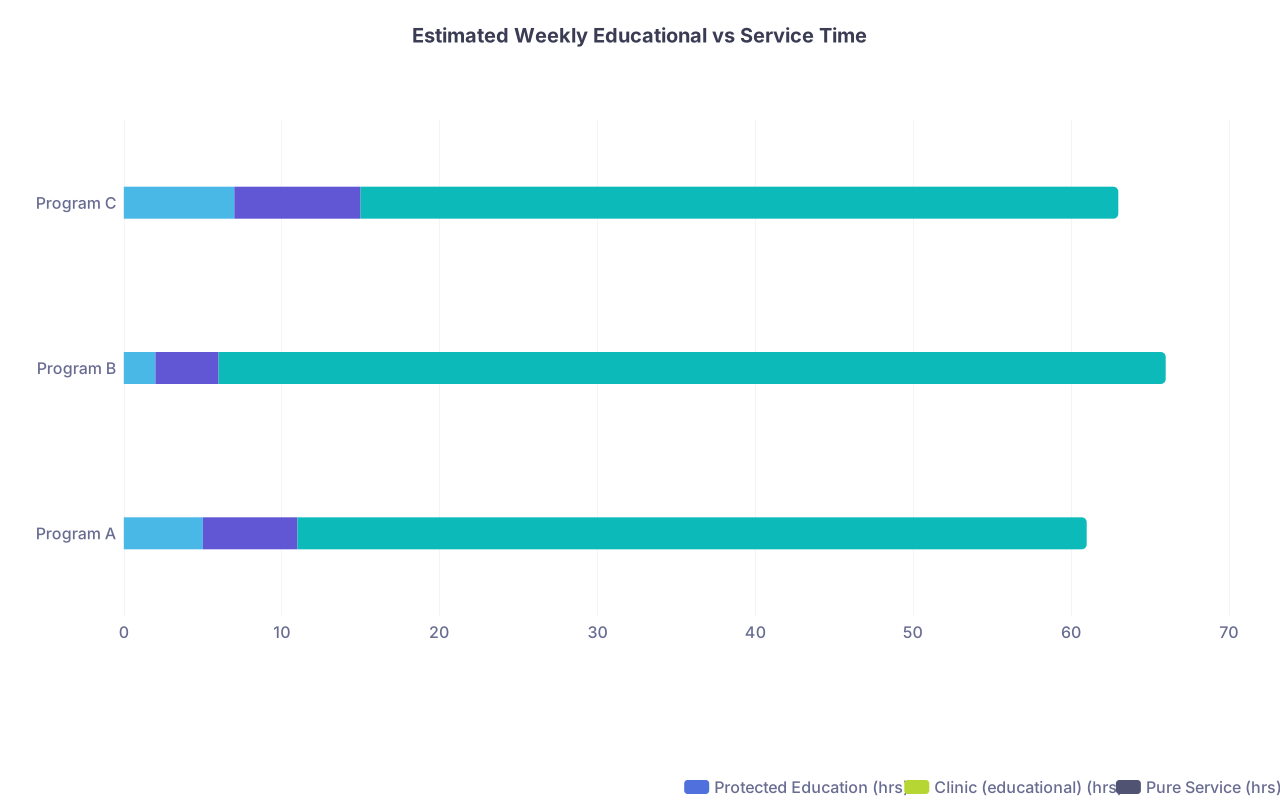
| Category | Protected Education (hrs) | Clinic (educational) (hrs) | Pure Service (hrs) |
|---|---|---|---|
| Program A | 5 | 6 | 50 |
| Program B | 2 | 4 | 60 |
| Program C | 7 | 8 | 48 |
These numbers are estimates, obviously. But the act of estimating will force you to confront how each program structures your week.
Ask yourself:
- Is there at least 4–6 hours per week of truly protected, usable teaching time?
- Is clinic structured with graduated responsibility and realistic volume?
- Does resident language reflect pride in education, or chronic frustration?
If you cannot convincingly answer “yes” to those, that offer is not as attractive as it looks on the surface.
10. Final Advice From Someone Who Has Watched This Go Wrong
I have seen this pattern more times than I care to count:
- MS4 chases big‑name program with weak educational structure.
- First year: constant exhaustion, missed didactics, chaotic clinic.
- PGY‑3: scrambling for boards, weaker than they should be, burned out, regretting priorities.
And the opposite:
- MS4 chooses a less flashy but structurally solid program.
- Consistent didactics, reasonable clinic, strong supervision.
- Leaves residency confident, competitive for fellowships, and not hollowed out.
Your future competence will be built during conference and clinic time. Or not built, if those are sacrificed daily to volume and throughput.
So treat these parts of the offer like they matter. Because they do.
Key points to remember:
- Do not accept vague language. Translate “robust, protected didactics” and “strong ambulatory training” into numbers: hours, patients per session, residents per preceptor, who holds the pager.
- Listen to residents’ actual descriptions of conference and clinic. Their stories will tell you whether education is truly protected or constantly sacrificed to service.
- When comparing pre‑match offers, weigh the structure of conference and clinic at least as heavily as salary, location, or prestige. Those hours are where you either become a strong physician—or just cheap labor with a name tag.