
The worst fellowship decisions are made in November of PGY‑2 with zero strategy and a lot of panic.
Let me be blunt: most residents treat pre‑match offers like lottery tickets. They get one, it feels flattering, and they grab it “before it disappears” without doing the hard work of asking: What does this actually do to my long‑term fellowship pathway?
This is where people quietly cap their own careers.
Let me break this down specifically.
1. What a Pre‑Match Offer Really Is (and What It Is Not)

| Step | Description |
|---|---|
| Step 1 | Resident gets pre match offer |
| Step 2 | Early contract for residency |
| Step 3 | Guaranteed fellowship later |
| Step 4 | Consider contract details |
| Step 5 | High risk to long term goals |
| Step 6 | Type of offer |
| Step 7 | Specialty fits long goal |
| Step 8 | Fellowship tier matches goals |
People mix up three different things under the label “pre‑match”:
- An early residency pre‑match offer (common in some specialties and some states).
- An internal fellowship track / pipeline offer tied to your current residency.
- An outright fellowship pre‑match offer (more common in non‑ACGME or IMG‑heavy environments).
They are not equivalent.
For this article, I am focusing on #2 and #3: offers that claim to “secure your fellowship future” before the regular NRMP / SF Match cycle.
Here is the core truth: a pre‑match offer is a trade.
You are trading:
- Flexibility for security
- Optionality for predictability
- Future competitive upside for guaranteed minimum outcome
Sometimes that trade is brilliant. Sometimes it is career‑limiting. The difference comes down to whether you understand your trajectory, the market, and the genuine caliber of what is being offered.
2. Start With Yourself: Are You Actually Competitive?
If you misjudge your own competitiveness, your decision making will be garbage.
You need an honest assessment across four domains:
- Exam performance
- Clinical performance / letters
- Research and productivity
- Institutional branding and connections
Let’s make it concrete.
2.1 Objective Markers You Cannot Hand‑Wave Away
For the big three fellowships (Cards, GI, Heme/Onc), across U.S. IM residencies, this is roughly the landscape I see over and over:
| Fellowship | Typical Step 2 CK for top programs | Research expectation | Match difficulty (subjective) |
|---|---|---|---|
| Cardiology | 245–255+ | Multiple pubs, abstracts | High |
| GI | 245–255+ | Strong, often GI-focused | Very high |
| Heme/Onc | 240–250+ | Robust, oncology-focused preferred | High |
Is this absolute? No. But it is directionally correct.
Add on top:
- You are at a strong academic IM residency (university or big academic affiliate)
- You have at least 2–3 meaningful projects, ideally one first‑author or in‑progress manuscript
- You have or can realistically get letters from people whose names other program directors actually recognize
If that sounds like you, an early lock into a mid‑tier or weakly academic fellowship can be a mistake. You are probably undervaluing your ceiling.
If, on the other hand, you:
- Struggled with exams (Step 2 CK under ~230, multiple attempts, or significant remediation)
- Have minimal research and no plausible way to build a solid portfolio in time
- Are at a small community program with very limited fellowship track record
Then a solid pre‑match fellowship offer might be one of the most protective, rational decisions you can make.
The point: you do not decide about pre‑match in a vacuum. You decide relative to your realistic match competitiveness.
3. The Only Three Questions That Actually Matter
Strip away the noise and every pre‑match fellowship decision comes down to three questions:
- Does this pathway keep my long‑term options open or close them?
- Is the caliber of this offer aligned with my realistic ceiling, not my insecurity?
- What am I giving up that I cannot get back?
I want to dissect each one.
3.1 Does this pathway narrow or preserve future options?
Pre‑match pathways fall on a spectrum:
- Ultra‑narrow: “Sign now and you are locked into Cardiology here, cannot apply externally, and if you back out we will not support you.”
- Semi‑flexible: “You sign indicating strong interest; we prioritize you internally, but you are free to apply externally—with some political cost.”
- Flexible, true pipeline: “By joining this track, you get mentorship and research priority; you still compete in the regular match, here and elsewhere.”
You need to ask blunt questions:
- “If I sign this, am I contractually or practically discouraged from applying externally?”
- “What happens if I change my mind about specialty?”
- “Have prior residents ever signed this and then successfully gone elsewhere?”
If the answer is essentially: You will be ours and you will like it, then this better be a program you would be proud to have on your fellowship CV in ten years.
Because you are betting your subspecialty identity on them.
3.2 Is the caliber of this offer at, below, or above your ceiling?
Residents underestimate how much reputation follows them.
A simple mental model: take the name of the fellowship being offered and imagine you are applying for:
- Advanced fellowships (EP, interventional, transplant, advanced endoscopy)
- Academic junior faculty roles at major centers
- Competitive practice groups in good cities
Would that fellowship name help, be neutral, or quietly drag you down?
Here is a quick way to visualize relative program tiers, using Cardiology fellowship as an example:
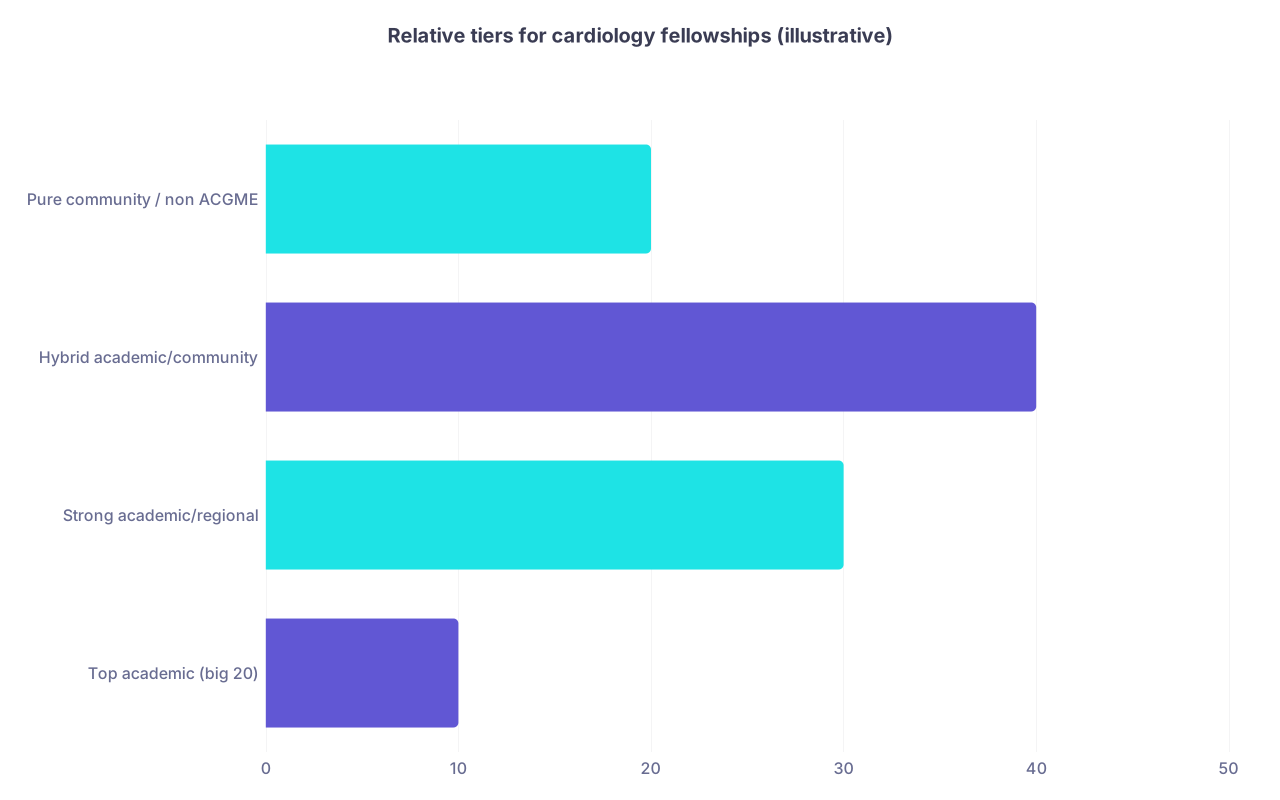
| Category | Value |
|---|---|
| Top academic (big 20) | 10 |
| Strong academic/regional | 30 |
| Hybrid academic/community | 40 |
| Pure community / non ACGME | 20 |
If your current trajectory (based on performance and program) could plausibly reach “Top academic or strong academic/regional”, and your pre‑match offer locks you into “Hybrid academic/community” with no easy way to pivot, that is a meaningful downgrade.
You are trading upside for security. Sometimes wise. Sometimes not.
3.3 What are you giving up that you cannot get back?
A few sacrifices are reversible. Most are not.
Things you may be giving up:
- The chance to explore or pivot specialties during PGY‑2 / early PGY‑3
- The possibility of a substantially stronger letter from an external away rotation
- The option to use your improved CV (after research, leadership, exams, awards) in a wider market
- The ability to negotiate for better conditions because you are a free agent
Once you pre‑match fellowship, most of that leverage evaporates. You have told the market: I am already spoken for.
Sometimes that is exactly what you want. Many times, it is 6–9 months premature.
4. Dissecting Common Pre‑Match Scenarios
Let us go through real patterns I see, especially in IM, FM, Psych, and some surgical subspecialties.
4.1 Internal fellowship pre‑match in Internal Medicine (Cards/GI/HemeOnc)
Scenario: PGY‑2 IM resident at a decent academic program. Evaluations are strong. Research is in progress. The home Cardiology program offers an early internal spot if you commit now.
On the surface this feels like winning the game early.
Questions you should be asking:
- Where does this Cardiology program sit nationally?
- Do they actually place fellows into strong jobs / advanced fellowships?
- What is their track record for external matches for residents who do not pre‑match?
- How many of their fellows are home vs external?
You also want hard numbers:
| Metric | Green flag value | Red flag pattern |
|---|---|---|
| ABIM board pass rate | >90% consistently | Repeated low pass rates |
| % fellows in academic jobs | 30–50% in real institutions | Almost none |
| Advanced fellowship placement | Regular EP/Interv/Imaging | Rare or never |
| External match rate for residents | Steady, predictable | Almost all stay home only |
If you see a fellowship with:
- Strong faculty
- Clear subspecialty depth
- Graduates landing in serious jobs
…pre‑matching there as a solid but not superstar resident may actually be perceptive. You lock in a good outcome before you prove to the rest of the country that you are good enough.
If, instead, the program lives off its own residents because no one else wants to go there, and graduates mostly disappear into low‑acuity jobs without choice, you are locking in a low‑ceiling pathway.
4.2 FM or Psych resident offered pre‑match fellowship in Sports, Addiction, Geri, etc.
Typical pattern: PGY‑2 FM resident gets an early nod for a Sports Medicine fellowship in the same health system. Or a Psychiatry resident is offered guaranteed Addiction fellowship if they sign now.
These fields are different from Cards/GI. They are:
- Smaller
- Highly network‑driven
- Variable in quality and exposure
Here, the content of the fellowship and the network matter more than the name brand alone.
You want answers to:
- What are your graduates actually doing? (Not hypothetical. Names and practice settings.)
- How much procedure or niche exposure do I get? (Ultrasound, interventional pain, interventional psych, etc.)
- Do residents from other programs try to get into this fellowship, or is it almost all homegrown?
If this is a program that truly mentors people into strong, satisfying jobs in the niche you want, an early guarantee can be excellent. Many FM and Psych residents overestimate how easy it will be to “just match a better spot later” in highly saturated geographic markets.
If, on the other hand, it is clearly a “we need to fill our own slots” move and you are a top performer who can clearly compete broadly, do not undersell yourself for the comfort of being done early.
5. Concrete Evaluation Framework: How to Score a Pre‑Match Pathway
Let me give you something more structured than vibes.
Create three separate scores from 1–5:
- Program Power Score (P)
- Fit and Trajectory Score (F)
- Option Cost Score (O)
5.1 Program Power Score (P): How strong is this fellowship objectively?
Consider:
- National reputation (how often do you hear this name, where do grads go?)
- Faculty depth in subspecialty areas
- Case volume and diversity
- Board pass rates
- Alumni outcomes
Rough rubric:
1 – Weak community, poor outcomes, unknown
2 – Mediocre, limited academic footprint
3 – Solid regional academic or strong community with good clinical exposure
4 – Strong academic, good national footprint
5 – Top‑tier, known for your desired niche
Be honest. Nobody else sees your number.
5.2 Fit and Trajectory Score (F): How well does this align with who you are becoming?
Consider:
- Specialty fit: how certain are you of this field?
- Style fit: academic vs clinical, research vs service heavy
- Geographic / personal life fit (partner, kids, visa, etc.)
- Your realistic projected competitiveness at peak application time
Rubric:
1 – Field uncertain, poor lifestyle/geographic fit
2 – Some interest, but serious reservations about field or location
3 – Good fit but not your dream scenario
4 – Strong fit on multiple dimensions
5 – Ideal specialty, environment, and life alignment
5.3 Option Cost Score (O): How much future optionality are you burning?
High number here means you are giving up a lot.
Consider:
- Will you be blocked or discouraged from external applications?
- Do you have a realistic chance at much stronger programs with 6–12 more months of CV growth?
- Are you closing off major geographic zones or career types?
Rubric:
1 – Almost no real option cost; you would likely rank this #1 anyway
2 – Mild trade‑off but alternatives are not clearly superior
3 – Moderate sacrifice of potential options
4 – Significant loss of potential higher‑tier or high‑fit opportunities
5 – Major, irreversible narrowing of future routes
Now calculate:
- Net Value Score (NVS) = P + F − O
You want that number as high as possible. For most sane decisions, NVS ≥ 4–5; exceptional decisions are 6–8.
Example:
Mid‑tier but strong academic Cardiology program, you are a solid resident with some research, likely to be regionally competitive, but not clearly national‑level. They offer an internal pre‑match.
- P = 3
- F = 4 (you love Cards, like the city, partner employed there)
- O = 2 (you might do slightly better, but not dramatically)
NVS = 3 + 4 − 2 = 5 → Very reasonable to take.
Another example:
Community GI fellowship with limited research, offered to a resident at a rising academic IM program with 255 Step 2 CK and strong research potential.
- P = 2
- F = 3 (you like GI, but not sure about this city; spouse neutral)
- O = 4 (you are very likely to be nationally competitive in 10 months)
NVS = 2 + 3 − 4 = 1 → This is probably a bad trade.
6. Red Flags People Ignore When They Are Flattered
The pre‑match psychology is predictable: “They want me. They see my value.” That is intoxicating. That is also where you get played.
Here are patterns that should slow you down immediately.
They push a hard deadline with vague threats.
“We really need to know by next week, or we have to move on.”
Good programs want commitment, but they do not usually behave like used‑car sales.They cannot (or will not) show you hard data.
You ask: “Where did your last 5 fellows go?” They answer: “Oh, all over. People do really well.” That is not an answer. That is a dodge.Nobody external comes.
Look at the fellowship roster. If 80–100% of fellows are from the same residency, year after year, for a supposedly competitive field, that is a signal. Strong programs draw from multiple residencies.Fellows seem exhausted and vague about their plans.
Talk to current fellows without faculty present. Ask: “If you could redo your fellowship choice, would you?” The tone of that answer will tell you more than any brochure.Residents who did not sign early did better later.
Every program has a quiet legend: “X did not sign the early contract and matched GI at [better place].” If that story exists repeatedly, learn from it.
7. Special Situations: IMGs, Visa Holders, and Non‑ACGME Fellowships
Here is where things change.
7.1 IMGs and visa constraints
If you need:
- H‑1B sponsorship
- A very specific geographic area
- A program with a history of handling complex visa situations
Then the value of a guaranteed fellowship jumps dramatically.
I have seen very capable IMGs roll the dice on the open market, only to discover that half the programs silently filter out their visa status. They go unmatched not because they are weak, but because the market is brutal.
If the pre‑match fellowship:
- Is ACGME‑accredited
- Has a real track record of successful visa handling
- Gives you a stable multi‑year pathway in the U.S.
Then P and F get a quiet boost, and O often matters less. Survival and stability are not trivial.
7.2 Non‑ACGME and “niche” fellowships
Sports Medicine, Pain, certain procedural fellowships, hospital medicine “fellowships”, etc.
Here, you must ask a different question: Does this credential actually change my job options or pay?
If the fellowship:
- Is non‑ACGME and poorly recognized
- Does not confer significant new skills or billing codes
- Effectively just pays you less to be a slightly fancier attending
Then pre‑matching to that is often not worth it, unless it heavily aligns with long‑term lifestyle or geography you deeply care about.
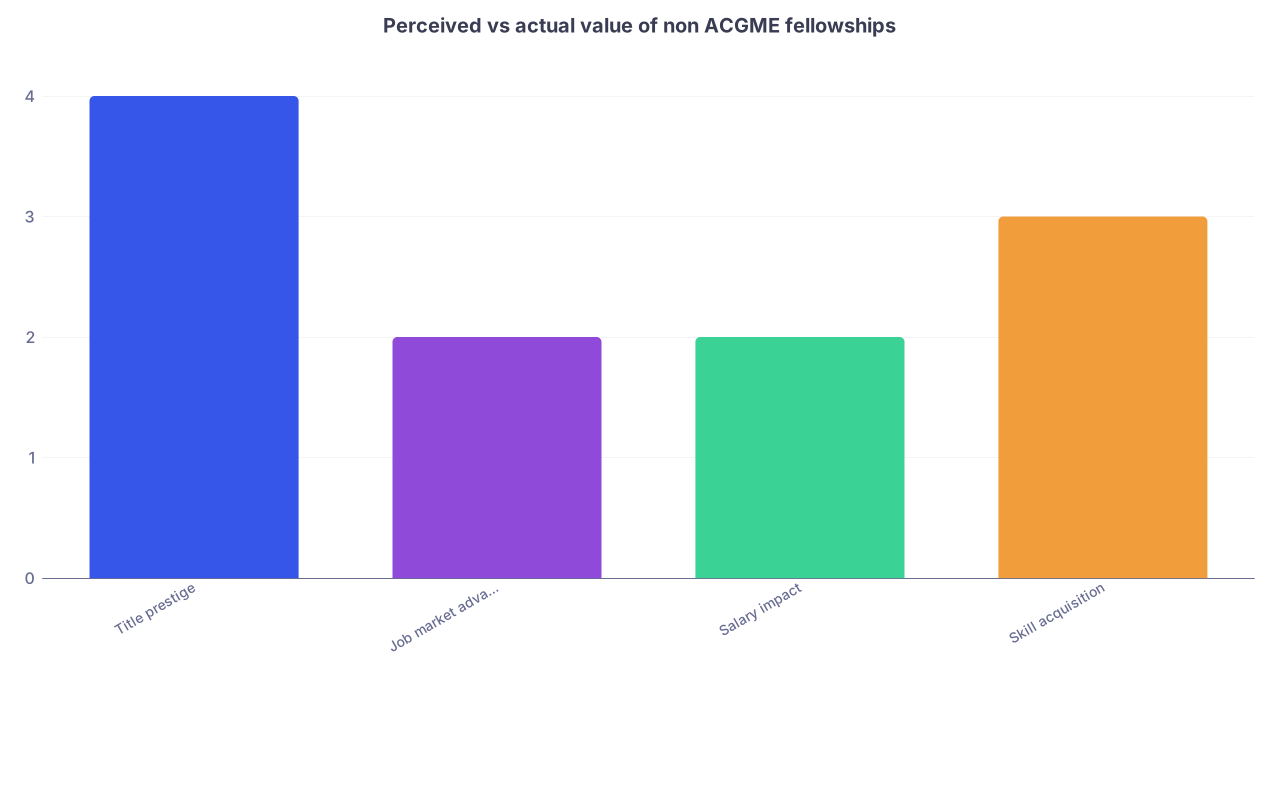
| Category | Value |
|---|---|
| Title prestige | 4 |
| Job market advantage | 2 |
| Salary impact | 2 |
| Skill acquisition | 3 |
(Scale 1–5, typical non‑ACGME: high title prestige, mediocre job/financial returns, variable skills.)
8. How to Actually Prepare for Pre‑Match Offers
Preparation is not just “know your CV.” You need to deliberately shape your leverage before anyone ever approaches you.
8.1 Build a fellowship‑ready profile early
By mid‑PGY‑2, if you are fellowship‑inclined, you should already have:
- At least one ongoing project with a likely abstract/poster before application season
- A short list of faculty who can potentially write you strong letters
- Exposure to your target specialty on elective rotations
- Some sense of your national competitiveness (ask honest mentors, not just friends)
This does two things:
- You become the type of resident who gets pre‑match offers.
- If you decline, you are not doing it from a weak, desperate position.
8.2 Decide your “walk‑away” criteria before the offer arrives
This is key. You cannot think clearly in the glow of being wanted.
Before any offer:
- Define your minimum acceptable P (Program Power) for each fellowship type.
- Decide how much optionality (O) you are willing to sacrifice in PGY‑2 vs PGY‑3.
- Write it down. On paper. Not in your head.
If you tell yourself: “I will not lock into a program I would not be happy to list as my top choice in the open match,” then when a pre‑match from a clearly backup‑tier spot arrives, you are less likely to rationalize it.
8.3 Have 2–3 external mentors outside your own program
Internal mentors are politically constrained. They often want to keep good residents.
You need:
- One mentor from your medical school or prior research experience
- Possibly one from an away rotation or national society connection
- One senior fellow or junior attending who has recently been through the match
They can tell you things like:
- “No, that fellowship is not as strong as you think; the name recognition is very local.”
- “Given your scores and CV, I strongly suspect you can match as good or better elsewhere.”
- “If you had my background, I would sign that pre‑match tomorrow.”
This external calibration is worth a lot more than a program director telling you “we think you would be a great fit here.”
9. Step‑by‑Step When You Actually Get a Pre‑Match Offer
Here is the actionable sequence, condensed.

| Step | Description |
|---|---|
| Step 1 | Receive pre match offer |
| Step 2 | Clarify details in writing |
| Step 3 | Gather data on program outcomes |
| Step 4 | Score P, F, O |
| Step 5 | Discuss with external mentors |
| Step 6 | Negotiate terms and timeline |
| Step 7 | Politely decline or request more time |
| Step 8 | NVS high enough? |
Clarify the offer in writing.
Is it binding? For how many years? What happens if you later match elsewhere (rare but important)? What are the contingencies?Collect hard data.
Ask for recent graduate destinations, board pass rates, call schedules, research expectations. Talk to at least two current fellows privately.Score P, F, O honestly.
Use the framework earlier. Write down numbers.Run it by 2–3 external mentors.
Show them your scores and the data you have. Ask them where they would draw the line.Decide on a timeline.
You are allowed to say, “I appreciate this and I take it seriously. I would like X days to speak with my mentors and family.”If you accept, commit.
Once you say yes, your reputation is now tied to honoring that. Backing out later without truly extraordinary circumstances damages you and your program.If you decline, keep the relationship intact.
“I am very grateful and truly honored. After careful thought, I feel I need to go through the open match to fully explore my options. I hope we can still work together and I would be happy to apply through the regular process as well.”
Programs respect clarity. What they hate is vague stalling and evasiveness.
10. The Quiet Reality: Most Residents Under‑Aim, Not Over‑Aim
The fear narrative you hear is: “If you do not take this pre‑match, you might end up unmatched.” That happens, but far less often than people think in reasonably competitive residents.
What I see more commonly:
- Very capable residents accepting mediocre pre‑match offers
- Then watching their slightly bolder co‑residents match at stronger programs a year later
- And quietly resenting it, stuck in a less powerful environment for 3 more years
If you are weak on paper and your program knows it, and they still offer a decent fellowship pre‑match, that is often a gift. Take it.
If you are strong on paper, with upward momentum and time to mature your CV, automatically taking the first safe harbor you see can be an overcorrection to anxiety, not a strategy.
Key Takeaways
- A pre‑match fellowship offer is a trade: security now in exchange for future optionality. You must judge that trade against your real competitiveness, not your fear.
- Use a structured framework—Program Power (P), Fit (F), and Option Cost (O)—and calculate a Net Value Score before you say yes or no. Do not decide purely on flattery or pressure.
- The best pre‑match decisions come from residents who prepared early: built a fellowship‑viable profile, knew their walk‑away criteria, and had external mentors to sanity‑check the true value of the pathway being offered.