
It is early November. You just opened an email from a community internal medicine program in Texas: “We’d like to extend you a pre-match offer…” Your heart rate jumps. Salary looks fine. Visa support included. Then you scroll to the bottom of the PDF and hit the section most applicants half-skim and pretend they understand: “Call Responsibilities.”
q4 in-house. “Flexible nights.” Home call for ICU “as needed.” No cap on admissions in writing. You tell yourself, “It’s just residency, it’s supposed to be hard.”
This is exactly where people sign themselves into three years of preventable burnout.
Let me be blunt: the call schedule embedded in that pre-match contract is one of the strongest early predictors of your long-term burnout risk. I have watched residents go from energized interns to hollow-eyed PGY-3s almost entirely because of one thing: call structure that never let up.
Let me break this down specifically.
1. Why Call Structure Is A Burnout Crystal Ball
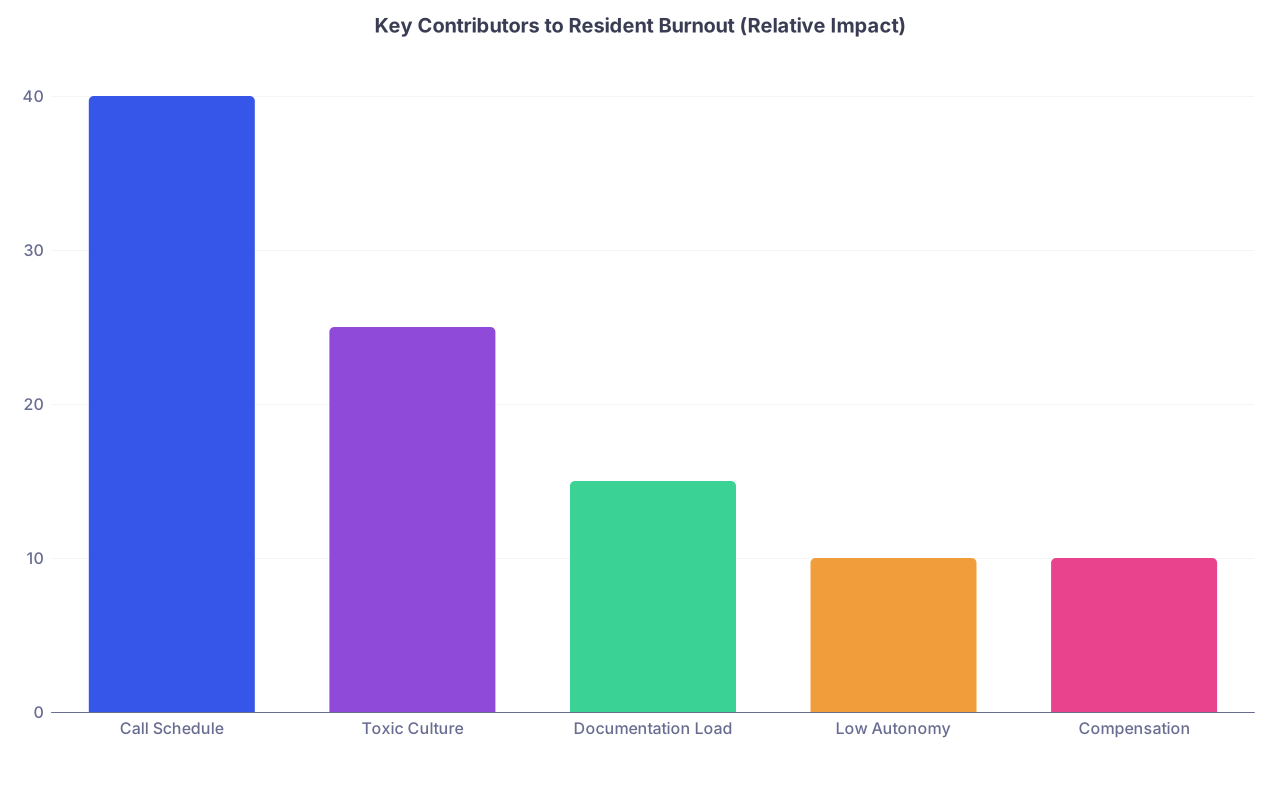
| Category | Value |
|---|---|
| Call Schedule | 40 |
| Toxic Culture | 25 |
| Documentation Load | 15 |
| Low Autonomy | 10 |
| Compensation | 10 |
Most applicants obsess over:
- Geographic location
- Prestige / fellowship match
- Salary and benefits
And they casually glance at call. That is backwards.
Here is why call is so predictive of burnout:
- It dictates your sleep architecture for 3–7 years. Chronic circadian disruption is not subtle; it hits cognition, mood, immune function, and cardiovascular risk.
- It defines your time control. How many evenings you have off, how many weekends you actually see sunlight, whether you can maintain relationships.
- It shapes your clinical intensity curve. Are you dealing with acute chaos in long in-house shifts, or a more spread-out, manageable load?
Every longitudinal study on physician burnout converges on a few themes: long hours, loss of control, chronic stress, and lack of recovery. A bad call schedule checks all four boxes.
When I hear a resident say, “I hate this place,” nine times out of ten, if you strip away the details, what they actually mean is: “The call is destroying me.”
So your pre-match question is not just “Do I want this program?” It is “Am I willing to live the reality of this call schedule for several formative years, knowing what that does to people?”
2. Decoding Call Types: What Actually Matters
Residents love to compare call using labels: “We are q4.” “We have night float.” Those labels are half the story. You need the structure, not just the name.
A. Classic q4 / q5 In-House Call
This is the old-school model: every 4th or 5th night you are in the hospital 24–28 hours.
Typical pattern:
- Pre-call day: regular work
- Call day: 24–28 hours in-house
- Post-call day: you leave by late morning (in the better programs)
- Then 1–2 “golden” days
Sounds tolerable on paper. In reality:
- Sleep during call is fragmented and unpredictable
- You’re never fully rested for your “golden” days
- Recovery debt accumulates over weeks
Risk factor for burnout:
- High, especially in programs that still push right up against (or quietly over) 80 hours/week on average.
- Worst when combined with: high admission caps, minimal ancillary support, and an unsafe ratio of residents to patients.
Red flags:
- q3 or q4 in-house call on multiple busy rotations every month as an intern
- “Post-call can leave by 2 pm” (translation: you are there until 2 pm, minimum)
- No clear mechanism for logging work hours or enforcing caps
B. Night Float Systems
Night float sounds attractive: “No 28-hour calls, just week-long blocks of nights.” But there is nuance.
Basic structure:
- 5–7 consecutive nights
- 10–13 hour shifts (e.g., 7 pm–7 am)
- Followed by a few days off or switch back to days
Advantages:
- Limits max continuous duty hours
- Sleep during off blocks can be more stable
- Less brutal circadian swing than intermittent all-nighters, if scheduled intelligently
Burnout risk depends on:
- Duration of blocks: back-to-back 2-week night blocks are brutal.
- Turnover between day and night: programs that flip you rapidly between nights and days without proper buffer days are sleep-wrecking.
- Load at night: one night resident covering 4–5 services plus cross-cover for 80+ patients is a different universe from 2–3 residents sharing the load.
Safer patterns:
- 1-week night float blocks, not stacked excessively
- Guaranteed post-night recovery days
- Reasonable cap on cross-cover census and admissions
C. Home Call
Home call is the most abused label in residency.
On paper:
- You are “at home”
- You come in only if needed
- Less intense than in-house
Reality varies from:
- True light home call: 0–2 calls per night, occasionally have to come in
- De facto in-house from home: phone rings nonstop, you are driving in multiple times, charting remotely until 2–3 am
Burnout risk:
- Moderate to high when home call is frequent (every 2–3 days) and actually busy
- Especially bad for surgical subspecialties and ICU where “home call” basically means “in-house most nights but unpaid for in-house call premiums”
You need specific data:
- How often do residents actually have to come in?
- How many hours do they average working from home on these nights?
- Is there a mandated post-call protection if they were up most of the night?
If nobody can answer that clearly, assume the worst.
D. Step-Down and Senior Call
PGY-2+ call often shifts from pure workhorse to supervisory:
- Cross-cover multiple teams
- Take admissions with interns or independently
- Handle more complex decision-making
Burnout risk here is tied to:
- How many patients you are covering
- How much backup you actually have at 2 am
- Whether you are constantly “the only one” making calls on critical patients
Senior call can be less physically exhausting but more morally and cognitively draining. In some ways, more dangerous for eventual burnout if you are unsupported.
3. Reading Call Language In Pre-Match Contracts Like A Lawyer

Most pre-match offers do not scream, “We will burn you out.” They hide it in vague phrases. Your job is to translate.
You will typically see a combination of:
- “Average of one in four call”
- “Night float system utilized on select rotations”
- “Home call as needed on subspecialty services”
- “Duty hours in compliance with ACGME standards”
Let’s decode:
“Average of one in four call”
- Could mean four months q4, eight months q6. Or nine months q3–4 and three light ones.
- Ask: “Can you break down call frequency by rotation for each PGY year?”
“Night float system utilized”
- Could be civilized 7-on / 7-off. Could be 14 nights straight every other month.
- Ask: “How many weeks of nights per year, and how are they distributed?”
“Home call as needed”
- If it is not quantified, assume it is heavy.
- Ask: “On average, how many times do residents get called in per home call night on X service? Can I speak with a current resident who did that rotation recently?”
“Duty hours in compliance with ACGME”
- This is baseline legal language, not a compliment. Everyone writes this; not everyone truly abides by it.
- Ask: “Have you ever had ACGME citations regarding duty hours in the last 5 years? If so, for what and how was it addressed?”
Where programs get especially slippery is with:
- “Flex call” or “jeopardy call”
- “Resident may be asked to cover additional call to meet service needs”
Translation: short-staffed. You will be the plug for every leak.
That language, buried near the end of a contract, is responsible for an unbelievable amount of resident misery.
4. Specific Call Patterns That Strongly Predict Burnout
Let’s stop speaking generically. Here are patterns I have seen again and again in people who end up exhausted, cynical, or leaving medicine entirely.
Pattern 1: High-Frequency In-House Call Plus Weak Post-Call Protection
Example:
- IM program, PGY-1
- q4 in-house call on wards for 6 months of the year
- Post-call “must leave by 2 pm” language
- Clinic sometimes scheduled the afternoon after a heavy night
Effect over time:
- Chronic sleep restriction (you are up until at least 3–4 am, rarely sleeping more than 2–3 fragmented hours)
- Post-call day is not recovery; it is a half-workday
- Your off days become pure recovery, not real life
Three years of this and people are done. Not because they do not love medicine. Because their brains never got to be off duty.
Pattern 2: Heavy, Poorly Supported Night Float With Massive Cross-Cover
Example:
- Single night float resident covering: 3 wards + step-down + cross-cover admissions
- No in-house attending after 8 pm, limited senior backup
- Interns at home, you carry the night
Burnout trajectory:
- Emotional exhaustion from constant high-stakes decisions
- Hypervigilance even off shift (“What did I miss?”)
- Long-term sleep inversion leading to mood issues
Residents in this pattern often show classic depersonalization signs: joking darkly about patients, disconnecting emotionally, snapping at nurses, not because they are cruel people but because they are maxed out.
Pattern 3: Pseudo-Home Call That Destroys Evenings
Example:
- Surgical subspecialty PGY-2+
- “Home call every other day”
- Pager goes off 10–20 times nightly
- You physically come in almost every night for consults or post-op issues
- Still expected in OR/clinic at 6–7 am daily
This is a slow burn. You technically “go home,” but you never truly leave work. Family dinner? Interrupted. Sleep before midnight? Unlikely. Exercise? Fiction.
Burnout risk is compounded by the fact that people in these programs often normalize it with a macho culture: “This is how we train surgeons.” That culture is a giant red flag on its own.
Pattern 4: Chronic Violation Of The “Golden Weekend”
The “golden weekend” (both Saturday and Sunday off) is whatever is left of normal human life in residency.
Programs that:
- Rarely give full weekends off
- Stack call so that you are always working at least one day on weekends
- Use your post-call day as your “day off”
End up producing residents who have no real psychological separation between work and non-work. That is textbook burnout territory.
5. How To Interrogate A Call Schedule Before Accepting A Pre-Match Offer

| Step | Description |
|---|---|
| Step 1 | Receive Pre Match Offer |
| Step 2 | Review Written Call Language |
| Step 3 | List Specific Questions |
| Step 4 | Ask Program Coordinator or PD |
| Step 5 | Cross Check With Current Residents |
| Step 6 | Assess Fit and Consider Offer |
| Step 7 | High Burnout Risk - Reconsider |
| Step 8 | Consistent and Reasonable? |
You need a method, not vibes.
Step 1: Get The Detailed Call Grid
Do not settle for “q4 on average.” Ask explicitly:
“Can you share an example call schedule by rotation for each PGY year, even if approximate?”
You want:
- How many months of wards, ICU, ED
- Call type and frequency on each
- Night float blocks (how many weeks, how distributed)
- Home call rotations and frequency
If they cannot provide this, that by itself is information. Either they are disorganized or they are hiding an ugly truth. Neither is good.
Step 2: Calculate Your Realistic Weekly Workload
Do a rough calculation:
- For each rotation: estimate average weekly hours including call
- Multiply by number of weeks that rotation occurs
- Divide by 52 to get a baseline annual average
You are not trying to be precise; you are stress-testing.
If your back-of-the-envelope math keeps landing above 75–80 hours/week on several months, that is a big burnout multiplier, even if “the average for the year” floats under 80.
Step 3: Talk To The Right Residents, The Right Way
Never trust only the official line. You want hallway-level truth.
Whom to talk to:
- At least one PGY-1, one PGY-2, one PGY-3
- Preferably someone not selected by the PD as your “contact”
Ask concrete questions:
- “How many 24+ hour calls did you do in the last 2 months?”
- “On night float, how many admissions do you usually take, and how many patients do you cross-cover?”
- “How many weekends were completely off in the last 3 months?”
- “How often are duty hours actually violated, and what happens when you report that?”
Pay attention to:
- Hesitation before answering
- Forced positivity (“Well, everywhere is hard”)
- Normalization of dysfunction (“We all just power through it”)
If multiple residents independently warn you about call, believe them.
Step 4: Look For Structural Protections
You are trying to gauge whether the program as an institution respects resident limits or views them as obstacles.
Good signs:
- Transparent duty-hour logging with real consequences when violated
- Night float specifically designed to reduce fatigue, not to hide violations
- Genuine post-call relief before noon, consistently
- Explicit “no clinic post-call” rules for heavy nights
Bad signs:
- “We do not like to report violations; it causes paperwork.”
- “We all pitch in when it’s busy” with no defined backup system
- Residents shrugging when you ask about caps (“We just take what comes”)
6. Matching Call Patterns To Your Own Risk Profile
| Resident Profile | Highest-Risk Call Pattern | Lower-Risk Alternative |
|---|---|---|
| Needs regular sleep | Frequent 24+ hour q4 in-house | Shorter night float blocks |
| Has young children/family duties | Unpredictable heavy home call | More structured in-house nights |
| Prone to anxiety / rumination | Solo senior overnight crosscover | Team-based nights with backup |
| Planning intense fellowship path | Chronic 80+ hour months PGY-1 | Programs with true 70–75 hour avg |
Not everyone burns out under the same load. Some people tolerate circadian chaos better than others. But almost nobody thrives under years of nonstop excess call.
Ask yourself:
- How do I function with fragmented sleep?
- Have I struggled with depression, anxiety, or insomnia in the past?
- How important is predictable time off for my relationships and sanity?
- Am I likely to need to study meaningfully for boards / fellowship during residency?
Then map your answers onto call structures:
- If you are already sleep-fragile: avoid heavy 24+ hour call systems, even if the program looks “big-name.”
- If you have significant family responsibilities: chronic, unpredictable home call is a landmine.
- If you are aiming for a competitive fellowship: a call schedule that leaves you cognitively flattened will sabotage your study consistency.
Do not moralize this. Picking a less punishing call schedule is not being “soft.” It is being strategic about a 30–40 year career.
7. How Pre-Match Pressure Makes People Ignore Red Flags
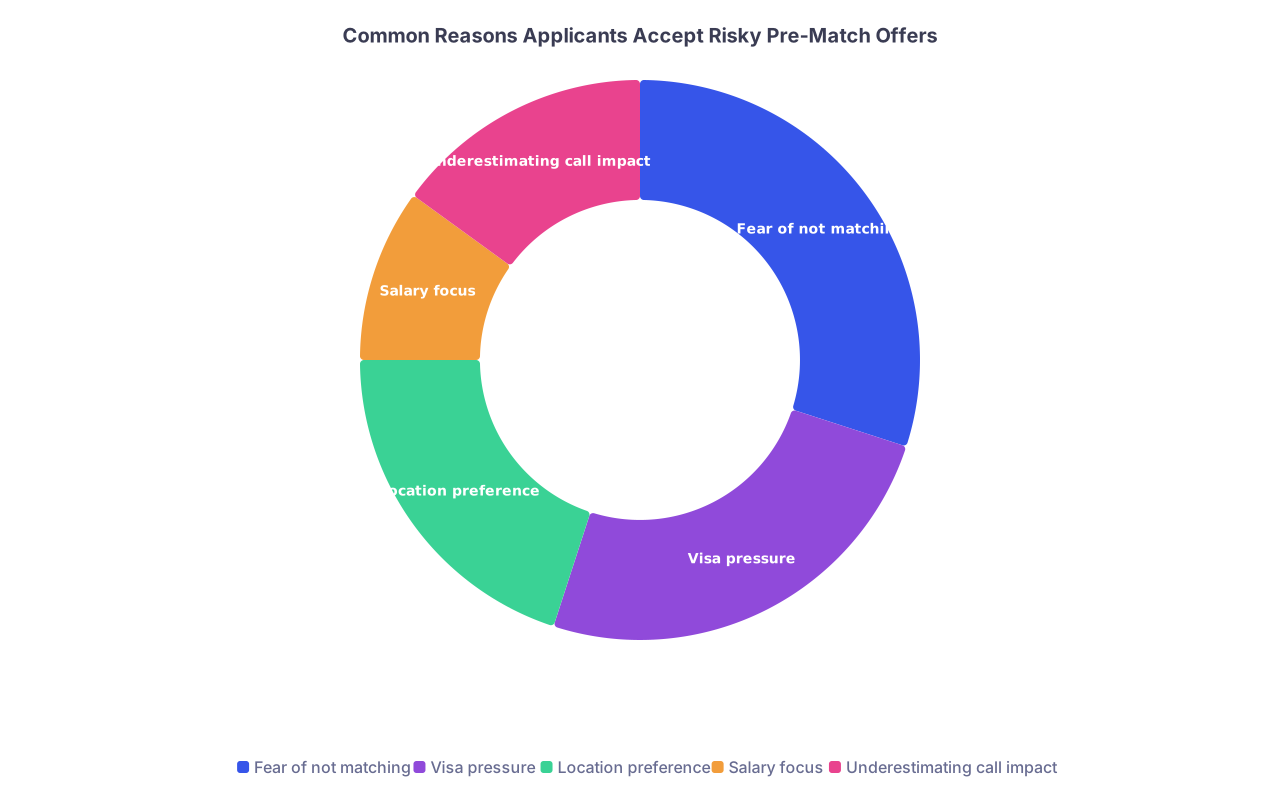
| Category | Value |
|---|---|
| Fear of not matching | 30 |
| Visa pressure | 25 |
| Location preference | 20 |
| Salary focus | 10 |
| Underestimating call impact | 15 |
Pre-match offers come with psychological traps:
- Fear: “I might not get anything better.”
- Visa anxiety: “This one is willing to sponsor me; I cannot risk saying no.”
- Social pressure: “My classmates are already signing; I am behind.”
All of that makes you minimize call red flags.
I have seen people on J-1 or H-1B pathways accept absolutely brutal call schedules because they felt locked in. Years later, they are the ones describing panic attacks before shifts, divorces, or complete career disillusionment.
You need a rule for yourself:
“I will not accept any pre-match offer where the call schedule is clearly unsustainable, even if the rest looks perfect.”
Does that mean some people will roll the dice and do fine anyway? Sure. But that is not a strategy; that is gambling your health on “maybe it will not be that bad.”
8. Practical Checklist Before You Sign

Use this as a literal checklist with any pre-match offer:
Do I have a rotation-by-rotation breakdown of call for all 3 years?
Do I know:
- How many 24+ hour calls per month, per year?
- How many weeks of night float per year?
- How often home call occurs and how busy it is in reality?
Have I spoken to at least three residents at different levels, privately, about:
- Actual hours worked
- Frequency of duty-hour violations
- How they feel right now about their work-life balance?
Are there structural protections:
- Post-call relief?
- No clinic after heavy nights?
- A workable jeopardy/backup system?
Does the call schedule, combined with my own risk factors, feel survivable for 3+ years?
If you cannot answer these five with confidence, you are signing a contract with a major blind spot.
9. When A “Bad” Call Schedule Might Still Be Worth It — And How To Survive It
I am not naive. Some of you will knowingly walk into harder call environments for:
- Elite training
- Specific fellowship pipelines
- Geographic or visa constraints
If you are going to accept a heavy call schedule, do it with your eyes open and a plan.
At minimum:
- Maximize sleep hygiene on non-call days. Dark room, strict bedtime, no heroics.
- Treat free weekends as protected: no unnecessary extra shifts, minimal social overcommitment.
- Build micro-recovery: 10–15 minutes of genuine downtime during shifts when possible.
- Offload life admin. Pay for services that save you time and energy if you can: grocery delivery, cleaning help.
- Get a therapist or at least a confidante early. Do not wait until PGY-3 to treat burnout.
But even then, if during intern year you realize: “This is not sustainable,” do not martyr yourself. Transfer is possible. Fellowship paths exist from less punishing programs. The sunk-cost fallacy keeps a lot of residents in environments that are actively harming them.
10. Visualizing the Trade-Off: Call vs Burnout vs Training Quality
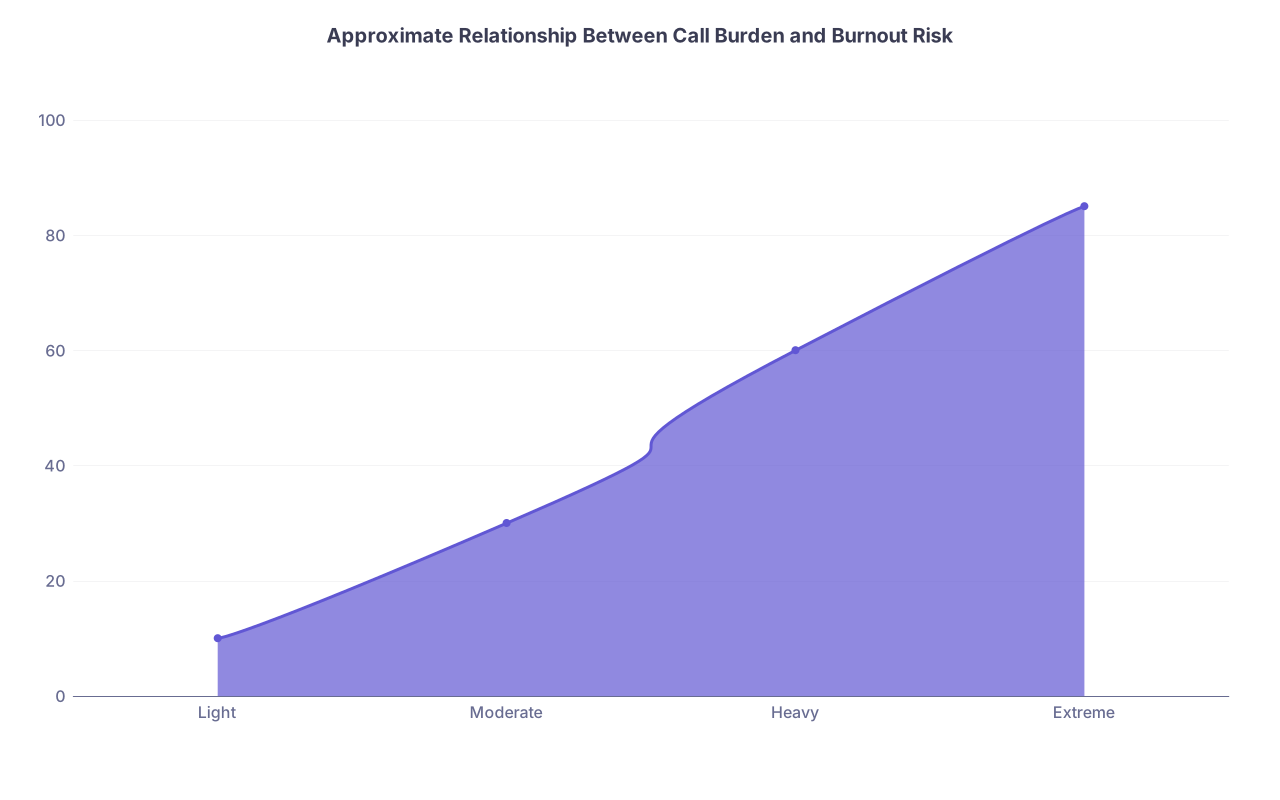
| Category | Value |
|---|---|
| Light | 10 |
| Moderate | 30 |
| Heavy | 60 |
| Extreme | 85 |
There is this myth: “Hard call makes you a better doctor.” Up to a point, increased exposure does improve clinical skill. Beyond that, performance and learning tank because your brain is fried.
The curve looks like this:
- Light to moderate call: enough repetition to build skill, manageable fatigue.
- Heavy call: you are still learning but with noticeable erosion of empathy and cognitive sharpness.
- Extreme call: your learning density per hour plummets. You are just surviving.
Long-term, the people who become the best physicians are not the most sleep-deprived. They are the ones who got enough reps with enough rest to integrate what they were seeing.
Your pre-match call schedule is not just about whether you will be tired. It is about whether the next 3–7 years will build you up or strip you down.
FAQs
1. Is any residency call schedule “safe” from burnout?
No schedule is burnout-proof. But some are clearly lower risk. Programs with:
- Reasonable caps on 24-hour calls
- Limited, well-structured night float
- Transparent duty-hour enforcement
- Genuine post-call recovery
produce far fewer burned-out residents than programs that live at the edge of ACGME limits and hide violations.
2. Should I ever reject a strong pre-match offer based mainly on call?
Yes. If call is clearly extreme (constant q3–4 24+ hour shifts, chronic weekends lost, heavy home call with no real backup), that can outweigh prestige, location, or even slightly higher pay. You cannot buy back your health or your relationships later.
3. How much should I trust what the program director says about call?
Use it as one data point, not the truth. PDs have incentives to present the rosiest version. Always cross-check with multiple current residents, and compare what you hear to the written contract and rotation schedules. Inconsistencies are a loud warning.
4. What if every program I am considering has heavy call?
Then your job is to choose the least toxic version. Look for:
- Honest culture about duty hours
- Strong camaraderie among residents
- Real backup systems when things get unsafe
If the call is heavy everywhere, pick the place that treats residents as humans, not disposable labor.
Key points:
- The call schedule in a pre-match offer is one of the clearest long-term predictors of your burnout risk; treat it as a central decision factor, not fine print.
- Vague phrases like “average q4 call” or “home call as needed” are not enough; demand rotation-level specifics and verify them with current residents.
- Never let fear of not matching or visa pressure push you into signing a contract with a call structure you already suspect is unsustainable.