
Moonlighting clauses in pre‑match offers are where smart residents get burned.
They are not “standard boilerplate.” They are how programs quietly control your time, your income, and sometimes your risk of disciplinary action before you even start residency. If you are walking into a pre‑match contract thinking “my dean said it’s fine” without actually dissecting the moonlighting language, you are gambling with your license and your sanity.
Let me break this down specifically, the way nobody bothers to do on interview day.
1. First principles: what “moonlighting” actually means in this context
Every contract uses the word, but not the same way. If you do not pin down the definition, the rest of the clause is meaningless.
There are really three separate things people call “moonlighting”:
Internal moonlighting
Extra paid shifts at the same institution or within the same GME system (extra ED shifts, cross‑coverage nights, etc).External moonlighting
Paid clinical work for another employer (urgent care, telemedicine, another hospital system).“Anything with a stethoscope”
Some contracts word this so broadly that even a low‑acuity telehealth gig counts as moonlighting that needs approval.
Most pre‑match offers blur these together. Your job is to read the language and ask: “What exactly are they calling moonlighting, and what are they restricting?”
Typical phrases you will see (pay attention to the connectors):
- “Resident shall not engage in any professional medical services for remuneration outside the scope of this Agreement without prior written approval of the Program Director.”
- “All internal and external moonlighting is prohibited during PGY‑1.”
- “Moonlighting may be permitted, subject to written approval and compliance with ACGME work‑hour requirements.”
If “professional services” is undefined, they can interpret it aggressively later. If “outside the scope of this Agreement” is vague, they can argue that half of what you do is covered and half is “moonlighting.” That flexibility benefits them, not you.
Your first mental move: translate the clause into a plain‑language yes/no:
- Can I do any paid clinical work outside this institution?
- Can I do extra paid work inside this institution beyond my standard schedule?
- Who must say “yes,” and can they say “no” for any reason?
If you cannot answer those three clearly from the contract alone, the clause is dangerous.
2. The structure of a moonlighting clause: what you’re actually looking for
Most pre‑match contracts tuck moonlighting language into either:
- a “Duties and Responsibilities” section,
- a “Secondary Employment / Outside Activities” section, or
- a “Professional Activities” or “Exclusivity” provision.
There are four structural elements you should deliberately search for.
2.1 Definition and scope
Look for the operative definition. Keywords:
- “professional services”
- “clinical services”
- “outside employment”
- “remuneration”
- “for pay or for other compensation”
You are trying to map: what exact activities are covered?
A narrow definition (better for you):
“Moonlighting means clinical medical services rendered by Resident to patients not assigned through the Program, for compensation, for an employer other than Hospital.”
A broad definition (worse for you):
“Resident shall not engage in any outside employment, including but not limited to medical, academic, consulting, or telemedicine services, without prior written approval of Hospital.”
The broader the definition, the more your side gigs (and sometimes nonclinical consulting work) become hostage to program approval.
2.2 Prohibition vs permission
There are three main patterns:
Absolute prohibition
“Moonlighting is prohibited during the term of this Agreement.”Prohibition with discretionary exceptions
“Resident shall not engage in moonlighting unless expressly approved in writing by Program Director.”Conditional permission
“Moonlighting may be permitted subject to:
(a) written approval of Program Director;
(b) compliance with ACGME work‑hour limits;
(c) maintenance of satisfactory performance.”
Pattern 1 is straightforward, even if you dislike it. Pattern 2 is where residents get strung along: technically allowed, practically blocked whenever convenient.
2.3 Process and criteria for approval
Any clause that says “subject to approval” without telling you:
- who approves,
- by what process,
- using what criteria, and
- within what time frame
is essentially unfettered discretion.
Better language (you will almost never see this unless negotiated or in very resident‑friendly programs):
- “Program Director shall not unreasonably withhold approval if Resident remains in good standing and compliant with duty‑hour requirements.”
- “Hospital shall respond to written requests for external moonlighting within 30 days.”
Worse language:
- “At the sole discretion of Program Director.”
- “Hospital may revoke permission at any time, with or without cause.”
“Without cause” is a red flag. It means your side income can vanish overnight with no explanation.
2.4 Consequences of violation
Finally, you need to know: what happens if the program decides you violated this?
Look for explicit links to:
- disciplinary action,
- probation,
- non‑renewal, or
- immediate termination.
If the clause says “a material breach of this provision constitutes grounds for immediate termination,” they have given themselves a hammer. “Material” is vague. And they decide what is “material.”
3. The ACGME and duty hours: what the clause should (but often does not) reflect
You do not need a health law degree, but you do need to know exactly what the ACGME says about moonlighting. Because your contract is supposed to align with it.
Core ACGME points:
- Both internal and external moonlighting count toward the 80‑hour weekly limit.
- PGY‑1 residents are not allowed to moonlight. Period.
- The program is responsible for monitoring your total hours if they allow moonlighting.
- You must not be required to moonlight. It must be voluntary.
Now compare that to typical moonlighting clauses:
- Some correctly prohibit PGY‑1 moonlighting.
- Some sloppily copy‑paste the rule but then ignore it in practice.
- Some are stricter than ACGME (for example, banning all external moonlighting for all years).
Being stricter than ACGME is legal. But it is a choice. And it tells you something important about the culture: control > flexibility.
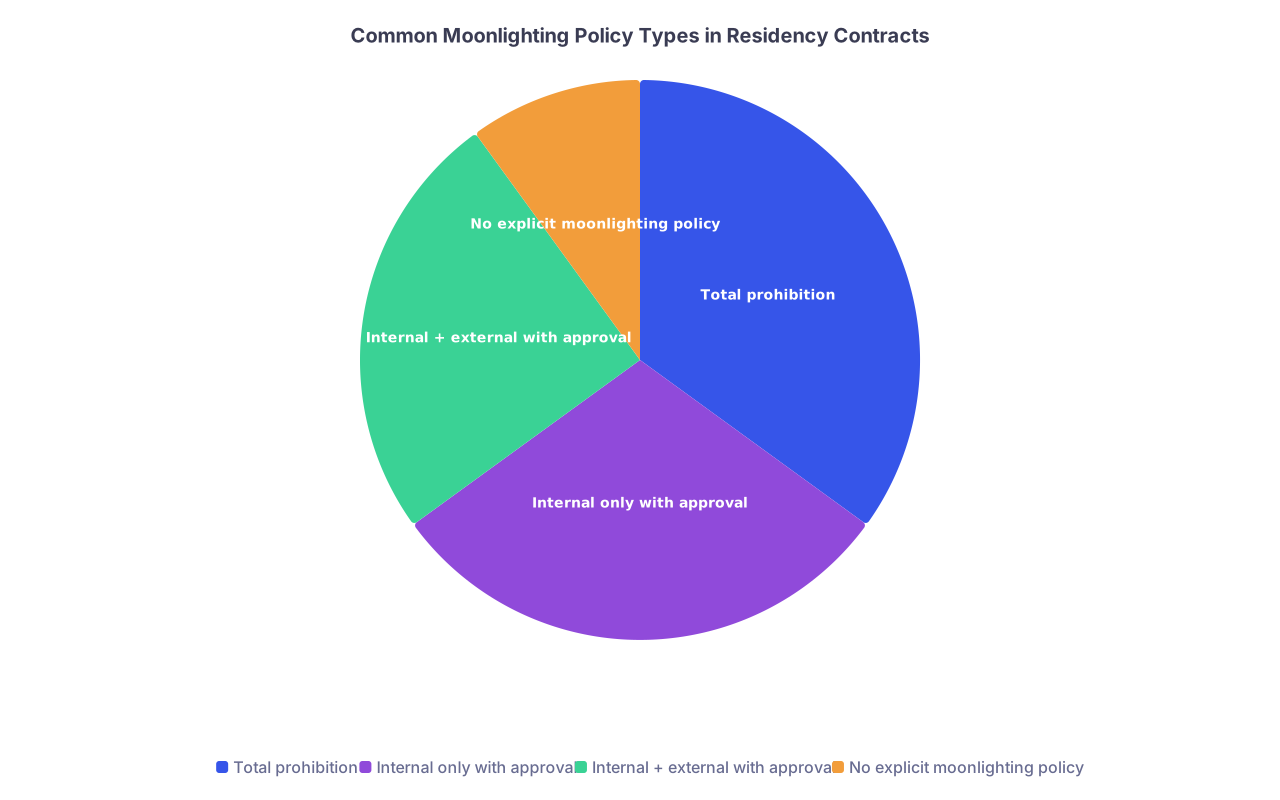
| Category | Value |
|---|---|
| Total prohibition | 35 |
| Internal only with approval | 30 |
| Internal + external with approval | 25 |
| No explicit moonlighting policy | 10 |
The key move here: check whether the clause acknowledges duty‑hour accounting.
Good, aligned language:
“Any approved moonlighting hours will be counted toward the 80‑hour weekly work limit, and Resident shall report such hours in the duty‑hour system.”
Sloppy or risky language:
“Moonlighting shall be performed outside normal duty hours and shall not interfere with Resident’s program responsibilities.”
The second version sounds benign but ignores the legal reality: if they “approve” it, they own it. Ethically and under accreditation.
When the contract denies that reality, it is a sign they want the benefit of your extra work without taking on any liability.
4. Internal vs external moonlighting: why the contract cares
Programs care very differently about internal versus external moonlighting. You should, too.
4.1 Internal moonlighting
Internal shifts are:
- easier to supervise,
- easier to insure under the hospital’s malpractice policy, and
- revenue‑positive for them.
So contracts often:
- allow internal moonlighting starting PGY‑2,
- require credentialing within their own system only, and
- tie approval to “satisfactory performance.”
What you need to check:
- Does the clause explicitly label internal moonlighting as employment under the same or a separate agreement?
- Are you paid at a clear rate (hourly, per shift)?
- Is malpractice coverage for these shifts clearly within the hospital’s coverage?
Some programs bury this:
“Compensation for any additional clinical services performed at Hospital’s request shall be determined by Hospital.”
That is how you end up with vague promises of being “paid somehow” for extra calls that evolve into expected unpaid coverage.
4.2 External moonlighting
External work is where legal risk becomes real.
To do external moonlighting safely you need:
- a separate employer;
- separate malpractice coverage (often through the external site);
- appropriate license status (full vs training license, state‑specific);
- clear boundaries with your residency training hours.
Pre‑match contracts like to either flatly ban this or impose so many conditions that it is de facto impossible.
Common restrictive phrases:
- “Resident shall not contract with any competing hospital or health system.”
- “External moonlighting is prohibited within a 25‑mile radius of Hospital.”
- “External moonlighting is prohibited for the entire duration of this Agreement.”
This is not about your safety. It is about monopoly on your labor and avoiding any perceived conflict with competitors.
From a pure practical standpoint: if external moonlighting matters to you financially, a contract with total external prohibition is a deal‑breaker, not an afterthought.
5. The malpractice trap: how coverage actually works
This is where people get into real trouble, because they assume “my residency covers me” everywhere. It does not.
You analyze malpractice in moonlighting clauses by asking four questions:
- For internal moonlighting, does the hospital’s existing malpractice explicitly cover the additional shifts?
- For external moonlighting, who is providing malpractice coverage—your residency hospital or the external employer?
- Is the coverage claims‑made or occurrence‑based?
- Who pays for any tail coverage, if relevant?
Most pre‑match contracts will say something simple like:
“Hospital shall provide professional liability insurance coverage for Resident’s activities within the scope of this Agreement.”
That phrase “within the scope of this Agreement” is doing a lot of work. It often excludes:
- external moonlighting,
- any independent contractor work,
- any clinical activity outside their facilities unless specifically assigned.
Better language (rare, but you might see it with internal moonlighting structures):
“Hospital’s professional liability coverage shall apply to all approved internal moonlighting activities performed at Hospital facilities.”
If you see nothing about external moonlighting coverage, assume you are not covered by the residency hospital for that work. You would need a separate policy through the moonlighting site.
Telehealth gigs are especially messy. Many contracts were not updated for the explosion in telemed. If the clause bans “telemedicine” explicitly, that is intentional. They do not want your name and their program showing up in anything they cannot control.
6. Hidden control: non‑compete and exclusivity dressed as moonlighting
Some pre‑match contracts use the moonlighting section to slide in what is essentially a soft non‑compete.
Signs you are looking at that:
- “Resident shall not engage in any clinical services at any facility within X miles that is not operated by Hospital.”
- “Resident agrees not to provide professional services to Hospital competitors during the term of this Agreement.”
This is not about duty hours. It is vertical integration.
You also see “exclusivity” clauses that sound narrow but are broad in practice:
“During the term of this Agreement, Resident’s professional time and efforts shall be devoted exclusively to the Program and Hospital.”
If paired with a broad definition of “professional services,” they can use this to shut down almost any outside work—clinical or not—at their discretion.
| Side Gig Type | Frequently Treated As | Usually Needs Approval? |
|---|---|---|
| Extra ED shifts at same hospital | Internal moonlighting | Yes |
| Telemedicine urgent care | External moonlighting | Yes / often banned |
| USMLE tutoring | Outside employment (nonclinical) | Sometimes |
| Paid research consulting | Outside employment / professional service | Often |
| Locums in another state | External moonlighting | Yes, high risk |
The danger is not just lost income. It is disciplinary leverage. Once they can call your side gig “unapproved professional services,” they can label it “unprofessional behavior” if they feel like it.
7. How to read your specific clause line‑by‑line
Let’s walk through a very typical pre‑match clause and dismantle it.
“Resident shall not engage in moonlighting activities, whether internal or external, without prior written approval of the Program Director. Any approved moonlighting must not interfere with Resident’s responsibilities to the Program and must comply with ACGME duty‑hour requirements. Resident acknowledges that Hospital’s liability coverage does not extend to external moonlighting activities. Violation of this provision constitutes grounds for disciplinary action, up to and including non‑renewal or termination.”
Breakdown:
“shall not engage … without prior written approval”
→ default is “no,” and you bear the burden to submit, track, and obtain written approval.“must not interfere with responsibilities”
→ totally subjective. “Interfere” can mean anything they decide.“must comply with ACGME duty‑hour requirements”
→ correct on paper. But if they do not monitor or document these hours, the risk falls on you.“liability coverage does not extend to external moonlighting”
→ clear: you need separate malpractice. Good that it is explicit rather than vague.“grounds for disciplinary action, up to and including non‑renewal or termination”
→ they intentionally tied this to your reappointment. Violations are not harmless.
What you do with this:
- Assume external moonlighting is a serious risk unless the external site has robust coverage and credentialing.
- Assume you could be cut from the program if they decide your side work crossed a line.
- Decide whether the ability to do internal shifts (if historically used and paid decently) offsets the restrictions on external work.
You do not need to be a lawyer to do this level of parsing. You just need to be aggressive about translating each sentence into: “What can I actually do? What can they actually do to me?”
8. Contract red flags and yellow flags around moonlighting
Let me give you a more direct triage. You are glancing at a pre‑match offer. Here is what should make you pause.
Hard red flags
These are “strongly consider walking away” level issues, especially combined:
“External moonlighting is prohibited for the duration of residency and for one year thereafter within a 50‑mile radius.”
(That is basically a non‑compete in disguise.)“Resident agrees that any outside professional activity without prior written approval shall be deemed a material breach permitting immediate termination.”
(That is a loaded gun pointed at your head.)“Resident shall be responsible for obtaining and maintaining any professional liability coverage for all activities, including internal moonlighting.”
(They want your labor without owning the risk. Very bad sign.)
Yellow flags
These are survivable but should inform your ranking strategy:
“Approval is at the sole discretion of the Program Director.”
(You are trusting the personality of one person, not a policy.)“Moonlighting is generally discouraged.”
(Code for: many residents ask, most are told no.)No explicit mention of ACGME duty‑hour tracking for moonlighting.
(Suggests they either have not thought it through or do not care.)

These are the programs that might be fine if you do not care about moonlighting at all—but if you are counting on extra income, they will probably disappoint you.
9. Questions to ask programs before accepting a pre‑match offer
The contract text is one layer. The real policy lives in behavior. You need both.
Target your questions very specifically:
“Do any current residents do internal or external moonlighting? At what PGY level?”
If the answer is “it is allowed but nobody does it,” assume there is a reason.“Can you walk me through the approval process for external moonlighting? Who signs off and what is the timeline?”
If they cannot describe a concrete process, it probably does not function.“Does the program help coordinate malpractice coverage for internal moonlighting shifts?”
You want to hear something like: “Yes, it is under the hospital’s umbrella.”“Is approval revocable mid‑year? Has that happened in the past?”
You are looking for patterns: did they pull the plug suddenly when budgets tightened?“Are there any restrictions on telemedicine or nonclinical consulting work?”
This flushes out how broadly they interpret “professional services.”
Document the answers you get—date, name, rough quote. If the clause is vague but they make reassuring promises verbally, you at least have a record of what was represented, even if it is not legally airtight.
10. When and how to push back: residents can negotiate, just selectively
Pre‑match offers exist outside the NRMP Match rules by definition. That gives you a small amount of leverage, especially in less competitive programs or specialties.
You do not negotiate like an attending. You target one or two specific, realistic tweaks.
Commonly achievable asks:
- Clarifying PGY‑2+ eligibility for internal moonlighting in writing.
- Adding one sentence like: “Approval for internal moonlighting shall not be unreasonably withheld provided Resident is in good standing.”
- Explicitly stating that internal moonlighting is covered by the hospital’s malpractice.
Less commonly, but sometimes, you can:
- Change “may not engage in any external moonlighting” to “may engage in external moonlighting with prior written approval, subject to duty‑hour limits.”
How you phrase the ask matters. Do not lead with “my lawyer said.” Better:
“I plan to rely on internal moonlighting as part of my financial planning. Would you be open to clarifying that PGY‑2+ residents in good standing can apply for internal moonlighting, and that those shifts are covered under the hospital’s malpractice policy?”
If they come back with: “We do not modify our standard agreement for residents,” you have your answer. Not about the clause. About the culture.
11. Concrete scenarios: how this plays out in real life
Let me give you a few composite examples I have seen versions of repeatedly.
Scenario 1: Telemedicine “non‑compliance”
PGY‑3 in internal medicine. Contract has broad “no outside professional services without written approval” clause. Resident skims it. Six months in, picks up a telemedicine urgent care gig, a few evening shifts a month. Assumes no problem because it’s remote and low‑acuity.
Program hears about it when a patient complaint includes “resident at X University Hospital.” GME office calls resident in. They point to the clause. Label it “unreported external professional activity” and “unprofessional behavior.”
Outcome: written warning, threatened non‑renewal. Telemed gig gone overnight.
Scenario 2: Internal moonlighting without malpractice clarity
PGY‑2 EM resident. Program dangles “extra shifts available in our community ED.” Contract is silent on whether malpractice covers these. Resident assumes yes. Two years later, a case from one of those shifts becomes a lawsuit.
Hospital’s insurer initially balks: “Were these shifts under your residency contract or an independent contractor arrangement?” There is confusion. Resident spends months in anxiety while lawyers sort it out.
Outcome: eventually covered, but only after unnecessary risk because nothing was spelled out.
Scenario 3: External moonlighting banned when hospital merges
PGY‑4 anesthesia. For years, senior residents have done well‑paid external moonlighting at a nearby surgery center. Approval is loosely “granted” by a PD who likes giving residents some flexibility.
Hospital merges with a larger system. Legal/compliance decides “no resident may work for a competitor.” Overnight, external moonlighting is banned. No contract changes. Just a new internal policy.
Residents with mortgages suddenly lose $2–3k/month in expected income. Their contracts allowed that kind of unilateral change because the clause said “subject to Hospital policies as amended from time to time.”
You see the pattern. The exact words in the moonlighting clause are what empower these decisions.
12. A simple, repeatable way to analyze any moonlighting clause
You do not need legal training. You need a checklist and a bit of discipline.
Use this four‑step approach on any pre‑match offer:
Scope scan
Highlight every occurrence of: moonlighting, outside employment, professional services, exclusivity, competitor, telemedicine, liability coverage.
Ask: what activities are captured by these words?Permission structure
Circle phrases like: prohibited, may, must not, with prior written approval, in sole discretion, without cause, material breach.
Ask: is the default “yes, with conditions” or “no, unless we feel like it”?Risk hooks
Underline: disciplinary action, probation, non‑renewal, termination, grounds for.
Ask: what bad things can they formally tie to a moonlighting dispute?Alignment check
Compare against ACGME basics (no PGY‑1 moonlighting, 80‑hour weeks, voluntary).
Ask: is this more restrictive than ACGME, or sloppier than ACGME?
If anything feels off, that is when you consider a short consult with an actual health‑care attorney. Not to teach you what “moonlighting” is. To pressure‑test whether their clause is industry‑standard restrictive or quietly predatory.

| Step | Description |
|---|---|
| Step 1 | Receive Pre-match Offer |
| Step 2 | Locate Moonlighting and Outside Employment Sections |
| Step 3 | Decide if moonlighting is essential |
| Step 4 | Identify Internal vs External Rules |
| Step 5 | Check Approval Process and Discretion |
| Step 6 | Review Malpractice Coverage Language |
| Step 7 | Compare to ACGME Duty-hour Rules |
| Step 8 | Consider legal review or decline offer |
| Step 9 | Clarify in writing or accept with eyes open |
| Step 10 | Any Moonlighting Allowed? |
| Step 11 | Major Red Flags? |

The bottom line
Three key points and you are done:
- Moonlighting clauses are not filler text. They define what you can do with your license, your time, and a significant chunk of your potential income during residency.
- You do not need a health law degree, but you do need to be ruthless about translating every sentence into: what can I do, what can they forbid, and what can they punish.
- Pre‑match leverage is limited but real. Use it to get clarity on definitions, approval processes, and malpractice coverage—or walk away from programs that want total control with zero responsibility.