
The most dangerous part of a pre‑match offer is not the salary. It is the autonomy clause you skim at 11:47 p.m. and “assume is standard.”
Let me be blunt: programs know most applicants have no idea how to read resident autonomy language. They borrow language from employment manuals, malpractice policies, and ACGME boilerplate, stitch it together, and you are supposed to sign away three years of your life based on a two‑minute glance.
You need to stop treating those sentences as decorative legal filler. They tell you exactly how much you will actually function as a physician vs. as a scribe with a stethoscope.
Below, I am going to walk you through how to interpret resident autonomy clauses in pre‑match agreements, line by line, and how to translate vague contract language into what your life on the wards will actually look like.
1. What “Resident Autonomy” Really Means in a Contract
You will not see a heading that says “RESIDENT AUTONOMY” in all caps. Instead, autonomy is buried in sections labeled:
- Supervision
- Scope of practice
- Clinical responsibilities
- Moonlighting
- Professional liability and independent practice
- Duty assignments or clinical duties
All of those sections, taken together, define your autonomy. Not just: “Do I get to operate by PGY‑3?” but:
- Can you write independent orders?
- Are you allowed to see patients without an attending in the room?
- Who is legally responsible for your decisions?
- Can the program unilaterally strip your privileges “for education”?
Let me give you a translation framework.
When you read an autonomy‑related sentence, ask three questions:
- Who is allowed to do what? (Resident alone vs. resident + direct supervision vs. attending only)
- Under what conditions? (PGY level, setting, time of day, after “competency,” etc.)
- Who decides if that autonomy exists or disappears? (Program director, GME office, hospital bylaws)
If those three elements are not clear, the clause is weak or program‑tilted.
2. The Core Autonomy Clauses: How to Dissect the Wording
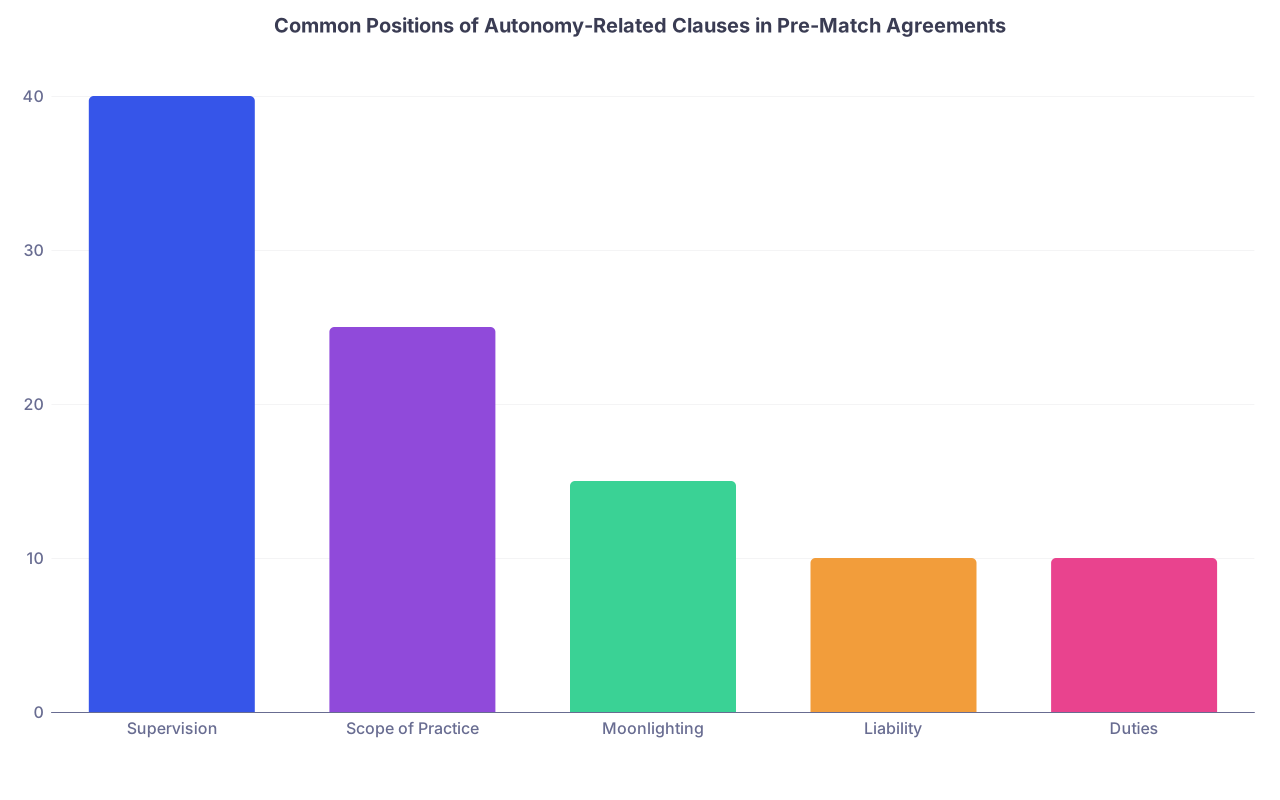
| Category | Value |
|---|---|
| Supervision | 40 |
| Scope of Practice | 25 |
| Moonlighting | 15 |
| Liability | 10 |
| Duties | 10 |
A. “Resident will work under the supervision of attending physicians”
Typical contract language:
“The Resident will perform clinical duties under the supervision of attending physicians, in accordance with ACGME and institutional requirements.”
On its face, this sounds normal. Every resident is supervised. The problem is whether the contract locks you into perpetual “direct” supervision or contemplates meaningful “indirect” supervision.
Red flags / questions:
- Does it distinguish between PGY‑1, PGY‑2, PGY‑3+?
- Does it ever use the phrase “independent” or “unsupervised” in a clinical sense?
- Does it reference “progressive responsibility” explicitly?
Better language looks like:
“Resident shall exercise progressive responsibility and autonomy commensurate with level of training, education, and demonstrated competence, consistent with ACGME and institutional policies.”
That phrase “progressive responsibility and autonomy” matters. It ties the program to the ACGME standard that you are supposed to function with more independence over time, not stay in the same tightly controlled box for three years.
If that phrase is absent anywhere in the supervision or duties section, that is not an accident. It usually reflects either:
- Very risk‑averse institutional culture, or
- A service‑heavy program where you are a worker first, learner second
You want at least one place in the contract where “progressive responsibility” shows up.
B. Definitions of Supervision: Direct vs. Indirect
Many contracts incorporate supervision definitions by reference to the GME handbook:
“Supervision will be provided in accordance with the Institution’s GME policies and ACGME supervision standards.”
That is vague. You should ask to see:
- The GME Supervision Policy
- Any specialty‑specific supervision policy (e.g., for surgery, anesthesia, EM)
You are looking for a structure like this:
- PGY‑1: Direct for high‑risk, indirect for routine
- PGY‑2: Indirect with supervision immediately available
- PGY‑3+: Indirect with oversight, with ability to make initial decisions independently
If the policy (or contract) only mentions “direct supervision” or “immediately available” in every single sentence, your “autonomy” will be mostly theoretical.
A subtle but important phrase to watch for:
“Ultimate responsibility for patient care rests with the attending physician.”
That is normal and legally necessary. But if they then also bar you from making any initial decisions (writing admission orders, putting in consults, triaging ER calls) without explicit pre‑approval, you are not being trained to function as an independent physician.
C. Scope of Practice Clauses
Typical language:
“Resident’s clinical activities shall be limited to duties assigned by the Program Director and shall conform to the scope of practice defined by institutional and departmental policies.”
This is the clause programs use to expand or shrink your real‑world autonomy.
Questions to ask yourself when reading this:
- “Limited to duties assigned by the Program Director” – does that mean they can pull you from operative cases to cover wards indefinitely?
- Where is “scope of practice defined”? You want that in a written, accessible policy, not purely “as determined from time to time.”
- Does it say anything about procedures? “Resident will perform procedures commensurate with level of training.” That is good. No mention at all? Less good.
Watch for this kind of language:
“Resident shall perform only such procedures as specifically approved in writing by the Program Director.”
If you see that, ask how “approval” works in practice. Is there a standardized list by PGY level (e.g., PGY‑2: central lines, intubations, chest tubes), or are you begging for permission every time?
3. The Clauses That Quietly Kill Autonomy
Some of the most telling autonomy limitations are not in supervision sections at all. They are hiding in moonlighting, liability, and “no independent practice” clauses.
A. No Independent Practice / No Privileges Clauses
Typical language:
“Nothing in this Agreement shall be construed to grant the Resident independent medical staff membership or clinical privileges. Resident shall not engage in independent medical practice.”
This is standard. You are not being hired as an attending.
What you are looking for is whether they weaponize this concept:
“Resident is prohibited from representing themselves as the primary treating physician or from exercising independent medical judgment without attending approval.”
That second sentence is dangerous. And I have seen variations of it. It can be interpreted to mean:
- You cannot present yourself as “the doctor” to the patient
- You cannot make time‑sensitive decisions overnight without tracking down an attending first
- You are legally a functionary, not a trainee physician with real responsibility
Better language would be something like:
“Resident shall not hold themselves out as an independently licensed attending physician and shall practice under supervision. This does not limit residents from exercising medical judgment within the supervised training environment.”
If you see extremely restrictive “no independent practice” language, combine that with how the residents describe their actual autonomy. Some institutions have aggressive risk management departments that over‑tighten contract language, but the day‑to‑day culture can still be reasonable. You need both data points.
B. Moonlighting and Autonomy

Moonlighting clauses are a back‑door window into how the program views your independence.
Common patterns:
“Internal moonlighting is prohibited.”
“External moonlighting requires written approval of the Program Director and DIO.”
“PGY‑1 residents are prohibited from moonlighting. PGY‑2 and above may moonlight if in good academic standing and compliant with duty hour regulations.”
The key autonomy questions:
- Do they ever allow you to bill or work as an independent provider under your own license at any point during training?
- Is moonlighting allowed only in “in‑house supervised” settings (e.g., extra call shifts) or also in genuinely independent urgent care / community hospital contexts?
A program that categorically bans all external moonlighting, for all PGY levels, “due to liability concerns,” is usually also skittish about in‑program autonomy.
If moonlighting is allowed, check:
“Moonlighting activities must not interfere with the resident’s ability to attain the educational goals and objectives of the program.”
Good. Then:
“The Program Director may revoke moonlighting authorization at any time for any reason.”
That “for any reason” is powerful. It means your autonomy outside the program is entirely discretionary. If you are relying on moonlighting income, that is a real risk.
Autonomy interpretation:
- Generous moonlighting rules + clear supervision structure = program trusts senior residents
- Hard no on all forms of moonlighting, even PGY‑4+ = watch for micromanagement in other areas
C. “At the Sole Discretion” Language
Autonomy and “sole discretion” do not mix well.
You will see things like:
“Resident’s clinical duties and level of responsibility may be modified at the sole discretion of the Program Director.”
“The Program may, at its sole discretion, limit or revoke a Resident’s authority to write orders, perform procedures, or participate in certain clinical activities.”
Translation: If you irritate the wrong person, your autonomy can be cut to zero without any due process.
Some discretion is necessary; no one wants a contract that makes it impossible to protect patients from an unsafe resident. But balanced language looks like:
“Based on assessments of competence and performance, the Program Director may adjust a resident’s clinical duties and level of supervision, consistent with institutional due process policies.”
Look for two things:
- A reference to “competence” or “performance,” not simply “sole discretion.”
- A cross‑reference to due process / grievance policies (so you have some recourse if autonomy is unfairly restricted).
4. Cross‑Checking Autonomy Language With ACGME Standards

| Step | Description |
|---|---|
| Step 1 | Identify autonomy clauses |
| Step 2 | Compare to ACGME language |
| Step 3 | Check GME policies |
| Step 4 | Ask residents for reality check |
| Step 5 | Decide risk tolerance |
ACGME is your leverage. Programs love to throw “consistent with ACGME requirements” into their contracts without actually honoring the spirit of those requirements.
Core ACGME ideas you should mentally check against the contract:
- Supervision must allow for “progressive authority and responsibility”
- Residents must have enough operative / procedural / decision‑making exposure to graduate competent
- Programs must evaluate and document competence before granting more autonomy (but that cannot be indefinitely delayed with no criteria)
When the contract says:
“Autonomy will be granted as determined appropriate by the Program Director and attending staff.”
Compare that to ACGME’s “progressive authority and responsibility, conditional on demonstrated competence.” If no one can tell you how “demonstrated competence” is assessed, autonomy can be withheld arbitrarily.
Useful move: directly ask during an interview or call with the PD:
- “How do you operationalize ‘progressive responsibility’? For example, what can a PGY‑2 on nights do independently that a PGY‑1 cannot?”
- “What are the defined criteria for a resident to run the ICU / take chief‑level call?”
If the answers are hand‑wavy, assume the contract’s vague wording favors the program, not you.
5. Translating Contract Language into Day‑to‑Day Reality
| Contract Language Snippet | Likely Real-World Meaning |
|---|---|
| “Resident will perform duties assigned by PD” | You can be shifted between service and education needs with little say |
| “Under supervision of attending physicians” | Expect variable independence; details depend on culture, not contract |
| “No independent medical practice” | You cannot bill or function as an attending; autonomy still possible within team |
| “Progressive responsibility commensurate with training” | ACGME-aligned; usually correlates with real increasing autonomy |
| “At the sole discretion of the Program Director” | Autonomy and privileges can be revoked or limited very easily |
Contracts and culture interact. I have seen:
- Rigid contracts at programs where attendings quietly let seniors run the ICU like junior faculty.
- Friendly, autonomy‑heavy words on paper at places where attendings never leave the workroom and micromanage every order.
You cannot read the contract in isolation. But you also cannot ignore the clues it gives you.
Here is how you combine the data:
- Read the autonomy‑pertinent clauses: supervision, duties, scope of practice, moonlighting, liability.
- Make a quick one‑page list: “What does this say about what I can do alone by PGY‑2, PGY‑3?”
- Ask actual residents: “Does this match what you experience?”
- If there is a mismatch, trust the residents about the present, and the contract about how easily things could get worse.
A concrete example.
Contract:
“Residents will not independently perform invasive procedures without direct attending supervision unless specifically credentialed by the Program Director.”
Residents tell you:
“Honestly, we almost never get ‘credentialed.’ Even seniors have to find attendings for lines and tubes, and OR cases are mostly fellow‑run.”
The contract gives the program future cover. If administration decides to crack down even more, they are already set up to block autonomy entirely simply by never “credentialing” you.
6. Red Flags vs. Acceptable Trade‑Offs
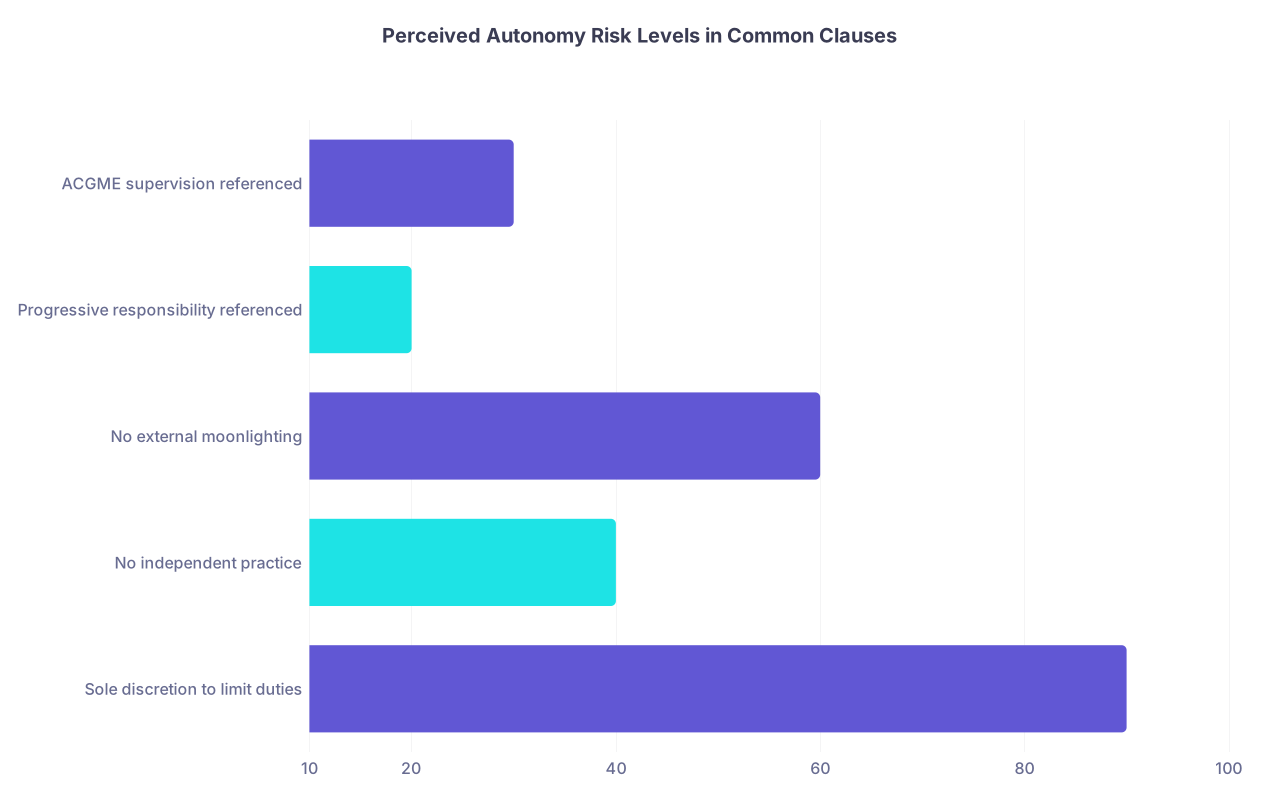
| Category | Value |
|---|---|
| Sole discretion to limit duties | 90 |
| No independent practice | 40 |
| No external moonlighting | 60 |
| Progressive responsibility referenced | 20 |
| ACGME supervision referenced | 30 |
Let me be specific about what should make you pause on a pre‑match offer.
High‑Risk Autonomy Red Flags
- No mention anywhere of “progressive responsibility” or autonomy
- Multiple “at the sole discretion of the Program Director” clauses around duties, privileges, and supervision
- Extremely restrictive no‑independent‑practice language that bars you from “exercising independent judgment”
- Blanket, permanent bans on any moonlighting at any PGY level, framed as “liability” rather than “education”
- Language that suggests you may be reassigned “to meet institutional service needs” without reference to education
Those are the contracts where I have seen residents stuck in:
- 100% ED admit holding roles with no procedure time
- “Non‑teaching” services that magically become permanent
- ORs where residents are “observers” because fellowship programs claimed the cases
Acceptable (Annoying but Normal) Limitations
Some clauses are not ideal but are standard realities:
- Statement that ultimate responsibility rests with attendings
- Requirement that PGY‑1s work under direct supervision for high‑risk procedures
- Need for PD approval for external moonlighting
- A general no‑guarantee clause about specific rotations (legal protection for the hospital)
These do not inherently destroy autonomy. What matters is whether there is a clear path, even if not perfectly described, from “always directly supervised” to “senior resident with meaningful independence.”
7. How to Actually Analyze a Pre‑Match Autonomy Clause Step‑by‑Step

| Step | Description |
|---|---|
| Step 1 | Obtain full pre match agreement |
| Step 2 | Highlight supervision language |
| Step 3 | Find scope of practice and duties |
| Step 4 | Locate moonlighting and liability clauses |
| Step 5 | Mark sole discretion or limiting phrases |
| Step 6 | Summarize autonomy by PGY level |
| Step 7 | Verify with current residents |
| Step 8 | Decide accept, clarify, or walk away |
Here is how I tell residents to do this in practice. Takes 30–45 minutes if you focus.
- Print the agreement. Grab a highlighter and pen.
- Highlight every instance of these words: “supervision,” “duties,” “responsibility,” “autonomy,” “independent,” “moonlighting,” “privileges,” “sole discretion.”
- In the margin next to each clause, write a one‑line translation. For example:
- “Means PD can pull me from OR whenever”
- “Moonlighting allowed but fragile”
- “No independent billing; normal”
- On a clean sheet, make three sections: PGY‑1, PGY‑2, PGY‑3+. For each, jot down what the contract implies you can do independently (orders, consults, nights, procedures).
- Bring this sheet to a call with a current resident and read them your interpretation. Ask: “Is this what actually happens?”
- If there is something especially ugly (e.g., “sole discretion to revoke order‑writing”), you can ask the PD directly:
- “I noticed the agreement says X. In practice, how often is that used and under what circumstances?”
Do not expect the contract to be rewritten substantially for you. But their reaction and explanation tell you a lot.
8. Comparing Programs: Autonomy Profile, Not Just Salary

You will likely see multiple pre‑match offers that look “fine” on a quick skim. This is where being systematic helps.
Create a simple grid for yourself. Something like this.
| Factor | Program A | Program B | Program C |
|---|---|---|---|
| Mentions progressive responsibility | Yes | No | Yes |
| Moonlighting allowed by PGY-2 | No | Yes | No |
| “Sole discretion” used to limit duties | 3+ times | 1 time | 0 times |
| Residents say they run nights by PGY-3 | Yes | No | Mixed |
| Clear PGY-based procedural expectations | Yes | No | Yes |
You are not doing formal contract review like an attorney. You are trying to answer one practical question:
“Will I graduate from this program able to function as an independent attending, or will I have to learn real autonomy in my first job?”
If you see a pattern of:
- Contract vagueness
- Strong program control language
- Residents reporting low autonomy
That is not the program where you should tie yourself with a pre‑match agreement if you have any other options.
9. When to Push Back, When to Walk Away
You are not powerless just because it is a pre‑match offer. You have more leverage early than you think.
What you realistically can do:
- Ask for clarification in writing on especially vague or harsh autonomy‑related language. Sometimes they will reply with a reassuring explanation that, while it does not change the contract, shows you they view those clauses as “emergency only.”
- Request to see the GME handbook / supervision policy if not already provided.
- Ask to talk to a senior resident in your intended track (e.g., ICU‑heavy, surgery, EM nights).
What you probably cannot do:
- Get them to strike all “sole discretion” language.
- Add your own custom autonomy clause.
- Force them to allow moonlighting if their institutional policy bans it.
When I tell people to seriously consider walking away:
- If the program refuses to let you see supervision and moonlighting policies. That is a transparency problem.
- If residents consistently describe themselves as “glorified scribes” or “permanent interns,” and the contract is packed with restrictive language.
- If you ask direct autonomy questions and get defensive non‑answers from leadership.
You will not get a perfect contract. You are deciding how much asymmetry you can tolerate.
10. Final Thoughts: How to Read Between the Lines

Autonomy clauses in pre‑match agreements are not about one word that magically makes or breaks your training. They are about patterns.
Look for:
- Whether the contract’s language even acknowledges the concept of progressive responsibility.
- How often the program reserves unilateral power to limit your responsibilities.
- How the moonlighting and liability sections reveal their real attitude toward your independence.
Three core points to keep in your head:
- “Progressive responsibility” is not decoration. If the agreement never says it, assume you will have to fight for autonomy.
- Phrases like “at the sole discretion of the Program Director” and “may revoke authority to write orders or perform procedures” are loaded weapons. Count how many you see.
- Never read autonomy clauses in isolation. Cross‑check them with ACGME standards and, more importantly, with what current residents tell you about who is actually running the service at 2 a.m.
If you discipline yourself to read these contracts with that lens, you stop being the applicant who just hopes the culture is good. You become the applicant who can look at a pre‑match offer and say, very clearly: “This is how much real medicine I am going to be allowed to practice here.”