
The most dangerous line in a surgical pre‑match contract is not about salary or vacation. It is the casual promise: “You will get excellent operative experience and plenty of cases.”
Why procedural volume promises are usually fiction dressed as optimism
Let me be blunt: you should distrust any pre‑match “we promise you X number of cases” unless it is backed by data, structure, and accountability. Surgical residents do not operate a lot just because a PD says they “believe in early autonomy.” They operate a lot because:
- The hospital actually has the case volume.
- The service structure lets residents get to those cases.
- Senior residents and fellows are not eating everything.
- The culture supports residents being primary surgeon, not “camera holder number 7.”
Most applicants ask the wrong questions. They ask, “Will I get enough cases?” Programs respond, “Yes, we’re very busy.” That exchange is worthless.
You need to interrogate how busy, with what, and for whom.
Let me break this down specifically.
1. First principle: volume is not one thing
Programs love to throw around raw numbers. “Our chiefs graduate with 1,200–1,400 cases.” Sounds great on a tour. Means very little on its own.
You have to separate out at least five distinct ideas:
- Total logged cases.
- Diversity of cases.
- Autonomy in cases.
- Year-by-year progression.
- ACGME minimums vs real-world competence.
If you do 1,400 cases but 600 are “assist on lap chole” and 300 are “closing skin,” you will not feel like a competent surgeon. You will feel cheated.
The minimums vs reality gap
For ACGME-accredited surgical specialties, there are case minimums. Those minimums are not targets. They are the floor of “barely acceptable.” Look at them as the line below which the program should be in serious trouble.
As you evaluate a pre‑match offer, your goal is not “Will I hit the minimums?” Your goal is, “Will I be clearly above these minimums, in the right categories, without having to beg and scrap every year?”
| Category | ACGME Minimum (approx) | Strong Training Target |
|---|---|---|
| Total Major Cases | ~850-900 | 1100-1400+ |
| Core Bread & Butter | Just specified numbers | 1.5–2x the minimums |
| Endoscopy (EGD/Colonos) | ~100-120 | 250+ |
| Chief Year Cases | Not directly specified | 250–400+ as chief |
These numbers vary by specialty and year, and you should always check the current ACGME case log minimums. But if a program is promising “strong operative exposure” and their chiefs graduate barely at the minimums, their promise is already broken.
2. How to force a program to show you their true volume
Do not accept vibes. Do not accept “we’re very busy; our ORs are always full.” That tells you nothing about resident exposure.
You want concrete, verifiable data. Here is what you ask for, explicitly, before signing any pre‑match contract:
- De‑identified case log summary for the last 3 graduating classes, by resident.
- For your specific track (categorical vs prelim; gen surg vs ortho vs ENT, etc.).
- Broken down by: PGY year, category (e.g., bread-and-butter, subspecialty, endoscopy, trauma, etc.), and role (surgeon vs assistant).
If the program cannot or will not provide this, then their “we promise good volume” is meaningless. Programs that truly care about volume trends have this pulled up all the time for ACGME, internal review, and recruitment.
Here is what those trends often look like in reality:
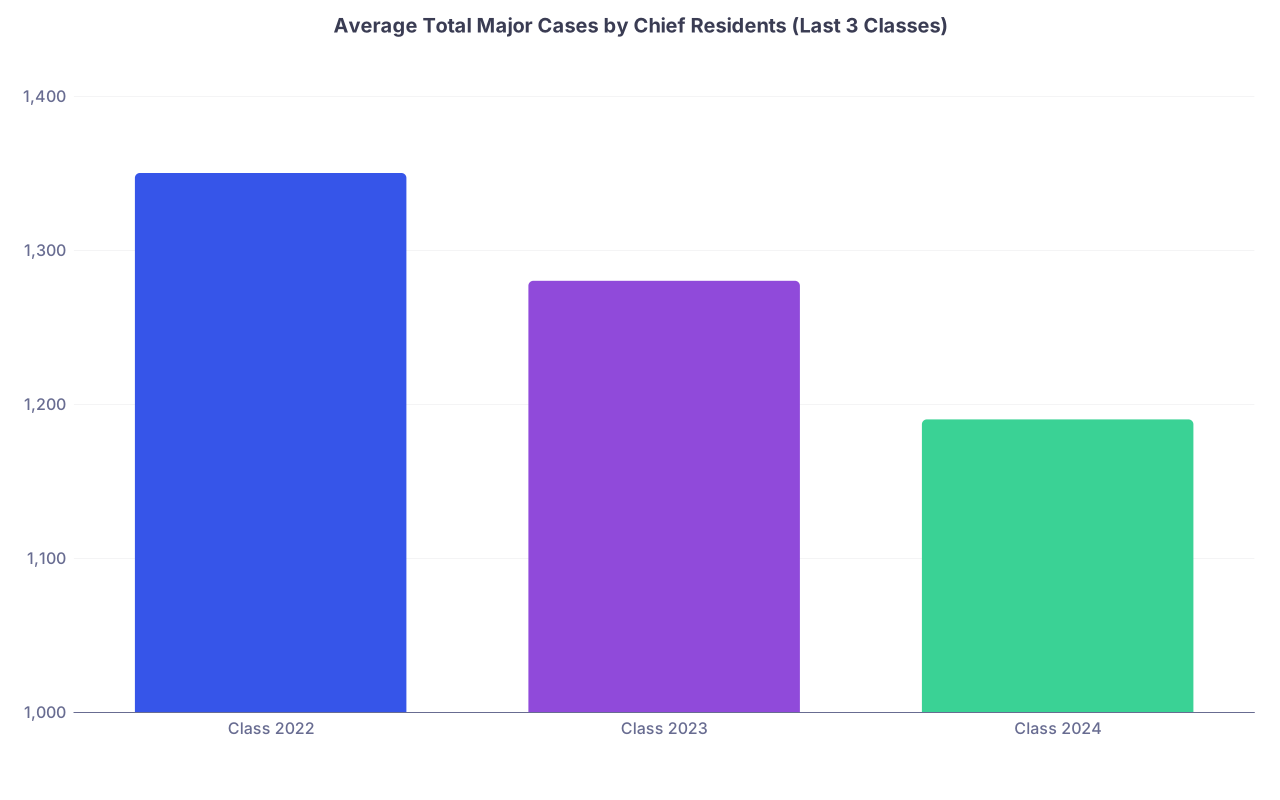
| Category | Value |
|---|---|
| Class 2022 | 1350 |
| Class 2023 | 1280 |
| Class 2024 | 1190 |
If the numbers are drifting down every year, and the explanation is “we added fellows,” you should assume you will live on the lower trend, not the rosy narrative.
Key interpretation moves
When you see case logs, do three specific things:
- Sort by resident: Is everyone graduating with strong volume, or are there 1–2 “golden children” with very high numbers and a tail of undertrained grads? A wide spread is a red flag.
- Look at chiefs, not overall totals: PGY1–2 case logs are noise. PGY4–5 (or PGY6 for some specialties) show whether the program gives real autonomy where it counts.
- Check for category holes: Excellent total numbers with glaring gaps in trauma, endoscopy, vascular, or peds (depending on specialty) mean you will graduate lopsided.
3. Structures that make or break procedural promises
Volume is not just about the hospital being busy. I have seen programs with insane ED traffic and perpetually booked ORs that still produce residents with mediocre operative experience. Why? Structural decisions.
You should specifically interrogate these structural factors before trusting any procedural volume promise in a pre‑match contract.
3.1. Fellows: the black hole of resident cases
Fellows are not automatically bad. But they absorb cases. That is just reality.
You need details, not slogans like “our fellows are very resident-friendly.”
Ask:
- Which services have fellows (trauma, MIS, vascular, colorectal, ortho sports, spine, ENT subspecialties, etc.)?
- How many fellows per year per service?
- Who is the default primary surgeon on typical cases: junior resident, senior resident, or fellow?
The honest hierarchy at many places:
Attending → Fellow → Senior Resident → Junior Resident → Medical Student.
If they tell you, “Our PGY3s do all the lap choles,” and then casually mention 4 MIS fellows on the same service, those statements are incompatible. Somebody is lying or out of touch.
3.2. Service design: who owns what?
Look closely (and ask explicitly) about service structures.
Key questions:
- Are juniors cross-covering multiple busy services at once? (Translation: less OR time, more floor chaos.)
- Are there dedicated “OR days” for juniors and seniors, or is it purely opportunistic?
- Does night float exist, and how does it hit OR exposure? Some night float systems are great for trauma; others destroy continuity and clinic/OR time.
Here’s a simple decision-tree style way to think through it:

| Step | Description |
|---|---|
| Step 1 | Ask about service structure |
| Step 2 | Better chance of real volume |
| Step 3 | Case access likely random |
| Step 4 | Residents higher on food chain |
| Step 5 | Residents fight for cases |
| Step 6 | Dedicated OR days for residents |
| Step 7 | Fellows on key services |
If juniors are constantly pulled to cover floor drama, ED consults, and ICU issues while seniors and fellows camp in the OR, you will not get the early procedural exposure you are imagining from that “busy” program.
3.3. Case assignment rules
Programs that care about equitable volume have rules. Not vibes.
Examples of healthy structures:
- “PGY3s own all straightforward lap choles unless acuity demands senior or fellow.”
- “Chiefs must log X number of specific cases, so they preferentially get those cases.”
- “No fellow takes a bread-and-butter case if a senior resident needs numbers.”
If they cannot articulate such rules, then you should assume the real rule is: “The attending picks whoever they like most or whoever happens to be free.”
4. Reading between the lines of a pre‑match contract
Pre‑match contracts are rarely explicit about case numbers. They are carefully vague. You might see:
- “Strong operative experience.”
- “High-volume tertiary care center.”
- “Residents graduate with excellent surgical skills.”
Useless. None of that is binding.
Here is what actually matters in the document and the conversation around it.
4.1. What cannot be legally guaranteed
Programs cannot realistically put a legally binding promise like “You will graduate with 1,200 cases” into a contract. Case volume depends on patient flow, hospital economics, and individual performance.
So if they claim, “We can guarantee you will hit X,” that is already slightly dishonest. What they can do is show you historical data and structural protections that make those numbers likely.
4.2. What can and should be written down
When you’re evaluating a pre‑match offer, you push for things that can be explicitly clarified, even if not in the contract’s legalese, at least in email or in a program policies document they send you.
Ask for written clarification on:
- Call schedule by PGY year, including night float details.
- Expected average number of days per week in the OR by PGY year.
- Rules or guidelines for case assignment (e.g., which level does what scenarios).
- Policy around residents moonlighting in procedural roles (if applicable).
- Policy around fellows vs residents for bread-and-butter cases.
You will not get perfection. But the act of asking will reveal a lot. Programs that immediately get defensive or vague when you ask for specifics about case assignment are telling you what you need to know.
5. How to interrogate volume during interviews and second looks
If you have a pre‑match offer or are on the way to one, you likely already interviewed. That does not mean your questioning is over.
You need two sources of truth:
- The program leadership (PD, APDs, chair).
- The residents, in private, especially juniors and seniors who are not “chosen” spokespeople.
5.1. Specific questions for leadership
Drop the “How is the operative experience?” nonsense. Ask like this:
- “Can you show me the de‑identified case logs for the last 3 graduating classes?”
- “Has total case volume per chief trended up or down in the last 5 years? Why?”
- “How did adding fellows in ___ affect resident case numbers? Do you have data?”
- “How many residents in the last 5 years have had to do a remediation year for case volume?”
- “What is the policy when both a fellow and a resident want the same straightforward case?”
These are uncomfortable questions. Good. You are signing up for several years of your life and your future career. Being a little “extra” now is cheaper than realizing as a PGY5 that you are 150 colonoscopies short.
5.2. Specific questions for residents
Residents will tell you things PDs dance around. But only if you are precise.
Ask:
- “How many days a week do you actually scrub as PGY2? PGY3?”
- “On a typical general surgery service, who does most of the lap appys and lap choles—PGY2/3, chiefs, or fellows?”
- “Have you ever had to fight other residents for cases you need? How does that get resolved?”
- “Do any graduating chiefs feel underprepared in a specific area? Endoscopy? Vascular exposure? Trauma?”
- “How often do you sign up for a case and then get pulled for floor or ED issues instead?”
And the best one: “If you had to do it again, would you choose this program specifically for operative volume?” Watch their face before their words.
6. The hidden tradeoffs that affect volume in pre‑match programs
Pre‑match offers often come from less competitive programs or those under recruitment pressure—community programs, newer academic departments, or places in less desirable locations. That is not inherently bad. Some of these places are operative gold mines.
But there are predictable tradeoffs. You have to decide what you care about.
6.1. Academic vs community heavy
Academic-heavy programs:
- Pros: Complex cases, subspecialty exposure, research.
- Cons: More fellows, more competition for cases, more observers.
Community-heavy programs:
- Pros: Tons of bread-and-butter, more resident-first culture, fewer fellows.
- Cons: Less niche subspecialty exposure, fewer giant complex cases, sometimes sloppier documentation/education structure.
Ideal scenario: a hybrid program where residents rotate to both a high-volume community hospital and a tertiary academic center, with clear resident priority at the community site.
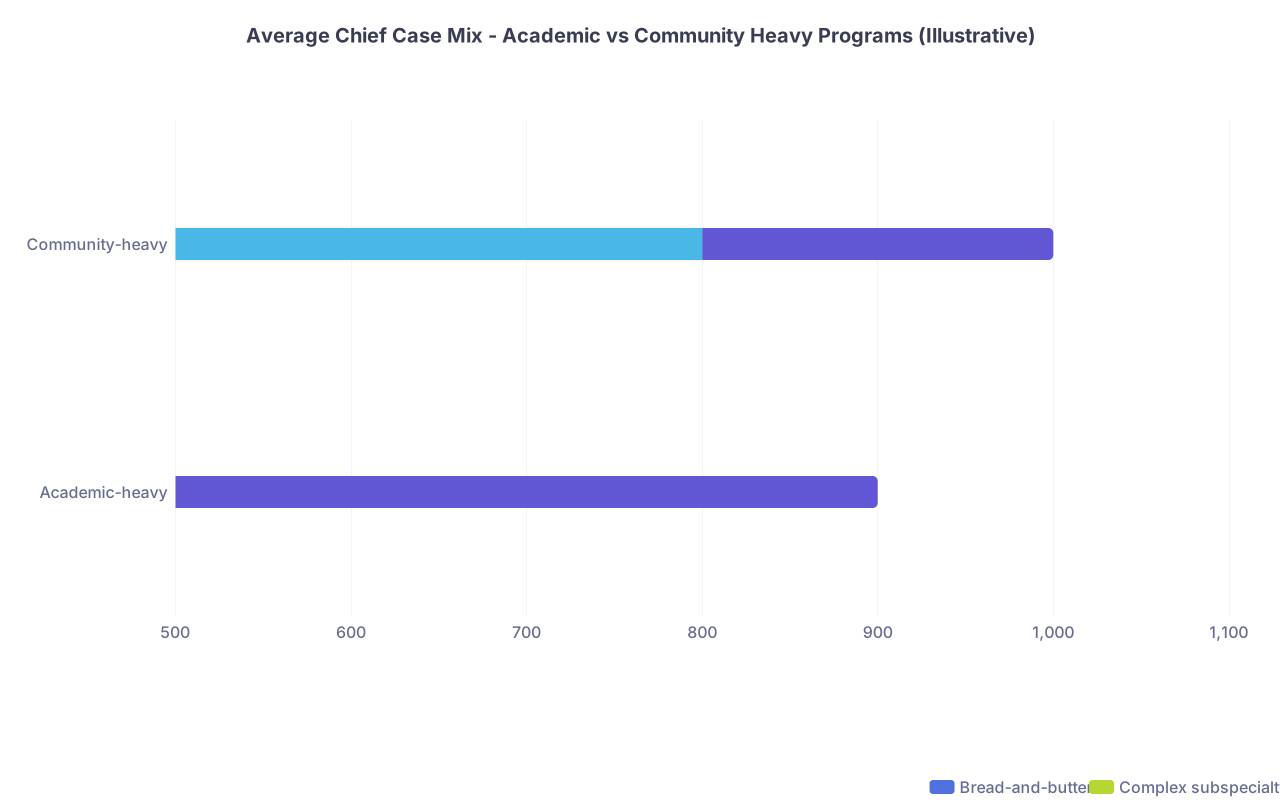
| Category | Bread-and-butter | Complex subspecialty |
|---|---|---|
| Academic-heavy | 500 | 400 |
| Community-heavy | 800 | 200 |
Interpretation: If you go pure academic and the fellows dominate, you may end up with lots of “assists” on highly complex cases and fewer primary bread-and-butter cases. Surgeons are built on bread-and-butter.
6.2. Patient population and payer mix
Blunt truth: Hospitals chasing high RVU elective work for insured patients may push cases to attendings and fellows for “efficiency.” Safety-net hospitals with high un- or under-insured populations often have residents deeply embedded in every case because they are the workforce.
You should ask:
- “What is the primary payer mix?”
- “How much of your schedule is elective vs emergency/trauma?”
- “On elective days, are cases routinely double- or triple-booked? Who gets what?”
High trauma, high ED volume, and a strong safety-net mission usually correlate with residents doing a lot.
7. Evaluating whether stated volume will actually meet your goals
You are not just collecting numbers for fun. You are deciding whether signing this pre‑match contract will make you the surgeon you want to be.
Anchor on your realistic post-residency plan:
- Community general surgeon doing everything.
- Fellowship in trauma, MIS, vascular, ortho subspecialty, ENT subspecialty, etc.
- Academic surgeon doing mainly complex or niche work.
Then ask: “Does this program’s actual case mix line up with that path?”
Example scenarios
You want to be a broad-based community general surgeon with heavy endoscopy.
You need:- High total major cases (1,200+).
- Massive bread-and-butter volume.
- 250+ scoped personally, not just logged as “assist.”
You want a very competitive fellowship (ortho sports at a top program, complex HPB, etc.).
You need:- Solid total numbers but especially strong in that subspecialty.
- Credible faculty who can write letters, not just case volume.
- Enough research exposure that you are not dismissed as “just” a workhorse community grad.
You want trauma-critical care.
You need:- High level 1 trauma exposure with residents doing real cases at night.
- A trauma structure where residents are not blocked out by a swarm of trauma fellows.
In each scenario, a generic “we are very busy and you will get a lot of cases” is irrelevant. The right cases, in the right structure, are what matter.
8. Red flags you should not explain away
When you are hungry for a pre‑match offer, you will be tempted to rationalize. Do not. There are specific red flags around volume you should take seriously.
Major red flags:
- Program leadership resists sharing hard case log data.
- Wide spread in chief case logs (one person with 1,500, another with 800).
- Recent or upcoming addition of multiple fellows without a clear resident protection plan.
- Residents repeatedly mention “fighting” for cases, or favoritism in case assignment.
- PD uses vague phrases like “our residents feel comfortable operating” but cannot answer specifics about category numbers.
Moderate red flags:
- Heavy emphasis on research and conferences, minimal mention of OR early in training.
- Juniors mostly doing scut, consults, and floor work with infrequent scrubbing.
- Frequent OR cancellations or chronic staffing issues that reduce block time.
If you see two or more major red flags and they are still pushing a pre‑match contract, be very careful. Loyalty to a program that will under-train you is not noble. It is self-sabotage.
9. Tactical checklist before you sign anything
Here is an explicit, brutal checklist to run through before you accept a surgical pre‑match contract on the basis of “good operative volume”:
- Have I seen de‑identified case logs for at least the last 3 graduating classes?
- Are chief case numbers comfortably above ACGME minimums in total and key categories?
- Is there relative equity among graduating residents, or are there massive outliers?
- Do juniors and seniors I spoke with independently confirm strong day-to-day OR exposure?
- Are there fellows on key services, and if so, are there explicit resident protections for bread-and-butter cases?
- Does the call/service structure realistically allow OR time, or is it floor-heavy chaos?
- Is there clear evidence (not just talk) that residents are primary surgeon on a large proportion of cases?
- Does the case mix logically match my post-residency goals?
If you cannot answer “yes” to at least 6 or 7 of these, then that program’s volume promise is fragile. You may still sign—for location, visa, family, desperation, whatever. But go in with your eyes open, and plan early how you will compensate (elective rotations, away rotations, extra endoscopy time, etc.).

10. How to protect yourself if you already signed and discover the truth later
Sometimes you only see the cracks as a PGY2. The trauma exposure is thinner than advertised. Fellows arrived suddenly. Cases are getting cannibalized. Now what?
You are not powerless. But you have to be strategic.
Concrete steps:
- Start tracking your own case numbers obsessively from PGY1. Not just total, but category trends.
- Meet with your PD or advisor early if you are lagging in key areas; document that conversation in a follow-up email.
- Volunteer aggressively for under-covered services or community rotations with higher volume.
- Consider external electives late in training, especially for endoscopy or niche skills.
- If things are truly unsafe (multiple grads failing to meet minimums), consider escalation to the DIO or even ACGME. But this is a nuclear option; use it only when absolutely stuck.
Pre‑match contracts make switching complicated, especially in visa-dependent situations. That is why front-loading your skepticism before signing is so critical.

11. Quick mental model: the three filters for volume promises
Every time a program talks about volume, run their claims through three filters:
- Data filter – Do they have hard numbers, recent and detailed?
- Structure filter – Do they have systems that put residents into those cases predictably?
- Resident reality filter – Do actual residents independently confirm the story?
If any one of those three fails, be cautious. If two fail, assume the written or verbal promise is marketing, not reality.
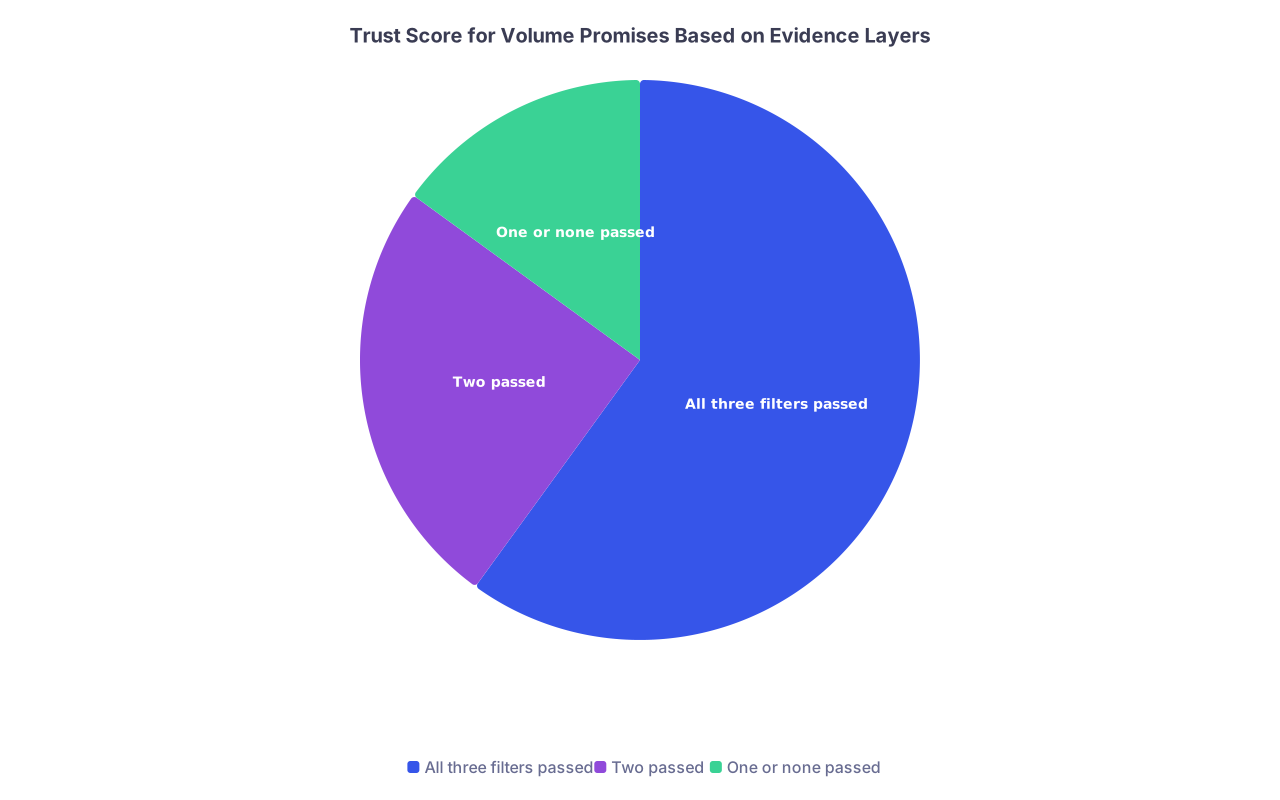
| Category | Value |
|---|---|
| All three filters passed | 60 |
| Two passed | 25 |
| One or none passed | 15 |
Interpretation: You do not need perfection, but you absolutely do not commit your career to a place that only clears one “filter” and expects you to rely on faith for the rest.

FAQ (exactly 4 questions)
1. Can I negotiate procedural volume or case assignments in a pre‑match contract?
You cannot realistically negotiate specific case numbers or assignments into a legal contract. Programs will not bind themselves to “You will get X cases” because they know patient flow and staffing are variable. What you can do is push for transparency: case logs, service structures, and fellow impact. You can also ask for written clarification in policy documents or emails about resident priorities for bread-and-butter cases and how the program protects resident volume when fellows are present. That documentation will not be perfect leverage, but it gives you something concrete to reference if things drift.
2. Is a lower-volume program always a bad choice if I want to be a surgeon?
Not automatically. A “lower-volume” program that is honest, well-structured, and extremely resident-centered can still produce very competent surgeons, especially if the case mix is well aligned with your goals and the autonomy is high. I would rather see a resident graduate with 1,000 carefully chosen, resident-driven cases and strong chief autonomy than 1,400 cases as second assistant. Where low volume becomes dangerous is when you are near ACGME minimums in multiple categories and do not have a clear path to supplement that training before graduation.
3. How do I factor procedural volume into my rank list if I have both NRMP and pre‑match options?
Weight volume heavily, but not in isolation. If your NRMP options are mid-volume but academically strong, and your pre‑match offer is high-volume but weaker in everything else, ask which mismatch you are more willing to fix on your own. Academic gaps (research, letters, networking) are sometimes easier to patch with fellowships and post-docs than fundamental operative undertraining. As a rule, if you are dead set on being a practicing surgeon rather than a full-time researcher, do not sacrifice operative experience for prestige alone.
4. What if the program’s case logs look fine, but residents still say they “do not feel ready”?
That discrepancy tells you something subtle but critical: numbers are not everything. Feeling ready depends on autonomy, complexity, decision-making, and continuity, not just how many times you held the knife. A program can meet or exceed minimums while still sheltering residents from major portions of cases: attending does the hard parts, fellows take the key portions, residents close. When residents say they are underprepared despite decent numbers, you should probe for who does what in the OR, not just how often they are present. That is often the difference between a box-checking program and a place that actually builds surgeons.
Key takeaways:
- Do not trust procedural volume promises without hard data, clear structures, and resident confirmation.
- Evaluate case logs by trends, equity, and category mix, not just totals.
- Before signing any pre‑match contract, interrogate fellows, service design, and real resident autonomy—those three will make or break your operative training.