
It is late November. You just got an email from a community internal medicine program in Texas: “We are pleased to extend you a pre-match offer…”
Your heart rate jumps. Then you see the line: “Employment is contingent upon your ability to obtain work authorization in the United States.”
You are visa-dependent. Suddenly this is not just “Do I want this program?” It is:
- Will they actually sponsor my visa?
- Is this language safe or a trap?
- If I sign this, what happens with NRMP?
- Can I even consider a different offer later without destroying my career?
Let me break this down specifically, because this is where I see IMG applicants make irreversible mistakes.
1. Pre-Match Basics For Visa-Dependent Applicants (What Is Different For You)
Pre-match offers are already tricky. Add visa dependence and the complexity doubles.
What “pre-match” really means in your situation
In non-NRMP states (e.g., many Texas programs historically, some prelims, some specialties) or in non-participating programs, a program can offer you a contract before the Match:
- They send you an employment contract or “offer letter”
- You sign
- Both sides agree you will not use NRMP to determine placement
For a U.S. citizen, the main issues are location and training quality. For you, there are extra variables:
- Visa type (J‑1 vs H‑1B vs rare alternatives)
- Timing of visa petition vs hospital HR deadlines
- What happens if the visa is denied or delayed
- Whether the contract “locks” you out of the Match by NRMP rules
Where most visa-dependent applicants get burned: assuming “we support visas” in an email is equivalent to “we are contractually obligated to sponsor your specific visa type on time.” It is not.
2. Visa Types In Pre-Match Contracts: The Uncomfortable Specifics
If you do not understand how your visa category interacts with the contract, you are gambling.
J‑1 vs H‑1B: completely different risk profiles
| Visa Type | Who Sponsors | Typical Use in Residency | Key Risk in Pre-Match |
|---|---|---|---|
| J-1 | ECFMG | Most IMGs | Subject to 2-year HRR; no moonlighting limits relief early |
| H-1B | Hospital/Employer | Limited programs | Requires USMLE Step 3 & cap-exempt petition |
| H-4/EAD | USCIS via spouse | Some applicants | Dependent on spouse status & EAD timing |
| Green Card | USCIS | Ideal | Not visa-dependent; fewer contingencies |
J‑1 (sponsored by ECFMG)
For most IMGs, J‑1 is the default. You need:
- Valid ECFMG certification
- A signed contract/offer from an accredited program
- Program completes the “Sponsoring Institution” part of the process
- You complete your ECFMG J‑1 application, then consular processing
In a pre-match contract, the “J‑1 language” you want to see is something like:
“The Institution agrees to sponsor the Resident as an ECFMG-sponsored J‑1 exchange visitor, contingent upon the Resident’s eligibility for such sponsorship and timely completion of all required documentation.”
If the contract only says:
“Employment is contingent upon employment authorization in the U.S.”
— that is not J‑1 sponsorship language. That is a generic HR CYA sentence.
H‑1B (sponsored by the hospital)
Different beast, different landmines.
H‑1B requires:
- USMLE Step 3 passed before petition filing
- Employer willing and able to file a cap-exempt H‑1B
- Specific prevailing wage + HR support
- Filing windows and premium processing decisions
For a visa-dependent applicant looking at an H‑1B-supporting program, the contract should address:
- That they will petition for H‑1B, not just “may consider”
- Who pays USCIS filing + premium processing fees (and which are employer-mandated)
- What happens if H‑1B is delayed past start date (e.g., late July / August start on J‑1 then convert, or unpaid leave, or contract termination)
If the PD says verbally “We can do H‑1B” but the contract reads:
“The Institution does not guarantee sponsorship for any particular visa classification.”
Assume they may default to J‑1 or bail out if HR says no. Verbal H‑1B promises are worthless without written support.
3. Dissecting Pre-Match Contract Language: Line-by-Line Red Flags
Here is where you need to be borderline obsessive.
The core components that matter to a visa-dependent applicant
You should scan for at least these components:
- Visa sponsorship clause
- Contingency / termination clauses
- Start date vs immigration timeline
- “Entire agreement” and addenda
- NRMP status / Match participation language
I will go through them one by one.
1. Visa sponsorship clause
Good, clear clause example (J‑1):
“The Institution will sponsor the Resident for ECFMG J‑1 exchange visitor status for the duration of the training program, subject to the Resident maintaining eligibility for such status and timely completion of ECFMG and immigration requirements.”
For H‑1B:
“The Institution will petition for H‑1B temporary worker status on behalf of the Resident for participation in the Residency Program, contingent upon the Resident meeting all legal requirements for H‑1B classification, including but not limited to successful completion of USMLE Step 3 prior to petition filing.”
Watch for weak/murky wording like:
- “may sponsor”
- “will consider sponsoring”
- “if feasible”
- “if institutional policy allows”
Those phrases are exit doors for the program. If you rely on them, you are the safety valve, not them.
2. Contingency / termination clauses
Every GME contract has a general line:
“This agreement is contingent upon the Resident maintaining authorization to work in the United States.”
That is normal.
The dangerous ones are:
“In the event that the Resident fails to obtain any required visa or work authorization by [exact date], this agreement shall be null and void without further obligation by the Institution.”
“The Institution has no obligation to seek an alternative visa classification in the event the requested classification is denied or delayed.”
You want one of two things here:
- A realistic date (e.g., June 30 for a July 1 start is tight; May 15 is common), and/or
- Some flexibility language: “The Institution may, at its discretion, adjust the start date or delay training to allow completion of visa processing.”
You will not always get this flexibility. But if the clause is both rigid and vague on visa sponsorship, you are taking on disproportionate risk.
3. Start date vs immigration realities
Programs love “July 1 start date” on paper, but consulates, ECFMG, and USCIS have their own timelines.
Example: You sign a pre-match contract in January. Your ECFMG certificate is still pending, and your Step 2 CK just posted. They expect you to have a J‑1 in time.
You need to ask explicitly, before signing:
- “By what date must my J‑1 (or H‑1B approval) be in hand for HR to clear me to start?”
- “What is the latest start date the program will tolerate if there are consular delays?”
- “Has your hospital successfully started a visa-dependent resident late and backdated pay or extended training?”
If they dodge or seem confused, that tells you a lot about their true experience with visa-dependent residents.
4. NRMP Rules, Match Participation, and Pre-Match: The Legal Landmines
Here is where talented IMGs get themselves banned or censured because nobody explained the rules properly.
NRMP vs non-NRMP: which world are you in?
There are three broad categories:
- NRMP-participating programs that do not offer pre-match.
- NRMP-participating programs that use pre-match outside NRMP (very rare, heavily regulated; usually not allowed as “side contracts” that conflict with NRMP policy).
- Non-NRMP programs (or states that historically had separate systems, e.g., some Texas positions), which offer contracts directly.
The safest mental rule:
If a program participates in NRMP for that position, you must assume NRMP rules apply. Anything that smells like “sign this now and we will rank you #1” is suspect and can be reportable.
What happens if you sign a binding pre-match contract?
If it is a non-NRMP program:
- Once you sign a binding contract, ethically you are done.
- If you then participate in the Match and try to avoid the signed position, you risk NRMP violations or future professional issues if it comes to light.
If it is an NRMP-participating program for that position:
- A binding pre-match employment contract that attempts to circumvent the Match may violate NRMP policies.
- NRMP has explicit rules about “improper agreements” before the Match.
- Both sides can be sanctioned if this is reported.
Point: Before signing, ask bluntly:
- “Is this position offered through NRMP or outside NRMP?”
- “Will this position be listed in the Match?”
- “Do you expect me to withdraw from NRMP after signing?”
Get the answer in writing (even if only via email).
5. Negotiating As A Visa-Dependent Applicant: What You Can And Cannot Push
No, you are not powerless. You just need to choose your battles.
What is usually not negotiable
- Base salary and benefits (GME set structure)
- Start date month (July)
- Generic HR legal language about at‑will employment / institutional policies
Trying to haggle over PGY‑1 salary or vacation days as a visa-dependent IMG with a pre-match in hand is not a good use of leverage.
What is worth pushing on — very specifically
Clarity of visa type
- Ask: “Can you please specify in the contract that you will sponsor me for [J‑1/H‑1B] status, assuming I meet requirements?”
- If they refuse to specify type, assume they will choose whichever is easiest for them, not you.
Timing of key contingencies
- If the contract says: “Visa must be obtained by April 1,” and you are signing in January with pending scores, that is unrealistic.
- Ask them to extend to May 15 or June 1, with a brief explanation of your situation.
Addendum for H‑1B specifics
- If you are aiming for H‑1B: request an addendum that outlines responsibilities and cost coverage.
- At minimum: “Institution agrees to pay all employer-mandated H‑1B petition filing fees. Resident responsible for costs related to personal immigration documents and dependent visas.”
Confirmation of non-NRMP status
- Ask for a short sentence in email or letter: “This position is not being offered via the NRMP Match.”
You do not need to be aggressive. Just precise. Programs that routinely take visa-dependent IMGs will not be offended by these questions. The ones that get irritated are often the ones least prepared to support you.
6. Timing Scenarios: When You Should Say Yes, No, or “Not Yet”
You are going to face one of a few classic patterns.
Scenario A: Early strong pre-match, weak overall profile
You have:
- 1 solid Texas IM pre-match offer
- Few other IVs, modest scores, average CV
- Heavily visa-dependent (no backup in home country)
If:
- Contract clearly states J‑1 sponsorship
- Program has history of multiple J‑1/H‑1B residents (you checked their current roster)
- No shady NRMP conflict
Then you usually accept. Take the bird in hand. The extra nuance is making sure the visa language and timelines are clean.
Scenario B: Pre-match offer, but you are still in the running at stronger programs
You have:
- A pre-match from a small community hospital
- IVs at 2–3 larger academic or mid-tier programs that sponsor visas through NRMP
Here the decision is not just prestige. It is sequence and risk:
- If the pre-match is from a non-NRMP program that will not affect your NRMP participation, you can technically sign and still go through the Match elsewhere.
- Ethically, though, you are taking a spot and might back out later. Some programs will blacklist you.
My rule: Do not sign unless you are willing to actually go there if nothing “better” materializes. If you already know you will abandon it if a higher-ranked NRMP spot appears, you are walking into professional drama.
Scenario C: Vague visa language, desperate applicant
You have:
- One pre-match offer
- No other IVs
- Mediocre scores, high visa dependence
The contract has vague visa language: “You must have authorization to work… Institution will not guarantee visa sponsorship.”
Harsh truth: This is a dangerous “offer.”
You could sign, get strung along by HR, and be dropped in May when they decide “too complex.” Then you are out of the Match and out of a job.
In this exact situation, I strongly advise:
- Ask them directly on a call: “Have you sponsored J‑1/H‑1B for IMGs in the last 3 years? How many?”
- Ask them to modify the contract language to specify visa sponsorship.
If they refuse both and cannot name a single recent IMG on a visa, I consider this “unsafe” for a visa-dependent applicant. Tempting, but not safe.
7. Operational Details You Ignore At Your Own Risk
Small things that blow up later.
ECFMG certificate timing
You cannot get a J‑1 without ECFMG certification. Programs will often put a clause:
“This agreement is contingent upon the Resident achieving ECFMG certification by [date].”
If you still have a pending Step 2 CK or OET at the time of signing, you are attaching your entire pre-match to test performance and score release timelines.
Ask:
“What happens if ECFMG certification is delayed by one month beyond the contract date due to exam result timing? Will you hold my spot?”
Their response tells you everything.
Occupational health + background checks
Visa plus licensing plus credentialing plus occupational health are parallel tracks. Some contracts tie all of them together vaguely:
“Failure to meet any institutional requirement, including but not limited to visa acquisition, background clearance, or occupational health screening, may result in termination.”
You do not negotiate this usually. You just need to understand there are multiple failure points. Plan travel, document collection, and medical records early, especially if you are abroad.
Dependents and family visas
Programs do not care about your spouse and kids from an HR standpoint. U.S. consulates do. For J‑1 dependents (J‑2) or H‑4s, delays can affect when your family can join you.
Do not expect the program to delay your start date just because your spouse’s visa is late. The contract will not care.
8. Practical Workflow: How To Process a Pre-Match Offer as a Visa-Dependent Applicant
Let me give you a clean stepwise flow.

| Step | Description |
|---|---|
| Step 1 | Receive Pre-match Offer |
| Step 2 | Confirm NRMP Status of Position |
| Step 3 | Request Draft Contract |
| Step 4 | Check NRMP Rules and Policies |
| Step 5 | Review Visa Clause and Timelines |
| Step 6 | Evaluate Program Quality and Fit |
| Step 7 | Ask for Clarification or Revision |
| Step 8 | Consider Declining - High Risk |
| Step 9 | Compare With Other Interviews |
| Step 10 | Sign and Plan Visa Steps |
| Step 11 | Politely Decline |
| Step 12 | Non-NRMP Position? |
| Step 13 | Clear Visa Sponsorship Stated? |
| Step 14 | Program Clarifies in Writing? |
| Step 15 | Reasonable Risk-Reward? |
This is how I’d actually walk through it with an IMG on a Zoom call. No magic. Just order and discipline.
9. Common Mistakes I See Visa-Dependent Applicants Make
Let’s be blunt.
Believing PD verbal assurances over written language
- “We always support visas” means nothing if the contract does not reflect that.
Ignoring termination date clauses tied to visa acquisition
- You sign in February; the contract quietly requires J‑1 in place by April 15; you read it in May.
Signing with programs that have zero track record with IMGs
- Look at their resident list on the website. If everyone is a U.S. grad, and they are vaguely “open” to IMGs for the first time, expect HR chaos.
Letting desperation override basic legal caution
- “This is my only offer, I have to sign” — even when the contract clearly says “no visa guarantee” and they have never sponsored before.
Not getting independent review
- You are signing a U.S. employment contract with immigration implications. Showing it to at least one of: an experienced IMG mentor, an immigration-savvy advisor, or an attorney is not optional if there are red flags.
10. Simple Preparation Steps Before You Ever See a Pre-Match Offer
You can prep for this months earlier.
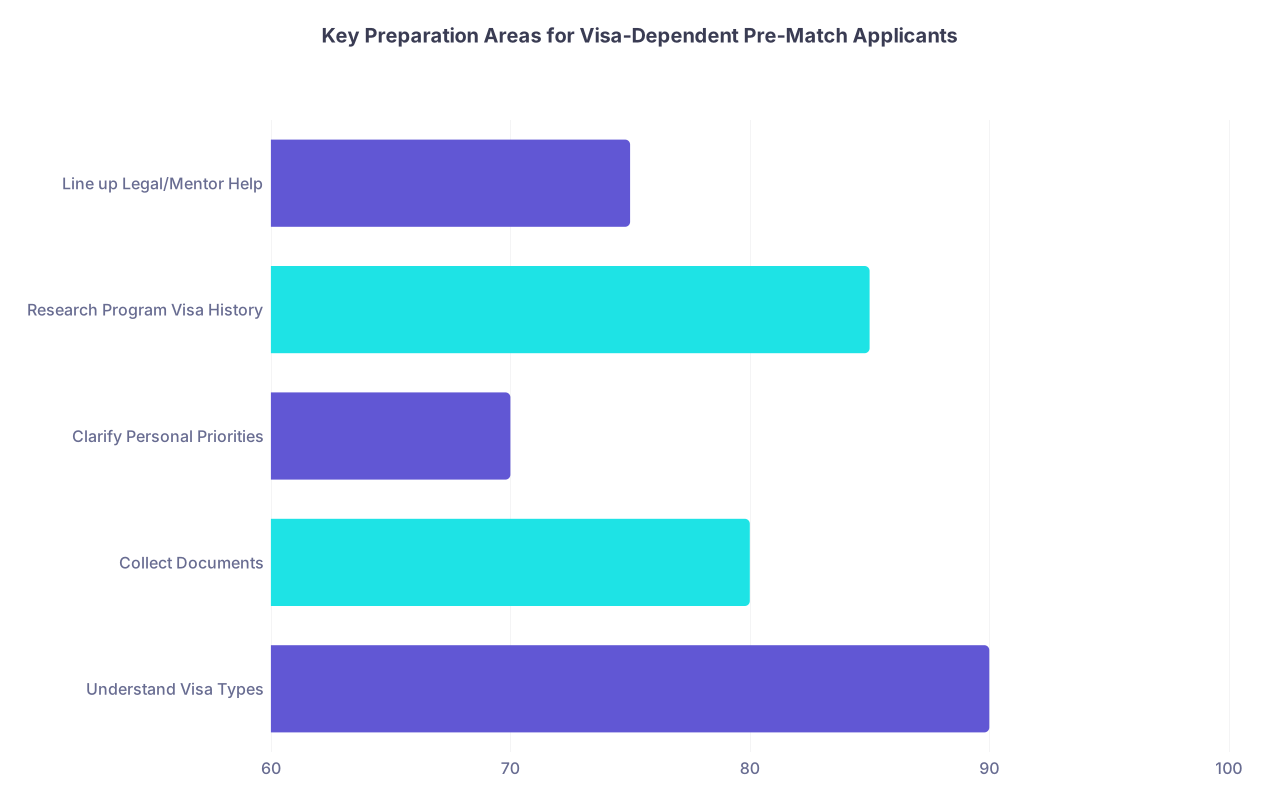
| Category | Value |
|---|---|
| Understand Visa Types | 90 |
| Collect Documents | 80 |
| Clarify Personal Priorities | 70 |
| Research Program Visa History | 85 |
| Line up Legal/Mentor Help | 75 |
Do these before pre-match season:
- Decide your true visa priority: “J‑1 is fine” vs “I must try for H‑1B if at all possible.”
- Gather and scan all critical documents: passport, prior visas, ECFMG papers, score reports.
- Create a short list of programs known to sponsor your preferred visa type.
- Identify at least one person you can send a contract to for a 24–48‑hour review (someone who has done this before, preferably).
- Know your own red lines: “I will not sign anything that does not explicitly mention visa sponsorship,” for example.
FAQ (Exactly 5 Questions)
1. If a program emails “We will support your visa” but the contract is silent, is that enough?
No. Email promises are better than verbal only, but they are still weaker than contract language. At minimum, keep the email, reply to confirm your understanding (“Just to confirm, you will sponsor me for a J‑1 visa, correct?”), and ask if they can reference sponsorship in the contract or an addendum. If they refuse to put anything in writing beyond vague HR boilerplate, assume risk is on you.
2. Can I sign a pre-match with a non-NRMP program and still participate in the NRMP Match?
Technically yes, if the position is truly outside NRMP. Many IMGs do this with some Texas pre-match positions while still ranking NRMP programs. Ethically, you should only do this if you are genuinely willing to honor the pre-match if nothing better appears. Do not treat a signed contract as a “placeholder.” Also, read NRMP rules carefully; if there is any overlap, you risk sanctions.
3. Should I hold out for H‑1B if a program offers only J‑1 pre-match?
If you are heavily dependent on staying in the U.S. long-term and avoiding the J‑1 two-year home residency requirement, then yes, H‑1B has advantages. But in practice, relatively few programs offer H‑1B to IMGs, and many have strict Step 3 timing requirements. For many visa-dependent applicants with limited interviews, a stable J‑1 pre-match from a reliable program is a much safer and more realistic path than waiting for a speculative H‑1B that may never come.
4. What if I sign a pre-match and my visa is denied or delayed past the cutoff date in the contract?
If the contract has a strict contingency clause, the institution can legally terminate the agreement with no further obligation. Some may try to help by adjusting a start date or re-filing, but they are not required to. If you are in a high-risk consular environment, this is a real concern. You reduce risk by having complete documentation, applying early, and choosing programs familiar with your country’s consulates and common issues.
5. Is it worth hiring an immigration attorney just to review a pre-match contract?
If you are truly visa-dependent and the language is vague, yes, it is often worth the cost. A short review focused on visa clauses and contingencies is not outrageously expensive, and it can prevent catastrophic misunderstandings. At minimum, have someone experienced (senior IMG, prior resident from that program, institutional advisor) read it. Going blind into a binding contract as a foreign national is how people end up stranded in June with no job and no legal status.
Key points to walk away with:
- For visa-dependent applicants, the exact wording about sponsorship and contingencies in a pre-match contract matters more than almost anything else.
- Do not let desperation override basic risk assessment; programs with no clear visa commitment and no track record are unsafe bets.
- Treat NRMP rules, visa timelines, and contract clauses as one integrated system — because that is how they will determine whether you actually start residency on July 1.