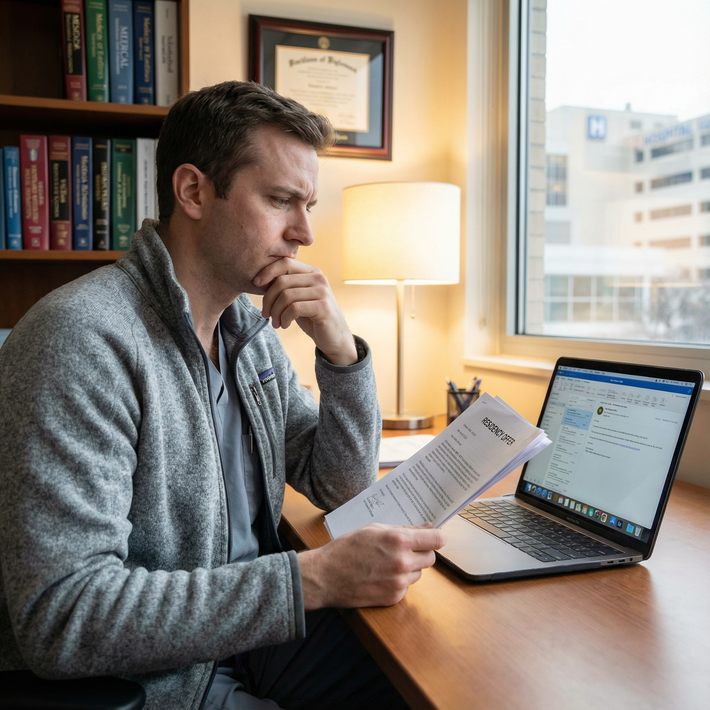
Pre-match communication in the surgery residency match is one of the most confusing—and anxiety‑provoking—parts of the process, especially for a DO graduate pursuing general surgery. You’ll hear terms like “pre-match offers,” “letters of intent,” and “early commitment,” often with conflicting advice about what’s ethical or even allowed.
This guide breaks down what pre-match communication looks like specifically for a DO graduate in general surgery, what’s permitted under NRMP rules, how to protect yourself, and how to use communication strategically without crossing important ethical boundaries.
Understanding Pre-Match Communication vs. Pre-Match Offers
Before you can navigate this well, you need to separate two concepts that get mixed up all the time:
1. Pre-match communication
This refers to any interaction with a residency program before rank lists are certified and the Match occurs, such as:
- Thank-you emails and updates after interviews
- Program-initiated check-ins (“We really enjoyed meeting you…”)
- You reaching out with questions about the program
- Expressions of interest (e.g., “Your program is my top choice.”)
- Clarifying logistics, second looks, or research opportunities
These are allowed, as long as no one is pressuring you or asking for commitments about how you will rank.
2. Pre-match offers or early commitment
A pre-match offer (or “early commitment”) is when a program says or strongly implies:
- “If you rank us #1, we’ll rank you #1.”
- “We want you to commit to signing with us before the Match.”
- “We can guarantee you a spot if you agree now.”
In NRMP-participating programs, this is not allowed. It violates the Match Participation Agreement for both applicants and programs.
Key point for DO general surgery applicants:
- ACGME/NRMP-participating general surgery programs cannot make binding pre-match offers.
- “Old school” pre-match deals that used to occur in some osteopathic or non-NRMP programs are largely gone now that most programs are in the single accreditation system.
- You may still encounter pressured “soft promises”—you must handle these carefully.

What the Rules Actually Say (NRMP & Ethics Overview)
As a DO graduate in general surgery, you’ll almost certainly be applying through ERAS to ACGME-accredited programs participating in the NRMP Main Residency Match. That means NRMP rules govern nearly all your interactions.
NRMP rules about communication and commitments
NRMP explicitly allows:
- Post-interview thank-you notes
- Expressions of interest or preference
- Reasonable communication to clarify program details
NRMP forbids:
- Asking you how you will rank programs
- Programs requesting or requiring a verbal commitment
- You asking programs to commit to ranking you in a certain way
- Any statement that sounds like a binding commitment (e.g., “I promise I will rank you #1 if you promise to rank me #1”)
NRMP also cautions about misleading language:
- A PD saying “We’re going to rank you very highly” is not a contract.
- You saying “I plan to rank your program highly” is also not binding.
How this plays out in general surgery
General surgery is a competitive specialty, and informal signaling is common. You may hear things like:
- “You’ll be very competitive on our list.”
- “You’d fit in well here. We hope to work with you in July.”
- “If you ended up here, we’d be thrilled.”
These are encouraging, but they are not guarantees. Programs often say similar things to multiple applicants.
Bottom line:
- You are never obligated to tell a program where you’ll rank them.
- You should never feel forced into an early commitment.
- Ultimately, the safest path is to treat every interaction as non-binding and still rank programs in your true order of preference.
Strategic Communication Before and After Interviews
Pre-match communication is not just about avoiding violations. When used well, it helps you stand out as a DO graduate in a field where MDs may still be more common.
Before the interview: pre-interview communication
Most pre-match communication before your interview falls into two categories:
Initial outreach or updates
- Rarely necessary unless:
- You have a strong connection to that region or institution (e.g., “I did an away rotation on your service.”)
- You are offering a significant update (new research, publication, leadership role).
- Keep it brief and professional.
- Rarely necessary unless:
Clarifying logistics
- If you’re unsure about:
- Interview format
- Opportunities to meet residents
- Whether DO applicants are considered equally
- It’s appropriate to email the program coordinator for clarification.
- If you’re unsure about:
Example pre-interview email (DO-focused):
Subject: Question Regarding Interview Day – [Your Name], DO
Dear [Coordinator Name],
Thank you for the opportunity to interview at [Program Name] on [Date]. I am very interested in general surgery training that emphasizes [specific aspect—breadth of cases, trauma, etc.].
I had a quick logistical question about the interview day: [your question].
As a DO graduate, I was also wondering whether there will be an opportunity to speak with any current residents about their experiences with the program’s support for osteopathic graduates.
Thank you very much for your time and assistance.
Sincerely,
[Your Name], DO
[AAMC/ERAS ID]
After the interview: thank-you notes and interest signaling
For many DO applicants to general surgery, post-interview communication is where you can differentiate yourself constructively.
Should you send thank-you emails?
While not mandatory, thoughtful emails can:
- Reinforce your interest
- Highlight a specific part of the conversation
- Help faculty remember you positively
Avoid generic copy-paste messages. Tailor 1–3 short paragraphs.
Example post-interview thank-you:
Subject: Thank You – General Surgery Interview on [Date]
Dear Dr. [Last Name],
Thank you for taking the time to speak with me during my interview at [Program Name]. I especially appreciated our discussion about [specific topic—early OR exposure, global surgery, trauma volume].
As a DO graduate, I’m particularly drawn to your program’s emphasis on hands-on operative experience and supportive teaching environment. The way your residents described the culture of teamwork on the trauma service resonated with the environment I’m seeking for my training.
I remain very interested in [Program Name] and would be honored to train there.
Sincerely,
[Your Name], DO
You may also send a separate note to the program director (PD) summarizing your appreciation and specific reasons for interest.
How much is too much?
Overcommunication can hurt you:
- Avoid weekly emails or “check-ins” without substance.
- Only send meaningful updates (e.g., new publication, Step 2 score if stronger, additional case logs, leadership award).
A safe pattern:
- Thank-you email within 48–72 hours of interview.
- One substantive update sometime mid-season if relevant.
- One final, clear statement of interest (if they’re truly your top choice) after you’ve decided.
Expressing Interest Without Crossing Ethical Lines
A major source of confusion is how to express interest in a program without creating—or being seen as creating—a binding early commitment.
Levels of interest statements
Think of your language in three levels of strength:
General positive interest (low-commitment)
- “I remain very interested in your program.”
- “I could see myself thriving at [Program Name].”
High interest (serious, but not exclusive)
- “Your program is one of my top choices.”
- “I am strongly considering ranking [Program Name] very highly.”
Top choice (maximum clarity)
- “I intend to rank [Program Name] as my #1 choice.”
- “Your program is my top choice in the Match.”
When to use each level
- Use Level 1 for most programs after interviews.
- Use Level 2 for programs where you are seriously considering ranking them in the top tier but are not yet sure of your final order.
- Use Level 3 only for one program—your genuine #1 choice—and only once you are certain.
Ethical rule of thumb:
- Do not tell more than one program they are your “#1 choice.”
- Do not make any promise you are not genuinely prepared to keep.
Sample “top choice” email (for your true #1)
Subject: [Your Name], DO – Strong Interest in [Program Name]
Dear Dr. [PD Last Name],
I want to sincerely thank you and your team for the opportunity to interview at [Program Name]. After thoroughly considering my experiences and goals in general surgery, I have decided that [Program Name] is my top choice.
The combination of high operative volume, early autonomy, and the supportive, collaborative environment described by your residents aligns closely with what I am seeking in a training program. As a DO graduate, I am particularly appreciative of the program’s openness to osteopathic applicants and the success of past DO residents matching into competitive fellowships.
I recognize that both applicants and programs must adhere to NRMP guidelines, and I understand that this message does not constitute any binding commitment. I simply wanted to express my genuine enthusiasm and my intention to rank [Program Name] #1.
Thank you again for your consideration.
Sincerely,
[Your Name], DO
This language:
- Clearly states your preference
- Acknowledges NRMP rules
- Avoids putting pressure on the program for a reciprocal commitment

Handling Grey Areas: Pressure, “Soft Promises,” and Difficult Situations
As a DO graduate in the surgery residency match, you might encounter situations that feel uncomfortable or unclear. Here’s how to respond.
Scenario 1: “If you rank us #1, you’ll match here.”
A PD (or assistant PD) says this on interview day or in a follow-up call.
Problems:
- This implies a conditional guarantee, which goes against the spirit of NRMP policy.
- It’s not legally or contractually binding.
- You have no way to verify where they’ll truly place you on their list.
How to respond:
You can respond politely, without making a reciprocal commitment:
“I really appreciate your enthusiasm and that feedback. I am very interested in your program and will be thinking carefully about how I rank all my options.”
Privately:
- Do not feel obligated to rank them #1 because of this statement.
- Rank them according to your true preference list.
Scenario 2: Being asked directly, “Where will you rank us?”
This question itself is inappropriate under NRMP guidelines, but it still happens.
Possible responses:
Option A – Neutral, rules-based:
“I’m still in the process of finalizing my rank list and want to be thoughtful about it. I can say I’m very interested in your program, and I’ve really enjoyed my time here.”
Option B – More direct but respectful:
“I was advised not to disclose my specific rank order to programs so that I can create an honest list based on overall fit. I hope you understand.”
You do not have to answer with specific rankings.
Scenario 3: You’re a DO applicant; a program seems unsure about DOs
You sense hesitation about your osteopathic background—or you are explicitly asked if you’re comfortable in an environment with mostly MD residents.
How to reframe and reassure:
- Highlight your performance on standardized metrics (USMLE scores, COMLEX concordance).
- Emphasize successful performance on surgical rotations, sub-internships, or away rotations at academic centers.
- Reference any DO general surgery mentors or alumni from your school who have succeeded in ACGME programs.
Sample response:
“As a DO graduate, I’ve trained in a system that emphasizes hands-on clinical skills and patient-centered care, and I’ve complemented that by taking the USMLE exams and completing sub-internships at ACGME programs where I’ve received strong evaluations. I’m very comfortable in mixed MD/DO environments and feel well prepared for the rigor of your general surgery residency.”
Scenario 4: You regret something you said in an email
Maybe you told two different programs they were “my top choice” in a moment of panic.
Steps to take:
- Stop sending further conflicting messages.
- Do not try to “undo” with another email confessing or contradicting yourself; that often draws more attention.
- Privately decide your true rank order and stick to it.
- View it as a learning point about being extremely careful with strong language.
Practical Tips for DO Graduates Targeting General Surgery
This final section puts everything together into actionable steps for managing pre-match communication as a DO applicant.
1. Create a communication tracker
Use a simple spreadsheet to avoid inconsistency:
- Program name
- Date interviewed
- Thank-you sent? (Y/N, date)
- Updates sent (what/when)
- Interest level statement used (Level 1, 2, or 3 as described earlier)
- Key contacts (PD, coordinator, faculty champion)
This helps ensure:
- You don’t accidentally promise #1 to multiple programs.
- You maintain professionalism and organization across dozens of programs.
2. Consider program-specific context for DO graduates
When deciding where to invest more communication energy:
- Prioritize programs that:
- Have historically matched DOs into general surgery residency
- Have DO faculty or chief residents
- Speak openly and positively about osteopathic training
- During interviews, ask:
- “Have you had DO residents in your program before?”
- “How have osteopathic graduates performed in your program?”
If they have a track record of DO graduates matching into fellowships, you can highlight that in your follow-up email:
“I was encouraged to hear about your DO graduates who went on to vascular and surgical critical care fellowships. As a DO, that success is very important to me in choosing a program.”
3. Align your pre-match communication with your rank strategy
Your rank list should drive your communication, not the other way around. After interview season:
Draft your initial rank list based on:
- Fit with program culture
- Case volume and complexity
- Resident satisfaction
- Geographic preferences
- Support for DO graduates
Identify:
- Your true #1 (if clear)
- Your top 3–5 programs
Plan communication:
- Top choice: Send a Level 3 “#1 choice” email.
- Other top tier: Use Level 2 “one of my top choices” messages if appropriate.
- Mid-tier programs you still like: Maintain Level 1 interest statements and send updates only if meaningful.
4. Know when not to communicate
Sometimes silence is better:
- If you’re not interested in a program, there’s no obligation to send repeated emails.
- If a program made you uncomfortable or expressed bias against DOs, you are not obligated to “fix” their perception.
- If you’re angry about something that happened in the interview, do not send a confrontational email—just rank them accordingly or not at all.
5. Protect your integrity and peace of mind
The pressure of the surgery residency match can tempt applicants to:
- Exaggerate their intentions
- Promise everyone they’ll rank them highly
- Try to “game” program behavior
This usually backfires emotionally if not practically.
As a DO graduate, your professional reputation—and your own sense of integrity—will follow you into residency and beyond. Aim for:
- Honest, consistent communication
- Respect for NRMP rules
- A focus on fit, not on coercing outcomes
FAQs: Pre-Match Communication for DO Graduates in General Surgery
1. As a DO graduate, should I mention that your program is my “top choice”?
Yes—but only if it’s true and only to one program. A clear, honest statement that you intend to rank a program #1 can help communicate your enthusiasm. Make sure you understand:
- It’s not a binding contract.
- The program is not obligated to rank you #1 in return.
- Overusing this language with multiple programs is unethical and risky.
2. Do general surgery programs look down on DO applicants if we communicate a lot?
Most will not—if your communication is professional, concise, and meaningful. Where DO graduates sometimes get into trouble is:
- Sending multiple long, repetitive emails
- Asking for assurances about rank order
- Sounding desperate instead of confident
Programs in competitive fields like general surgery respect applicants who:
- Communicate clearly and politely
- Know the rules and don’t push for commitments
- Demonstrate insight about fit and training goals
3. Can I ask a general surgery program how they view DO applicants?
Yes, and it’s often wise. Appropriate ways to ask include:
- “Can you share how DO graduates have performed in your program?”
- “Do you currently have or have you previously had DO residents on your service?”
- “How does your program support the transition of osteopathic graduates into a primarily ACGME environment?”
This signals that you’re thoughtful about your training environment and that you’re looking for a place where you’ll be genuinely supported.
4. Are pre-match offers still common for DO graduates in general surgery?
In NRMP-participating ACGME general surgery programs, formal pre-match offers are not allowed and are increasingly rare. You may still encounter:
- Vague or encouraging language (“We’d love to have you here”)
- Implicit pressure to rank them highly
But any explicit early commitment (“If you commit to us now, we guarantee you a spot”) is problematic under NRMP rules. If you encounter this:
- Do not feel compelled to agree.
- Consider discreetly discussing the situation with your dean’s office or an advisor.
- Ultimately, you should still rank programs in your true order of preference.
Navigating pre-match communication as a DO graduate aiming for general surgery residency requires a balance of strategy, professionalism, and ethics. Understand the rules, communicate honestly, highlight your osteopathic strengths, and let your true preferences guide your rank list. When you do that, you maximize both your chances of matching well and your confidence that you did it the right way.