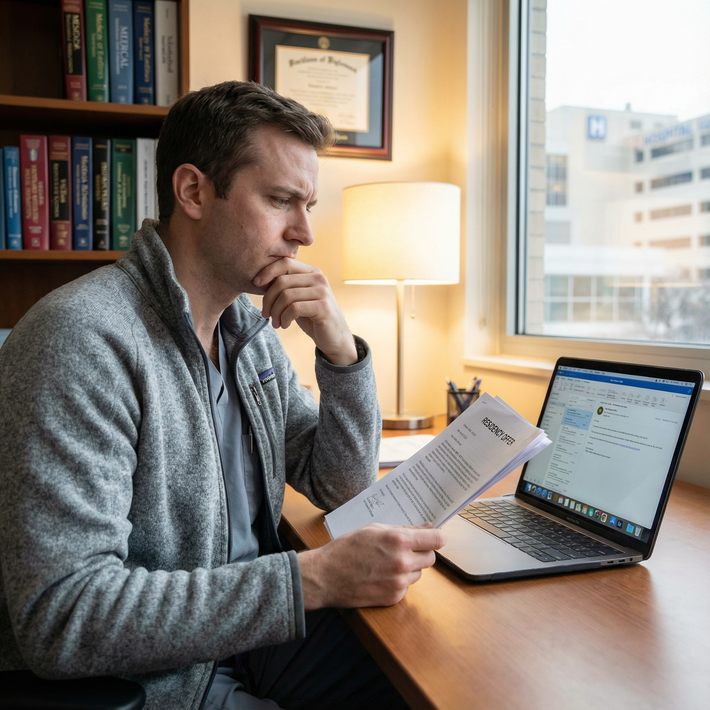
Understanding Pre-Match Communication as a DO Graduate in OB/GYN
Pre-match communication can feel like one of the murkiest parts of the residency process—especially for a DO graduate targeting an OB GYN residency. You’ll hear conflicting advice: “Never email a program,” “Email every program you love,” “Pre-match offers don’t really exist in OB/GYN,” or “You must secure an early commitment.” The truth lies somewhere in the middle and depends heavily on timing, policies, and professional judgment.
This guide focuses on ethical, effective, and strategic pre-match communication for DO applicants seeking an obstetrics match in ACGME-accredited programs. You’ll learn how to communicate interest, respond to signals from programs, and navigate the gray areas without jeopardizing your integrity—or your Match.
We’ll cover:
- What pre-match communication is (and is not) in the NRMP era
- Special considerations for DO graduates in OB/GYN
- How and when to contact programs before, during, and after interviews
- Responding to expressions of interest and informal “pre-match offers”
- Sample email templates and talking points
- FAQs and practical tips to avoid common mistakes
The Landscape: Pre-Match Communication in the OB/GYN Match
What “Pre-Match Communication” Means Today
In most ACGME-accredited programs participating in the NRMP, there is no formal pre-match (in the sense of signing a contract before Match Day). However, pre-match communication still occurs and can influence rank lists on both sides.
Pre-match communication includes:
- Emails to express interest before interview invitations
- Thank-you notes and follow-up messages after interviews
- Updates about new publications, scores, rotations, or awards
- Signals from programs (e.g., “You are ranked to match” or “You will be highly ranked”)
- Conversations that feel like an informal early commitment
In OB/GYN, most programs are strict about following NRMP Match Participation and SOAP policies, which prohibit:
- Solicitations or requirements for statements of rank order
- Asking applicants where they will rank a program
- Making or requesting explicit promises, commitments, or guarantees about ranking
However, there is still a gray zone of “interest” language, and this is where you must be careful and strategic.
DO Graduate Reality: Why Communication Matters More
As a DO graduate seeking an OB GYN residency, you may:
- Face implicit bias or unfamiliarity with your school from some programs
- Be competing in a specialty that has become more competitive each year
- Need to demonstrate that you can thrive in academic, research-heavy, or high-volume sites
- Be applying to a mix of historically osteopathic-friendly and more “MD-dominant” programs
Because of this, deliberate, high-quality communication can:
- Put your application back on a program’s radar
- Demonstrate professionalism, maturity, and genuine interest
- Clarify why your DO training is an asset to their program
- Counteract limited exposure to DO graduates at traditionally allopathic institutions
This doesn’t mean you should flood inboxes; it means each touchpoint should be timely, purposeful, and polished.
Before the Interview: Strategic Outreach and First Impressions
Pre-interview is your first chance to set the tone. Your goal is not to beg for an interview, but to connect your story to the program’s mission and highlight why you’re a strong fit—especially as a DO graduate.
When It Makes Sense to Email Before Interviews
Appropriate reasons to contact a program before they’ve invited you:
- You completed an away rotation or audition there and want to reaffirm interest
- You have a specific connection to the institution or region (family, partner, service ties)
- You have significant new information (COMLEX Level 2 / USMLE Step 2 scores, a publication, new leadership role, etc.)
- You are a DO applicant and want to ensure your application isn’t overlooked in a large pool
- You have a clear, well-articulated reason the program aligns with your career goals (e.g., strong maternal-fetal medicine exposure, robust advocacy curriculum, underserved patient population)
Less ideal reasons:
- “I haven’t heard from you yet and I’m anxious”
- “You’re a higher-tier program and I want to increase my odds” without any genuine, specific fit
- Sending the same generic email to 50 programs
What to Include in a Pre-Interview Email
Your email should be concise (8–12 sentences) and professional:
Subject line:
- “Prospective OB/GYN Applicant – DO Graduate with Strong Interest in [Program Name]”
- “DO OB/GYN Applicant – Continued Interest in [Institution] Residency Program”
Introduction: Who you are (DO graduate, school, graduation year), that you’ve applied to their OB/GYN residency.
Connection to the program: 1–2 program-specific points (curriculum, patient population, values).
Why you as a DO: Briefly highlight how your osteopathic training (holistic care, OMT exposure, continuity, primary care foundations) enhances your fit in OB/GYN.
Update or key strength: Recent step/COMLEX scores, publication, QI project, chief role, or an impactful OB/GYN experience.
Professional close: Express appreciation and willingness to provide additional information.
Example Pre-Interview Email (DO OB/GYN Applicant)
Dear Dr. [PD Last Name] and the [Institution] OB/GYN Residency Selection Committee,
My name is [Name], a fourth-year DO student at [School], and I recently applied to the [Institution] Obstetrics & Gynecology residency program through ERAS. I am writing to express my sincere interest in your program and to briefly highlight why I believe I would be a strong fit.
During my clinical training, I have been particularly drawn to caring for underserved women in [region/setting], and I am impressed by [specific aspect: your safety-net hospital role, the resident continuity clinic model, your emphasis on advocacy, family planning training, etc.]. The breadth of obstetrics exposure and the structured mentorship in your program strongly align with my career goals of becoming a community-focused OB/GYN physician.
As a DO graduate, my training has emphasized a holistic and patient-centered approach, which I believe complements the longitudinal, relationship-based nature of OB/GYN care. I also wanted to share a brief update that I recently received my COMLEX Level 2 score of [score] (and USMLE Step 2 CK [score], if applicable), and completed a quality improvement project on [brief topic] that has been submitted for presentation at [conference].
Thank you for your time and consideration of my application. I would be honored to interview at [Institution], and I am happy to provide any additional information that may be helpful.
Sincerely,
[Full Name], DO
AOA/COMLEX ID: [ID]
ERAS AAMC ID: [ID]
Used sparingly and strategically, this type of outreach can give your osteopathic residency match application a helpful boost, especially if you are otherwise a borderline candidate for that institution.

During Interview Season: Professionalism, Signaling, and Staying Visible
Once interview invitations begin, your program communication before Match should be thoughtful and measured. Your goals now:
- Reinforce genuine interest
- Clarify fit
- Leave a professional, memorable impression
- Avoid anything that could be construed as NRMP-unethical
Post-Interview Thank-You Notes and Follow-Up
Most OB/GYN programs do not require thank-you notes, but many faculty and PDs still appreciate them. They can be helpful if:
- You’re a DO graduate at a program with few DOs historically
- You had a strong connection with an interviewer and want to reinforce it
- You have specific, personalized reflections that show you understand the program
Guidelines:
- Send within 24–72 hours of the interview
- Keep it short: 1–2 short paragraphs
- Mention something specific you learned and how it aligns with your goals
- Avoid ranking language (“You’re my top choice”) which can complicate later communication
Sample Post-Interview Thank-You Note
Dear Dr. [Interviewer Last Name],
Thank you very much for taking the time to speak with me during my interview at [Program] on [date]. I especially appreciated learning about how your residents gain early autonomy on labor and delivery and the strong mentorship available in family planning and minimally invasive gynecology.
As a DO student, I value the emphasis [Program] places on comprehensive, patient-centered care for women across the lifespan, particularly in underserved populations. Our conversation further confirmed my belief that [Program] would be an excellent environment to grow into a well-rounded OB/GYN.
Thank you again for your time and for considering my application.
Sincerely,
[Name], DO
Clarifying Interest Without Violating NRMP Rules
A common dilemma: how do you signal strong interest without making promises?
You may say:
- “Your program is one of my top choices.”
- “I could see myself thriving in your program and community.”
- “I will be ranking your program very highly.”
You should avoid:
- Stating “I will rank your program #1” if it’s not true
- Asking, “Where will you rank me?”
- Pressuring for any type of early commitment or guarantee
As a DO graduate, honesty and professionalism will often be more memorable than overly effusive but vague praise.
Handling Informal “Pre-Match Offers” or Strong Signals
In OB/GYN, explicit pre-match offers (like those once common outside the NRMP in some specialties or states) are unusual, but you may still encounter:
- “We intend to rank you to match.”
- “If you rank us first, you are very likely to match here.”
- “We consider you one of our top applicants.”
How to respond:
- Acknowledge and appreciate their interest.
- Do not reciprocate with promises you aren’t prepared to keep.
- If you are truly certain the program is your first choice, you may say:
- “You are my first choice, and I plan to rank [Program] #1.”
- If you are not certain, maintain flexibility:
- “I am very interested in your program and will be ranking [Program] highly.”
NRMP expects both sides to create rank lists independently, free from coercion. Don’t let anxiety push you into early commitment language you later regret.
Late Season and Ranking Time: Updates, Signals, and Tough Decisions
As interview season winds down and rank list deadlines approach, many DO graduates begin to worry: “Should I send another email?” “Will an update help my obstetrics match chances?” This period is especially sensitive.
When to Send a Post-Interview Update
Appropriate reasons to send an update:
- New significant achievement: publication acceptance, national presentation, new leadership role, improved Step/COMLEX score
- Major personal information relevant to the program: spouse/partner matched or employed in that city, change in geographic constraints
- True change in preference: a program has clearly become your first choice after reflection
What an update should not be:
- A weekly check-in asking for your rank position
- A pressure tactic to extract information about how they’ll rank you
Example Final-Season Update Email (True First Choice)
Use this sparingly—ideally for one program only (your genuine #1). This is where your early commitment message becomes explicit, but still NRMP-compliant.
Dear Dr. [PD Last Name],
Thank you again for the opportunity to interview at the [Institution] OB/GYN residency program on [date]. Since our interview, I have reflected extensively on my experiences this season and on what I am seeking in a training environment.
I am writing to let you know that [Program] is my first choice for residency, and I plan to rank your program #1. I was particularly drawn to [1–2 specific aspects: your supportive resident culture, high-volume obstetrics training, strong gynecologic surgery exposure, commitment to serving diverse populations, etc.], and I can clearly see myself contributing to your team as a hardworking and collegial resident.
In addition, I wanted to share a brief update: [New publication, Step/COMLEX score, leadership role]. I believe this further reflects my dedication to [education, quality improvement, advocacy] in women’s health.
Thank you again for your time and consideration. Regardless of the outcome, I am grateful for the chance to have gotten to know your program.
Sincerely,
[Name], DO
Sending this only when fully truthful protects your integrity and aligns with NRMP expectations. Programs respect consistency and honesty, and untrustworthy communication can travel informally between institutions.
If a Program Strongly Recruits You
Some programs may reach out with:
- Personal calls from PDs or faculty
- Strong language: “We hope you rank us first,” “We would be thrilled to have you,” etc.
How to respond:
- If they’re truly your first choice: it’s appropriate to say so clearly.
- If you’re undecided but very interested:
- “I am very grateful for your interest. I greatly enjoyed learning about your program and will be ranking [Program] highly.”
Avoid being pressured into verbal contracts. You must preserve your autonomy to create a rank list that reflects your true preferences.

DO-Specific Considerations and Pitfalls to Avoid
As a DO graduate seeking an OB GYN residency, pre-match communication can help you stand out—but it can also hurt you if misused.
Leverage Your Osteopathic Background Intentionally
When communicating with programs, explicitly connect your DO training to OB/GYN:
- Emphasize holistic, patient-centered care, especially in prenatal counseling, postpartum support, and chronic gynecologic conditions.
- Highlight experiences where OMT or manual skills helped pregnant patients with back pain, pelvic discomfort, or postpartum recovery (without overselling OMT as a required feature for the program).
- Clarify your comfort with evidence-based medicine, guidelines, and surgical training to reassure any lingering misconceptions about DO training rigor.
Phrase examples:
- “My DO training has reinforced the importance of considering social, psychological, and physical factors in every patient encounter, which I believe is particularly relevant in obstetrics and gynecology.”
- “While I value OMT as part of my background, my primary focus is on comprehensive, guideline-based OB/GYN care and surgical competency.”
Common Communication Mistakes to Avoid
Over-emailing
- One or two well-timed emails per program (pre-interview and/or post-interview) are usually enough.
- More than that risks seeming needy or unprofessional.
Copy-paste messages
- Programs notice generic templates.
- Always mention at least one specific detail about the program that couldn’t apply elsewhere.
Dishonesty about rank intentions
- Telling multiple programs “You are my #1” is unethical and may backfire.
- Your future colleagues and faculty may discover it later.
Emotional or apologetic tone
- Avoid sounding desperate (“I’m very nervous about matching,” “I know my scores are low but please consider me”).
- Confidence, maturity, and self-awareness are far more appealing.
Ignoring NRMP guidelines
- Don’t ask programs where they’ll rank you.
- Don’t send anything that sounds like a contract (“If you promise to rank me highly, I promise to rank you first”).
How Pre-Match Communication Fits into Overall Strategy
Remember that communication alone will not override your application fundamentals (scores, evaluations, letters, experiences). It should be viewed as:
- A refinement tool to highlight fit, not a cure-all
- An opportunity to correct misconceptions (“DOs are not used to high-acuity settings”)
- A way to demonstrate your professionalism and maturity
Combine this with:
- A well-curated program list (including DO-friendly and mid-tier allopathic programs)
- Strong OB/GYN letters (at least one from a core OB/GYN faculty, ideally another from a rotation where you excelled)
- Thoughtful personal statement reflecting why OB/GYN and how you’ll contribute
Used wisely, your pre-match communication can meaningfully enhance your obstetrics match prospects.
FAQs: Pre-Match Communication for DOs in OB/GYN
1. Do OB/GYN programs still give true “pre-match offers”?
For ACGME programs participating in the NRMP match, formal pre-match offers (contracts outside the Match) are generally not used and are against NRMP rules. You may still receive strong expressions of interest, like “We intend to rank you highly” or “We hope you’ll rank us first,” but you should not encounter binding offers outside the Match in standard OB/GYN training programs.
If a program ever appears to pressure you into a commitment outside the Match, consider contacting your dean’s office or the NRMP for guidance.
2. As a DO graduate, should I mention that I’ll rank a program #1?
Only if all of the following are true:
- You have finalized your rank list in your mind.
- You are certain that this program is your true first choice.
- You are comfortable with that communication potentially being shared among faculty.
If so, a single, clear, honest message to your top choice program can be appropriate:
“You are my first choice, and I plan to rank [Program] #1.”
Do not send this to multiple programs.
3. How many emails to a program are too many?
In most cases:
- Pre-interview: 0–1 email (only if you have a specific reason).
- Post-interview: 1 thank-you or follow-up email.
- Late season update (optional): 0–1, if you have meaningful new information or want to communicate a true #1 ranking.
Beyond that, additional emails tend to add anxiety without benefit and may annoy busy program leadership.
4. Are pre-interview emails actually effective in getting OB/GYN interview invitations?
They are not a magic key, but they can be modestly helpful, especially if:
- You did an away rotation at that institution.
- You are a DO applicant whom the program might otherwise overlook in a large pool.
- You have a geographic or mission-aligned connection to the program’s patient population.
Think of them as professional nudges, not guarantees. Your core application still matters most, but strong, authentic communication can help differentiate you in a competitive osteopathic residency match field.
By approaching pre-match communication with clarity, honesty, and professionalism, you position yourself as the kind of colleague OB/GYN programs want: thoughtful, ethical, and genuinely committed to women’s health. As a DO graduate, you bring a valuable perspective to the specialty—your job is to make sure programs can see it clearly, long before Match Day.