You know the type. Maybe you are the type.
Phone buzzes at 2 a.m. It's not your patient. It's not even your service. It's the intern on nights who "just has a quick question" about a pressor drip because everyone said you'd know. Daytime, the med student finds you before their own senior. Cross-cover pages you instead of the actual primary team. Attendings start looping you in on "tough cases" that have nothing to do with your rotation. Your name becomes shorthand for competence.
It feels good. For a while.
Then you notice you're exhausted in a way that sleep doesn't fix. Your own notes are late. Your own learning has stalled because you're busy being everyone else's safety net. And the cruelest part? The system rewards you for it right up until it hollows you out.
Here's the myth I'm busting today: being the resident everyone calls is a pure career asset. It's not. The data, and a pile of ruined second years, say it's one of the sneakiest burnout accelerants in training. The "indispensable" resident isn't winning. They're quietly drowning while everyone else claps.
This article is for educational purposes only. It is not financial advice, not legal advice, and not tax advice. Figures vary by individual circumstances, so consult a qualified professional before acting.
The Hero Narrative Is a Trap
Medicine loves its savior stories. We praise the resident who "always steps up." Program directors write glowing evals about reliability and teamwork. Co-residents call you a lifesaver. Your identity fuses with being useful.
That narrative is incomplete to the point of being dangerous.
What actually happens is a classic dependency loop. You answer the first few calls because you're solid and you care. People learn you're faster and safer than the alternative, looking it up, calling their own senior, or tolerating discomfort. Your availability trains the system. Soon you're not helping occasionally. You're the default infrastructure.
I've watched this play out on wards more times than I can count. The strong second-year becomes the unofficial rapid-response for three services. Their own patient list suffers. They stop asking questions in conference because they're behind on everything else. Six months later they're the ones crying in the stairwell, stunned that "doing everything right" still broke them.
Burnout research has a name adjacent to this: role overload combined with high psychological demand and low recovery. Maslach's framework is blunt, emotional exhaustion climbs when demand is chronic and the reward is mostly identity, not resources or control. Being the helper looks like high control. It's often the opposite. You don't control the inflow. You just absorb it.
National data keep underscoring how common the broader problem is. Resident burnout rates still hover in the 40-60% range across specialties depending on the survey year and instrument. What's less advertised is how personality and informal role assignment interact with those numbers. The conscientious, high-agreeableness residents, the ones who hate leaving a colleague hanging, are not magically protected. They're often the first to tip into exhaustion because the hidden curriculum selects them for extra load.
Why "Just Say No" Feels Impossible
If the fix were simple refusal, we wouldn't need this conversation. The barriers are structural and social.
First, evaluation anxiety. You worry that declining makes you look unhelpful or not a team player. In a hierarchy where letters and vibes still matter, that fear isn't imaginary. I've seen residents keep saying yes purely to protect a future fellowship letter.
Second, competence signaling. Every time you solve someone else's problem, you get a hit of "I'm good at this." Declining feels like dimming your own reputation. The short-term status boost is real. The long-term cost is invisible until your tank is empty.
Third, moral distress lite. Medicine frames help as virtue. Turning someone away, especially a struggling intern, can feel like abandoning the profession's ethic. That guilt is a feature of the culture, not a personal failing. But guilt is a terrible allocator of labor.
Fourth, skill atrophy in the group. When you always catch the ball, other people never learn to catch it. You become load-bearing. The team's collective capability stays artificially low, which guarantees more future pages to you. You didn't create the under-preparation. You maintained it by being endlessly available.
None of this means you should become cold or refuse genuine emergencies. It means the default "yes" is not neutral. It's a choice with compounding interest.

What the Pattern Actually Costs You
Let's get concrete about the damage, because "burnout" as a vague cloud doesn't change behavior.
Your learning flattens. Residency is a narrow window. If your cognitive bandwidth is spent re-explaining electrolyte repletion to the third person this week, you're not reading the new trial, not practicing the procedure you still feel shaky on, not reflecting on your own misses. You stay wide and shallow while peers who protected focus go deep.
Your clinical ownership erodes. Paradoxically, the rescuer often has worse longitudinal follow-through on their own patients. You're interrupted; your attention fragments; handoffs get messier because you're context-switching constantly.
Resentment builds in both directions. You start feeling used. They start feeling managed or subtly judged. Relationships curdle. The same people who praised you for being available will later describe you as "intense" or "hard to approach about sharing work" when you're depleted and snappish.
Exit ramps disappear. Once the system depends on you, stepping back feels like betrayal or failure. I've known residents who delayed parental leave logistics, skipped their own medical appointments, and postponed therapy because "the team needs me." That's not dedication. That's a system with no redundancy using a human as the redundancy.
And yes, career upside is overstated. Fellowship directors and hiring chiefs like "team players," but they like finished, non-burned-out humans who can set priorities even more. A glowing "always available" comment paired with signs of exhaustion or thin scholarly output is not the flex people think it is.
The Evidence-Based Pushback (Not the Motivational Poster Version)
Boundary advice in medicine usually arrives as soft slogans: practice self-care, take your days off, say no. Useful as far as it goes, and often useless in the moment because it ignores incentives.
Here's what actually moves the needle, based on how high-functioning residents and a few wise chiefs quietly operate.
Make your help finite and visible. "I can walk through the first pressor decision with you for five minutes; after that you run it by your senior" is different from open-ended rescue. You're teaching, not replacing. Time-boxing prevents the black hole.
Redirect to the correct owner out loud. "This is Dr. Patel's patient, want me to listen while you call them?" forces the system to use its actual chain. It feels awkward the first dozen times. It works.
Stop answering non-urgent cognitive work after hours unless you're on. If it's educational and you're willing, schedule it: "I'll review that ECG with you at 7:30 before rounds." Asynchronous help with a delay trains people to problem-solve first.
Document the informal load with your chief or PD when it's chronic. Not as a complaint about colleagues, as a systems issue. "I'm getting cross-covered for clinical questions multiple times a shift on non-primary patients; it's affecting my note completion and sleep." Good programs will redistribute or clarify expectations. Bad programs reveal themselves, which is information you need.
Build a replacement bench on purpose. When you teach someone the thing they keep asking you, your future self gets time back. The residents who escape the trap are slightly selfish teachers, they invest in making themselves less necessary.
Watch the identity fusion. If "I'm the one who fixes it" is the main story you tell about yourself, burnout will feel like ego death when you finally pull back. Cultivate other proof of worth: your own cases, a small teaching file, one research question, being the person who leaves on time so the intern sees it's allowed.
The Uncomfortable Truth About "Teamwork"
A lot of what gets labeled teamwork in residency is actually unpriced labor transfer onto the most capable or least boundary-protected person. Real teamwork includes coverage systems, clear escalation paths, and chiefs who notice when one resident's pager is a community resource.
If your program's culture runs on heroics, the culture is the problem. You still have to survive it. Surviving it is not the same as feeding it forever.
I am not telling you to become the resident who never helps. Medicine without mutual aid is brutal and unsafe. I am telling you that unlimited availability is not virtue. It's a slow-motion injury dressed up as professionalism.
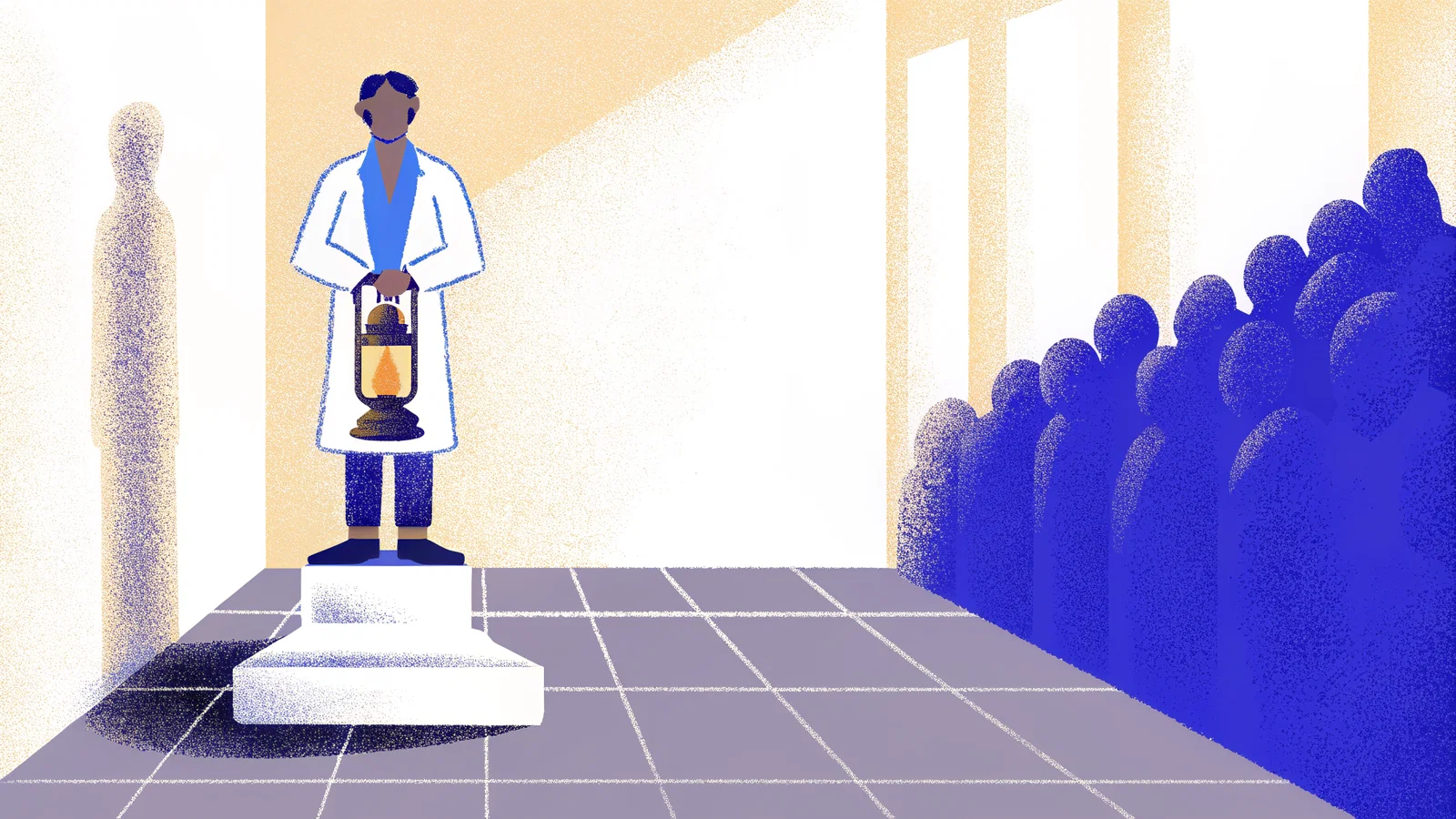
The residents who last, and who stay kind, are the ones who learned early that their job is to become excellent and replaceable. Not famous for answering everything. Not the lantern everyone else stands in the dark waiting for.
Remember This When the Phone Lights Up
You are not the backup generator for the entire hospital. You are a trainee with a finite nervous system, a learning curve that still needs oxygen, and a future self who will inherit every boundary you fail to draw now.
The next time everyone calls you first, pause. Help when it makes sense. Teach when you can. Redirect when it's not yours. Protect the hours that belong to your patients and your own brain.
Being needed feels like success. Needing nothing from a system that should share the load is how you finish residency intact.
Don't confuse the two.