

The line between “normal resident exhaustion” and “dangerous burnout” is a lot thinner than programs like to admit.
You’re not weak for worrying about it. Honestly, I’d worry more about the people who aren’t questioning it.
Let me say the scary part out loud first: yes, residents do crash. They quit, they get depressed, they make mistakes, they end up in therapy or the hospital or both. I’ve watched interns in July go from tired-but-excited to hollow-eyed by November and swear they’re “fine” because everyone else looks the same.
So if your brain is currently running the loop of:
“Am I just tired? Am I broken? Am I lazy? Am I burned out? Am I going to ruin my career if I say something?”
This is for you.
The Ugly Truth About “Normal” Exhaustion in Residency
Programs normalize some pretty insane stuff.
You work 28 hours, go home, sleep 4, come back. You cry in the call room, wipe your face, present on rounds. You eat graham crackers and peanut butter at 2 a.m. and call it “dinner.” Everyone shrugs. “Welcome to residency.”
So what actually is “normal exhaustion” here?
Normal exhaustion in residency usually looks like this:
- You’re tired basically every day. Chronic, background tired.
- On post-call days, you feel like a zombie, but after a solid sleep (like 10–12 hours), there’s at least some reset.
- You complain about work, but if someone genuinely offered you a different career tomorrow, you’d hesitate. You still care.
- You can be excited about a good case, a nice patient, a compliment from an attending, even if the excitement is brief.
- You have days where you think, “I hate this,” but not weeks or months where that thought never lets go.
The alarming part is how easy it is to call everything “normal” when you’re surrounded by other exhausted people. The floor is so low you start thinking, “Well, at least I’m not crying in the stairwell every day like PGY-2 X, so I must be okay.”
That’s how people slip into real burnout without noticing: they just keep moving the goalposts of what’s “fine.”
Dangerous Burnout: The Stuff You Can’t Just Sleep Off
Here’s the thing: burnout doesn’t show up as a big dramatic moment. It creeps.
By the time you use the word “burnout” seriously about yourself, you’re probably already deep in it.
Burnout isn’t just being tired. It’s a combination of three patterns that hang around for weeks to months:
- Emotional exhaustion – you feel drained and done, all the time.
- Depersonalization – you start seeing patients as tasks, not people.
- Reduced sense of accomplishment – you feel like you’re terrible at everything, even when that’s objectively not true.
If you’re trying to figure out “normal” vs “dangerous,” look at how long these things last and how much of your life they’re infecting.
Let me be very blunt about some red flags that move this into “dangerous” territory:
- You’re not just tired of work; you feel nothing about anything. No joy about food, friends, hobbies, even on days off.
- You wake up dreading the day every. single. day. Not just on call days, not just on that one horrible rotation – every morning.
- You start thinking, “If I got hit by a car and had to be out for a while, that’d be a relief.” You’re not actively suicidal, but you fantasize about escape via injury or some catastrophe.
- You’re making more mistakes, forgetting orders, missing labs, and instead of problem-solving, you just think, “See, I’m trash.”
- You used to feel guilty if a patient did badly; now you feel… nothing. Or worse, irritation that it made your night harder.
- You’re drinking more, taking benzos, popping sleep meds, or using anything as a “necessary” crutch just to turn off your brain.
- You’ve lost any sense of future. You can’t picture being an attending. You can’t picture anything beyond the next shift.
That’s not “everyone feels that way.” That’s your brain and body waving a giant flaming flag saying: this is not sustainable.
The Quick Gut-Check: A One-Minute Self-Screen
You want something simple? Fine. Ask yourself these five questions, honestly:
If I had a full, protected week off starting tomorrow, no charts, no exams, just rest and normal life…
Do I believe I’d feel at least somewhat better by the end?In the last month, have I had at least one day where I thought, “Yeah, this was okay, I’m glad I’m doing this,” even if it was brief?
When I screw up or get criticized, do I think, “I need to fix that” more than I think, “I’m useless and shouldn’t be here”?
On days off, do I do anything that isn’t just lying in bed scrolling or sleeping? Even one or two things: coffee with a friend, a walk, a show you actually enjoy?
Do I still care – even a little – about the kind of doctor I want to become?
If you’re saying no to most of these, that’s not normal resident exhaustion. That’s a cliff edge.
What Programs Actually Expect (Versus What You’re Afraid They Expect)
You probably have this script in your head:
“If I admit I’m struggling, they’ll think I’m weak, not cut out for medicine, and I’ll tank my career.”
I’ve heard chiefs say, “Burnout isn’t an excuse; we all did it.” I’ve heard attendings casually joke, “Residency is supposed to suck.” That stuff sticks in your brain and turns into shame.
Let me cut through some of the paranoia with a reality check.
| Feature | Normal Exhaustion | Dangerous Burnout |
|---|---|---|
| Relief with rest | Yes, at least partial | Minimal or none |
| Lasts | Days to a tough month | Weeks to months, continuous |
| Feelings about work | Mixed, some pride | Hopeless, detached, resentful |
| Outside life | Reduced but still present | Basically gone or numb |
| Self-talk | “This is hard” | “I’m a failure/I don’t care” |
Is that oversimplified? Yes. But you’re not filling out a psych textbook; you’re trying to figure out if you’re allowed to be worried. You are.
Most programs do not actually expect you to be a machine. What they expect (and what keeps you safe career-wise) is:
- You show some insight. “I’m struggling, and here’s what I’m noticing.”
- You reach out before you’ve blown up, screamed at a nurse, or disappeared.
- You participate in some kind of solution: schedule adjustment, therapy, PCP visit, meds, time off, something.
The real professional red flag isn’t “this resident is exhausted and got help.” It’s “this resident is clearly drowning, denying it, and refusing every lifeline.”
Concrete Signs You Should Stop Calling It “Just Tired”
Let’s get super specific. Here’s where I start to mentally move someone out of “normal exhaustion” and into “this is dangerous burnout and might become a safety/health issue.”
You’re not weak if any of this is you. You’re just overdue for help.
- You cry multiple times a week because of work and it’s been like this for over a month.
- You feel a tightness in your chest/panic walking into the hospital almost every shift.
- You’ve caught yourself thinking, “If this is what being a doctor is, I don’t want it,” and you think that a lot, not just after a terrible call.
- You feel guilty or angry that your friends/partner/family want your time because you have absolutely nothing left to give.
- You’re skipping basic stuff: showering, laundry, paying bills, eating regular meals, answering texts. Not just on call – chronically.
- You’re starting to cut corners at work, not out of laziness, but because your brain simply can’t hold all the balls in the air anymore.
- You’ve thought about quitting residency and it doesn’t feel like an overreaction; it feels like relief.
If you see yourself in several of those, you’ve pushed past “normal.” Don’t wait for some catastrophic breakdown to “justify” asking for help.
You don’t have to hit rock bottom to be taken seriously. That’s the lie burnout tells you.
What Actually Helps (Beyond “Self-Care” Nonsense)
If one more well-meaning person tells you to “do some self-care” after your seventh 80-hour week, you’re allowed to roll your eyes.
Self-care is not a bath bomb. It’s structural first, then personal.
Think of it in layers:
1. Structural changes – even small ones
You probably can’t redesign your program, but you can sometimes negotiate small but real changes. Stuff like:
- Switching one brutal elective or call-heavy block for something a bit lighter
- Getting off a toxic team early, with your chief’s support
- Consolidating your appointments (therapy, PCP, etc.) on predictable half-days
- Asking explicitly for fewer consecutive nights or a break between brutal rotations
Residents underestimate how often chiefs/PDs will flex if you come with specific, concrete needs like: “I’m not safe driving home post-call anymore” or “I need one afternoon a week for therapy; can we build that in?”
2. Professional support – and yes, I mean actual professionals
This is where people panic: “If I see psychiatry or therapy, is that going in some secret file?” The paranoia is real.
You need to know the difference between:
- Employee assistance programs / institution therapists – often confidential but sometimes feel too close to work.
- Outside therapists/psychiatrists – fully separate from your program.
- Occupational health or formal leave – this is where stuff may intersect with HR/administration.
If your fear of being “on record” is stopping you from getting any help, go external. Pay out of pocket if you have to for 1–2 sessions just to get stabilized and clear-headed about options.
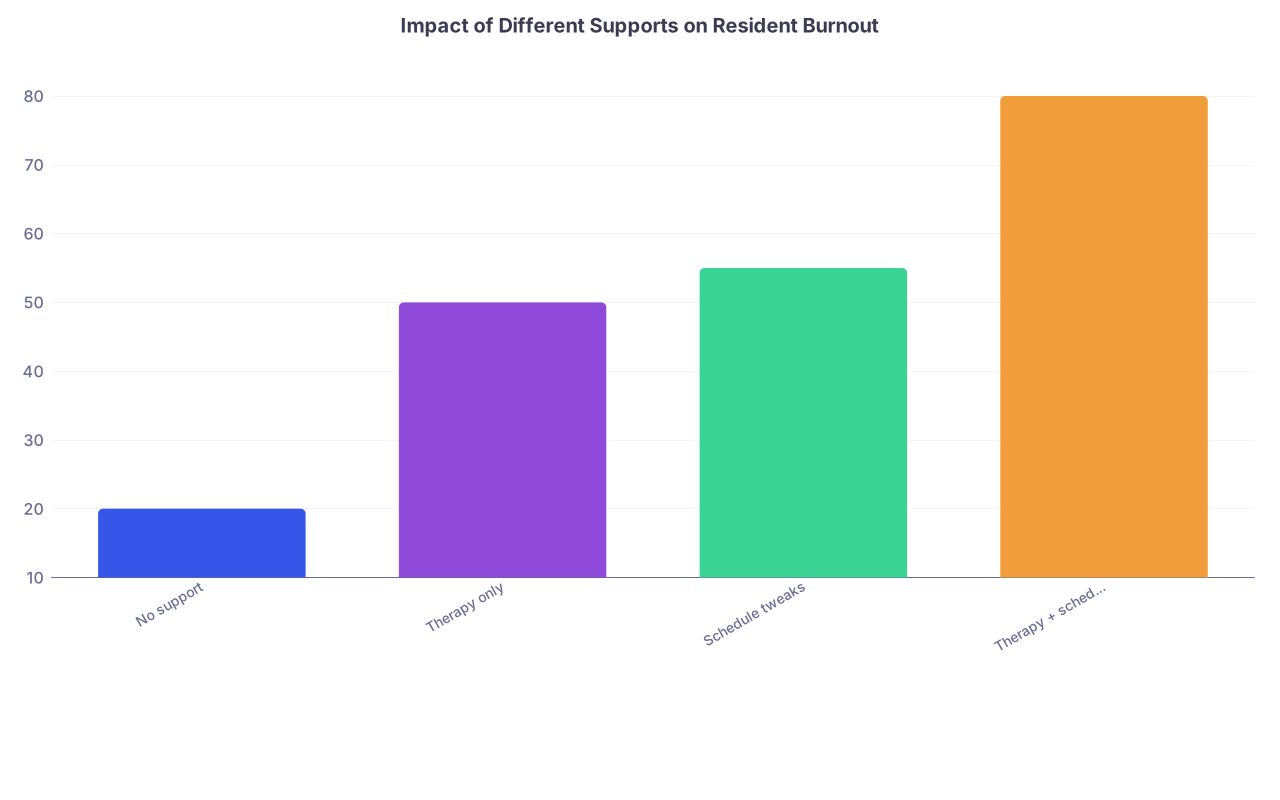
| Category | Value |
|---|---|
| No support | 20 |
| Therapy only | 50 |
| Schedule tweaks | 55 |
| Therapy + schedule support | 80 |
Is that chart generic? Yes. But the pattern is real: mixed support beats “just suffer through it” every time.
3. Tiny, almost stupidly small personal changes
When you’re burned out, people say “exercise, sleep, eat better” and you want to scream because you can barely remember to drink water.
So scale down the goal until it’s almost embarrassing. That’s how you know it’s doable.
Instead of “I’ll work out 4x a week,” make it: “On non-call days, I’ll go outside for 7 minutes. Even if I just sit on a bench.”
Instead of “I’ll fix my diet,” try: “I will eat one real meal per day that isn’t from a vending machine.”
Instead of “I’ll reconnect with friends,” say: “I will respond to one text today, even with just ‘Hey, drowning, will reply later.’”
This is not about becoming optimal. This is about proving to your nervous system that it’s not in a permanent war zone.
The Part No One Wants to Say Out Loud: Sometimes You Need to Step Back
Everyone is terrified of the nuclear option: leave of absence, switching programs, changing specialties, or (the word everyone hates) quitting.
I’m not going to romantically tell you, “Quitting is never the answer.” Because sometimes it is.
But here’s what I’ve seen: the vast majority of residents who step back temporarily for burnout, mental health, or medical issues do not destroy their careers. They take time. They get more support. They come back. They finish.
You don’t hear about them because no one advertises it. Programs quietly adjust. CVs get smoothed. People move on.
What does wreck careers long-term is ignoring dangerous burnout until it explodes as:
- A terrible patient outcome tied to your impairment
- A full psychiatric hospitalization after a suicide attempt
- A massive professionalism problem (blowing up in public, walking off service, coming to work impaired)
If your brain is whispering, “I can’t keep doing this,” believe it. That doesn’t automatically mean you’re done with medicine. It might mean you’re done doing it like this.
Quick Reality Anchor: It’s Not Just You
Let me throw some numbers in, not to scare you, but so you stop thinking you’re uniquely defective.
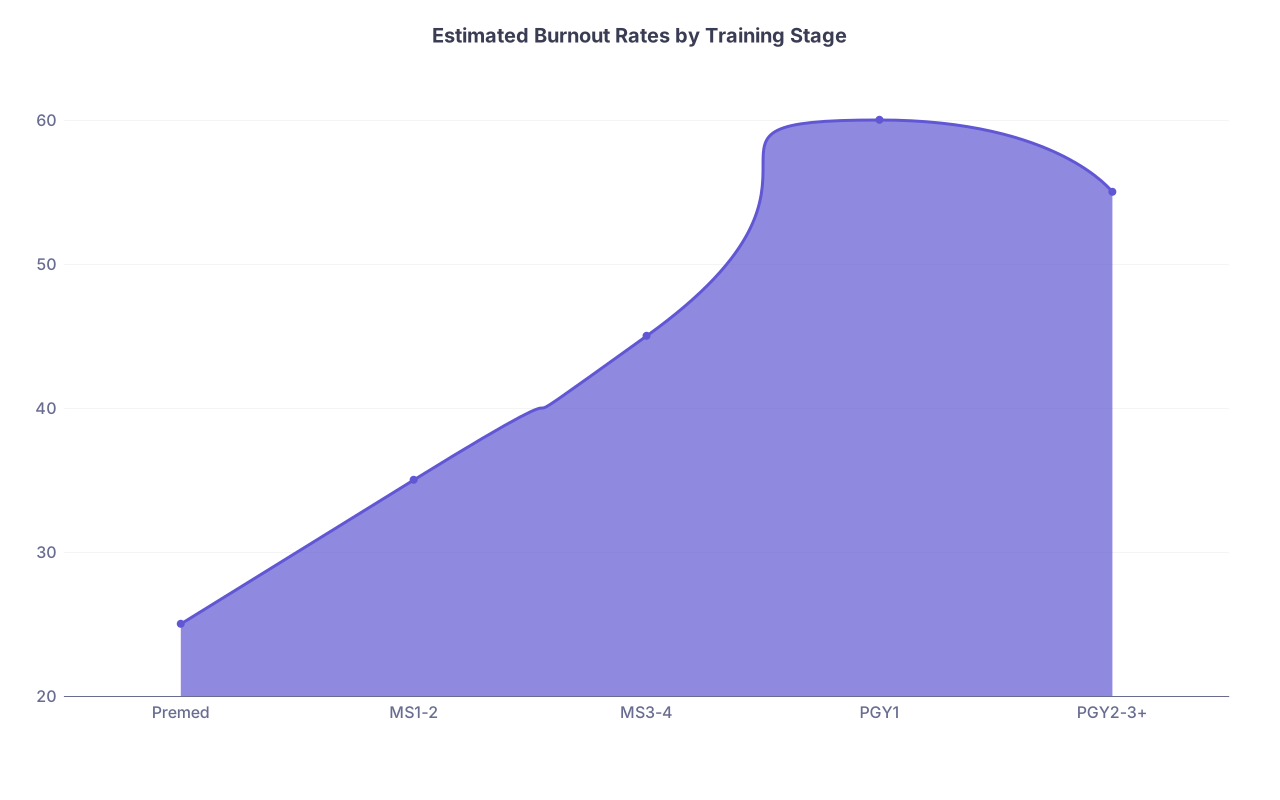
| Category | Value |
|---|---|
| Premed | 25 |
| MS1-2 | 35 |
| MS3-4 | 45 |
| PGY1 | 60 |
| PGY2-3+ | 55 |
Residency is where burnout spikes. Not because you’re weaker than your classmates, but because the system is built on chronic overload, emotional trauma, and very little control.
You being exhausted and scared you’re burning out is not proof that you “can’t hack it.” It’s proof that you’re still self-aware.
The ones who terrify me are the residents who say, “Yeah, I don’t feel anything anymore. But that’s just residency. It’s fine.” That’s not fine. That’s a shutdown nervous system on autopilot.
FAQ: The Fears You Probably Don’t Want to Say Out Loud
1. If I tell my PD or chief I’m burned out, will they think I’m weak or unstable?
Some might judge. Let’s not pretend everyone is enlightened. But most PDs are way more worried about a resident quietly imploding than one who comes in and says, “I’m struggling, and I want to handle this before it gets worse.”
Frame it that way. Concrete, honest, not dramatic: “I’m noticing I’m not bouncing back from call, I’m making more mistakes, I’m losing my ability to care. I don’t want this to become a patient safety issue. I need some adjustments and support.”
2. How do I know if I’m just in a bad rotation versus real burnout?
Time and spread. A brutal month on nights where you hate life but feel yourself rebound on your next lighter rotation? That’s rotation-specific misery.
If no matter where you are – clinic, wards, elective – you feel the same dead-inside exhaustion, dread every shift, and nothing changes with a week’s vacation? That’s real burnout.
3. I’m scared that going to therapy or taking meds will ruin my license later. Is that real?
What boards and licensing usually care about isn’t “Have you ever felt depressed?” It’s: “Do you have a current condition that impairs your ability to practice safely, and are you refusing treatment?”
Getting care is often a protective factor, not a liability. If you’re anxious about specific wording on applications, talk to a physician mental health advocate or your state medical society. But don’t sacrifice your sanity and safety on the altar of hypothetical future stigma.
4. What if I’m just not cut out for medicine and burnout is my sign to leave?
Maybe. Or maybe you’re drawing massive conclusions from data gathered during the most extreme, pathologic years of training.
If you can, don’t make a forever decision from inside a crisis brain. Get yourself to “barely stable” – some sleep, some support, someone objective to talk to – and then revisit the “Should I leave medicine entirely?” question. If you eventually decide to walk away, doing it from a place of clarity instead of collapse will feel very different.
Key things to hold onto:
- Normal exhaustion gets at least somewhat better with real rest. Dangerous burnout doesn’t.
- Losing all joy, all caring, and all sense of future for weeks to months is not “just residency.” It’s a problem you’re allowed to treat.
- Asking for help early is not career suicide. Waiting until you shatter can be.
You’re not dramatic for worrying about this. You’re paying attention. And that’s exactly the part of you I’d like to see stay intact.


