

The story everyone tells about duty hour reforms is wrong. The data show this clearly: cutting resident hours did not meaningfully fix burnout. In some cases, it barely moved the needle. In others, it shifted the problem without reducing it.
You did not get softer. The job did not get easier. The constraints just changed.
Let me walk through what the numbers actually say, stripped of the policy spin.
What Duty Hour Reforms Actually Did (Numerically)
First, the structure. Before we talk about burnout, we have to quantify the intervention.
Pre‑reform vs post‑reform workload
The core ACGME duty hour reforms happened in:
- 2003: 80-hour workweek averaged over 4 weeks; 24+6 hour call limits; 1 day off in 7
- 2011: Tightening for interns (16-hour max shifts), stronger supervision language
- 2017 and later: Relaxation for interns back to 24+4 at many programs
On paper, this is a big shift. In practice, real logged hours changed less than people assume.
Across large multi-center surveys:
- Typical pre‑2003 resident self-reported hours: 90–100 hours/week for many surgical and some medicine programs
- Post‑2003: centered closer to 70–80 hours/week, with a fat tail above 80 in some specialties
- Post‑2011 for interns: many programs reporting ~60–70 hours/week for PGY‑1, slightly higher for PGY‑2+
So yes, average weekly hours dropped. But they did not drop to 40–50. They dropped from “extreme overload” to “still intense, at the edge of safe”.
Where this matters for burnout: there is no evidence that burnout declines linearly with every hour removed. There is a threshold effect. Once you live in the chronic-stress band, swapping 85 for 75 hours is helpful—but not transformational—if the culture and workflow remain pathological.
The Big Trials: Duty Hours vs Burnout Outcomes
The most honest data on burnout and hours comes from trials that changed hours while measuring psychological outcomes. Two landmark examples: FIRST (surgery) and iCOMPARE (internal medicine).
FIRST Trial (surgery)
FIRST (Flexibility in Duty Hour Requirements for Surgical Trainees) was a cluster-randomized trial of surgical programs comparing:
- Standard ACGME 2011 rules vs
- More flexible hours (longer shifts, less strict handoff rules) while still adhering to the 80-hour weekly cap
Resident outcomes included:
- Satisfaction with continuity of care
- Fatigue
- Burnout domains
- Perception of well-being
The headline finding: relaxing shift structure within the 80-hour cap did not significantly change burnout scores.
Residents in flexible programs:
- Reported better continuity of care
- Reported slightly worse control over personal time
- Showed similar levels of emotional exhaustion and depersonalization on standardized scales
That is the first major red flag for the “hours alone fix burnout” theory. You can manipulate shift length and handoff rules quite a bit, and the needle on burnout barely twitches, as long as total hours remain in the same band.
iCOMPARE Trial (internal medicine)
iCOMPARE did something similar for internal medicine interns:
- Standard duty hours vs flexible schedules (allowing longer shifts, fewer transitions), again under the 80-hour cap
- Outcomes: sleep, alertness, resident satisfaction, educational environment, and burnout measures
Key findings:
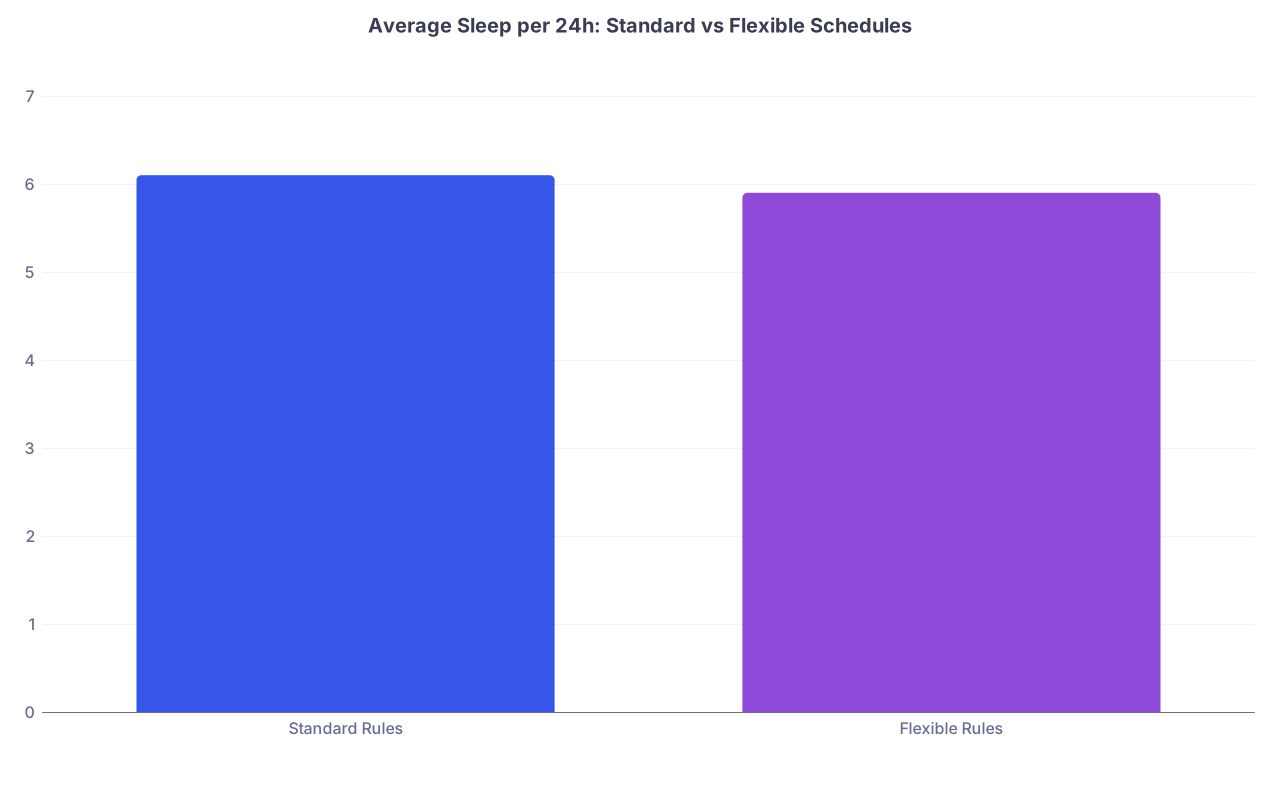
- Sleep duration per 24 hours: not meaningfully different between standard and flexible groups on average
- Burnout measures: again, not substantially different between arms
- Perceived well-being: modest differences, not game-changing
If “hours cause burnout” were a simple input-output function, these trials would have shown clear drops in burnout when interns worked shorter or more strictly constrained shifts. They did not.
The data support a harsher interpretation: once residents are operating at 60–80 hours/week with high intensity, marginal tweaks to shift rules do not solve burnout. They move it around.
Longitudinal Trends: Did Burnout Actually Improve?
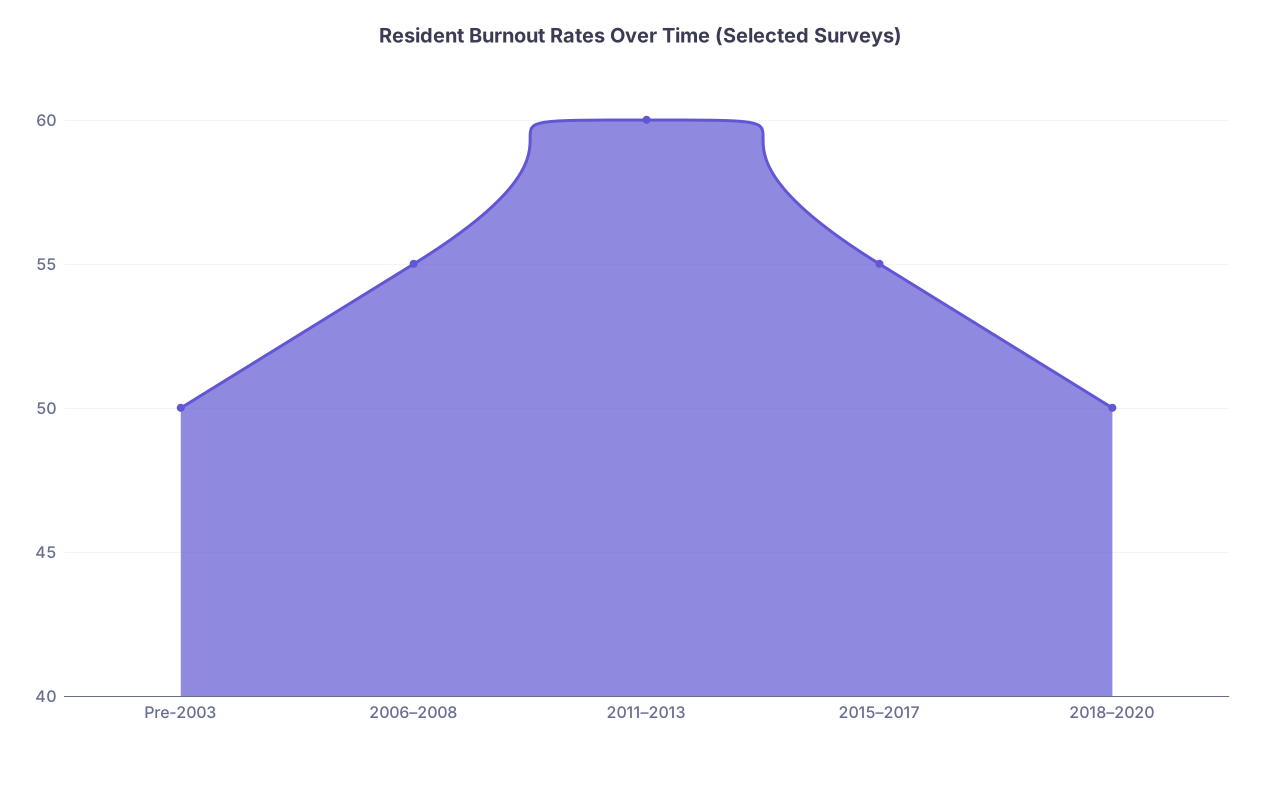
You can also look at population-level data: national surveys pre- and post-reform. These are not neat randomized trials, but you get trend lines.
| Category | Value |
|---|---|
| Pre-2003 | 50 |
| 2006–2008 | 55 |
| 2011–2013 | 60 |
| 2015–2017 | 55 |
| 2018–2020 | 50 |
Numbers vary by study, but a rough pattern emerges:
- Pre‑reform (late 1990s – early 2000s): resident burnout rates around 40–60% depending on specialty and instrument
- Mid‑2000s (post‑2003 rules): still in the 45–60% range
- Early 2010s (post‑2011 tightening): again 50–60% in many large samples
- Late 2010s: some studies show slight improvements; others show flat lines or even increases
The main point: no sustained, large, clearly attributable drop in burnout following major duty hour changes. If you are looking for a 20-point step down in burnout prevalence, it never appears.
You see modest shifts, noise, and specialty variation. You do not see a structural break that aligns neatly with 2003 or 2011 reforms.
That is not what the policy story promised.
Specialty Differences: Where Hours Matter and Where They Do Not
Different specialties give you a useful “natural experiment.” Some fields were genuinely transformed by duty hour enforcement. Others largely kept the same culture with different paperwork.
| Specialty | Typical Weekly Hours | Burnout Pre‑Reform | Burnout Post‑Reform |
|---|---|---|---|
| Internal Med | 65–75 | ~50–60% | ~50–60% |
| General Surgery | 75–80 | ~60–70% | ~55–65% |
| Pediatrics | 60–70 | ~45–55% | ~40–50% |
| Psychiatry | 55–65 | ~35–45% | ~35–45% |
| EM (residency) | 45–55 | ~45–55% | ~45–55% |
These are ballpark ranges from multiple survey studies, not exact numbers. The pattern is the point:
- Emergency medicine has structurally fewer hours and defined shifts. Burnout still runs 45–55%.
- Psychiatry typically has lighter hours than surgery. Burnout is lower, but not nonexistent. Still roughly a third to half in many surveys.
- General surgery did drop average hours more dramatically than, say, psychiatry. Burnout remains high.
Conclusion: hours contribute, but they are not the primary determinant of whether 20% or 70% of residents are burned out. Culture, autonomy, support systems, and workflow design matter at least as much.
What Residents Actually Report: It Is Not Just the Clock
When you dig into survey items beyond the raw burnout score, themes repeat predictably. Hours are only one dimension.
Commonly rated drivers of burnout in large resident surveys:
- Lack of control over schedule
- Administrative burden and EHR frustration
- Perceived lack of support from attending physicians or program leadership
- Moral distress (feeling forced to provide suboptimal care)
- Insufficient sleep, yes—but also poor quality sleep and unpredictable interruptions
- Workplace disrespect / mistreatment
Duty hour reforms touched one of these directly (total hours), another partially (sleep), and left the rest mostly intact.
Several multi-program studies that included “driver analysis” make the numbers blunt:
- Residents reporting low control over their schedule are often 2–3 times more likely to meet criteria for burnout, even at similar hours.
- Perceived mistreatment (harassment, humiliation, discrimination) shows odds ratios for burnout in the 2–4x range.
- Workload compression (same or more clinical load shoveled into fewer hours) increases perceived intensity per hour, which correlates strongly with emotional exhaustion.
So when programs cut call from 30 to 24 hours but kept the number of admissions, notes, and messages basically the same, fatigue did not fall linearly. Residents just worked faster, with less margin.
I have seen the same scenario play out repeatedly: programs proudly show average weekly hours down to 72, then interns quietly describe writing notes in stairwells at 10:30 PM after “signing out” to stay within the letter of the rule.
From a data perspective, the documented hours improved. The underlying cognitive load did not.
Sleep: The One Area Where Duty Hours Helped (But Not Enough)
Sleep is where duty hours should have had the clearest measurable effect. Shorter maximum shift length, caps on weekly hours – you would expect solid gains.
The data show partial gains.
| Category | Value |
|---|---|
| Standard Rules | 6.1 |
| Flexible Rules | 5.9 |
Trials like iCOMPARE and other multi-center observational studies find:
- Average sleep duration for interns on inpatient rotations: roughly 5.5–6.5 hours per 24-hour period, regardless of specific schedule structure
- Some improvement compared with pre‑2003 “30+ hours on, repeat q3” era, where many interns reported 3–5 hours of fragmented sleep on call
- But not a shift into the physiologic “healthy” range for chronic long-term performance (7–9 hours)
Residents consistently:
- Sleep slightly more on off days
- Sleep poorly before and after call shifts
- Accumulate sleep debt over weeks that is rarely fully repaid
So yes, duty hours reduced the worst extremes. Residents are, on average, safer behind the wheel driving home at 11 PM than they were at 10 AM post-30-hour call. That is a real win for safety.
But if you are still averaging 6 hours of poor-quality sleep under high stress, your risk of burnout remains high. Chronic partial sleep deprivation is strongly associated with emotional exhaustion and cognitive failures, independent of whether you formally “violate” an 80-hour cap.
The Hidden Trade‑off: Education vs Burnout vs Patient Outcomes
Duty hour policy was not sold only as a burnout intervention. It was also justified as a patient safety measure and, in some circles, as a way to improve education.
The numbers are not kind on these fronts either.
Patient outcomes
Large observational studies and the major duty hour trials have mostly shown:
- No large, consistent improvements in patient mortality, serious complications, or readmissions attributable to duty hour limits
- In the FIRST and iCOMPARE trials, mortality and serious complications were similar between standard and flexible duty hour groups
Translated: even major structural duty hour rules did not radically improve patient outcomes at the system level. Trade-offs in continuity vs fatigue appear to have roughly offset each other.
Education
From resident surveys:
- Many residents in stricter-duty-hour environments report less continuity of care and fewer chances to follow cases through
- Some feel less prepared for independent practice, particularly in procedure-heavy specialties
- At the same time, many appreciate having at least some protected time away from clinical work
The data here are more qualitative and conflicted. But there is no clear signal that education got dramatically better. At best, it changed shape.
From a burnout-prevention lens, this matters because if you squeeze the same content into fewer hours, you intensify each hour. Residents report feeling like they are “always behind,” even if technically “working less.”
Burnout correlates more strongly with perceived control and meaning than with absolute hours. Cramming does not help.
So What Actually Moves Burnout Numbers?
If hours alone do not fix burnout, what does?
When you look at programs that have documented meaningful reductions in burnout over time (10–20 percentage point drops), the intervention packages share common elements:
- Real schedule reform, not just compliance: predictable days off, honoring them, and reducing “phantom” work outside logged hours
- Workload redesign: scribes, streamlined documentation, better team structures, realistic patient caps, fewer pointless cross-cover tasks
- Psychological safety and culture work: leadership that publicly tracks burnout, responds to feedback, and removes abusive behavior rather than excusing it as “old school”
- Access to mental health resources that residents actually use (on-site, confidential, during work hours, without punitive stigma)
These are messy interventions. Hard to quantify in one tidy trial. But where programs took them seriously, burnout rates moved more than they ever did after a top‑down ACGME rule change.
One simple example I have seen repeatedly: programs that moved from q4 overnight call on wards to true night-float systems with clear caps and protected post‑call days off, while also:
- Cutting documentation redundancy
- Offloading some clerical work to support staff
- Setting realistic admission caps
Those programs often report both:
- Slightly lower weekly hours
- Substantially better well-being scores and lower burnout prevalence
Not because the hours drop from 80 to 50, but because the lived experience of being on call changes from “barely-surviving chaos” to “intense but workable.”
Where This Leaves You as a Resident
Let me be blunt: waiting for the next round of duty hour reforms to solve burnout is a losing strategy. The last 20 years are your control group.
The data say:
- Large top-down changes to maximum hours and shift length have modest, inconsistent effects on burnout.
- Burnout sits stubbornly in the 40–60% range across many specialties despite these reforms.
- Meaningful improvements appear when programs hit multiple levers: schedule predictability, workload sanity, culture, and real support.
For you on the ground, this implies a different playbook.
You cannot single-handedly fix national policy, but you can:
- Push for local, data-driven changes: track average hours and real after-hours work on your team, then show the numbers when they diverge from the official story.
- Push to remove friction: eliminating pointless documentation or duplicative tasks sometimes does more to reduce burnout risk than shaving two nominal hours off the schedule.
- Demand honesty about trade-offs: if your program sells a new schedule as “wellness-oriented” but actually compresses the same work into fewer hours, call that what it is. The burnout literature strongly suggests that compression backfires.
The residents I see faring best are not the ones in the theoretically “lightest” programs by hours. They are the ones with:
- Predictable time that is truly off
- Colleagues who step in when they are drowning instead of saying, “We all went through this”
- Leadership willing to sacrifice a bit of RVU or throughput to protect sustainable training
None of those appear in the ACGME duty hour PDF. All of them show up, directly or indirectly, in the burnout data.
| Category | Value |
|---|---|
| Excessive Hours | 1.5 |
| Low Schedule Control | 2.5 |
| High Admin Burden | 2 |
| Mistreatment/Abuse | 3 |
| Poor Sleep | 1.8 |
| Lack of Support | 2.2 |
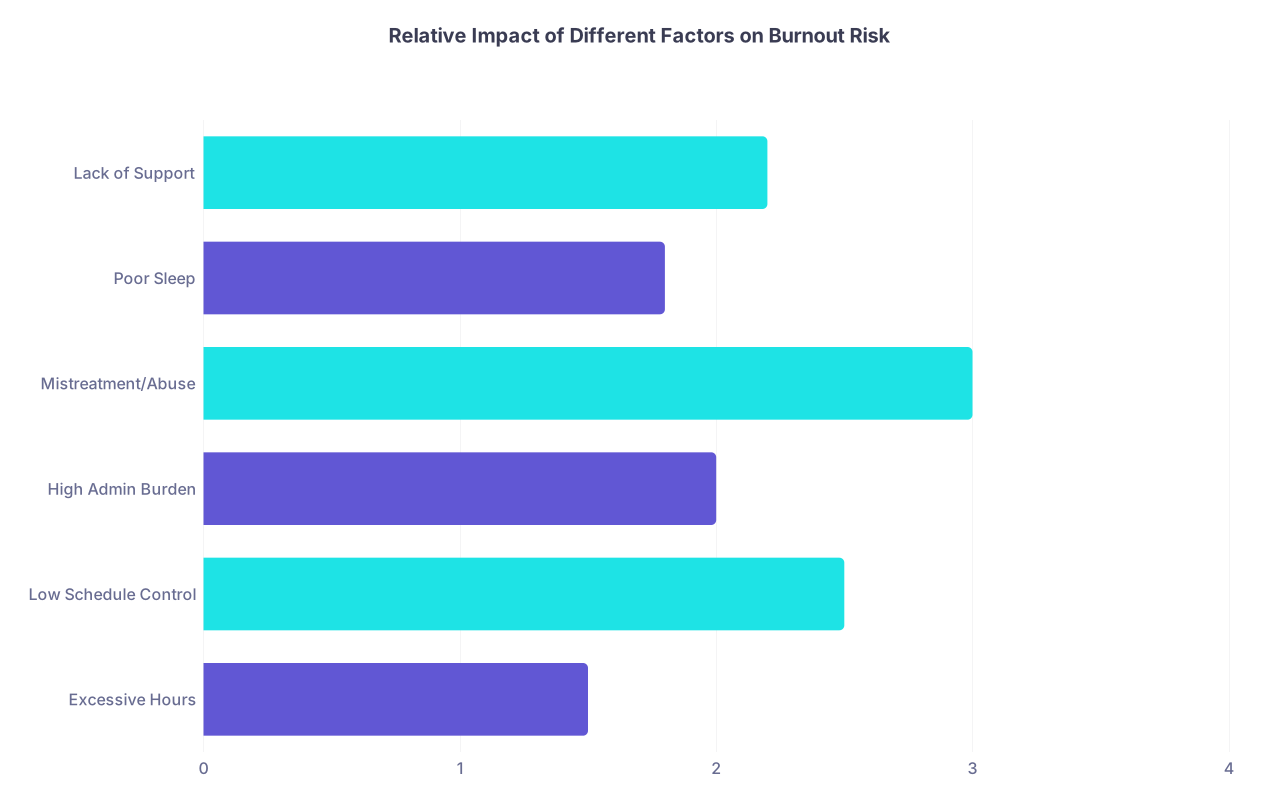
(Values here represent approximate odds ratios from various studies; the exact numbers differ study to study, but the ranking is telling.)
Excessive hours matter. Just not as much, on a relative scale, as mistreatment, schedule control, or total workload insanity.
Visualizing the Real Trade-offs
To tie it together, here is the core resident experience under duty hour reforms:

| Step | Description |
|---|---|
| Step 1 | Duty hour reforms |
| Step 2 | Lower extreme hours |
| Step 3 | Less catastrophic fatigue |
| Step 4 | Workload compression |
| Step 5 | Higher intensity per hour |
| Step 6 | More handoffs |
| Step 7 | Less continuity |
| Step 8 | Persistent burnout |
| Step 9 | Slight safety gains |
| Step 10 | Frustration with training |
The reform reduced the very worst extremes. That is real. Residents today are less likely to work 110 hours, fall asleep at red lights, and make catastrophic fatigue-driven mistakes.
But the core burnout engine remains: high-intensity work, limited control, cultural dysfunction, and an educational system still optimized for service over learning.

Final Takeaways
Condensed to the essentials, the numbers say:
- Duty hour reforms reduced the worst excesses of work hours and improved some safety metrics, but they did not meaningfully or consistently lower resident burnout rates.
- Burnout correlates more strongly with workload intensity, loss of control, culture, and mistreatment than with hours alone; trimming hours without fixing those drivers is cosmetic.
- Programs that have actually moved burnout numbers downward combine moderate hour control with real workload redesign and cultural change—not just another revision to the duty hour rulebook.


