

The casual way medicine treats burnout is statistically indefensible. You cannot manage what you never measure.
If you are in residency and relying on “I’ll know when it’s bad” as your monitoring strategy, you are flying blind. The data from multiple cohorts of residents is painfully consistent: self‑perception of “I’m doing fine” often lags far behind objective burnout scores by 3–6 months.
This is fixable. You can quantify your own burnout risk using tools that have already been validated on thousands of physicians and trainees. And you can track trends over time, not just vibes.
Let me walk you through how to do this like a data analyst, not like someone hoping things don’t get worse.
1. The Case For Treating Burnout Like a Vital Sign
The numbers on burnout are not subtle.
Large studies across specialties show:
- 40–60% of residents meet criteria for high burnout on validated scales at any given time.
- Burnout rates often spike during PGY-2 and during ICU-heavy blocks.
- Burnout correlates with depression, medical errors, and thoughts of leaving medicine.
Here is what keeps showing up in the data: residents consistently underestimate their level of burnout until they hit a cliff (sudden functional decline, serious error, relationship collapse, or needing leave).
From a measurement perspective, you have three hard problems:
- Your internal baseline keeps shifting (“this is just intern year,” “this is just ICU,” “this is just boards”).
- Culture teaches you to normalize misery.
- You see only snapshots (“yesterday was ok, so I am ok”) instead of the trend line.
Validated scales fix all three:
- They give you stable anchors: cutoffs grounded in large samples, not your mood that day.
- They allow change over time to be visible in numbers, not just feelings.
- They are comparable: your scores today actually mean something relative to other residents.
Think of burnout risk as you would blood pressure:
- A single value is mildly interesting.
- A series of values over time, with clear thresholds, is powerful.
- A rising trend from 120/80 to 140/90 is concerning even if you “feel fine.”
Same logic here. Except the organ at risk is your entire career.
2. The Core Burnout Scales Residents Should Use
There are dozens of instruments. You do not need dozens. You need a small toolkit that is:
- Validated in physicians/residents
- Short enough to repeat monthly
- Interpretable with clear cutoffs
Three tools meet that bar very well: the Maslach Burnout Inventory (MBI), the Oldenburg Burnout Inventory (OLBI), and the Copenhagen Burnout Inventory (CBI). I will add two shorter tools for depression/anxiety because the overlap is huge and clinically critical: PHQ‑9 and GAD‑7.
2.1 Maslach Burnout Inventory – Human Services Survey (MBI‑HSS)
This is the gold standard historically used in physician burnout research.
Structure:
- 22 items
- 3 subscales:
- Emotional Exhaustion (EE, 9 items)
- Depersonalization (DP, 5 items)
- Personal Accomplishment (PA, 8 items; note that lower is worse)
Items are rated 0–6 (from “never” to “every day”). Each subscale gets a sum score.
Typical interpretive cutoffs used in physician data:
Emotional Exhaustion
- Low: ≤ 16
- Moderate: 17–26
- High: ≥ 27
Depersonalization
- Low: ≤ 6
- Moderate: 7–12
- High: ≥ 13
Personal Accomplishment (reverse direction: low PA = worse)
- Low (bad): ≤ 31
- Moderate: 32–38
- High (good): ≥ 39
Most research defines “burnout present” as either:
- High EE (≥ 27) or
- High DP (≥ 10–13 depending on study)
Pros: deeply studied, specific physician norms.
Cons: behind a paywall, a bit long for frequent self‑use, some residents will not realistically do 22 items monthly.
2.2 Oldenburg Burnout Inventory (OLBI)
If you want something practical and open‑access for ongoing tracking, OLBI is the workhorse.
Structure:
- 16 items
- 2 subscales:
- Exhaustion (8 items)
- Disengagement (8 items)
Items are rated on a 1–4 scale (strongly agree to strongly disagree), with some items reverse‑scored.
Common research cutoffs:
- Exhaustion mean score ≥ 2.25 = high exhaustion
- Disengagement mean score ≥ 2.10 = high disengagement
You compute the mean per subscale (sum of items / number of items).
Pros: free, brief, good psychometrics, validated in health professionals.
Cons: fewer resident‑specific norms than MBI, but functionally usable.
2.3 Copenhagen Burnout Inventory (CBI)
CBI directly separates personal vs work vs patient-related fatigue. Useful if you want to know whether the hospital or your life is the main driver.
Structure:
- 19 items
- 3 subscales:
- Personal burnout (6 items)
- Work‑related burnout (7 items)
- Client/patient‑related burnout (6 items)
Scores are converted to 0–100. Typically:
- Response options are mapped like:
- Always / To a very high degree = 100
- Often / To a high degree = 75
- Sometimes / Somewhat = 50
- Seldom / To a low degree = 25
- Never / Almost never / To a very low degree = 0
The subscale score is the average of its item scores.
Interpretation (commonly used bands):
- < 50: low burnout
- 50–74: moderate burnout
- 75–99: high burnout
- 100: severe burnout
Pros: very transparent scoring, free, intuitive scales.
Cons: fewer physician‑specific datasets than MBI, though growing.
2.4 Why Add PHQ‑9 and GAD‑7 To Your Toolkit
Burnout is not the same as depression or anxiety, but the correlations are strong. In residents, moderate–severe burnout frequently coexists with:
- PHQ‑9 ≥ 10 (moderate depression)
- GAD‑7 ≥ 10 (moderate anxiety)
You can complete PHQ‑9 and GAD‑7 in under 3 minutes combined. They give you:
- Clear clinical cutoffs
- A signal for when this is not “just burnout” but a likely treatable mood disorder
This matters because suicidal ideation, while uncommon, clusters in the high PHQ‑9 range. You do not want to miss that signal.
3. How To Build a Personal Burnout Tracking System
Now the operational part. Data without process is just interesting trivia.
You need three elements:
- A fixed schedule
- A consistent bundle of tools
- A simple way to visualize your own trend
3.1 Choose Your Measurement Bundle
If you want a rational trade‑off between depth and time, a good personal bundle is:
- Oldenburg Burnout Inventory (OLBI) – primary burnout tracking
- PHQ‑9 – depression screen
- GAD‑7 – anxiety screen
Optional quarterly add‑on:
- CBI, if you want more nuance on personal vs work vs patient‑related fatigue
- MBI, if your program or institution provides access and you care about comparison to their data
Pick one main burnout scale and stick with it. Switching instruments mid‑year ruins trend comparability.
3.2 Set a Schedule That Matches Residency Reality
Residents live in cycles: rotations, call schedules, exam periods. Anchor your measurements to those.
A workable model:
- Frequency: once per month, every month.
- Timing: within 48 hours after the end of each rotation / major block.
- Extra measurements: after known stress spikes (boards prep month, ICU stretch, 80‑hour weeks that “somehow” are actually 95).
If you want to visualize this as a process:

| Step | Description |
|---|---|
| Step 1 | End of Rotation |
| Step 2 | Complete OLBI PHQ9 GAD7 |
| Step 3 | Record Scores in Sheet |
| Step 4 | Trigger Help Plan |
| Step 5 | Compare to Prior Month |
| Step 6 | Adjust Small Habits |
| Step 7 | Any Critical Cutoff Reached |
The key is automation. Do not rely on memory. Put calendar reminders titled “Burnout Check – 10 minutes, 3 forms”.
3.3 Record Your Data Like a Scientist, Not a Diary
Use a simple spreadsheet or note with columns like:
- Date
- Rotation (e.g., “MICU,” “Outpatient Peds,” “Night Float”)
- OLBI Exhaustion mean
- OLBI Disengagement mean
- PHQ‑9 total
- GAD‑7 total
- (Optional) CBI personal/work/patient
- Comment (1–2 lines: “q4 call,” “program director conflict,” “Step 3 soon”)
Then, once you have at least 3–4 timepoints, you can start plotting.
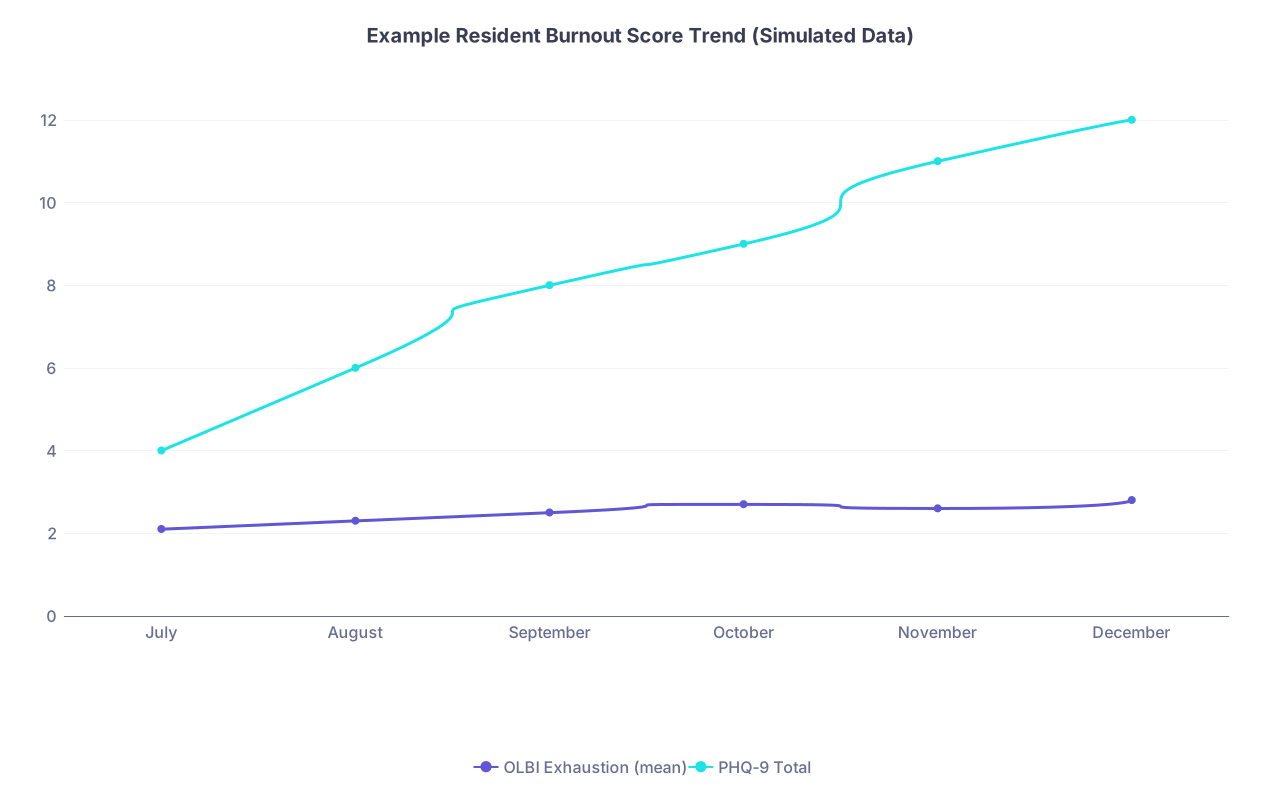
| Category | OLBI Exhaustion (mean) | PHQ-9 Total |
|---|---|---|
| July | 2.1 | 4 |
| August | 2.3 | 6 |
| September | 2.5 | 8 |
| October | 2.7 | 9 |
| November | 2.6 | 11 |
| December | 2.8 | 12 |
Look at that sample curve. Exhaustion creeping from 2.1 to 2.8 and PHQ‑9 from 4 to 12 in six months. This is what happens quietly to a lot of residents. They do not notice because each week feels only “slightly worse”.
The benefit of numbers is you see the slope, not just the last step.
4. Interpreting Your Scores: When the Data Says “Enough”
Now to the thresholds. I am going to be blunt: residents are experts at rationalizing away concerning numbers. So let’s put some hard lines on the table.
4.1 Practical Cutoffs For Action
Here is a simple summary using the tools above:
| Scale | Metric | Concerning Threshold |
|---|---|---|
| OLBI | Exhaustion mean | ≥ 2.25 |
| OLBI | Disengagement mean | ≥ 2.10 |
| PHQ-9 | Total score | ≥ 10 (moderate depression) |
| GAD-7 | Total score | ≥ 10 (moderate anxiety) |
| CBI | Any subscale (0–100) | ≥ 50 (moderate) / ≥ 75 (high) |
Use these operational rules:
- If PHQ‑9 ≥ 10 or GAD‑7 ≥ 10 → this is no longer a “wait and see” situation. It is “talk to someone qualified” territory.
- If OLBI Exhaustion ≥ 2.25 or Disengagement ≥ 2.10 for two consecutive months → treat as a real burnout trend, not just a bad block.
- If CBI work‑related burnout ≥ 75 → assume your work environment is now harmful to you unless proven otherwise.
You do not need all three scales screaming at once to justify action. One major red flag is enough.
4.2 Look at Trends, Not Just Single Points
A single rough month in the MICU does not mean you are doomed. The month‑over‑month trajectory matters more.
Use three basic trend patterns:
Stable low
- Scores consistently below thresholds, no upward creep.
- Interpretation: keep monitoring; current coping is working.
Upward drift
- Steady increase over 3+ months, even if still in the “normal” range.
- Interpretation: early warning. You are burning reserve. Adjust before you hit thresholds.
High and flat or high and rising
- Scores above threshold for 2+ months.
- Interpretation: you are in active burnout risk or likely already burned out.
If you plotted your OLBI Exhaustion over six months and it looks like a gentle but continuous upward slope, pay attention. Most residents only react when the line is already high and jagged.
5. Translating Scores Into Action: A Tiered Response Plan
Measurement without response is pointless. So build a simple tiered plan before your scores go bad, not after.
5.1 Tier 0 – Normal Range, Stable
Criteria:
- OLBI Exhaustion and Disengagement below cutoffs
- PHQ‑9 and GAD‑7 < 10
- No major upward trend
Actions:
- Keep monthly measurement
- Maintain current coping: sleep routines, exercise (if any), social contact
- Make one small “buffer” investment: something that protects future you (e.g., one therapy intake session even if not “urgent,” starting a non-clinical hobby again, setting a vacation block early)
5.2 Tier 1 – Mild Elevation or Clear Upward Drift
Criteria (any of):
- OLBI Exhaustion upward trend over 3 months but still < 2.25
- PHQ‑9 rising but < 10
- Self‑reported sense of “I am more irritable, but I’m functioning”
Actions:
Short, honest review of your data with a trusted peer or mentor. Show them the graph, not just “I’m okay.”
Make one structural change, not just a “self‑care” band‑aid. Examples:
- Stop picking up extra shifts for money you do not urgently need.
- Ask chief residents to adjust schedule intensity if there is flexibility.
- Protect one no‑work evening per week as non‑negotiable.
Increase measurement frequency temporarily (e.g., every 2 weeks for 2–3 cycles) to see if the trend stabilizes or accelerates.
5.3 Tier 2 – Threshold Reached
Criteria (any of):
- OLBI Exhaustion mean ≥ 2.25 or Disengagement ≥ 2.10 for at least 1 month
- CBI work‑related burnout ≥ 50
- PHQ‑9 or GAD‑7 ≥ 10
Actions:
Involve professionals:
- Contact your institution’s mental health service, an outside therapist, or primary care.
- Tell at least one person in your program who has some power (chief, program director, associate PD). Phrase it using the data: “My burnout/exhaustion and PHQ‑9 scores have crossed clinical thresholds.”
Negotiate immediate workload adjustments where possible: schedule swaps, reduced moonlighting, defer non‑essential projects.
Treat this as a health issue, not a character flaw. If your creatinine doubled, you would not say “I’ll wait a few more months.”
5.4 Tier 3 – High/Severe Scores or Safety Concerns
Criteria:
- CBI any subscale ≥ 75
- PHQ‑9 ≥ 15 or any suicidal ideation item > 0
- Unable to maintain basic functioning (sleep, appetite, show up)
Actions:
- This is emergency medicine, but for you.
- Same-day or next-day mental health evaluation. Use your employee assistance program, on‑call psychiatry, or an outside urgent mental health clinic.
- Immediate discussion about medical leave or formal accommodations.
- Loop in someone you trust personally (partner, sibling, co-resident) to help you execute the plan. Your cognition and judgment are not at baseline in this range.
This is not melodrama. It is exactly how you would behave if a patient’s lab values crossed critical thresholds. Apply the same cold logic to yourself.
6. How to Make This Sustainable (So You Actually Do It)
You already have 50 demands on your time. Any plan that takes 45 minutes per month will die by October. Let’s make this efficient.
6.1 Automate the Boring Parts
- Create a pre‑formatted Google Sheet with all the scale items and formulas once.
- Put one recurring calendar event titled “10‑minute burnout check” on the last Sunday of each month at a time you are usually awake.
- Save links to online versions of OLBI, PHQ‑9, and GAD‑7 in one bookmarked folder.
If you want to get nerdy, you can set up conditional formatting in your sheet so cells turn yellow or red when thresholds are crossed.
6.2 Pair It With an Existing Habit
Tie it to something immovable:
- Post‑call breakfast
- End‑of‑rotation evals
- Payday
You already complete duty hour logs and evaluations. Add this as your own “personal eval.”
6.3 Decide What You Will Do Before Numbers Worsen
Before you are exhausted, write a small “if‑then” plan:
- “If PHQ‑9 ≥ 10, I will email X therapist I looked up already.”
- “If OLBI exhaustion is above cutoff two months in a row, I will talk to my PD about schedule flexibility.”
- “If any suicidal ideation is present, I will tell [name] and go to [local urgent mental health facility or ER].”
You are pre‑committing like you would with an insulin sliding scale. High number → preset action. No debate in the moment.
7. What the Data Shows About Programs vs Individuals
One uncomfortable truth: a lot of burnout is structural, not individual. Your scores will reflect what your environment is doing to you.
At a systems level, studies show:
- Programs that reduce duty hour violations, improve supervision, and create predictable time off produce measurable decreases in burnout scores over 1–2 years.
- Residents in abusive or chaotic programs can have high burnout scores even when they sleep enough. Toxic culture matters as much as hours.
- Peer support and mentoring are not fluffy add‑ons; they correlate with lower emotional exhaustion in several surveys.
Why does this matter for your personal tracking?
Because your data can be evidence. If your whole class sees OLBI or CBI scores spiking during a specific rotation or after schedule changes, that is not “residents whining.” That is a measurable effect of program design. Harder to dismiss when you have charts, not just anecdotes.
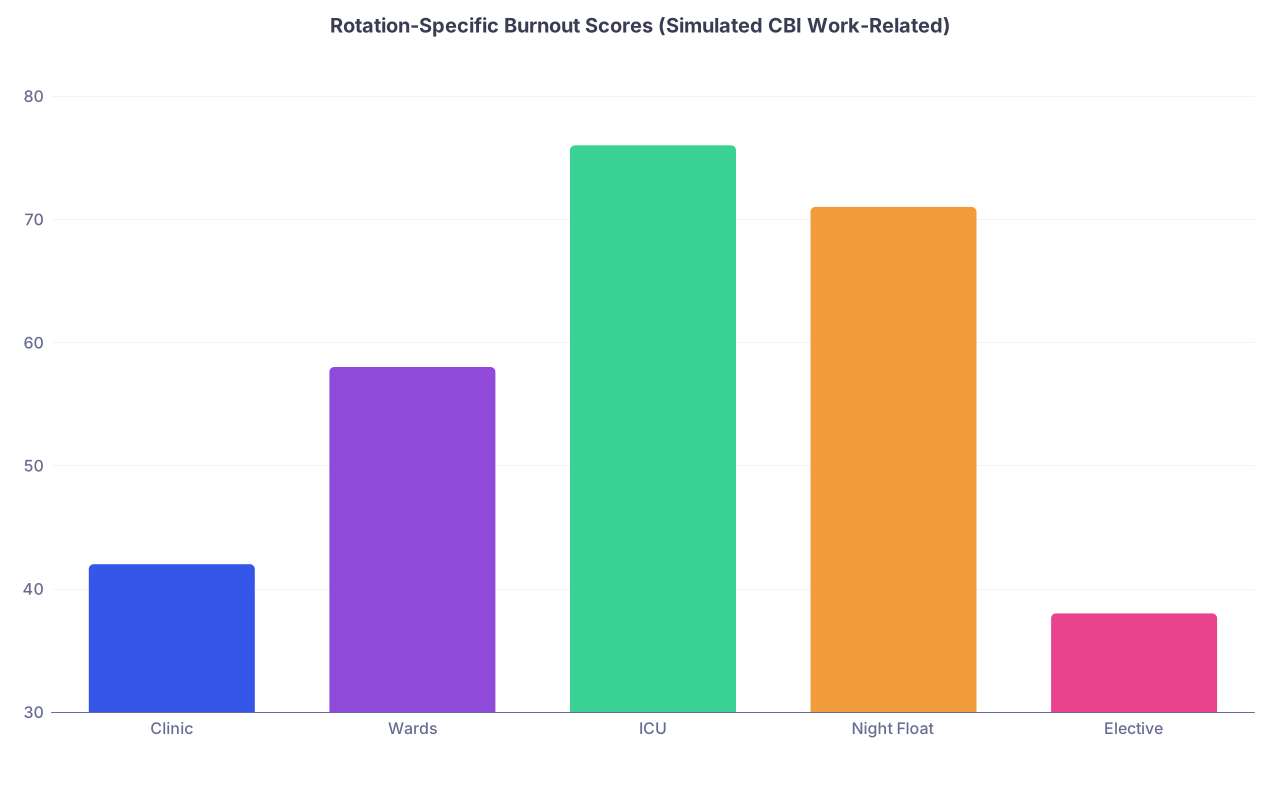
| Category | Value |
|---|---|
| Clinic | 42 |
| Wards | 58 |
| ICU | 76 |
| Night Float | 71 |
| Elective | 38 |
That kind of pattern – ICU and Night Float far higher than Clinic/Elective – is exactly what many programs see when they bother to measure. As an individual, you cannot fix the ICU, but you can:
- Plan extra recovery time after rotations you know spike your scores.
- Push for structural change with objective data backing you up.
- Decide, long term, whether a fellowship or job in that type of environment is worth the risk.
You do not owe your career to a program that is consistently damaging your health on measurable scales.
FAQ (exactly 4 questions)
1. Which single burnout scale should I use if I only have time for one?
If you want one practical, validated, and free tool, use the Oldenburg Burnout Inventory (OLBI). It is short, open‑access, and has clear cutoffs for exhaustion and disengagement that map well onto resident burnout. MBI is more widely published in the literature, but for ongoing monthly self‑monitoring, OLBI is more realistic and does not require institutional access.
2. How often should I repeat these scales to get meaningful data?
Monthly is the sweet spot. Weekly is overkill and noisy; yearly is too sparse to catch trends. Anchoring the measurement to the end of each rotation or block gives you a clean structure: one row per month, one score pair (exhaustion/disengagement) plus PHQ‑9 and GAD‑7. If you see a sharp spike or concerning scores, you can temporarily increase frequency to every 2 weeks for closer monitoring.
3. Will documenting high burnout or depression scores hurt my career if someone finds them?
Your personal tracking should be private unless you choose to share it. Use a personal device and account, not a shared work computer. When discussing issues with your program, you can describe the pattern (“my scores are in the moderate depression range and high burnout range”) without handing over your raw data. If you seek formal accommodations or leave, some documentation may enter your medical or employee record, but that is about safety and support, not punishment. The much greater career risk statistically is untreated burnout leading to errors, professionalism issues, or complete collapse.
4. What if my scores look bad but I still feel like I am functioning fine?
That discrepancy is exactly why standardized scales exist. Many residents operate at high levels of objective burnout or moderate depression for months while still “performing.” The danger zone is when your internal narrative (“I am just tired”) lags weeks or months behind your measurable distress. If your scores cross established thresholds (e.g., OLBI exhaustion ≥ 2.25, PHQ‑9 ≥ 10), treat that as an early warning system, not something to argue with. Functioning now does not guarantee you will still be functioning in three months if the trend continues.
Two core points to leave with you:
- Burnout is quantifiable. Use validated scales monthly, treat thresholds like you would lab values, and watch trends, not anecdotes.
- Data is leverage. For yourself, to act earlier. And with your program, to argue for structural changes using numbers they cannot easily hand‑wave away.


