

The idea that speaking up about burnout will tank your career is outdated—and directly contradicted by the data.
Let me be blunt: staying silent about burnout is more likely to hurt your performance, your evaluations, and your long‑term career than appropriately “complaining” ever will. The whisper-network advice to “keep your head down, never say you’re tired, and just grind” is not tough-love wisdom. It’s how you create unsafe doctors and toxic programs.
You’re in residency, not an initiation ritual. Medicine is high responsibility, yes. But it’s not a cult.
Let’s dismantle this myth properly.
The Myth: “If I Talk About Burnout, I’ll Be Labeled Weak”
You’ve heard the lines:
- “Don’t say you’re burned out on rounds. People will remember.”
- “PDs hate complainers.”
- “Just push through, everyone is tired.”
This gets internalized fast. By PGY-2, many residents have a mental blacklist of attendings they’ll never be honest with. And then they extrapolate that to everyone.
Here’s the problem: the fear is based on anecdotes, not on how people actually get evaluated, hired, or fired.
Look at what program directors and hospital systems are actually judged on now:
- ACGME survey results (resident wellness, workload)
- Burnout and turnover metrics
- Patient safety and quality data
- Duty-hour violations and adverse events
Complaints about burnout—when specific and documented—feed directly into those metrics. And leadership is held accountable for them. That changes incentives.
Do biased, old-school faculty still exist? Absolutely. Some still think “I worked 120 hours a week, you’ll be fine.” But the system around them has shifted. Quiet suffering doesn’t protect you; it just makes you invisible and more expendable.
What the Data Actually Shows About Burnout and Career Risk
Let’s cut through the folklore and look at actual numbers.
Burnout among residents is not rare. It’s the norm.
- Large multi-specialty studies routinely show 40–60% of residents meet criteria for burnout.
- For some high-intensity fields (EM, surgery, ICU-heavy programs), it’s higher.
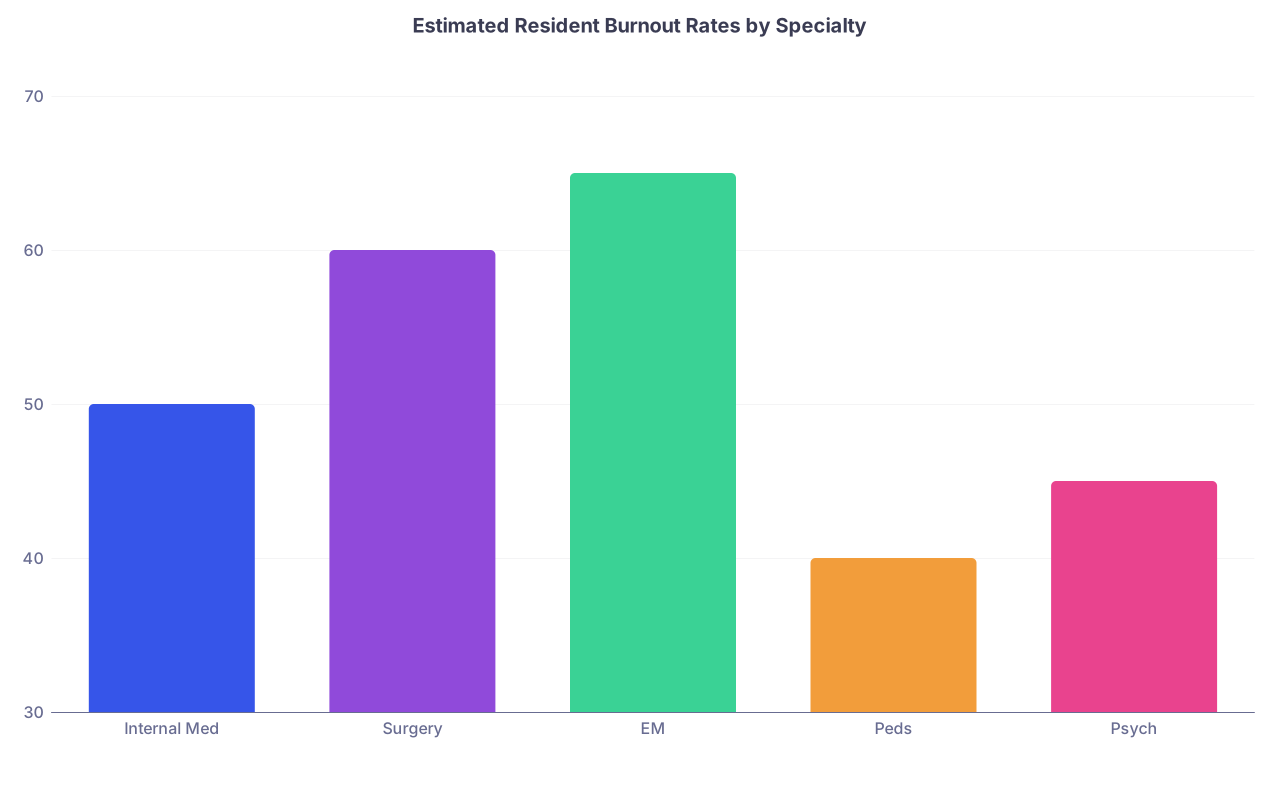
| Category | Value |
|---|---|
| Internal Med | 50 |
| Surgery | 60 |
| EM | 65 |
| Peds | 40 |
| Psych | 45 |
Now here’s the part people conveniently ignore:
Burnout is strongly associated with:
- More medical errors
- Lower in-training exam scores
- Higher intent to leave the program or specialty
- Higher actual attrition
Programs don’t get in trouble because their residents said “I’m burned out.” They get in trouble because:
- Residents quit.
- Residents fail.
- Residents make catastrophic mistakes.
- Surveys and accreditation reports document a pattern of unsafe workload and unaddressed distress.
Those outcomes are worse for programs and PDs than a resident who says, “This schedule is unsustainable and here’s how it’s affecting my work.”
I’ve sat in meetings where leadership was far more alarmed by unexpected resignations and low exam performance than by wellness committee reports showing high burnout but active mitigation efforts. The former says: “We’re losing control.” The latter says: “We see the problem and we’re working on it.”
Translation: spoken burnout is a management problem. Hidden burnout becomes a liability problem.
The Real Career Risk: Silent, Uncorrected Impairment
The myth frames the risk wrong. It assumes the danger is admitting burnout, not operating while burned out.
The evidence says otherwise:
- Residents with higher burnout scores report more self-perceived medical errors.
- Burnout correlates with depersonalization—the “I don’t care anymore” mode that patients and staff absolutely notice.
- That shows up in 360 evaluations, nursing feedback, patient comments, and attendings’ narrative evaluations.
Those things do hurt your career:
- “Consistently disengaged on rounds”
- “Poor follow-through on tasks”
- “Communication breakdowns with nursing staff”
- “Reliability concerns—missed key steps during cross-cover”
That is what gets flagged when PDs talk about “concerns” at CCC (Clinical Competency Committee) meetings. Not “This resident once said they were exhausted and advocated for safer cross-cover.”
There’s also the documentation issue. If you silently spiral, struggle, then finally crash (medical leave, near-miss, serious error), there’s no narrative of you recognizing problems early and seeking help. It looks like you decompensated “out of nowhere.”
If, instead, there’s a trail:
- Sent messages to chief about unsafe patient load
- Wellness check-ins
- Formal or informal suggestions about cross-cover or admission caps
You look like someone who:
- Recognizes limits
- Cares about safety
- Communicates issues
That’s not a career liability. That’s what physicians are supposed to do.
“Complaining” vs Professional Advocacy: Huge Difference
Here’s where people get twisted: they lump everything under “complaining.”
Vent in the workroom saying, “This place is trash, I hate everyone, I don’t care anymore”? Yeah, that will hurt you. Not because you mentioned burnout. Because you’re broadcasting contempt and disengagement.
But this? Very different:
- “Our cross-cover ratio tonight is 80 patients to one resident. I’m worried I’ll miss things; can we redistribute or get backup?”
- “The expectation to pre-round on 24 patients after leaving at 11 pm is affecting my charting accuracy and exam prep. Are there adjustments we can make during ICU months?”
- “Several of us are feeling overwhelmed by the weekend admission volume—would leadership be open to looking at cap data?”
That isn’t complaining. That’s clinical risk communication. Same muscles you use when you say, “We can’t safely discharge this patient yet.”
Most PDs, chiefs, and hospital leaders—especially the ones who grew up in this newer era of duty-hours and wellness metrics—can tell the difference instantly.
“Complaining” that hurts your career usually has these traits:
- Personal attacks (“That attending is useless”)
- Public toxicity (“This program is garbage” shouted at 3 am)
- Hopelessness with no attempt at solutions (“Nothing will ever change, I’m just here for the paycheck”)
Raising burnout and workload as safety and performance issues looks like:
- Specific examples
- Impact on patient care or education
- Suggestions or openness to discussion
You do not get blackballed for the second category. You get noticed as a grown-up.
How Speaking Up Actually Protects You (And Others)
Let’s be ruthless about incentives.
Hospitals and programs now track:
- Near-miss reports
- Incident reports
- ACGME duty hour violations
- Resident survey responses
- Staff retention
When multiple residents surface the same burnout drivers:
- “Cross-cover on nights is unsafe”
- “Clinic plus 28 inpatient patients is wrecking note quality”
- “ICU rotations with 28 straight days are crushing people”
Leadership can:
- Justify hiring more NPs/PAs or hospitalists
- Adjust caps or redistribute services
- Change call structures
- Expand wellness resources (actual ones, not pizza)
I’ve seen programs add a night float, hire scribes, or cap admissions specifically citing resident burnout and safety concerns as rationale to the C-suite. None of that happens if everyone pretends they’re fine.
On the individual level, speaking up:
- Creates a timestamp: you identified an issue before it turned into an incident.
- Signals insight: you see how your function is tied to conditions.
- Allows early interventions: modified schedule, coaching, mental health referral, protected time before exams.
Compare that to the golden-child fantasy: be silent, never complain, crush your evaluations. That works…until it doesn’t. Then you’re the resident who “mysteriously” fell apart PGY-3, and everyone scrambles to reconstruct what went wrong.
Where the Myth Does Have a Grain of Truth
Let me not sugarcoat it: some faculty and PDs are terrible at this.
You will run into:
- The attending who mocks wellness.
- The senior who brags about 36-hour calls as “real training.”
- The PD who superficially cares about burnout but retaliates against open criticism.
So no, I’m not telling you to trauma-dump on every attending or rant in the program-wide email chain. There is a strategic way to handle this.
Think in layers.

| Step | Description |
|---|---|
| Step 1 | Personal Awareness |
| Step 2 | Peer or Co-resident |
| Step 3 | Chief Resident |
| Step 4 | Program Leadership |
| Step 5 | Institutional Resources |
| Step 6 | External or ACGME Channels |
Start small and specific.
One-on-one with a trusted co-resident, chief, or faculty ally. Not the most toxic attending on service.Use private channels first.
Not group texts that get screenshot and circulated. Not public meltdowns on rounds.Separate the person from the system.
“The call schedule is causing unsafe fatigue,” not “Dr X is trying to kill us.”Document patterns.
When there’s a recurring unsafe situation, write it down. Dates, patient load, outcomes, near-misses. It turns a “complainer” into a reporter of data.
There are indeed landmines—especially in smaller programs or personality-driven departments. But that’s not an argument for silence. It’s an argument for being precise and strategic.
How to Talk About Burnout Without Tanking Your Evaluations
Let’s make this concrete. Here’s how the same sentiment can either help or hurt you.
Bad version (how residents get labeled):
- “This rotation is ridiculous. I’m so burned out. Honestly I don’t even care anymore.”
How that reads: disengaged, unsafe, maybe a professionalism flag.
Better version:
- “I’m concerned about my level of fatigue on these stretches. I’ve noticed I’m slower to catch lab abnormalities on post-call days. Is there any flexibility with caps or backup for nights?”
How that reads: self-aware, patient-focused, still committed.
Two more examples:
Bad:
- “I’m so over this. If they don’t fix this call schedule I’m just doing the bare minimum.”
Better:
- “Several of us are struggling to stay sharp on post-call clinic days. I’m worried this structure is affecting both patient care and our learning. Is this something the program is open to revisiting?”
You’re saying the same thing: this is unsustainable. But one is emotional shrapnel; the other is professional advocacy.
The Interview and Future Job Question: “Have You Ever Been Burned Out?”
Residents worry this will haunt them during fellowship or job interviews.
News flash: many interviewers are burned out right now. Burnout isn’t a shameful secret anymore; it’s a major topic in NEJM, JAMA, and every specialty conference.
The liability in interviews isn’t admitting burnout. It’s:
- Denying you’ve ever struggled (reads as naive or dishonest)
- Or implying you handle burnout by blowing up or quitting
A strong answer sounds like:
- “Yes. During my PGY-2 ICU rotation, I hit a point of significant burnout. I noticed I was becoming less patient with families and slower to process complex tasks. I raised this with my chief and PD, adjusted some scheduling issues, and worked with a therapist. My performance and engagement improved, and it also made me much more attuned to signs of burnout in colleagues.”
That’s not career suicide. That’s resilience with insight. Program directors are looking for doctors who will last 20–30 years, not people who pretend medicine never touches them.
Complaining Isn’t the Problem. Isolation Is.
The real career-killer isn’t talking about burnout. It’s isolating, numbing out, and quietly eroding your own competence while pretending nothing is wrong.
Residency is structured to make you feel replaceable:
- Endless admits
- Numbers over nuance
- Constant comparisons: in-service scores, procedure logs, research output
The myth that silence = strength fits too neatly into that culture. It keeps you from using the only leverage you actually have:
- Data (near misses, workload metrics)
- Collective experience (multiple residents reporting the same issues)
- External standards (ACGME duty hours, fatigue policies, wellness expectations)
You’re not “weak” for using those. You’re using the system’s own rules.
| Behavior | Short-Term Perception | Long-Term Career Effect |
|---|---|---|
| Strategic advocacy | Occasional discomfort | Better schedules, less error |
| Silent burnout | Looks “tough” at first | Errors, eval issues, attrition |
| Toxic venting | Immediate red flags | Reputation damage |

Practical Playbook: How to Push Back Without Backlash
Here’s a stripped-down playbook you can actually use.
Name what’s happening—in yourself first.
“I’m not just tired. I’m cynical, detached, and making more small mistakes. This is burnout.”Decide your goal.
Are you trying to: survive this block, change a schedule, push a safety issue, or seek mental health help?Choose your messenger wisely.
- First: trusted co-resident or senior
- Then: chief or wellness committee
- Then: PD or APD
- Only then: institutional or external channels
Use the language of safety and education, not martyrdom.
“This is affecting my ability to safely care for patients and learn.”Convert “complaints” into proposals.
- Suggest cap adjustments
- Propose backup systems
- Ask for protected time before major exams or after brutal rotations
You will not win every battle. Some programs simply aren’t ready. But you will not magically protect your career by pretending to love unsafe conditions. You’ll just be easier to exploit.

Summary
Three things to walk away with:
- The data is clear: unspoken burnout hurts performance and safety, which hurts careers. Speaking up intelligently helps.
- “Complaining” is not the problem; unprofessional venting is. Professional, specific advocacy about burnout is increasingly valued, not punished.
- Silence doesn’t make you look strong. It makes you easier to overwork and more likely to fail quietly.
Use your voice. Just aim it carefully.


