

The wellness industry’s favorite tools for burnout—yoga, meditation apps, gratitude journals—are wildly overrated for residents. Not useless. But nowhere near the cure they’re sold as.
If you’re in residency, you already know this. You’ve sat through a noon conference where someone from HR talked about “resilience,” handed out free Calm subscriptions, and then you went back to a Q4 call schedule and a malignant attending. No app in the world fixes that.
Let’s stop pretending burnout is a breathing problem you can fix with box breathing.
This isn’t an anti-yoga rant. This is a “let’s look at the data and stop lying to ourselves” rant.
What Burnout Actually Is (Not What the Wellness Slide Deck Says)
Real burnout isn’t “I’m tired” or “I had a rough week.” The better studies use the Maslach Burnout Inventory and similar tools: emotional exhaustion, depersonalization (you start calling the patient “the appy” instead of their name), and a reduced sense of personal accomplishment.
Among residents, the numbers are brutal. Large multi-specialty surveys have found burnout rates hovering between 40–60%, sometimes higher in surgery and EM. Those are not “a bit stressed” numbers.
Why does this matter? Because what causes burnout determines what can fix it—or not.
The core drivers from resident data keep repeating:
- Excessive workload and hours
- Loss of control over schedule and work
- Conflicting demands and constant interruptions
- Poor supervision or outright mistreatment
- Meaningful work buried under meaningless tasks (clicks, documentation, busywork)
- Chronic sleep deprivation
Now compare that with what most programs “offer” as solutions: mindfulness sessions, wellness workshops, free apps, maybe a yoga class in the conference room. None of those change workload, control, supervision, or sleep. So it’s no mystery why they barely move the needle.
The Myth of the Mindfulness App as a Fix
Let me be blunt: mindfulness can help individual people feel a bit better. But the hype around apps and quick digital fixes for resident burnout is way ahead of the evidence.
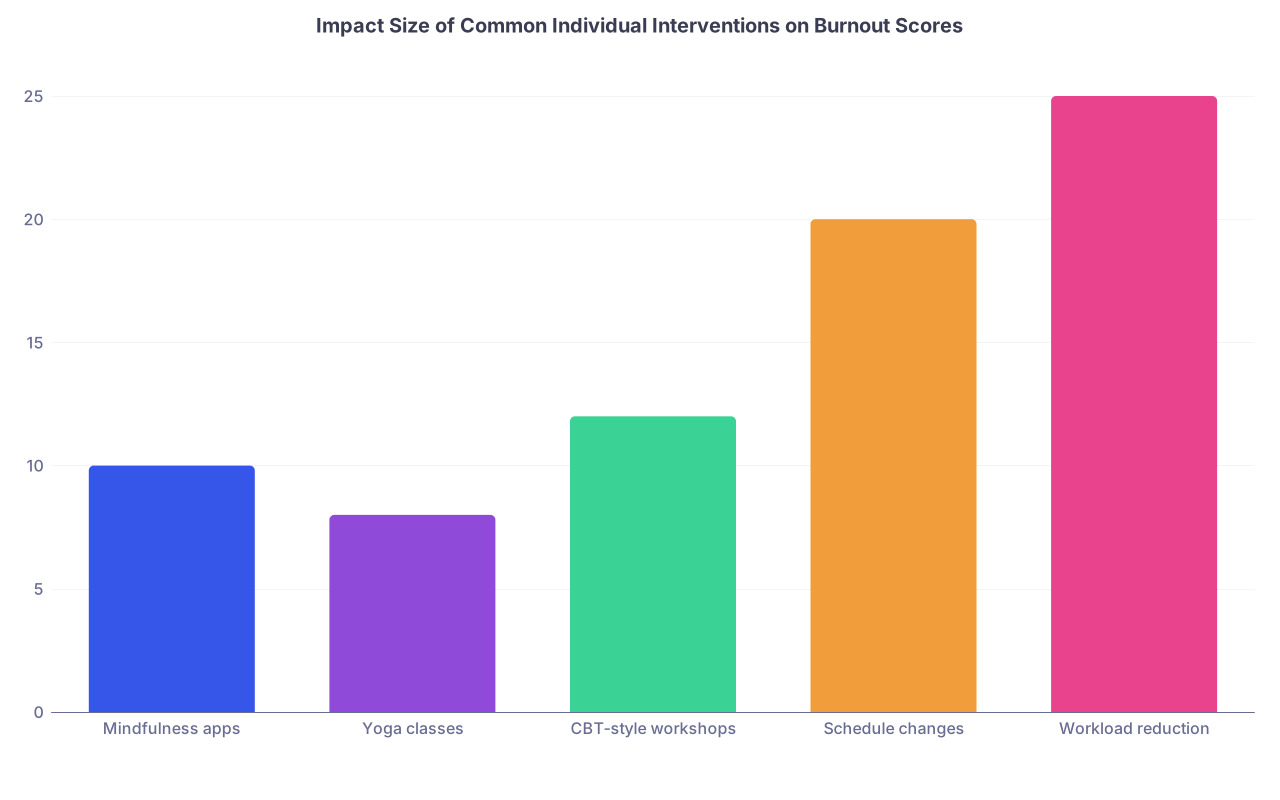
| Category | Value |
|---|---|
| Mindfulness apps | 10 |
| Yoga classes | 8 |
| CBT-style workshops | 12 |
| Schedule changes | 20 |
| Workload reduction | 25 |
Those bars are rough representations of relative impact seen across multiple studies: individual “skills” interventions do something, but the big wins tend to come from structural change—when programs actually change how work is organized.
A few key points from the literature:
- Meta-analyses of physician burnout show that both individual-focused and system-level interventions help, but system-level ones usually have larger and more durable effects.
- App-based mindfulness interventions for trainees often show small-to-moderate short-term reductions in perceived stress, but effects on actual burnout components are modest and often fade when the “program” ends.
- Most of those app studies have pathetic follow‑up windows: 4–8 weeks. Residency is 3–7 years. You see the problem.
I’ve watched residents download a meditation app, use it for a week, and then stop because “I fell asleep with my phone on my face after night float.” Not exactly a sustainable program.
The other ugly truth: wellness app usage is often worst among the residents who need it most. The people drowning the hardest have the least time and energy to sit quietly for 20 minutes with soothing chimes.
So no, the data doesn’t support the idea that a meditation app is your main weapon against burnout. At best, it’s a sidearm.
Yoga, Gratitude, and “Self-Care”: What They Actually Do
Yoga. Gratitude journals. Deep breathing. Walks outside. Let’s separate three things:
- Do they feel good for many people? Yes.
- Do they modestly reduce anxiety or improve mood in the short term? Often yes.
- Do they meaningfully fix resident burnout at scale? Not by themselves.
Most yoga or mindfulness studies showing strong effects are in controlled, relatively low-stress populations: college students, office workers, community adults. Residency is not that. You’re not choosing between yoga and email; you’re choosing between yoga and sleep, or yoga and finishing notes before an attending’s passive-aggressive 10 pm text.
In residency-specific contexts, “self-care” stuff tends to show:
- Slight improvements in stress and self‑reported well‑being.
- Little sustained change in emotional exhaustion unless combined with schedule or workload changes.
- High dropout or low participation when offered as “optional extras” after long clinical days.
The harsher version: if your program is still paging you at 2 am for nonsense and then bragging about their new yoga initiative, they’re managing optics, not burnout.
That said, for you personally, here’s the nuance: yoga, mindfulness, and related tools can buy you small pockets of recovery. They’re not a solution; they’re a pressure release valve. There’s value there, as long as you don’t confuse the valve with fixing the boiler.
What Actually Moves Burnout in Residency: Structural Reality
Let’s talk about the stuff that consistently shows bigger gains and isn’t as sexy in wellness presentations.

Large multi-center interventions that actually changed the work tend to show more robust improvements:
- Reducing duty hours or enforcing true caps
- Making schedules more predictable and reducing random last-minute changes
- Improving staffing: adding scribes, APPs, or support staff to offload scut
- Redesigning rotations that were notoriously toxic (e.g., ICU months with 28-hour calls every third night)
- Protected time that is actually protected for rest or learning—not repurposed for another meeting
When these happen, burnout scores drop more meaningfully. Not down to zero, but you see clear change.
Let me put some structure vs. app contrast in one place.
| Intervention Type | Typical Impact on Burnout | Durability | Main Barrier |
|---|---|---|---|
| Mindfulness/Yoga Apps | Small | Short | Engagement, time |
| One-off Wellness Workshops | Minimal | Very Short | Perceived irrelevance |
| Protected Didactic Time | Small–Moderate | Moderate | Clinical coverage |
| Schedule Redesign | Moderate–Large | Long | Culture, logistics |
| Workload Reduction | Large | Long | Money, staffing |
The problem: as a resident, you do not control scheduling templates, staffing, or billing pressures. So while “systems-level change” is where the big wins live, you still have to function in the current mess.
That’s where it makes sense to ask a more useful question:
Not “What’s the magic fix?” but “Given the real constraints of residency, what’s actually worth my limited energy—and what’s performative nonsense?”
Three Things That Help More Than Yet Another Wellness App
No magic here. Just the blunter, more evidence-aligned reality.
1. Sleep Protection > Fancy Interventions
Chronic sleep deprivation is one of the most consistent, boringly obvious predictors of burnout, depression, and medical errors. Yet programs will twist themselves into knots designing mindfulness curricula while still running 24+ hour calls with post‑call conferences.
Sleep is not optional. It’s infrastructure.
You probably cannot redesign your schedule. But you can treat sleep as non-negotiable on your off‑duty time. That means:
- Saying no to optional late‑night charting perfectionism when “good enough” will do
- Guarding post‑call sleep like it’s a procedure—door closed, phone on do‑not‑disturb outside emergencies
- Dropping or trimming activities that consistently steal sleep but don’t add real value (the 2 am Instagram scroll is not sacred)
No, this doesn’t fix 28‑hour calls. But the difference between an average of 4.5 vs 6 hours of sleep on non-call days is massive in every sleep and cognitive performance study. You will feel more human. That alone reduces emotional exhaustion.
2. Micro-Control in a Macro-Hostile System
Loss of control is a key burnout driver. You cannot control EMR downtime, patient volume surges, or which attending you get. But human brains don’t need total control; they need some.
Look at where you can carve out micro-control:
- Start-of-day ritual you own: 2–3 minutes reviewing your list, setting 1–2 priorities, before opening the floodgates of pages and emails. Tiny, but it shifts you from purely reactive to slightly proactive.
- Boundaries you can realistically enforce: “I stop checking non-urgent messages after X pm on non-call days.” Or “I will finish my notes before leaving, even if it means fewer hallway chats.”
- Input on schedules: When your chief asks for preferences, actually give them. Residents often shrug and say “whatever’s fine,” then get annoyed with the result. You won’t always get what you want, but you’ll get nothing if you never ask.
The psychology literature on autonomy is clear: even limited perceived control strongly impacts burnout and satisfaction. You’re gaming your own brain here. Not fixing the system—making it just tolerable enough that you don’t mentally detach and become that bitter PGY-7 in a PGY-4 body.
3. Real Social Support, Not Forced “Team-Building”
Loneliness and isolation fuel burnout. That’s not controversial. But forced fun and mandatory “team-building nights” usually make residents more irritated, not less.
What does help:
- Small, real alliances: the co-intern you can text “Is it just me or is this attending unhinged?” without a preamble. The senior who quietly says, “You did fine, that was just a rough case.” Those relationships buffer everything.
- Debriefing after bad cases: not a polished, hospital-approved Schwartz Rounds; even 5 minutes in the workroom with someone who gets it. There’s decent evidence that peer support and small debriefs reduce distress after adverse events.
- One or two people outside medicine who remind you there’s a world beyond ACGME milestones. Yes, that’s harder on a heavy schedule, but it matters more than another round of wellness bingo.
I’ve watched more residents survive toxic rotations on the strength of a solid co-resident group chat than on any wellness module.
Where Yoga, Apps, and Quick Fixes Actually Fit
So are yoga and meditation useless? No. They’re just miscast as the lead actor when they’re supporting characters.
Here’s the honest role they can play:
- Good for acute stress modulation: rough day, heart’s racing, can’t shut your brain off. Ten minutes of guided breathing or stretching can bring your sympathetic nervous system down a notch. That’s real physiology, not crystals and vibes.
- Helpful for some people as a regular routine: a small morning meditation, an end-of-day stretch. If you’re one of those people who can maintain that habit during busy months, great. You’re the minority, but it’s still real.
- Terrible as mandatory programming: once it’s forced, residents tune out, and the intervention starts to feel like one more task. A wellness checkbox.
The trick is being honest with yourself: is this practice actually giving you enough benefit to justify your time and energy right now, in this rotation, at this level of fatigue? If the answer’s no, skip it. Sleep or call a friend instead.

How to Tell If an Intervention Is Real or Cosmetic
You’re going to keep being offered “burnout solutions.” Some will be well‑intentioned. Some will be pure PR. You need a quick internal filter.
Ask:
- Does this change the amount or organization of my work in any meaningful way?
- Does this protect my time, rest, or learning—and is that protection enforced?
- Is participation genuinely optional, without subtle punishment for skipping?
- After this is implemented, would a neutral observer say my job is actually easier, safer, or more humane?
If the honest answer is “no” to all four, it’s probably a cosmetic fix. Use it if it helps you personally. But don’t gaslight yourself into believing the system is “taking burnout seriously” because they handed out Headspace codes.

| Step | Description |
|---|---|
| Step 1 | Offered Intervention |
| Step 2 | Likely meaningful impact |
| Step 3 | Moderate impact |
| Step 4 | Use if it works for you |
| Step 5 | Cosmetic - low impact |
| Step 6 | Changes workload or schedule |
| Step 7 | Protects real rest or learning time |
| Step 8 | Optional and personally helpful |
Where You Actually Have Leverage
You can’t fix ACGME policy. But you’re not powerless.
You have leverage in three zones:
- How you spend the small slices of time you do control (prioritizing sleep, real connection, and a few stabilizing rituals over yet another pointless checkbox activity).
- How honestly you name the problem. When surveys come, write, “Call schedule and workload are unsustainable” instead of “more wellness sessions.” Administrations count keywords. Give them the right ones.
- How you treat the people below you: MS3s, MS4s, interns. You can be the person who mitigates a bad system or the person who passes the abuse downhill. That’s not fluffy moralizing; that’s how culture shifts across a few years.

No, that won’t fix your current burnout overnight. But it does something rare in medicine: it stops the cycle from getting worse.
Stop Letting Them Blame You
One last myth to kill: that burnout is primarily about your personal resilience, your mindset, your breathing skills. The evidence is clear: residency environments are high‑risk by design. Individual tools help you survive better, but they do not absolve the system.
Use yoga if you like it. Use an app if it calms you down. Just do not let anyone convince you that your failure to perfectly meditate is why you’re exhausted after a 28-hour shift.
The real story, stripped down:
- Structural changes—workload, schedule, staffing, supervision—drive meaningful reductions in resident burnout. Quick fixes don’t.
- Individual tools like yoga, meditation apps, and “self-care” have small, real benefits but can’t compensate for a toxic system; they’re pressure valves, not repairs.
- Your smartest move is to fiercely protect sleep and micro-control, invest in real relationships, and refuse to internalize the lie that burnout is a personal weakness problem when the data says it’s mostly environmental.


