

Why Cutting Hours Alone Doesn’t Fix Resident Burnout, per the Data
What if I told you we’ve already tried the “just cap the work hours” solution for resident burnout—and it mostly failed?
Everyone keeps treating duty hour limits like a magic pill. 80-hour caps. 16-hour intern shifts. 24+4 rules. Every few years the ACGME tweaks the numbers and issues a press release, and hospital leadership pretends they’ve just “addressed” wellness.
But when you actually look at the data—not the wellness committee slide deck—the story is uncomfortable: simply cutting or capping hours has not reliably fixed burnout, hasn’t clearly improved patient outcomes, and has created a few new problems on the side.
Let’s walk through what the studies really show, why the hours myth is so persistent, and what actually moves the needle on resident burnout.
The Big Myth: “Burnout Is Mainly About Working Too Many Hours”
The intuitive story is simple: long hours → exhaustion → burnout. So the solution must be shorter hours. Except residency is messier than that.
Burnout is usually defined with three components: emotional exhaustion, depersonalization (you start seeing patients as tasks), and a reduced sense of personal accomplishment. Hours contribute to that. But they’re not the whole picture.
We’ve had a giant, real-world experiment on duty hours for over 20 years now. The results? Underwhelming.
What happened when duty hours got capped?
The ACGME rolled out major duty-hour reforms in 2003 (80-hour week, 30-hour max continuous duty, etc.) and then again in 2011 (16-hour cap for interns, more supervision rules). These changes were studied hard.
Here are the headlines from multiple large trials and meta-analyses:
- Burnout rates stayed high. Often unchanged.
- Depression and suicidal ideation did not vanish.
- Patient mortality and major outcomes did not consistently improve.
- Residents often felt less prepared and complained about “shift-work” medicine and endless handoffs.
That’s not my opinion. That’s what the data show.
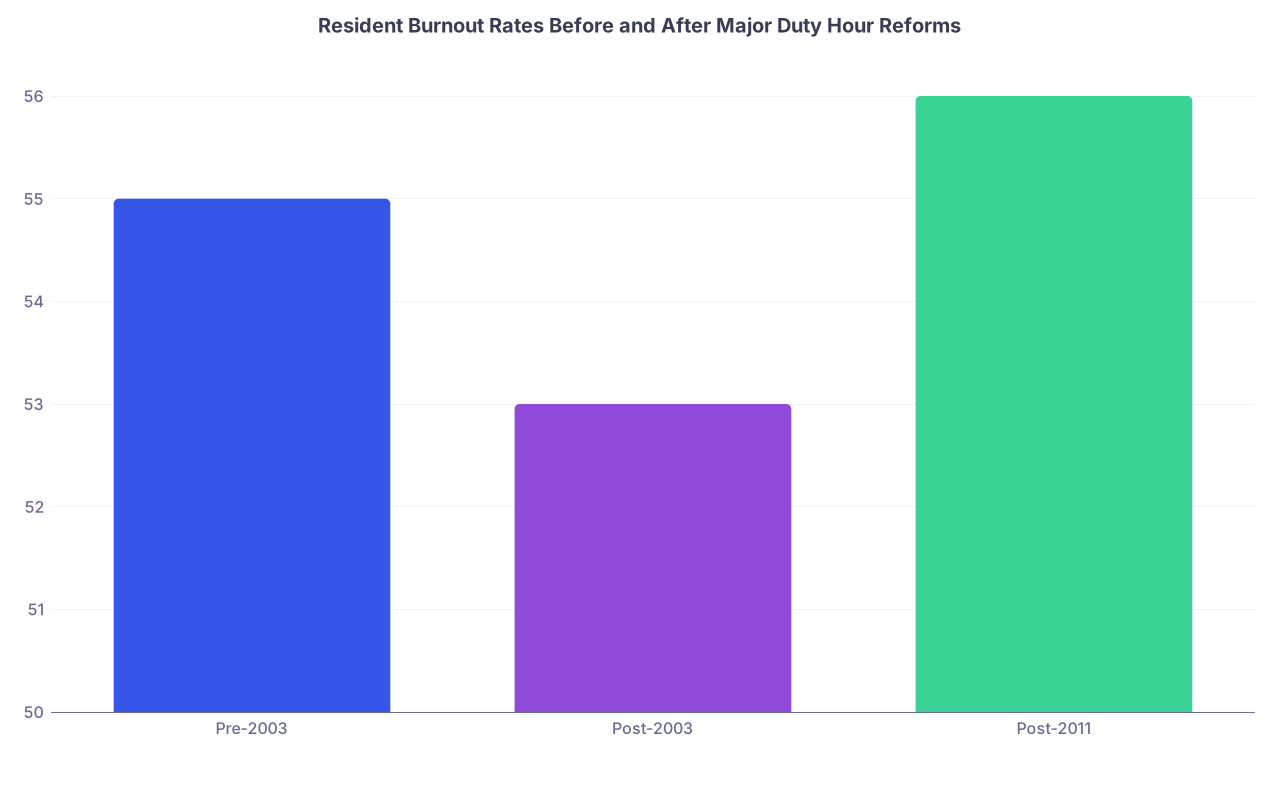
| Category | Value |
|---|---|
| Pre-2003 | 55 |
| Post-2003 | 53 |
| Post-2011 | 56 |
Those numbers are representative of what multiple studies show: burnout hovering in the 40–60% range across eras, with no clear, sustained drop after duty-hour reforms. You can tweak the exact percentages by specialty and study, but the pattern is consistent: the line does not crash the way you’d expect if “too many hours” were the dominant cause.
What the Landmark Studies Actually Found
You’ve probably heard faculty say stuff like, “We had 120-hour weeks and we survived. You all have it easy.” They’re wrong about both the past and the present.
Residents before 2003 were absolutely overworked and unsafe; nobody is arguing to go back. But the idea that our modern caps have solved anything is fiction too.
The FIRST Trial (Surgery)
The Flexibility in Duty Hour Requirements for Surgical Trainees (FIRST) trial looked at flexible duty hours vs standard ACGME rules in general surgery programs. This was a multicenter, cluster-randomized trial—serious design.
Results:
- No difference in 30-day patient mortality or major complications.
- No meaningful difference in resident satisfaction with overall well-being.
- Residents in the flexible group reported slightly worse satisfaction with continuity of care and some aspects of personal life, but not a clear shift in burnout.
Translation: tweaking shift length and timing without changing the rest of the environment did not dramatically change how burned out people felt—or how well patients did.
The iCOMPARE Trial (Internal Medicine)
iCOMPARE did similar work for internal medicine interns—standard vs more flexible duty-hour rules.
Results:
- No significant difference in patient mortality.
- No clear improvement in resident well-being in the standard (more restrictive) group.
- Sleep differences were marginal, not transformative.
Again: you change hours; you don’t fundamentally change burnout.
Meta-analyses and cross-sectional data
When you pool data across specialties, a pattern appears:
- Burnout and depression are common at all training levels.
- They persist despite duty-hour reforms.
- They correlate more strongly with factors like autonomy, meaning in work, organizational culture, inefficiency, and mistreatment than with hours alone.
If hours were the main driver, we would have seen a dramatic decline in burnout after 2003 and 2011. We didn’t.
Why “Just Cut Hours” Often Fails in Real Life
Let me spell out why duty-hour caps feel good on paper but don’t fix the lived experience.
1. The work does not disappear. It just gets compressed.
Hospitals rarely say, “We cut hours, so we’ll cut the workload by 25%.” Instead, the service still has 18 admissions, the same number of notes, the same discharge chaos—just fewer resident-hours to handle it.
So you get:
- More “sprint” culture. Same volume, less time, more pressure.
- Surface-level compliance games: clocking out on paper at 11:59 p.m. while still calling families at 1 a.m.
- Constant guilt and anxiety about “dumping work” on the night team or the next shift.
Having theoretically fewer hours does not feel better when every minute is frantic, and you’re constantly behind.
2. Handoffs multiply, and so does cognitive load
Shorter shifts = more transitions. Medicine is messy; humans are not perfect handoff machines.
Every handoff means:
- More details to remember.
- More chances for miscommunication.
- More emotional whiplash from picking up half-finished disasters.
Residents feel responsible for outcomes with far less sense of control. That loss of control is a huge driver of burnout.
3. Less continuity, less meaning
Ask almost any resident what keeps them going: it’s patient relationships, not the pager.
When you slice shifts into smaller pieces, you get:
- Less continuity of care. You admit the patient but do not see them turn the corner.
- Fewer opportunities to follow a clinical arc from “train wreck” to “walk out of the hospital.”
- More “transactional” medicine: you’re a temporary problem-solver, not a physician with a story.
That erosion of meaning matters. Burnout is not just “too tired.” It’s “this no longer feels worth it.”
So What Does Drive Resident Burnout?
Let’s stop pretending this is mysterious. The evidence and resident surveys line up pretty clearly.
Common, high-impact drivers include:
- Lack of control and autonomy: You’re micromanaged when it doesn’t matter and abandoned when it does.
- Constant administrative trash: EMR clicks, useless documentation, documentation for billing over safety, endless inboxes.
- Toxic culture and mistreatment: Public shaming, “pimping” that’s just bullying, harassment, discrimination.
- Absurd inefficiencies: Waiting 40 minutes for transport, hunting for equipment, fighting the EMR for a simple order set.
- Misaligned values: Being forced to prioritize metrics, length of stay, or billing over what you actually think is best for the patient.
- Poor support for mental health: Lip-service to wellness days and yoga, zero real access to confidential, non-punitive help.
Hours pour gasoline on this fire, yes. But they’re not the spark.

If you shorten the hours but leave all of that intact, you’ve changed the schedule, not the job.
Where Hours Do Matter – And How We Misinterpret That
Now, let’s not swing to the opposite extreme. Working 100 hours a week is not some noble rite of passage. Chronic sleep deprivation wrecks cognition, mood, and safety. There is clear evidence that beyond a certain point, more hours = more errors and more harm.
But clinically meaningful hours improvements are not the same as symbolic caps.
What actually seems to help:
- Predictable schedules instead of random, constantly changing shifts.
- Some control over scheduling—being able to request days off for major life events, swap shifts without drama.
- Protected time that’s genuinely protected: no pager, no “just finish your notes” during your “wellness session.”
- Limits that are enforced realistically, not just “don’t log post-call work so we pass the ACGME survey.”
When “hour reforms” are implemented as a compliance checkbox rather than a redesign of how teams work, you get the illusion of progress and the same underlying misery.
What the Programs With Lower Burnout Actually Do Differently
There are residency programs that consistently have lower burnout scores. No, they’re not fantasy-land 40-hour-week jobs. But they do a few things differently.
Patterns I’ve seen and that show up in the literature:
Real staffing support
Not just residents and one overworked attending. They invest in NPs/PAs, scribes, care coordinators. Residents do doctor work, not constant data entry.Functional EMR and workflows
Order sets that make sense. Standardized pathways. Somebody actually listens when residents flag pointless clicks.Decent culture at the top
Program leadership that shuts down harassment quickly. Faculty who will say, “Sign out and go home, I’ll finish this discharge.”Protected learning that is actually protected
Noon conference without constant pages for nonsense. Sim sessions where you are not expected to “make up the work” by staying three hours later.Integrated mental health support
Free, confidential counseling not tied to credentialing questions. Normalized attendance. Residents see senior people actually using it.
None of this is as simple as rewriting a duty-hour rule. It’s harder. It requires money, staffing, and leadership that is willing to call out stupidity in the system instead of just squeezing trainees.
The Most Uncomfortable Truth: Misalignment of Incentives
Here’s why the “just cut hours” narrative refuses to die: it’s cheap.
Hospitals love hour rules because they let leadership say, “We care about wellness; look at our compliance audits.” They can push residents to work at 110% intensity during those hours, pad FTEs with “resident labor,” and avoid investing in nurses, APPs, or technology that would reduce burnout-causing inefficiency.
You feel worse, they declare victory. It’s a neat trick.
| Aspect | Before Caps | After Caps (Typical) |
|---|---|---|
| Total hours | Higher | Slightly lower on paper |
| Workload per hour | High | Higher |
| Number of handoffs | Lower | Higher |
| Administrative burden | High | High |
| Culture | Variable | Usually unchanged |
This is why I’m blunt: duty-hour caps are necessary but wildly insufficient. They’re the floor, not the fix.
What You Can Actually Do as a Resident (Without Gaslighting Yourself)
You can’t single-handedly fix your institution’s staffing or EMR. But you are not completely powerless either.
A few practical, non-fluffy moves:
Be precise about what’s burning you out.
“Too many hours” is vague. “Four hours of useless EMR clicks daily” is leverageable. Document patterns. Bring specific, repeatable examples.Push for team-based solutions.
Ask: can clerical tasks be shifted to coordinators? Can standardized note templates cut documentation time? Programs are more open to concrete workflow tweaks than abstract wellness complaints.Use mental health resources early, not as a last resort.
Burnout is not a moral failure. You are not weak because this system is chewing you up. Use what exists. If what exists is garbage, that’s on the program, not you.Support your co-residents ruthlessly.
Cover for people when they’re drowning. Normalize saying “I’m not okay.” Peer support is one of the few things the system doesn’t control.
And if the culture is truly toxic, leadership is dismissive, and nothing changes despite documented issues and group feedback—start planning your exit strategy for after training. You’re not obligated to spend your career loyal to a system that treated you as disposable.
FAQs
1. So are duty-hour limits useless? Should we get rid of them?
No. Getting rid of duty-hour limits would be a disaster. Extreme overwork is dangerous, period. The point is that limits are the starting line, not the finish. They prevent the worst abuses but do not, by themselves, create a humane or healthy training environment.
2. I’m burned out and my program says, “But we follow ACGME hours.” What do I say?
Do not argue hours. Argue conditions. Be specific: EMR burdens, toxic behavior, lack of staffing, no real breaks, fake “protected time.” Ask for concrete changes. “I’m burned out despite hours compliance” is a more powerful statement than “we’re working too much.”
3. Is there any specialty where reduced hours clearly lowered burnout?
Even in “lifestyle” specialties, burnout is common. Dermatology, radiology, anesthesia—none are immune. You do see lower average burnout where cognitive load, culture, and workflow are better, but that’s not purely an hours story. It’s structure and support.
4. How do I know if it’s me (I’m not cut out for this) or the system?
If you were once engaged, functional, and cared about medicine, and now you feel numb, cynical, exhausted, and trapped while objective stressors have ramped up—that’s not a personality flaw. That’s a system effect. Healthy systems don’t routinely break healthy people.
Key points: Cutting resident hours without changing workload, culture, and workflow leaves burnout basically intact. Burnout is driven far more by loss of control, meaningless work, toxic culture, and inefficiency than by hours alone. Duty-hour limits are necessary guardrails, not a cure—and pretending they “fix” burnout is part of the problem.


