

It’s January. Mid-year evaluation season. You’re sitting in a cramped office across from your program director, pretending to read the Clinical Competency Committee summary while mentally replaying that one rough month on nights.
On paper, your “Milestones” are mostly Level 3s and 4s. But you can feel it. Something’s off. You’re working harder than ever, yet the written comments have this faint, uncomfortable pattern:
“Sometimes seems disengaged.”
“Efficiency improving, but attention to detail variable when busy.”
“Professionalism appropriate, but appears frustrated at times.”
Nobody said “burnout.” Nobody will.
Let me tell you what’s actually happening behind closed doors when those evaluations are written—and how faculty quietly document the early smoke of burnout long before anyone uses the word.
Because your evals are not just about competence. They’re an early warning system. And most residents never learn to read it.
What Faculty Really Talk About In Evaluation Meetings
You imagine the Clinical Competency Committee (CCC) as some formal academic panel, dispassionately reviewing your performance by Milestone and ACGME domain.
Sometimes. But often it’s far more human and much more subjective.
A typical CCC meeting looks like this:
Conference room. Coffee. Laptops open to your evaluations. Someone pulls up MedHub/New Innovations/whatever your program uses.
Then:
“Okay, next is PGY-2, rotation: MICU, attending: Patel. Any global concerns?”
That phrase—“any global concerns?”—is where burnout shows up. Not as “this resident is burned out,” but as stray comments faculty drop that never make it into the formal written record.
I’ve heard:
- “They’re solid clinically, but they look wrecked.”
- “I worry they’re withdrawing.”
- “Their notes are still good, but the energy is gone.”
- “They’re short with nurses when it’s busy. That’s new.”
Most programs will not put “burnout” into a written eval unless you’re crashing and burning or you’ve had an actual leave of absence. Liability, optics, accreditation, take your pick.
So instead, it leaks into coded language. Mild concerns. Qualifiers. “When busy.” “At times.” “Recently.”
These are the quiet flags.
And the CCC is looking for patterns. Not one bad month. But repetition.
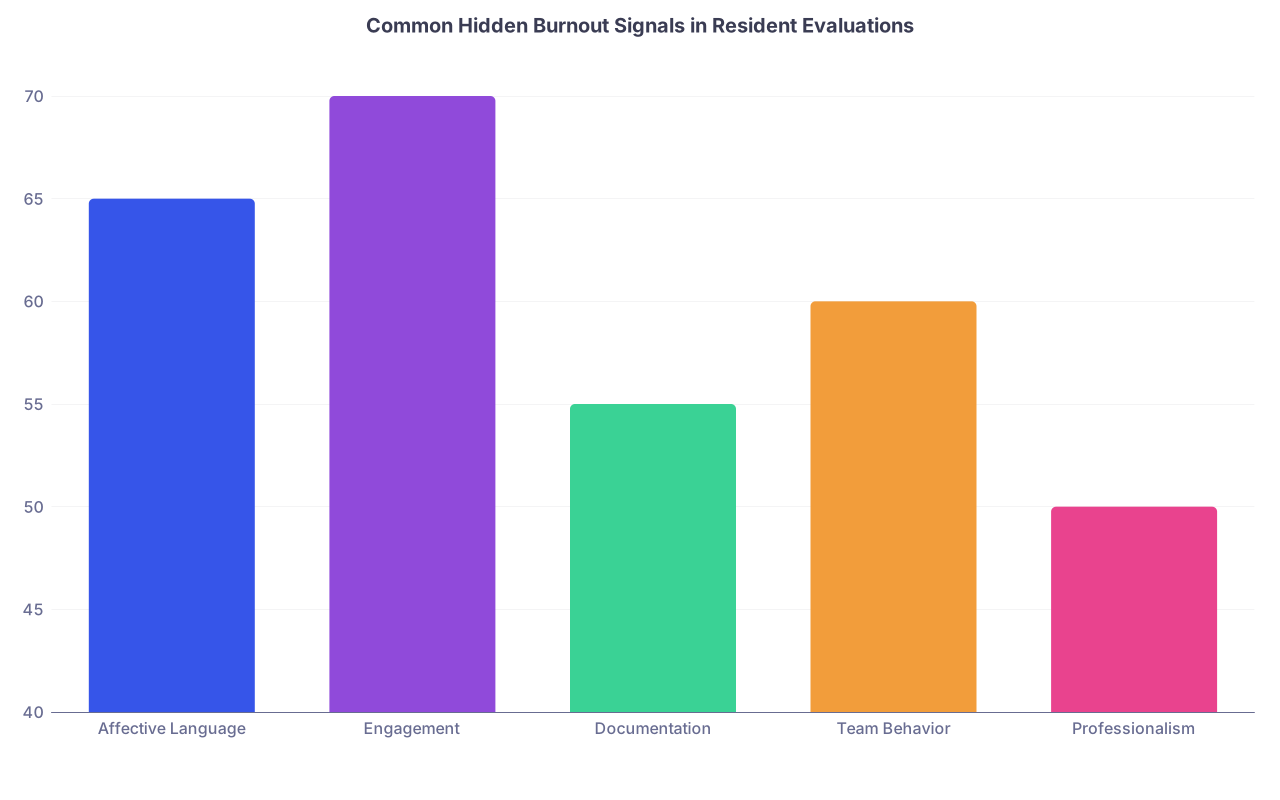
| Category | Value |
|---|---|
| Affective Language | 65 |
| Engagement | 70 |
| Documentation | 55 |
| Team Behavior | 60 |
| Professionalism | 50 |
Those categories right there—affect, engagement, documentation, team dynamics, professionalism—are where your hidden burnout signs live.
The Coded Phrases That Actually Mean “We’re Worried”
You’ve seen the obvious stuff before: “Works hard,” “Good team player,” “Strong clinical reasoning.” None of that tells you much.
The real story is in the soft negatives and faint hedging. Let me decode a few for you.
1. “Appears tired” / “Seems overwhelmed at times”
No attending writes “is completely fried and on the edge” unless something serious is already happening. Instead you get:
- “Appears tired during long shifts”
- “Seems overwhelmed when census is high”
- “Energy appears variable”
- “Can get flustered with competing demands”
Translation: You look like you’re drowning more often than they’d expect at your level. Maybe your work gets done, but they’re noticing the cost.
Behind the scenes, this might sound like:
“They’re fine clinically, but they look dead on their feet every single morning. I don’t know how sustainable that is.”
That does not go into your written eval word-for-word. Instead, you get “appears tired.” If you see that more than once, in different rotations, that’s not random.
2. “Can be quiet on rounds” / “Less engaged in discussions”
If you used to ask questions and now you stand at the back of the team silently surviving, faculty notice. They do not write “has lost the will to live,” even if that’s the vibe.
You’ll see:
- “More reserved during rounds”
- “Could participate more actively in teaching”
- “Sometimes appears disengaged during conferences”
- “Quiet but attentive”
That last one—“quiet but attentive”—is often code for “I think they’re still with us, but I’m not sure anymore.”
In the room where evals are discussed, someone will say:
“They were so curious as an intern. Now they’re just… flat. They’re not misbehaving; they’re just not there.”
That’s often early-stage burnout. Emotionally checked out but still showing up.
3. “Occasional lapses in attention to detail”
This one gets people in trouble because they treat it like a technical skill problem. Often, it isn’t.
Comments like:
- “Generally thorough, but occasional missed orders when busy”
- “Usually organized, but has had some lapses in follow-up labs”
- “Documentation complete, though some notes seem rushed”
Here’s the part residents don’t realize: attendings know exactly what it looks like when a resident is cognitively maxed out from chronic sleep deprivation and moral fatigue.
You might think you’re hiding it well. You’re not.
In the meeting, someone will say:
“They know what to do; this is not a knowledge deficit. They are just worn down. You can see it in their notes at 4 a.m. on nights.”
But again—that nuance rarely hits the official eval. Instead, you get vague “attention to detail” language, which on paper looks like a mild performance weakness. Under the surface, it’s burnout.
How Nurses and Peers Quietly Shape Your Burnout Narrative
Another piece you never see: the informal data funneling into your evaluations from people who never log into MedHub.
If a nurse or pharmacist says something to an attending more than once, it will color your eval—even if nobody types a word about it.
Comments like:
“They used to be so kind. Lately they snap at night when we page.”
Or:
“They’re always exhausted. I’m worried about them.”
Those phrases transform into written comments such as:
- “Generally professional, but can appear short under stress”
- “Valued member of the team, though interactions can be abrupt when busy”
- “Works well with staff, but should be mindful of tone in high-pressure moments”
That’s how burnout shows up socially: reduced patience, lower frustration tolerance, decreased emotional bandwidth. You still care—just not apparently enough to filter like you used to.
And peers? Same thing.
Co-residents rarely throw you under the bus. But in 360 evals or side conversations, you’ll hear faculty say:
“The team said they’re doing fine but seemed more withdrawn than usual.”
That becomes:
- “Gets along with team but can be somewhat withdrawn at times”
Again—pattern is everything. One comment? Noise. The same theme in three or four evals over six months? That’s your burnout profile being written in slow motion.
What the Program Director Actually Sees When They “Review Your File”
You see one eval at a time. Your PD sees the whole arc of your residency at once.
Think of it like this:

| Step | Description |
|---|---|
| Step 1 | PGY1 Early |
| Step 2 | Subtle Comments |
| Step 3 | Pattern Across Rotations |
| Step 4 | CCC Discussion |
| Step 5 | PD Concern |
| Step 6 | Conversation with Resident |
PGY-1, first half: lots of “works hard,” “good attitude,” maybe some “needs to improve efficiency” comments. Normal.
Then the grind hits. Maybe Step 3, maybe ICU blocks back to back, maybe a toxic rotation. Evaluations shift slightly. The language moves from “eager and enthusiastic” to “reliable and consistent.”
That change alone is not a problem. It’s expected. People mature.
But your PD is watching for clusters like:
- “Appears tired”
- “Sometimes disengaged”
- “Can be abrupt when busy”
- “Occasional lapses in detail”
- “Quiet on rounds”
- “Seems overwhelmed at times”
They’re not just reading the words. They’re tracking how many domains are being affected: clinical performance, communication, professionalism, engagement.
Here’s how it typically plays out:
- One attending flags soft concerns verbally in a CCC.
- Another rotation’s eval contains similar language, independently.
- A chief mentions you’ve been “off” lately.
- PD scrolls through all your evals and sees the trend.
Now your next “routine” PD meeting isn’t really routine. It’s a temperature check.
That’s when you hear:
“How are you doing?” asked too carefully.
“How are you really doing?” with eye contact that lingers.
If you brush that off with “I’m fine, just tired,” and they keep seeing the same coded burnout phrases, the tone in the back room changes:
“We offered support. They said they’re fine. I’m not sure they see it yet.”
The Line Between Burnout and “Performance Concern”
Here’s the part residents do not want to hear: if burnout words stack up long enough without action, the file starts to look like a performance problem, not a wellness problem.
Programs live in fear of missing someone who’s genuinely unsafe. So if your burnout spills into:
- Repeated missed labs or tasks
- Consistent documentation delays
- Multiple interpersonal complaints
- Visible anger or cynicism on rounds
Your eval language shifts from “appears tired and overwhelmed” to things like:
- “Needs to improve reliability in task completion”
- “Should work on consistent follow-through”
- “Must be more responsive to nursing concerns”
- “Professionalism concerns when under stress”
Notice the change from “could/should” to “must.” That’s the line.
Behind the scenes the conversation becomes:
“Is this burnout, or is this just who they are now?”
“At what point do we need to put this in a formal remediation plan?”
You do not want burnout to mature into “possible remediation.” By that point, the narrative about you is no longer “strong resident under strain.” It’s “resident with ongoing issues despite feedback.”
The earlier you read your eval language as a burnout signal, the easier it is to course-correct before anyone starts mentioning the R-word.
How to Read Your Evaluations Like an Insider
Let’s talk about what to actually do with this.
You should be scanning every eval for three things:
- Affective words – tired, overwhelmed, flat, quiet, disengaged, frustrated.
- Consistency words – occasional lapses, sometimes, at times, when busy, recently.
- Trajectory cues – “improving,” “still working on,” “continues to struggle.”
Then you ask yourself, bluntly: is this accurate? Not “is this fair” or “did they like me.” Are they right?
If you see:
- “Appears tired” on nights. Fine. You were.
- “Appears tired and overwhelmed” on every rotation, regardless of hours? That’s not about the rotation anymore.
If you see:
- One “seems disengaged at conference” after an especially brutal call night. Fine. Life happens.
- Three separate evals in six months using “quiet,” “less engaged,” “seems withdrawn”? That’s a flag.
Here’s where people screw up: they defend the specific incident instead of listening to the pattern.
“I was quiet that day because I’d gotten a bad page.”
“I was short with that nurse because they paged three times about the same thing.”
Individually, sure. Totally understandable. But burnout is pattern, not episode.
Turning Those Hidden Burnout Signals Into Leverage For Yourself
If you’re seeing those soft burnout codes in your evals, you have two options:
- Ignore them, keep grinding, and hope you don’t cross the line into formal “concern.”
- Use them as documented proof that something is off—and as leverage to change your reality.
Programs talk a big wellness game. Most of them will actually move if you present a clear, grounded case early. What they do not like is being blindsided when you crash.
So you go to your PD or APD and say something like:
“I’ve been reviewing my evals over the last 6 months. I’m noticing repeated comments about appearing tired, seeming disengaged, and some lapses in detail when busy. I’m concerned that reflects burnout creeping in. I’d like to talk about what we can adjust before this becomes a real performance problem.”
That sentence does a few important things:
- Shows insight
- Connects the dots for them
- Frames it as prevention, not crisis
- Signals you’re taking this seriously
Now your PD is not the cop. They get to be the ally.
Behind closed doors, they’ll say to the CCC:
“They actually came to me and said, ‘I think I’m burning out; I want to fix this before it worsens.’ That’s insight. That matters.”
Even if your program cannot magically lighten your rotation schedule, they can give you:
- Strategic scheduling (not back-to-back high-intensity blocks)
- A “quiet” elective at the right time
- Support for therapy or counseling
- Permission to say no to extra non-essential projects
And just as important—they’ll change the story they’re telling about you.
From “burning out and oblivious” to “under strain but self-aware and proactive.” That distinction is enormous when decisions about letters, fellowships, or borderline issues come up.
The Red Flag Comments You Can’t Ignore
Let me be blunt. There are a few phrases that, if they hit your eval, you need to take seriously immediately.
Here’s a quick reference.
| Phrase Fragment | What Faculty Are Really Thinking |
|---|---|
| "Professionalism concern" | This is now a formal issue, not a quirk |
| "Must improve reliability" | We are close to remediation territory |
| "Pattern of…" | We see this as ongoing, not isolated |
| "Concerns shared with leadership" | This has already been escalated |
| "Requires close supervision under stress" | We do not fully trust your judgment when tired |
If any of those show up mixed with the softer burnout language (tired, overwhelmed, disengaged), you’re not at “early warning” anymore. You’re on the edge.
At that point, pretending you’re fine is professional self-harm. You need to speak up, and you need to document that you did.
Not in a combative way. In a “I see what you see; help me fix it” way.
What You Don’t See: The Residents Who Quietly Adjust In Time
You mostly hear the horror stories—the person who melted down, the person who got put on formal remediation, the one who left residency altogether.
You do not hear about the ones who read between the lines early and course-corrected.
I’ve seen residents do this right:
PGY-2, strong clinically, starts racking up comments like “seems overwhelmed,” “quieter than usual,” “some lapses in documentation.” They notice. They bring it up themselves.
They negotiate:
- One lighter elective after a brutal stretch
- Dropping a non-essential QI project
- Moving a research deadline
- Getting referred to a real therapist instead of “wellness lecture” nonsense
Six months later, their eval language shifts again:
- “Back to prior level of engagement”
- “Handles stress better this block”
- “Improved consistency in follow-through”
Same resident. Same program. Different trajectory, because they treated those soft phrases as what they are: early smoke.
You will not see a note saying “burnout improved.” But you’ll see “improved resilience,” “better coping strategies,” “more consistent performance under stress.”
That’s how programs document recovery.
Reading Your Evaluations Is A Burnout Prevention Skill
Most residents treat evaluations like a hurdle or a judgment. That’s shallow. For burnout, they’re a diagnostic tool.
You’re not objective about your own exhaustion. Your brain normalizes insane workloads quickly. Faculty, nurses, and peers are often the first to notice you changing.
Your job is to learn their code.
If the people around you, across multiple rotations and settings, are describing you as more tired, more withdrawn, more irritable, less consistent—believe them. Do not wait until the word “remediation” appears.
Residency will not get magically easier. But the way you relate to it can change dramatically if you stop reading evals like a verdict and start reading them like vital signs.
With that lens, your next mid-year review is not just a check-box meeting. It’s an early warning, or a quiet confirmation that you’re still yourself in the middle of this grind.
If you can protect that—yourself inside the machine—you’ll get through residency intact. And that’s the real game.
You’ve learned how to see burnout hiding in your evaluations. The next step is learning how to build a system—habits, boundaries, allies—that keeps you from ever reaching the edge in the first place. That’s the work that comes next.


