

It’s 3:17 a.m. You’re on night float. Your eyes burn, your brain feels like wet cardboard, and you’re on your 11th admission. You’re staring at the med list thinking, “What if I miss something? What if I click the wrong dose? What if this is the night I make the error that ruins a life and ends my career?”
That’s what you’re really asking, right?
Not just “how do I avoid burnout,” but:
What if burnout makes me dangerous?
I’m going to be blunt: you are not the first person to have this thought, and the people who don’t have this thought honestly scare me more.
Let’s walk through this without sugarcoating it, but also without catastrophizing more than reality deserves.
The Fear You’re Afraid to Say Out Loud
You’re not just worried about being tired. You’re worried about:
- Killing someone because you were too burned out to think clearly.
- Being the resident whose name ends up in an M&M slide deck for the worst possible reason.
- Having to sit across from a family and explain that your mistake changed everything.
- Being reported, sued, or losing your license before you even get going.
- Realizing too late that you shouldn’t have been practicing in the state you were in.
Here’s the awful, quiet truth you probably already know:
Medical errors happen. Even to good people. Even to people who care. Even to residents who were trying their best.
Burnout doesn’t help. Chronic sleep deprivation, emotional exhaustion, depersonalization—those things absolutely increase risk. You’re not crazy for connecting those dots.
But here’s what your brain is not factoring in when it spins worst-case scenarios at 2 a.m.:
You will not be alone.
You will not be unsupervised.
You will not be the first or only person whose functioning is being worn down by this system.
And there are actual, practical ways to lower the risk from “paralyzing nightmare” to “serious but manageable danger.”
How Burnout Actually Shows Up Before Errors Happen
The fear is that burnout will slam into you out of nowhere and suddenly you’re unsafe. That’s not how it works.
It creeps.
You start noticing things like:
- You reread the same note three times and still don’t register what it says.
- You feel numb when a patient cries instead of automatically leaning in.
- You catch yourself almost signing an order but thinking, “Wait, did I actually check the creatinine?”
- You start relying on templates, old orders, old habits—because actual thinking feels expensive.
- You feel your patience drop to zero with nurses, consults, or family questions.
Those are not moral failings. Those are warning lights.
The danger isn’t “burnout” as some abstract idea. It’s burned-out you plus a system that:
- Expects you to function well past normal human capacity.
- Normalizes being tired, snappy, and spaced out.
- Praises you for “pushing through” until something breaks.
That’s the part I’ve seen over and over: residents ignore the early warning signs because everyone around them looks equally wrecked. So they assume, “Guess this is just what being a doctor is.”
No. It’s what being an unsafe system operator is.
The System Is Built Assuming You’re Not a Robot
I know it doesn’t feel like it, but the hospital isn’t actually betting everything on your personal willpower. It leans on layers.
Think of it like this:
| Layer | What It Does |
|---|---|
| Attendings/Fellows | Double-check plans, co-sign orders, redirect bad calls |
| Nursing | Catch wrong doses, wrong patients, conflicting orders |
| Pharmacy | Flag dangerous meds, interactions, renal/hepatic issues |
| EMR Safety | Pop-up alerts, dose limits, allergy warnings |
| Protocols/Checklists | Standardize high-risk tasks, reduce guesswork |
That doesn’t mean errors don’t get through. They absolutely do.
But it means the system expects human fallibility and builds some guardrails.
The problem is, you expect yourself to be perfect. And that mismatch is where a lot of this mental torture comes from.
What Actually Happens if You Make a Serious Error?
Let’s walk through the nightmare, because your brain will keep running it in the background until we drag it into the light.
Say you’re on night call. You enter a med at the wrong dose.
Nurse gives it. Patient decompensates. Code. ICU transfer.
Sometimes the error is caught quickly. Sometimes not. Sometimes harm is minimal. Sometimes it’s not.
If there’s harm or even potential harm:
- There’s usually an incident report.
- Risk management gets involved.
- There might be an M&M.
- Your program director will know.
- You may have to give a statement.
- You will probably feel sick to your stomach for weeks.
Here’s the part your brain skips:
Most of the time, if you were acting in good faith, not impaired, and within a reasonable scope of your training—
you’re not getting dragged in front of a firing squad.
You might get:
- Closer supervision for a while.
- Required education or process changes.
- A painful but very real learning experience that shapes the rest of your practice.
- Support (if your program isn’t garbage) from co-residents and sometimes even faculty who quietly share their own worst errors.
People do get disciplined. People do get reported when there’s a pattern of recklessness, dishonesty, impairment, or refusal to change.
But “I made a serious error because I was tired and overwhelmed, I reported it, and I worked to fix the system and myself” is not typically a career-ending event.
Traumatizing? Yes.
Career-ending? Usually no.
Burnout vs. “I Should Not Be Practicing Right Now”
There’s a difference between being tired and being unsafe. Your job is to be brutally honest with yourself about where you are on that spectrum.
You’re in the red zone when:
- You’re forgetting basic steps in routines you used to do automatically.
- You’re having near-misses frequently but brushing them off.
- You catch yourself thinking, “I don’t care what happens, I just want this over.”
- You’re relying heavily on others to catch things you know you should be catching.
- You’re dissociating on rounds—no idea what was just discussed.
- You’re making documentation errors constantly: wrong patient, wrong date, wrong med.
In that zone, “keep grinding” is not heroic. It’s dangerous.
This is where people panic and ask: “But what am I supposed to do—just not show up? Tell them I’m too burned out to work??”
Not exactly. But also… kind of yes. In a targeted, honest way.
What You Can Actually Do Before Burnout Makes You Unsafe
This is the stuff I wish someone had told me before I white-knuckled through my first real breakdown.
1. Use the words “I’m worried I’m unsafe right now”
Not “I’m tired.” Not “I’m stressed.” Everyone is.
Say: “I’m worried I’m not safe to be making independent decisions right now.”
That phrasing hits differently. It shifts it from personal weakness to patient safety.
Tell your senior. If they blow you off completely or mock you, that’s a program problem, not a you problem.
2. Build tiny, non-negotiable safety habits
When your brain is toast, habits are what save you. Not “trying harder.”
Things like:
- Always reading the med, dose, route, and patient name out loud to yourself before signing.
- Always checking creatinine and weight before ordering certain meds. No exceptions.
- Always asking yourself, “What’s the worst thing this could do to this patient?” before you click.
- Always repeating back verbal orders with dose and patient name.
These become your autopilot. When burnout wrecks your higher-level thinking, autopilot is what’s left.
3. Use nurses and pharmacists like the safety net they are
Not as adversaries. As extra brains.
If you’re unsure, say it out loud:
“I’m really tired and I want to double-check this—does this dose look right to you?”
“Can you walk me through the way you usually do this on this unit?”
You might feel stupid. You’ll feel way more stupid in an M&M slide.

4. Know your program’s actual resources, not the brochure
Every program loves to talk about “wellness” and “support.”
What you need is to know who you would concretely call if you felt you were at the edge.
That might be:
- A chief resident who actually gives a damn.
- A specific attending known to be reasonable.
- A GME office contact.
- An employee assistance program psychiatrist/therapist.
- A confidential hotline (some places have them) for impairment/burnout concerns.
Write these down before you need them. When you’re burned out, you’re not going to be googling “who to call if I’m not okay.”
5. Take near-misses seriously, not silently
If something almost goes very wrong and you catch it—don’t just say “phew” and move on.
Tell someone: “Hey, I almost ordered X instead of Y because the order sets are confusing.”
Submit an incident report if that’s how your hospital tracks system problems.
Is it annoying? Yep.
Does it feel like you’re snitching on yourself? Sometimes.
But this is how systems slowly get safer. And how your brain realizes, “We fix problems, we don’t hide them.”
The Part You’re Scared to Ask: What If I Just… Break?
Let’s go all the way there.
What if burnout gets so bad you truly cannot function safely? Like, panic attacks, derealization, suicidal thoughts, total collapse.
Then you’re dealing with something beyond “tired resident.” You’re dealing with a medical/psychiatric issue that absolutely does justify stepping away, getting treatment, maybe even going on leave.
People do this and come back. I’ve seen it.
Sometimes with accommodations. Sometimes with schedule adjustments. Sometimes with therapy and meds and better boundaries.
Yes, there are risks: stigma, gossip, possible career friction. I won’t lie about that. Medicine is slowly improving on this but still pretty bad.
But staying and practicing unsafely because you’re afraid of what asking for help might look like? That is how people end up in truly long-term disasters. License board issues. Severe harm events. Even worse mental health outcomes.
You can recover a career. It is much harder to recover from unaddressed full-blown collapse.
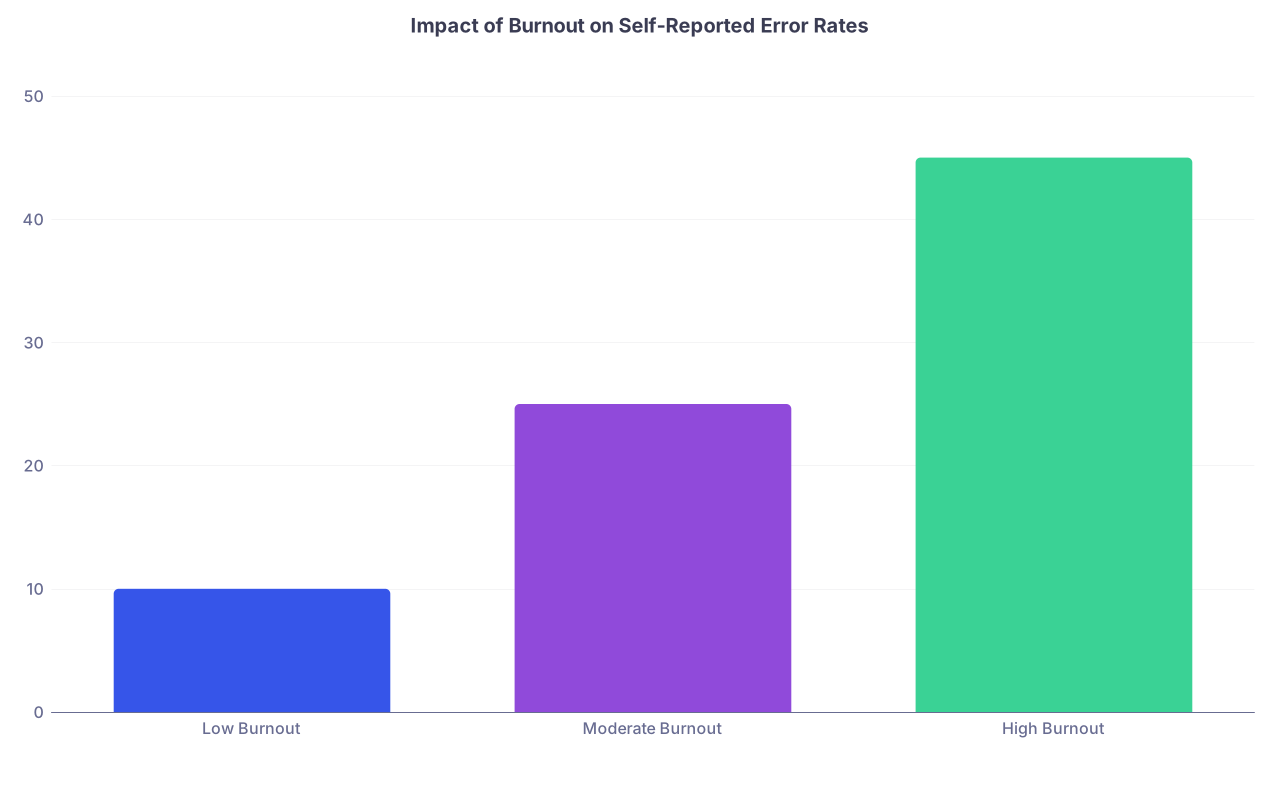
| Category | Value |
|---|---|
| Low Burnout | 10 |
| Moderate Burnout | 25 |
| High Burnout | 45 |
This Fear Means Something Good About You
I know it doesn’t feel like it, but the fact that you’re this anxious about harming patients means your internal compass is working.
The residents who scare me most are not the ones asking, “What if I screw up?”
It’s the ones saying, “Everyone makes mistakes, whatever,” with a shrug. Total detachment.
You’re already doing something protective by worrying: you’re paying attention.
The trick is not to drown in the anxiety, but to translate it into structure, habits, backup plans, and boundaries.
You’re not going to “mindset” your way into being invincible.
You can build a life where:
- You’re honest about your limits.
- You have language to use when you’re near them.
- You have people and processes to catch you when you’re not at 100%.
You will still make mistakes. That’s non-negotiable.
The work is making them earlier, smaller, and surrounded by people who help you learn, not bury you.
FAQ (The Late-Night Questions You’re Actually Asking)
1. Will one serious medical error end my career as a resident?
Usually, no. One serious error, honestly reported, with clear evidence that you were trying to act within your training and you engage fully in remediation—this does not typically end a career. What does cause long-term damage is a pattern: repeated similar errors, ignoring feedback, lying or covering up, or showing up impaired. Programs and hospitals know errors happen. They care a lot more about your response and your honesty than about one isolated event.
2. Should I tell my program if I feel burnout is making me unsafe, or will they judge me as weak?
Tell someone. A chief, a trusted attending, or GME. Yes, some people will judge; medicine still has a toxic streak. But people who are actually responsible for patient safety generally take “I’m concerned I’m unsafe” very seriously. You presenting it in terms of patient safety and asking for specific help—closer supervision, a chance to regroup, changes to your schedule—is a sign of maturity, not weakness. If their response is to mock or ignore you, that’s a red flag about them, not you.
3. What if I freeze during a crisis because I’m burned out and make the wrong call?
Freezing happens, even to people who aren’t burned out. That’s why codes and emergencies are supposed to be team events with clear roles, checklists, and leadership. If you notice you’re freezing, the safest move is to say out loud, “I’m not thinking clearly, I need help,” and let someone else step up, while you take on a smaller, concrete task (compressions, meds, documenting). That’s way safer than pretending you’re fine and guessing your way through high-stakes decisions while your brain is offline.
4. How do I know when it’s “normal residency exhaustion” versus “I actually need to step back”?
Short version: if exhaustion is occasionally intense but you still basically feel like yourself, can enjoy some things outside work, and your errors are rare and caught quickly—you’re probably in the “miserable but functional” residency zone. If you’re losing your sense of self, feel detached or hopeless, can’t recover even with time off, having frequent near-misses, or having thoughts like “I don’t care what happens to me or my patients,” that’s beyond normal. That’s the line where you need to talk to someone with power to change your workload and someone who can treat your mental health. Both, not either/or.
Here’s your next step, not tomorrow, not “sometime”:
Right now, open a note on your phone and write down three things:
- The name of one person in your world you’d tell if you felt yourself becoming unsafe (a chief, mentor, friend, therapist).
- One specific phrase you’ll use if you ever hit that wall: “I’m worried I’m not safe to be making independent decisions right now.”
- One safety habit you’re going to start today—something tiny, like always reading out med, dose, and patient name before signing.
That’s it. Three lines.
Then, when your brain comes back at 3 a.m. with “What if burnout makes me hurt someone?”, you’ll have something concrete to push back with—not just fear.


