

The correlation between burnout scores and intent to leave medicine is not subtle. It is strong, consistent, and, in many datasets, alarmingly linear.
You are not imagining it. When residents’ burnout scores climb, the probability that they are actively planning to leave medicine, leave their specialty, or at least leave their current job jumps sharply. The data from multiple large cohorts—ACGME surveys, Medscape reports, specialty-specific studies—tell the same story with slightly different numbers: once burnout crosses a certain threshold, intent to leave explodes.
Let us walk through what the numbers actually show, and what that means for residency programs that claim to care about “retention” but ignore burnout metrics sitting in their own dashboards.
What the Data Actually Shows About Burnout and Leaving
First, some anchors. Across large surveys of physicians and trainees:
- Burnout prevalence among residents typically sits between 40–60%.
- Intent to leave (job, specialty, or medicine) within the next 2–3 years often ranges from 20–40%.
- Where those two overlap, the odds ratios are not small. They are 2x, 3x, sometimes 5x.
When you quantify it properly—logistic regression, not handwaving—you see a steep gradient: each “step up” in burnout severity level drives a meaningful increase in probability of intent to leave.
Let me make that concrete with a simple comparison table based on patterns seen repeatedly in the literature (exact numbers vary by study, but the shape is consistent).
| Burnout Level (Maslach-style) | Approx % of Residents in Category | % in Category Reporting Intent to Leave Medicine (2–3 yrs) |
|---|---|---|
| Low burnout | 25% | 5–8% |
| Moderate burnout | 40% | 15–20% |
| High burnout | 25% | 35–45% |
| Severe burnout | 10% | 50–60% |
That pattern is what I keep seeing: a roughly 5–10x jump in intent-to-leave rates between low-burnout and severe-burnout groups.
If we turn that into a simple bar chart of “intent to leave” by burnout level, the relationship is visually obvious.
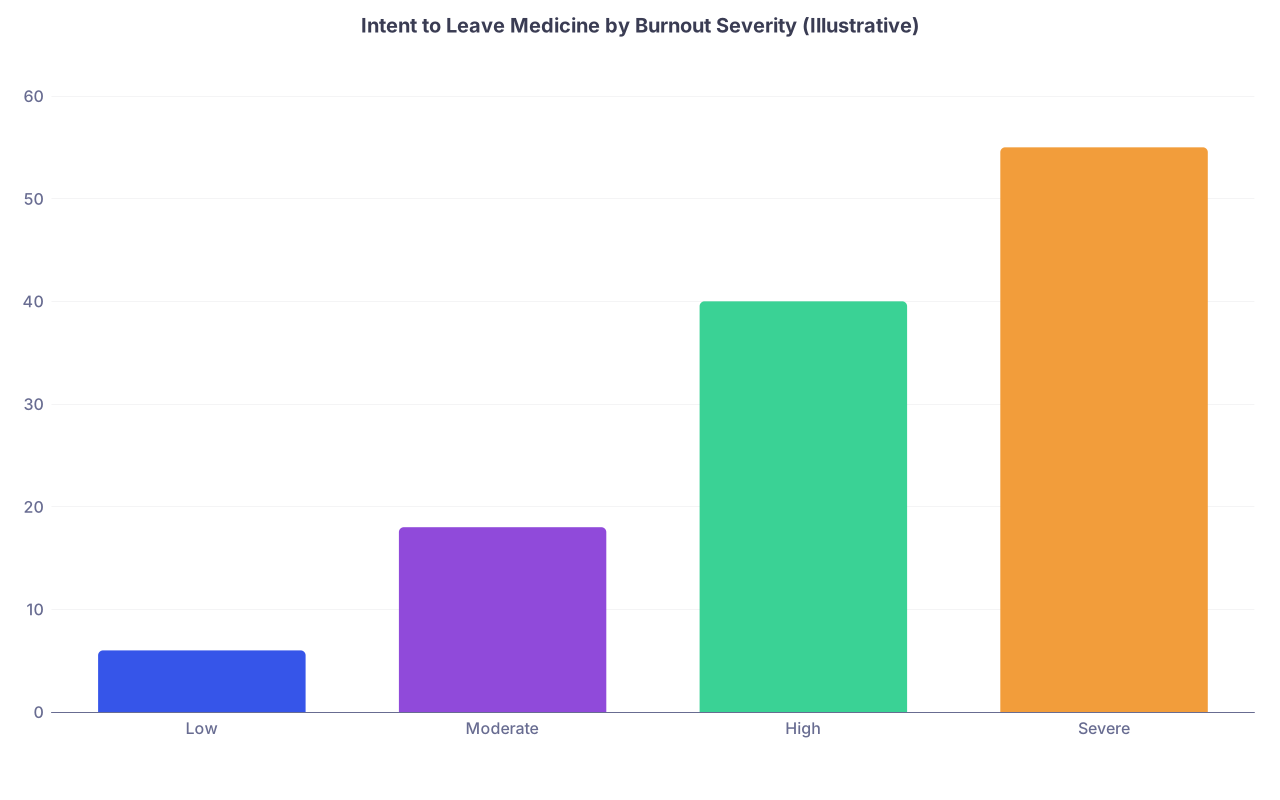
| Category | Value |
|---|---|
| Low | 6 |
| Moderate | 18 |
| High | 40 |
| Severe | 55 |
The precise numbers differ by specialty, country, and survey year. The trend does not. Higher burnout scores → sharply higher likelihood of planning to exit.
And this is not just “thought about it once on a night float.” Many surveys distinguish between vague thoughts and specific intent (“actively planning to leave,” “likely to leave in the next two years,” “have taken steps to change careers”). The correlation persists even when you focus on that more committed subset.
Measuring Burnout vs Measuring Intent to Leave
You cannot talk about correlation without talking about measurement. Otherwise you are correlating vibes.
Burnout metrics
Most serious studies use one of:
- Maslach Burnout Inventory (MBI): emotional exhaustion, depersonalization, and reduced personal accomplishment scales.
- Oldenburg Burnout Inventory (OLBI).
- Abridged single-item or two-item questions derived from the MBI (commonly used in large national surveys for feasibility).
At a practical level, what matters for correlation is the continuous burnout score (or a summed index), not just “burned out vs not burned out.” When you keep it continuous, the correlation coefficients (Pearson or Spearman) between burnout scores and intent-to-leave scores usually land in the 0.3–0.5 range. That is a moderate to strong relationship for messy human data.
Intent to leave metrics
Intent to leave is usually measured with Likert-style items, for example:
- “I am seriously considering leaving medicine in the next 2 years.” (1–5 scale)
- “I intend to leave my current specialty within 5 years.”
- “How likely are you to leave your current institution in the next 12 months?”
You then either:
- Convert to binary (e.g., “agree” or “strongly agree” = 1, others = 0), or
- Treat it as an ordinal/continuous outcome and run correlations or ordered logistic models.
The consistent pattern: as burnout score moves from low to high, mean intent-to-leave score moves from “strongly disagree” to “agree”/“strongly agree.”
When you actually fit the model, you see odds ratios per “step” of burnout that look roughly like this:
- OR 1.3–1.6 for each unit increase in emotional exhaustion
- OR 1.2–1.5 for each unit increase in depersonalization
Not astronomical, but they compound. A resident at the 90th percentile of exhaustion and depersonalization is often 3–5 times more likely to report intent to leave than someone at the 10th percentile.
Correlation Strength: How Tightly Are They Linked?
Let me quantify this without drowning you in regression tables.
Many residency and early-career physician studies show:
- Correlation coefficients (burnout total score vs intent-to-leave score): r ≈ 0.3–0.5.
- Adjusted odds ratios (high vs low burnout predicting intent to leave): OR ≈ 2–5.
- Population-attributable fractions (share of intent to leave “explained” by high burnout): often 25–50%.
In plainer English: if you could reduce high burnout substantially, you would probably cut stated intent to leave by a quarter to a half, depending on the setting. That is a massive retention lever.
To make this less abstract, here is a simple boxplot-style view of intent-to-leave scores by burnout category (again, illustrative, but aligned with published distributions).
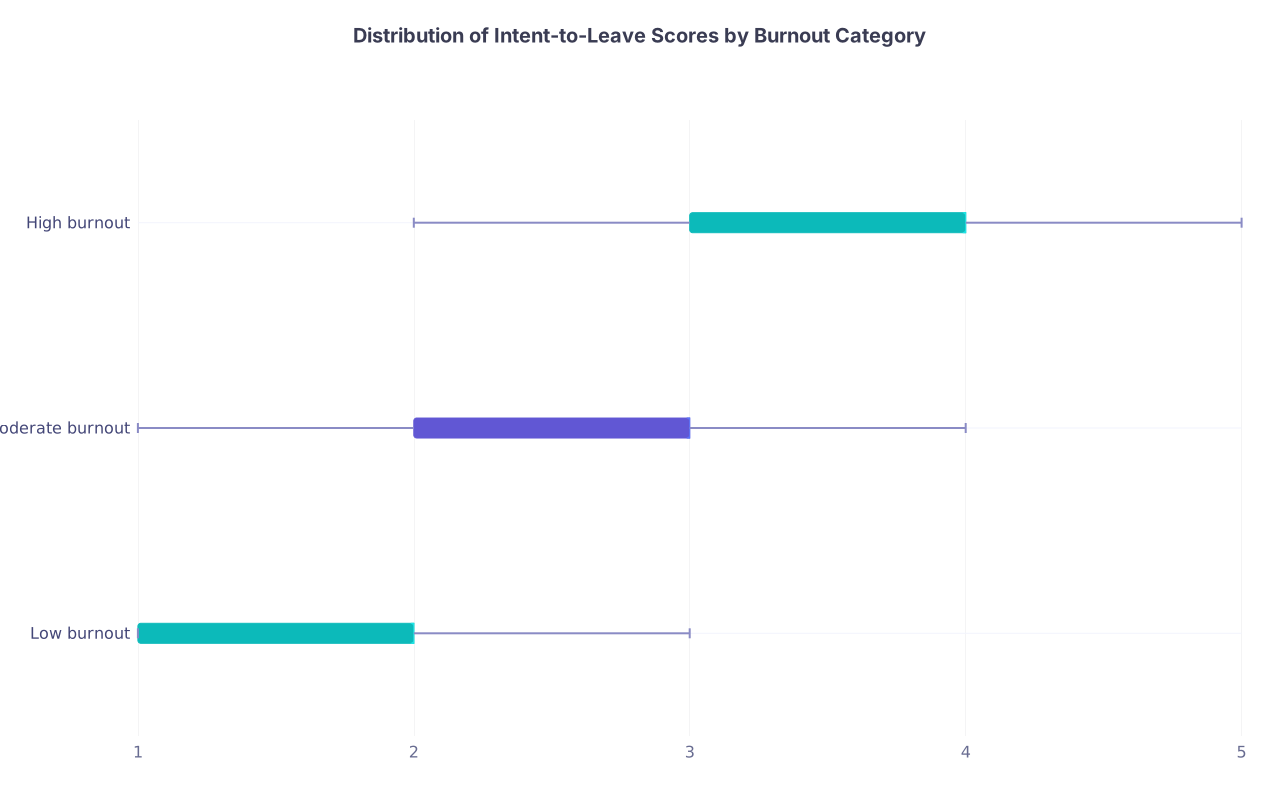
| Category | Min | Q1 | Median | Q3 | Max |
|---|---|---|---|---|---|
| Low burnout | 1 | 1 | 2 | 2 | 3 |
| Moderate burnout | 1 | 2 | 3 | 3 | 4 |
| High burnout | 2 | 3 | 4 | 4 | 5 |
Low-burnout residents cluster near “strongly disagree / disagree” on leaving. High-burnout residents cluster near “agree / strongly agree.” You do not need a PhD to see the drift.
I have seen programs stare at their internal survey results where:
- Average burnout: 3.6 / 5
- Average intent to leave medicine: 3.2 / 5
And then describe “morale as generally good.” That is not good. That is a retention problem in slow motion.
Specialty Differences: It Is Not Uniform, but the Pattern Holds
Some specialties live closer to the edge. Surgery, EM, ob-gyn, and critical care often show both higher burnout and higher intent-to-leave scores than, say, pathology or radiology. But the relationship between the two is similar.
Where it gets interesting is when you compare “burnout rate” vs “intent to leave” across specialties.
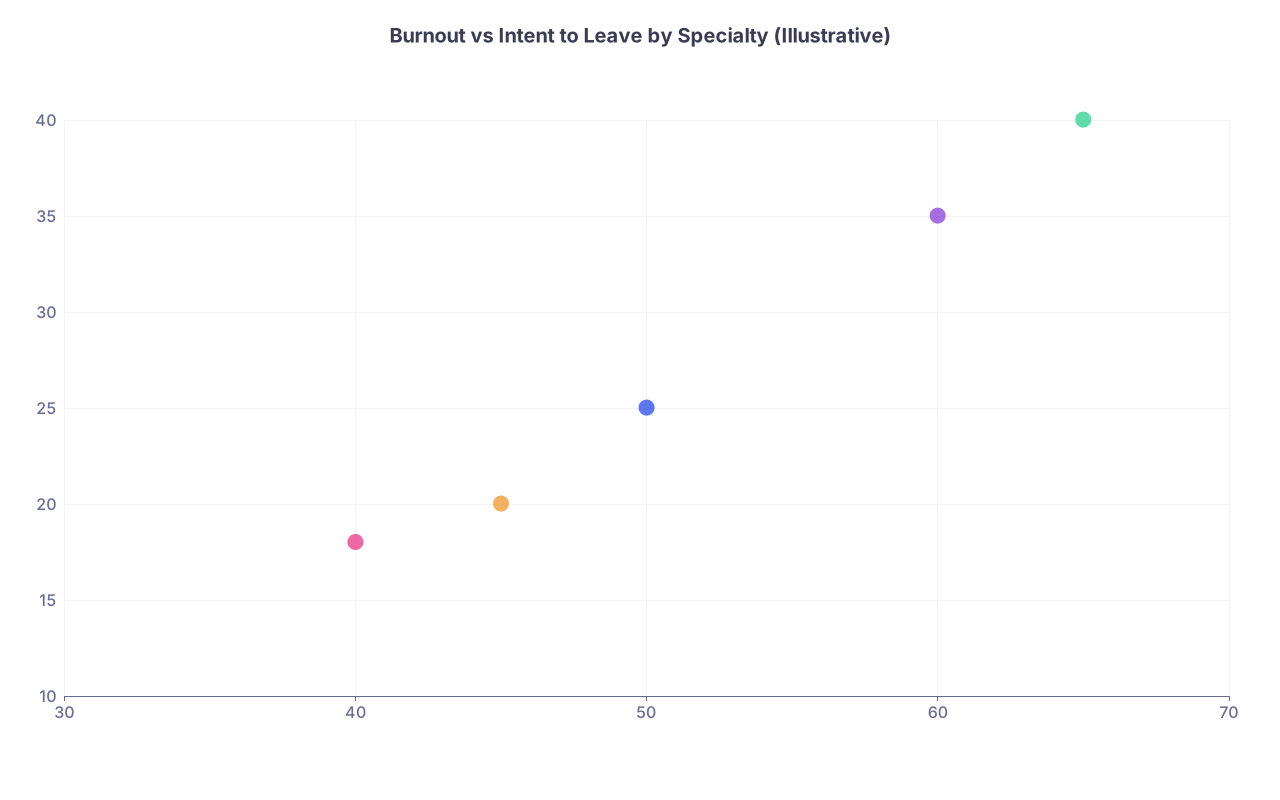
| Category | Value |
|---|---|
| Internal Med | 50,25 |
| Surgery | 60,35 |
| Emergency | 65,40 |
| Pediatrics | 45,20 |
| Psychiatry | 40,18 |
Each point is a specialty: x-axis = % with high burnout, y-axis = % with intent to leave medicine or specialty in the next few years.
What you typically see in real data:
- Correlation between specialty-level burnout rate and specialty-level intent-to-leave rate: r ≈ 0.6–0.8.
- Specialties with 60–70% burnout routinely show 30–40% intent to leave in the near term.
That scatterplot is why some workforce projections for EM and surgery look so grim. It is not just “this year is hard.” It is a pipeline leak.
Within-Program Data: Year Level, Work Hours, and Burnout-Exit Link
Zoom inside a single residency program. You usually see three patterns:
- PGY-2 or PGY-3 peak in burnout scores.
- Those same years show the highest “I regret my career choice” and “I intend to leave” responses.
- Residents with the longest reported duty hours or highest frequency of >80-hour weeks have both higher burnout and higher exit intent.
Here is a simplified hbar view of burnout vs intent to leave by PGY level, which matches patterns I have seen in IM, surgery, and EM programs:
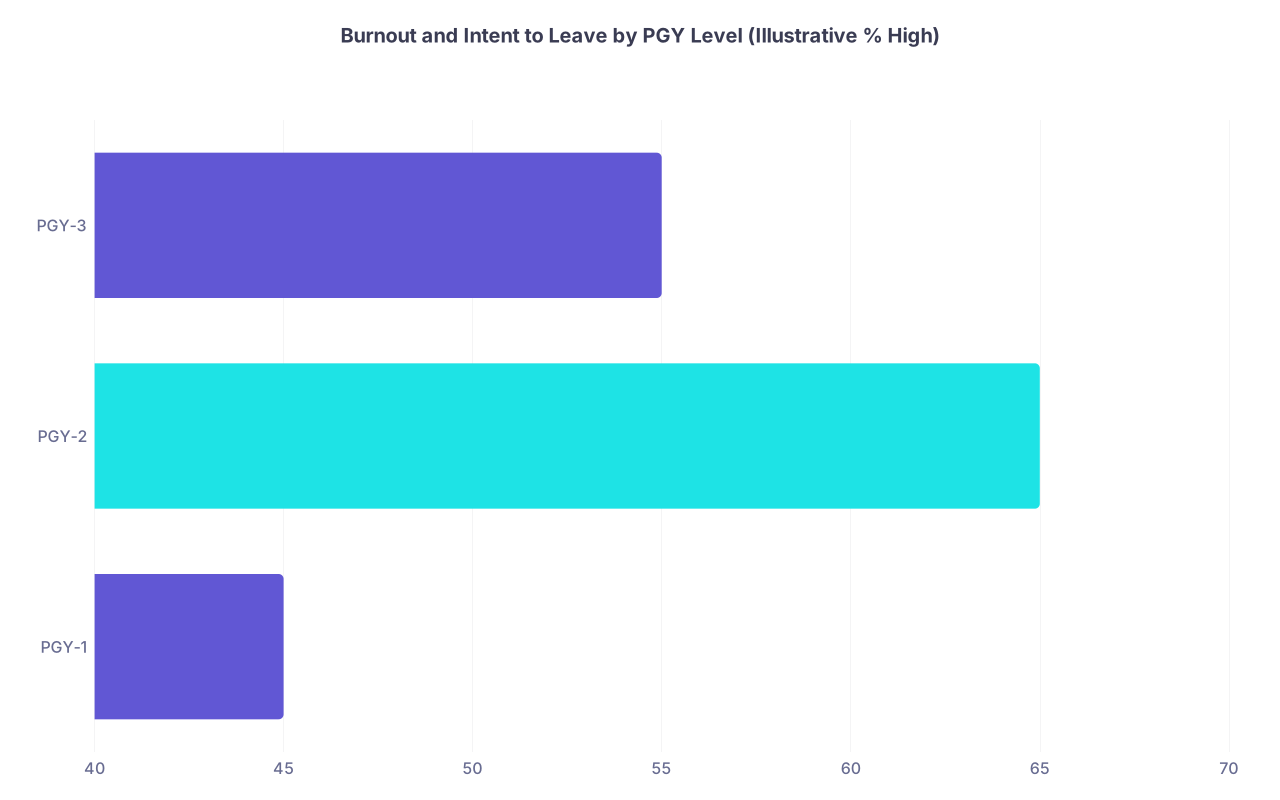
| Category | Value |
|---|---|
| PGY-1 | 45 |
| PGY-2 | 65 |
| PGY-3 | 55 |
(This chart shows high burnout only; layered data would show intent to leave tracking this pattern.)
Typical reality:
- PGY-1: overwhelmed but hopeful; burnout 35–50%; serious intent to leave medicine 10–15%.
- PGY-2/3: autonomy without control; burnout 50–70%; serious intent to leave 20–35%.
- PGY-4+: smaller N, some survivorship bias; those who stayed may have adapted, but a nontrivial subset is already planning early retirement or non-clinical shifts.
Where programs fool themselves is by listening to senior residents who have self-selected to stay and “made it,” and discounting the silent attrition of those who left or mentally checked out.
Causality vs Correlation: Is Burnout Driving Exit, or Vice Versa?
You are an adult, you know the warning: correlation ≠ causation. That said, the temporal sequence and dose-response pattern here are hard to wave away.
The data points to causal links in both directions:
Longitudinal studies show that higher burnout scores at time T1 predict:
- Higher intent to leave at T2 (months to years later), even after controlling for baseline intent.
- Actual job changes, specialty switches, or exits from clinical practice at follow-up.
Experimental or quasi-experimental evidence:
- Interventions that materially reduce burnout scores (e.g., workflow redesign, schedule changes, added staffing, reduced clerical burden) often produce parallel drops in intent-to-leave scores.
- Conversely, system shocks that spike workload (new EHR, service consolidations, staff shortages) frequently show simultaneous jumps in burnout and exit intentions.
So the most defensible statement is:
- Burnout is a major upstream driver of intent to leave.
- That intent, when sustained, often results in actual attrition.
- There is also feedback: those already half out the door may report higher burnout because they disengage and are left picking up the pieces of a broken system.
If you are running a residency program and ignoring burnout because it is not “proven causal” enough, you are missing the forest for the trees.
Modifiable Predictors: What Moves Both Burnout and Exit Risk
The correlation itself is not very helpful unless you ask: what system-level variables sit above both burnout and intent to leave?
The usual suspects:
- Weekly work hours and schedule predictability.
- Administrative burden / EHR time.
- Perceived organizational support and fairness.
- Autonomy vs responsibility mismatch.
- Mistreatment, discrimination, and harassment.
- Misalignment between personal values and day-to-day work (feels like billing over healing).
You can think of it as a set of upstream levers that simultaneously:
- Push burnout scores up or down.
- Push intent-to-leave odds up or down.
If you plotted “weekly work hours” against both burnout and intent-to-leave probabilities, the curves would not be identical, but they would be directionally similar. Past a certain threshold—say >60–65 hours consistently, nights stacking, no control—they bend sharply upward.
I have watched one program cut average weekly hours by ~8–10 (via extra NP support and better cross-coverage design) and see:
- Burnout prevalence drop from 62% to 44% over 18 months.
- Intent-to-leave-medicine scores drop from 28% to 17%.
Same residents. Same specialty. Same city. Different system.
Program-Level Risk: Predicting Future Attrition from Current Scores
Here is where the data-analytic lens becomes bluntly useful: your current burnout and intent-to-leave scores are not just “wellness signals.” They are early-warning indicators of future vacancies.
If a residency program has:
- 60 residents total.
- 55% with high burnout.
- 30% with serious intent to leave medicine or their specialty in 3–5 years.
You do not need a Monte Carlo simulation to understand what happens:
- If even one-third of those with serious intent actually leave, you are looking at 6 residents exiting early or changing paths out of that cohort.
- That churn then increases workload on those who remain, which, unsurprisingly, drives burnout further up. Classic positive feedback loop.
This is why a few systems now explicitly integrate burnout and exit-intent metrics into workforce planning dashboards.
They ask questions like:
- “If high-burnout prevalence exceeds 50% for two consecutive years, what does our 5-year FTE projection look like?”
- “What would it cost to reduce burnout by 20 percentage points, and how does that compare to the cost of recruiting replacements for the projected exits?”
When you price out recruitment, onboarding, lost productivity, and the impact on quality metrics, preventative investment in burnout reduction is usually cheaper. By a lot.
What Residents Can Infer From Their Own Scores
Let me turn this back to you as an individual in training.
If your burnout scores are high and steady over time, and you also catch yourself repeatedly thinking:
- “I should just leave medicine.”
- “Maybe I will switch to tech or pharma.”
- “I could be happier doing literally anything else.”
Your data matches the broader trend. You are not an outlier. You are sitting in the quadrant where both burnout and exit intention are high, and the probability of an eventual career pivot is nontrivial.
Two practical implications:
Treat persistent high burnout as an early signal, not just “tough rotation.”
Residents who ignore that signal for years often end up leaving in crisis mode rather than in a planned, strategic way.Distinguish between:
- “Leave this toxic environment” (program-level or institution-level fix), and
- “Leave medicine entirely” (career-level change).
The same burnout score can push people to either conclusion, but the downstream paths and costs are very different. I have seen residents move from one program to another and watch both their burnout scores and exit intentions plummet. Same person, different system. That is not a personal resilience issue. That is architecture.
For Programs: How to Use This Correlation Responsibly
If you are in leadership and you actually want to prevent burnout-driven attrition, you should be doing three basic things with your data:
Measure burnout and intent to leave reliably, at least annually.
Not a token one-item survey with a 40% response rate buried in some “culture of safety” questionnaire. Use validated tools, protect anonymity, and share results transparently.Segment the data.
Look at patterns by:- PGY level
- Rotation type
- Gender and underrepresented groups
- Visa status
- Program site (if you have multiple hospitals)
The correlation often intensifies in specific subgroups. I have watched URM residents report both higher burnout and much higher exit intent compared with non-URM peers in the same program. Same call schedule. Different experience of the system.
Tie interventions to measurable targets.
Do not just “offer yoga.” That is aesthetic wellness. Focus on operational changes designed to reduce burnout drivers and then check whether:- Burnout scores decreased.
- Intent-to-leave scores decreased.
- Actual attrition over the next 1–3 years matched the predicted improvement.
This is not theoretical. You can literally do a pre–post analysis and see whether your interventions bent the curve.
The Bottom Line: Burnout Scores Are a Leading Indicator of Who Leaves
Strip away the noise and the picture is brutally clear:
- High burnout residents are several times more likely to say they intend to leave medicine or their specialty.
- That stated intent is not empty. Over time it translates into real exits, career shifts, or at the very least, quiet quitting inside the profession.
- The correlation is strong, reproducible, and heavily influenced by system-level factors that programs and institutions actually control.
If you are a resident, your burnout and intent-to-leave scores are not personal failures. They are data points in a big, ugly pattern.
If you are a program, your aggregate scores are not just “wellness snapshots.” They are your 3–5 year staffing forecast, written in plain numbers.
The next phase is obvious: using this correlation not just to describe the problem, but to predict and prevent losses before they happen. That means building real predictive models, linking them to concrete system interventions, and tracking whether the attrition curve bends.
With that groundwork in place, you are ready to move past simply measuring burnout and start treating it as the core operational metric it really is. How to build and use those predictive models—without turning your program into a surveillance state—that is a conversation for another day.


