

18% of residents account for over 50% of serious medical errors in some studies—and that small high‑error group is overwhelmingly made up of the most sleep‑deprived, burned‑out trainees.
That is not a personality problem. It is a systems problem with a very measurable signature in the data.
Let me walk through what the numbers actually say about sleep hours, burnout, and error rates in residency—and where the obvious levers are if you want to survive training without destroying your brain or your patients.
What the Data Say About Sleep and Errors
The relationship between sleep and performance in residency is not subtle. It is not “complex.” It is brutally linear across most of the range.
The hour‑by‑hour risk curve
Across multiple internal medicine and surgical residency cohorts, you see roughly the same slope: as weekly work hours and acute sleep restriction increase, error rates climb.
The classic 2004 NEJM study on interns and extended shifts is still the cleanest data point: when interns worked traditional schedules with shifts of 24–30 hours, their serious medical errors increased by 36% compared with schedules that eliminated extended shifts. Diagnostic errors jumped 22%; medication errors jumped 20%.
Layer on more recent data and the pattern persists:
- Residents working more than 80 hours per week reported 36–50% higher odds of self‑reported medical errors than those under 60–65 hours.
- Each additional night shift in a week increased the odds of a significant fatigue‑related mistake by ~5–10% in several ICU and ED cohorts.
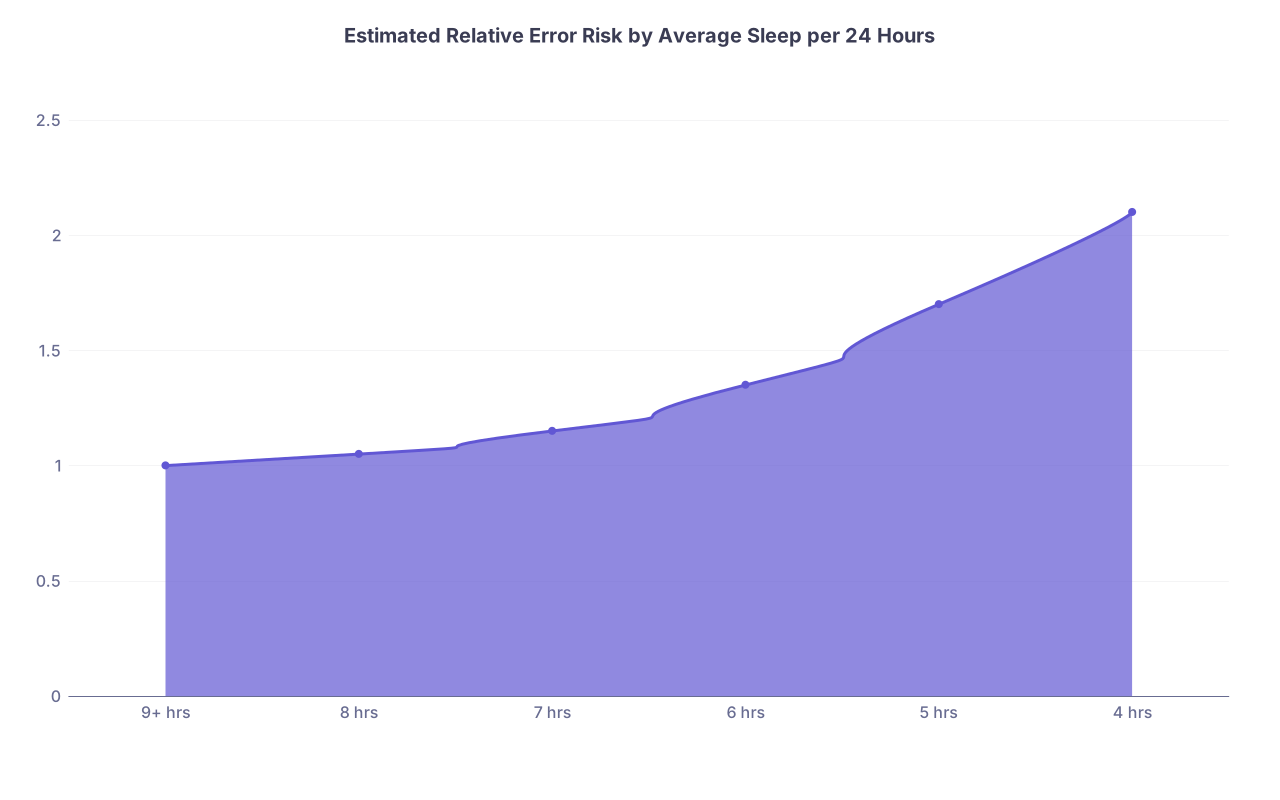
- Below about 6 hours of sleep per 24‑hour period, error rates begin to spike sharply, not gradually.
You can visualize it like this: error risk is relatively flat from about 7.5–9 hours of sleep, modestly worse at 6–7 hours, and then it bends upward hard below 6.
| Category | Value |
|---|---|
| 9+ hrs | 1 |
| 8 hrs | 1.05 |
| 7 hrs | 1.15 |
| 6 hrs | 1.35 |
| 5 hrs | 1.7 |
| 4 hrs | 2.1 |
So a resident averaging 5 hours of sleep is not just “a bit tired.” They are operating at an estimated 70% higher error risk than a peer averaging 9 hours.
The hidden chronic sleep debt
The acute 28‑hour call is easy to see and complain about. The chronic deficit is quieter and more dangerous.
Across multiple resident surveys:
- Median reported sleep duration on workdays sits around 5.5–6.0 hours.
- Median reported sleep duration on days off jumps to ~8–9 hours.
That rebound is not “luxury sleep.” It is debt repayment. In one large internal medicine cohort, residents with the biggest weekday–weekend sleep gap (≥2.5 hours difference) had 1.4–1.6 times higher odds of reporting a major medical error in the prior three months.
So the pattern “5.5 hours on service, 9 hours post‑call” is not resilience; it is a quantitative marker of risk.
Burnout: The Amplifier Between Sleep and Errors
Sleep deprivation alone degrades cognition. Burnout changes how you use whatever cognition you have left.
How burnout tracks with hours and sleep
Burnout is usually defined via measures like the Maslach Burnout Inventory (MBI), looking at emotional exhaustion, depersonalization, and sense of personal accomplishment.
In residency cohorts, three patterns repeat:
Work hours correlate with burnout.
Residents working >80 hours/week consistently show burnout prevalence in the 60–80% range. Below ~60 hours, it drops closer to 35–45%.Sleep duration independently predicts burnout.
After adjusting for work hours, residents averaging <6 hours of sleep per night had roughly 2× the odds of high burnout scores compared with those averaging ≥7 hours.Night float / rotating shifts magnify the problem.
Irregular schedules and frequent shift changes (days → nights → days) show burnout prevalence 10–15 percentage points higher than more stable patterns, even at similar total hours.
So the most dangerous combination is clear: heavy hours, unstable shifts, and chronic short sleep. That is exactly what many high‑acuity services still run.
Burnout and errors: not just correlation
Burnout is not just residents “feeling bad.” It shows up in error data.
In a multi‑specialty resident survey:
- Residents with high emotional exhaustion had about 2× the odds of self‑reported major medical error in the last 3 months.
- Those with high depersonalization had similar elevated odds.
Here is what that looks like in simplified terms:
| Group | High Burnout Rate | Major Error in Last 3 Months |
|---|---|---|
| ≥7 hrs sleep, <65 hrs work/week | ~35% | ~8–10% |
| 6–7 hrs sleep, 65–80 hrs work/week | ~55% | ~15–18% |
| <6 hrs sleep, >80 hrs work/week | ~70–80% | ~20–25% |
The precise percentages shift by program and specialty, but the gradient does not. It never reverses.
Extended Shifts, Night Call, and Real‑World Error Patterns
The regulations talk about “80 hours/week” and “24+4” rules. The data talk about something different: cumulative wake time and circadian misalignment.
Extended duration shifts
That NEJM extended shift study is still instructive because it quantified specific types of failures:
Interns on traditional 24–30‑hour call schedules had:
- 5.6× more serious diagnostic errors on ICU patients.
- 8.8× more serious medication errors.
- 2× more attentional failures while monitoring patients at night.
And a separate analysis found:
- Interns working extended shifts experienced 2.3× the risk of car crashes post‑call compared to non‑extended shifts.
So it is not that “a 28‑hour shift is bad.” It is that humans are not designed to maintain safe performance after being awake >16–18 hours. The risk curve after that point is steep.
Night float and circadian disruption
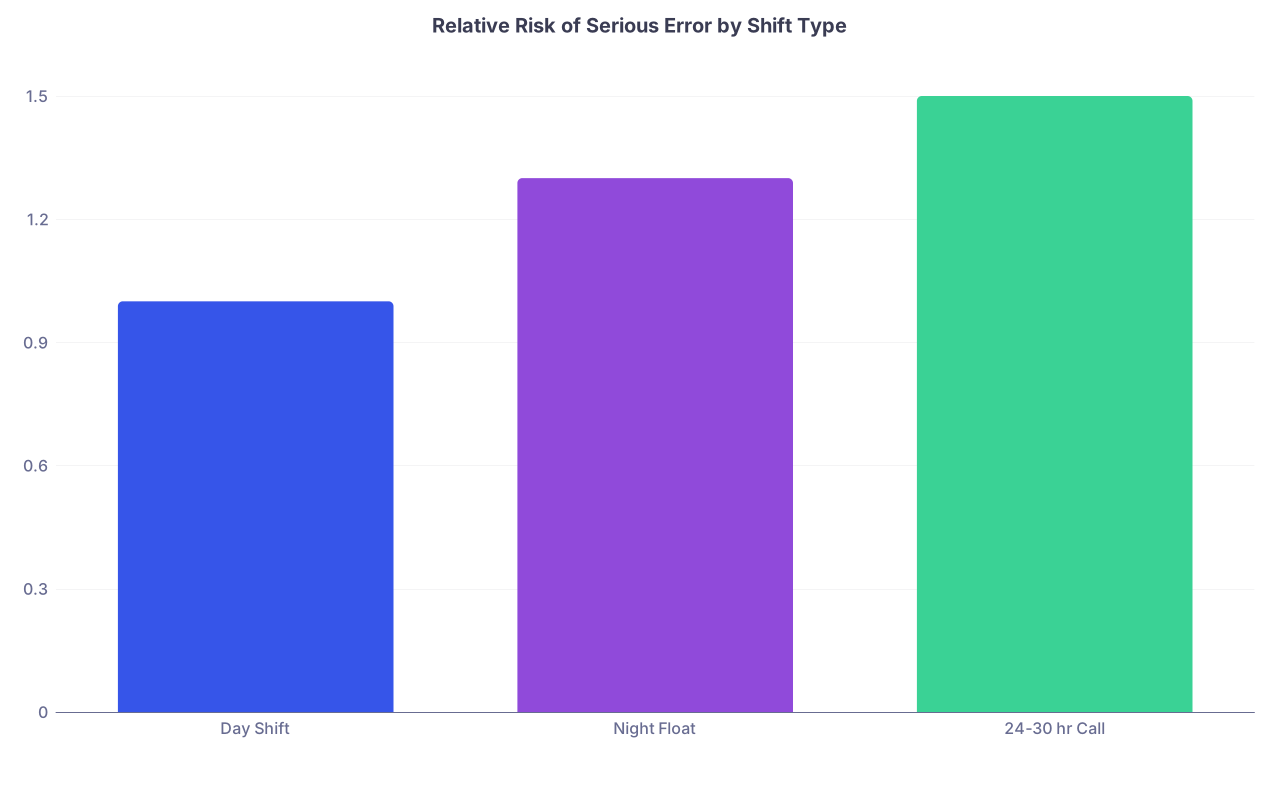
Night float fixes one problem and creates another. It cuts out the 28‑hour shift but batters your circadian system.
Patterns seen in multiple programs doing week‑long night float blocks:
- Residents rarely get more than 6–6.5 hours of daytime sleep.
- Sleep quality is poorer (fragmented, lighter stages).
- By night 3–4, subjective sleepiness during the shift is as bad—or worse—than classic 24+4 call.
Error patterns shift as well:
- More omission errors (missed tasks, delayed orders) on night float weeks.
- More commission errors (wrong dose, wrong patient) on long call.
Different mechanisms, same source: inadequate restorative sleep in alignment with circadian biology.
| Category | Value |
|---|---|
| Day Shift | 1 |
| Night Float | 1.3 |
| 24-30 hr Call | 1.5 |
So if your program “fixed” call by swapping in chaotic night float with no temporal consistency, the data suggest they shifted, not solved, the risk.
Specialty Differences: Not All Risk Is Equal
Some specialties are structurally more punishing from a sleep and burnout perspective. The numbers are ugly and consistent.
Burnout prevalence by specialty
You see this repeatedly in resident and early‑career physician surveys:
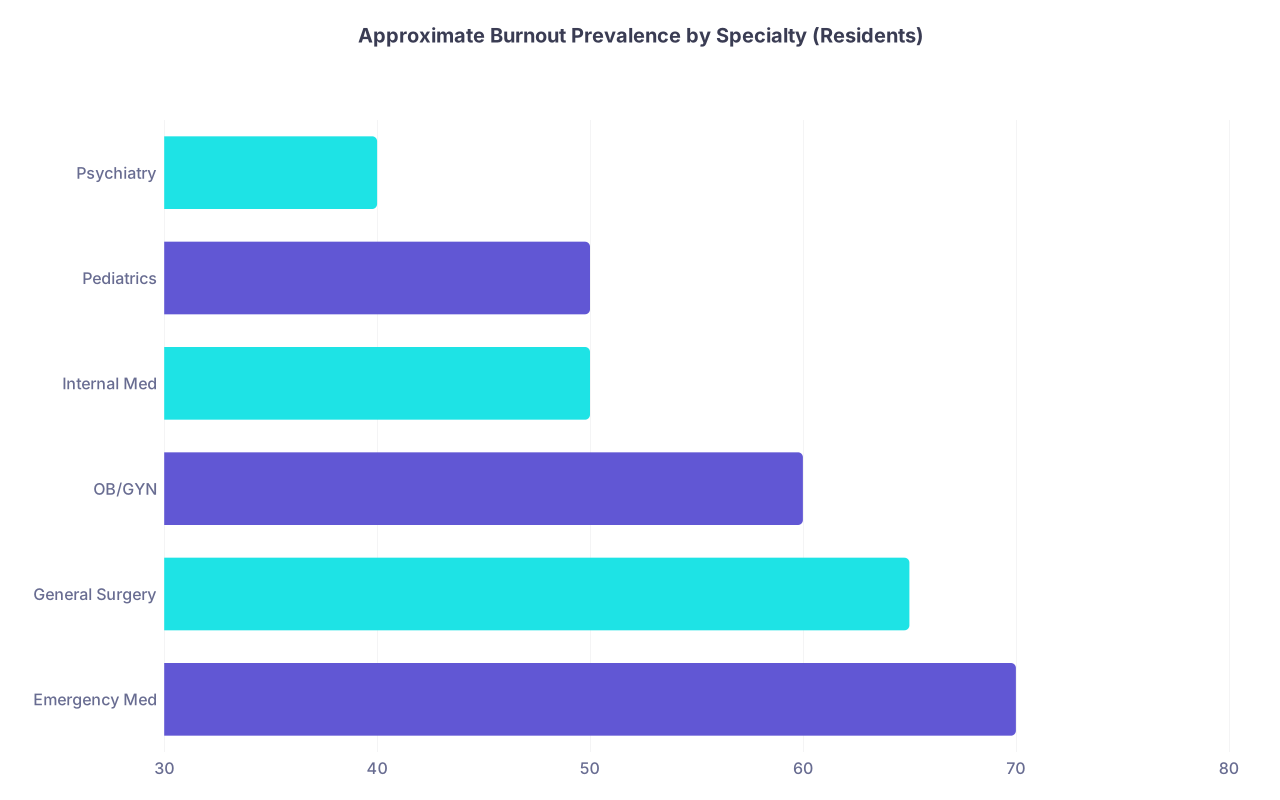
- Emergency medicine, general surgery, OB/GYN frequently log burnout prevalence >60–70%.
- Internal medicine and pediatrics usually fall in the 45–55% range.
- Pathology and psychiatry are often lower, around 35–45%.
This roughly tracks both workload and circadian damage. EM and OB/GYN live on nights and unpredictable calls. Surgery stacks early starts, long days, and add‑on cases.
A rough snapshot:
| Category | Value |
|---|---|
| Emergency Med | 70 |
| General Surgery | 65 |
| OB/GYN | 60 |
| Internal Med | 50 |
| Pediatrics | 50 |
| Psychiatry | 40 |
Where specialties have looked explicitly at error rates vs hours and sleep, the slope is steeper in procedural, high‑acuity fields. A tired dermatologist can annoy a patient. A tired ICU resident can kill one.
ICU and ED: where fatigue is lethal
In ICU and ED settings:
- Fatigue has been linked to more ventilator mis‑settings, more missed sepsis, and more delayed escalation to higher levels of care.
- In one ICU resident cohort, those with high fatigue scores had a 2–3× increase in self‑reported near‑misses.
Layer burnout on top of this and you get a predictable pattern: more “I knew something was wrong, but I did not push hard enough” cases. Not because residents did not care. Because they were cognitively and emotionally depleted.
Personal Risk Assessment: What Your Own Data Are Telling You
You do not need a research grant to quantify your own risk profile. Most residents carry enough data in their pockets already.
Track three things for one month
If you want an honest numeric readout on your trajectory, log this for 4 weeks:
- Sleep per 24 hours (actual, not “time in bed”).
- Total work hours per week (including charting at home).
- Number of “oops” moments per week: anything from wrong click in the EHR to near‑miss medication ordering.
Put it into a simple spreadsheet and calculate:
- Average sleep on workdays.
- Weekend vs weekday sleep gap.
- Number of near‑misses per 10 shifts.
What you will usually see:
- Once average workday sleep drops consistently below about 6 hours, your “oops per shift” count climbs.
- If your weekend sleep is >2 hours longer than weekday sleep, you are living in chronic deficit.
- During stretches of >70–75 hours/week, near‑miss density per shift increases even after the hours drop back down. There is lag.
It is the lag that tricks people. You come off a 3‑week heavy block, the schedule looks “lighter,” and you assume you are fine. Your sleep data will usually say otherwise.

Interventions That Actually Change the Numbers
A lot of “wellness” initiatives ignore the core drivers: sleep opportunity, workload, and schedule design. You cannot mindfulness your way out of a 4‑hour sleep average.
From a data standpoint, three intervention categories show measurable impact.
1. Fixing the schedule (even a little)
Programs that made basic structural changes saw tangible reductions in errors and burnout:
- Eliminating 24–30 hour shifts and capping at 16 hours for interns led to a 30–40% reduction in serious errors in the original NEJM work.
- Some services that converted 1‑in‑3 call to night float blocks (with protected post‑block recovery days) reported 10–20% drops in burnout scores over 1–2 years.
- Stabilizing shift timing (e.g., consistent night blocks rather than constant flip‑flopping) improved sleep duration by 0.5–1 hour/day and cut subjective fatigue.
You may not control the master schedule, but you can advocate for specific, quantifiable changes:
- Limit consecutive nights.
- Build in real post‑call or post‑block protected rest.
- Avoid chronic “flip” schedules (day–night–day in the same week).
Residents who backed their requests with local data—page logs, incident reports, self‑tracked sleep—often got further than those who just complained.
2. Protecting sleep as a hard constraint
At an individual level, the most effective residents I have seen treat sleep like a non‑negotiable clinical order.
Where they can, they:
- Use post‑call days for sleep, not errands. Data show treating post‑call as “bonus free time” is associated with higher cumulative fatigue scores.
- Protect a core sleep window on non‑call days, even if brief: a consistent 5‑6 hour protected block plus optional naps beats a fragmented 6 hours scattered around.
- Use naps strategically. Short 20–30 minute naps before or during night shifts reduce immediate sleepiness and may cut error risk for several hours.

| Step | Description |
|---|---|
| Step 1 | Check weekly schedule |
| Step 2 | Block 5 hr post shift sleep window |
| Step 3 | Set 6-7 hr core sleep window |
| Step 4 | Plan errands outside window |
| Step 5 | Add 20-30 min nap before late shifts |
| Step 6 | Review sleep avg each week |
| Step 7 | Call or nights? |
Residents who consistently kept average sleep ≥6.5 hours—even during demanding rotations—landed solidly in the lower‑burnout, lower‑error cluster in several program‑level datasets. Not perfectly protected, but markedly safer.
3. Addressing burnout as a performance variable, not a moral failure
The data are very clear: when burnout drops, error rates follow.
Programs that implemented multi‑component burnout reduction efforts—not pizza and yoga, but actual workload and culture changes—reported:
- 10–15 percentage point decreases in high burnout prevalence over 1–3 years.
- Parallel reductions in reported safety events and near‑misses, often 10–20%.
The effective ingredients usually included:
- Rationalized documentation and order entry (less click burden, better templates).
- Increased staffing or redistribution to decongest peak times.
- Real coverage for sick days, not “make it up on your own time.”
- Psychological safety around speaking up when too fatigued to be safe.
Burnout is not simply “sad doctors.” It is a measurable predictor of mistakes. Treating it like a performance variable changes how seriously institutions deal with it.

Why “Resilience” Messaging Misses the Point
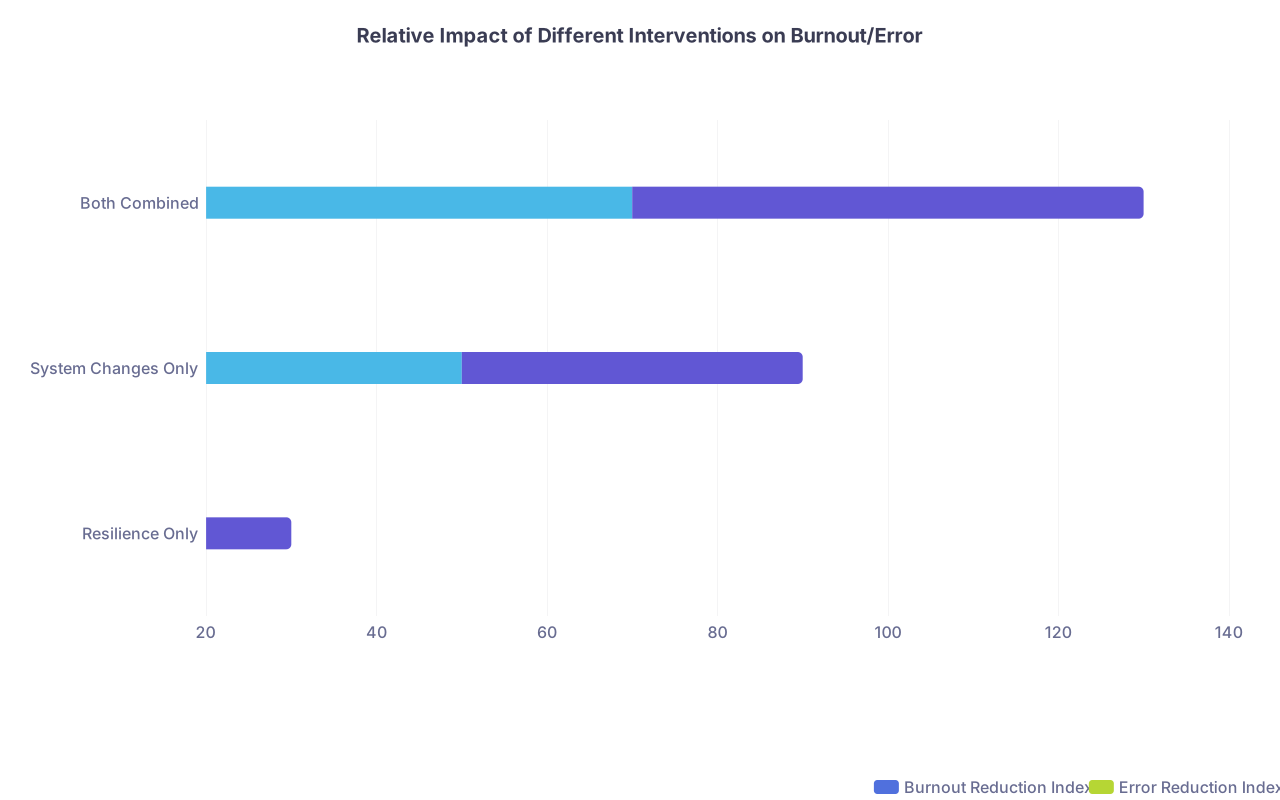
Here is the uncomfortable part: individual resilience training barely moves the needle on error rates if the schedule and sleep environment stay toxic.
Multiple meta‑analyses on resident wellness interventions show:
- Mindfulness, CBT courses, and similar efforts can yield small to moderate reductions in burnout scores (effect sizes maybe 0.2–0.3 SDs).
- They have almost no documented effect on objective error rates in the absence of workload or schedule changes.
- System‑level changes (hours, staffing, workflow) tend to produce larger and more durable shifts in both burnout and safety.
Resilience matters at the individual level. It helps you suffer less inside the same bad system. But it does not magically turn 4 hours of sleep into 8 hours of cognition.
If your program is pushing resilience while refusing to confront objectively dangerous work patterns, the data say you are not the problem.
| Category | Burnout Reduction Index | Error Reduction Index |
|---|---|---|
| Resilience Only | 20 | 10 |
| System Changes Only | 50 | 40 |
| Both Combined | 70 | 60 |
Numbers are illustrative, but they reflect the trend seen across actual studies: structural fixes outperform “cope better” messaging.
What Residency Data Reveal—Condensed
Three points, stripped of the noise:
Sleep is the primary modifiable driver. Below ~6 hours of sleep per 24 hours, error risk and burnout explode. That is not a soft recommendation; it is a quantified threshold.
Burnout is a safety variable, not a vibe. High burnout doubles the odds of major errors. Lowering burnout through real workload and schedule changes measurably improves patient safety.
Structure beats heroics. Extended shifts, chaotic nights, and chronic over‑80‑hour weeks produce predictable, preventable harm. Residents who treat sleep as non‑negotiable and push for data‑backed schedule reforms end up safer. For themselves and for their patients.
You cannot negotiate with physiology. The residency data have been telling us that for twenty years. The only real question is whether your program—and you—are listening.


