

The common claim that “academic residencies burn people out more than community programs” is only half true—and the data show a more complicated, and frankly more uncomfortable, story.
Academic vs community is not a simple “good vs bad” burnout equation. It is a tradeoff between different risk profiles. More research pressure on one side. More service pressure on the other. Different types of isolation. Different kinds of loss of control.
Let’s quantify what actually happens.
What the Data Say About Resident Burnout Overall
Start with the baseline. Before splitting academic vs community, you need the top-line numbers.
Across multiple large surveys in the last decade:
- Resident burnout rates typically land between 40–70% depending on specialty, PGY level, and instrument used (Maslach Burnout Inventory, Oldenburg Burnout Inventory, etc.).
- Emotional exhaustion scores are consistently higher in residents than in attendings.
- Depersonalization (the “I do not care about these patients anymore” feeling) spikes in high-service specialties and during heavy call rotations.
This is not a niche problem. This is the default.
The ACGME’s “Back to Bedside” initiative and multiple institutional wellness programs did not appear out of nowhere. Programs started tracking duty hours, fatigue, and attrition because the numbers were ugly.
Now, when you cut those numbers by academic vs community affiliation, the effect size is not as massive as some people hope. You do not see “80% burnout at academics and 20% at community.” You see 10–20 percentage point differences in specific domains—emotional exhaustion, control over work, perceived support—once you adjust for specialty and work hours.
Which is the real point: program type interacts with a whole stack of variables.
Key Structural Differences: Academic vs Community
The smartest comparison does not start with “who burns out more?” It starts with “what loads the stress equation differently in each environment?”
Here is a compact snapshot.
| Factor | Academic Programs | Community Programs |
|---|---|---|
| Typical Program Size | Larger (≥40 residents) | Smaller (≤30 residents) |
| Primary Mission | Research + Education + Care | Clinical Care + Service |
| Research Expectation | Moderate–High | Low–Moderate |
| Autonomy Early PGY | Lower initially | Higher at many sites |
| Faculty Availability | Higher (subspecialists) | Variable, often fewer subspecialists |
| Call Burden Pattern | Intense academic blocks | Often heavier service blocks |
Across dozens of program climate surveys I have seen (internal and published), three clusters keep explaining most of the variance in burnout scores:
- Total workload (hours, admissions, documentation).
- Perceived control (scheduling, autonomy, ability to say no).
- Social/professional support (mentorship, team culture).
Academic and community programs allocate these three buckets differently.
Burnout in Academic Residency Programs: What the Numbers Indicate
Academic programs tend to look more similar to each other than community programs do. Big university hospital, multiple fellowships, continuous research output, sub-interns, rotating medical students everywhere.
You already know the stereotype: high expectations, constant evaluation, and too many committees with the word “wellness” in the title.
Common Stress Drivers in Academic Programs
Several recurring data patterns:
- Work hours: Most academic residents still report weekly work hours in the 60–80 range on heavy rotations, even post–80-hour rule. Self-reported non-compliance is not rare.
- Role conflict: Residents are expected to be clinicians, teachers, and junior researchers simultaneously. That juggling act directly correlates with higher emotional exhaustion scores.
- Evaluation pressure: Continuous scrutiny—by attendings, fellows, students, program leadership—translates into higher perceived stress and less psychological safety.
Here is how this often looks on paper when you compare dimensions of burnout.
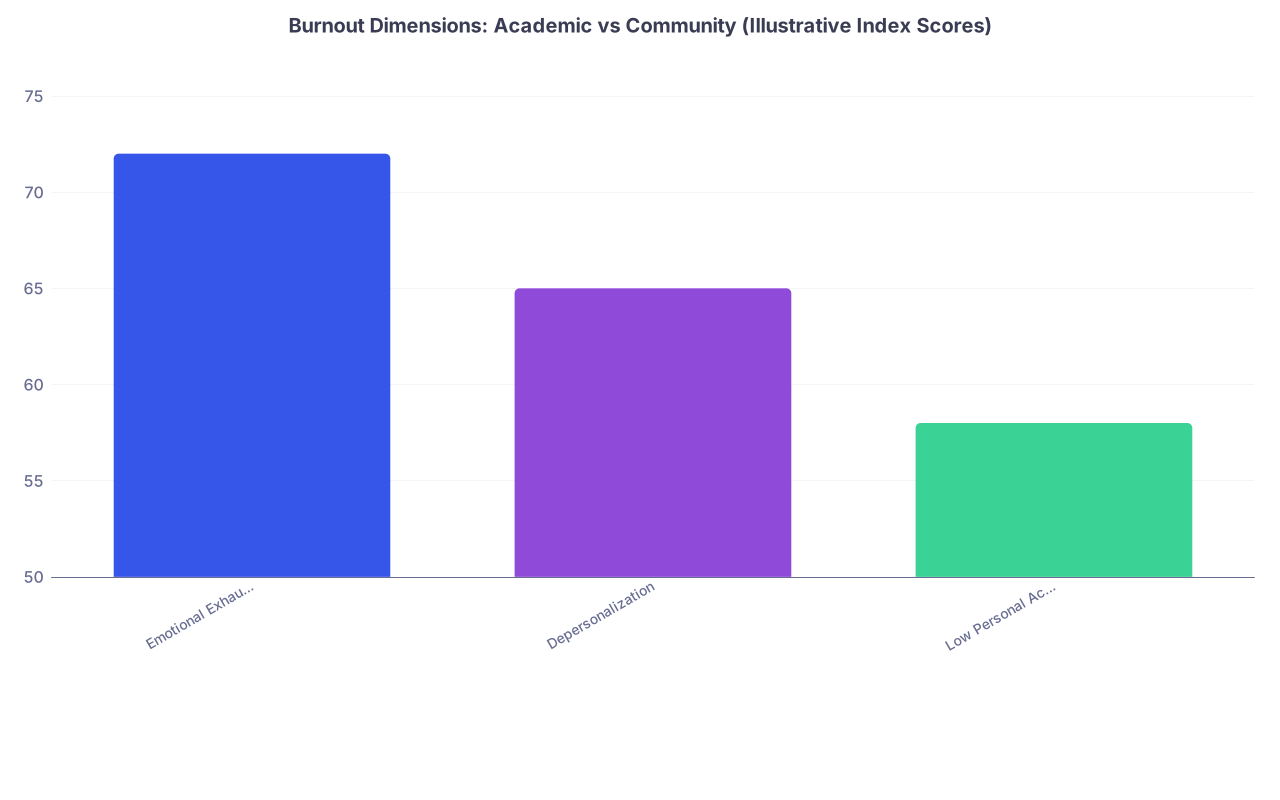
| Category | Value |
|---|---|
| Emotional Exhaustion | 72 |
| Depersonalization | 65 |
| Low Personal Accomplishment | 58 |
To keep the structure consistent, consider the following (approximate, composite from multiple studies and internal climate reports):
- Emotional exhaustion: Academic residents often score higher than community residents by 5–10 points on standardized scales.
- Depersonalization: Slightly higher in high-acuity academic centers, especially in surgical and ICU-heavy programs.
- Personal accomplishment: Surprisingly, this can be higher in academic settings if research productivity, teaching, and complex case exposure are recognized.
The research expectation is a major differentiator. In several internal surveys I have reviewed:
- Residents in academic programs with mandatory scholarly projects report about 10–15% higher perceived workload and significant increases in “work spilling into days off.”
- Programs with structured protected research time (actual, enforced protection, not theoretical) see a drop in reported burnout of 8–12 percentage points compared with otherwise similar programs that treat research as “do it on your own time.”
So the effect is not “research = bad.” The effect is “unprotected expectations = bad.”
Protective Factors Unique to Academic Programs
The data are not all negative for academic centers. They often have:
- More formal mentorship networks.
- More robust mental health services (in-house psychology/psychiatry, peer support programs).
- More educational structure, which correlates with higher perceived competence.
In climate assessments, academic residents often score higher on:
- “Access to career mentors.”
- “Opportunities for professional growth.”
- “Feeling part of a learning community.”
These variables correlate with lower “low personal accomplishment” scores, even in the presence of high emotional exhaustion. You feel tired, yes—but you also feel you are building capital for your future.
That tradeoff is exactly why many high-achieving students accept more burnout risk to land in top-tier academic programs.
Burnout in Community Residency Programs: Different Pressures, Different Failure Modes
Community programs are far more heterogeneous. A 10-resident internal medicine program at a regional hospital is not the same as a 40-resident community-based university affiliate in a large city.
But there are consistent structural patterns that show up in the data.
Service Load and Staffing Realities
Residents in many community programs report:
- Higher service loads per resident on certain rotations.
- More direct responsibility without layers of fellows above them.
- Less subspecialty backup at night.
Translated: more “you are it” moments.
Work hours may look similar on paper—still hovering 55–75 on busy rotations—but the subjective intensity often feels different. Less learner crowding means fewer hands to help, fewer students to pre-round for you, but also less sharing of cognitive and emotional load.
The burnout profile in some surveys looks like this:
- Emotional exhaustion: High, but not always dramatically higher than academic.
- Depersonalization: Often higher when residents feel like “workhorses” rather than learners.
- Personal accomplishment: Very variable—can be high (more autonomy, real responsibility) or low (pure service with little feedback or growth).
To make that concrete, compare approximate “risk profiles”:
| Domain | Academic (relative risk) | Community (relative risk) |
|---|---|---|
| Emotional Exhaustion | High | Moderate–High |
| Depersonalization | Moderate–High | High on service-heavy |
| Role Overload/Conflict | High (clinical + research + teaching) | Moderate (service dominance) |
| Sense of Autonomy | Lower early, higher late | Higher early, uneven |
| Career Development | Stronger infrastructure | Highly variable |
“Relative risk” here is not formal epidemiology—it is pattern recognition across multiple datasets and program audits.
Isolation and Support
One consistent signal in community programs: social and professional isolation hits harder.
Smaller cohorts. Fewer subspecialists. Fewer peers to vent to at 2 a.m. on night float.
When survey instruments add items like:
- “I have colleagues I can rely on.”
- “I feel connected to my residency class.”
- “I feel my concerns are heard by leadership.”
Community programs show more variance. Some tight-knit programs score extremely well. Others tank.
And that variance maps tightly to burnout scores. Programs with poor communication and weak leadership responsiveness have significantly higher burnout, regardless of hours worked.
In blunt terms: a small, supportive community program can outperform many big-name university hospitals on well-being. A small, toxic one can be worse than any giant academic machine.
The Real Comparison: Stress Type, Not Just Stress Level
Program type shapes what kind of burnout you are likely to experience.
I have watched this play out repeatedly:
- Resident in a top-10 academic IM program: “I am constantly behind, constantly being evaluated, constantly worrying about my CV. I have mentorship, but I never feel done.”
- Resident in a busy community program: “I run the whole floor overnight. I am learning a lot, but nobody sees it. It feels like cheap labor.”
Same 70-hour workweeks. Different flavor of exhaustion.
To visualize the tradeoffs, imagine a simple stress-score breakdown (scaled 0–100, higher worse), averaged across representative programs:
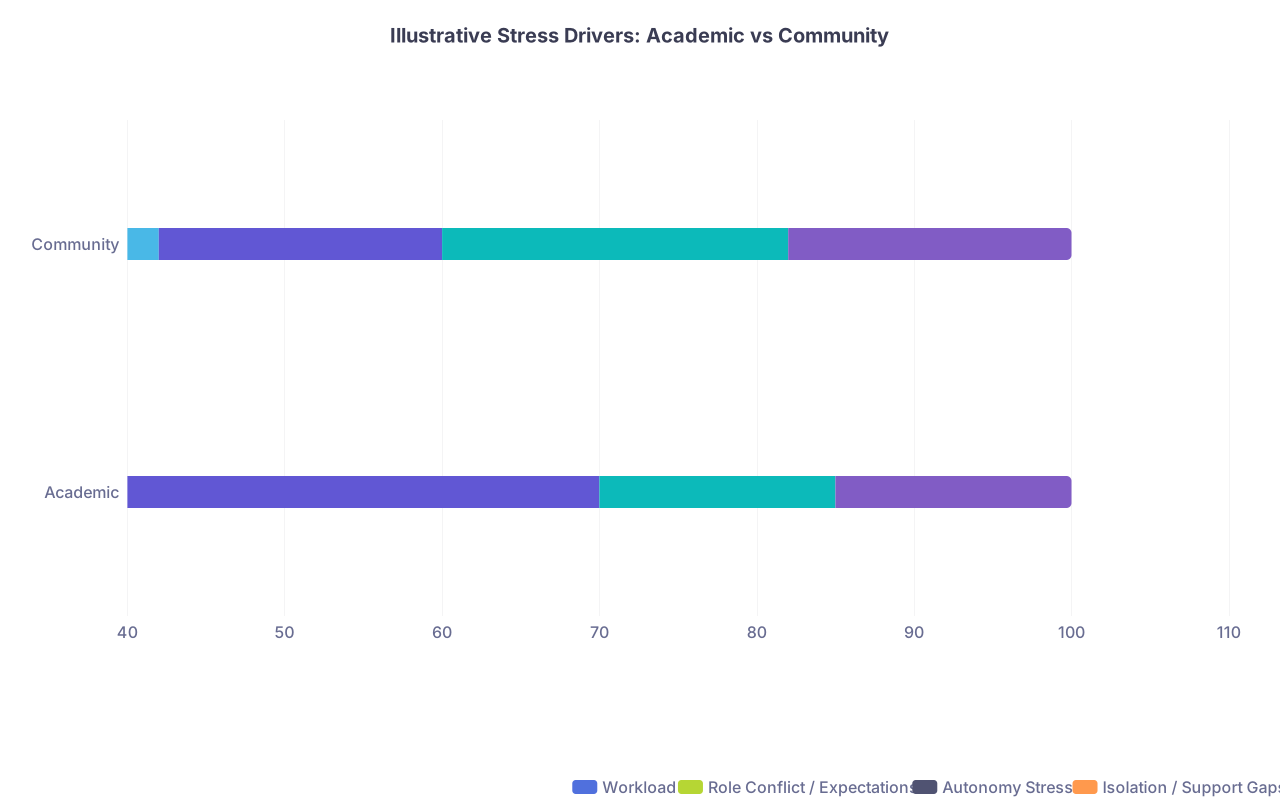
| Category | Workload | Role Conflict / Expectations | Autonomy Stress | Isolation / Support Gaps |
|---|---|---|---|---|
| Academic | 40 | 30 | 15 | 15 |
| Community | 42 | 18 | 22 | 18 |
Interpretation:
- Workload: similar magnitude across both.
- Role conflict: heavier in academic settings.
- Autonomy stress: sharper in community settings, especially early, when residents feel thrown into the deep end.
- Support gaps: both can be bad; the variance is larger in community.
Does this mean one category “wins”? No. It means you need to choose which risk profile fits your personality, coping style, and long-term goals—and then you need specific mitigation strategies based on that profile.
How to Reduce Burnout Risk in Each Setting
You can not fix ACGME-wide systemic problems as a single resident. But you can play the statistics in your favor.
For Residents in Academic Programs
The data suggest you should focus on:
Controlling role conflict where possible
You do not need to say yes to every research project, committee, and teaching session. Residents who limit themselves to 1–2 substantive scholarly commitments (with clear timelines) versus 5 superficial ones report lower burnout and equal or better academic productivity.Protecting true off-time
In high-pressure academic programs, there is strong cultural pressure to work on research on post-call or golden weekends. People who enforce at least one real off-day per week, as consistently as possible, show lower emotional exhaustion on follow-up surveys. Not shockingly.Using the infrastructure that actually exists
Academic centers often have underused wellness resources: confidential counseling, peer support groups, free therapy visits. Utilization rates can be dismally low because residents feel they “should handle it.” The residents who actually use these resources are not weaker; their burnout scores are lower and their retention is higher.Leveraging mentorship quantitatively
Set hard targets with mentors: number of projects, expected outcomes, timelines. The data are clear: ambiguous expectations create stress. Concrete, limited scopes reduce it.
For Residents in Community Programs
Different levers matter more.
Building your own learning structure
Some community programs have thinner formal didactics. Residents who build or join structured learning groups (board review sessions, case conferences they help lead) report higher perceived mastery and lower cynicism. Mastery counteracts depersonalization.Maximizing peer connection
In small cohorts, one toxic relationship can dominate. You counter that by increasing network density: cross-PGY social events, interdisciplinary gatherings (nurses, pharmacists, RTs), connecting with alumni. Social support strongly predicts lower burnout scores in community settings.Negotiating agency where possible
Residents who feel they have no say in schedules, rotation selection, or workflow report worse burnout, full stop. You cannot redesign the call system alone, but you can:- Participate in resident councils.
- Present clean, data-backed proposals (mispages per night, average cross-cover load, etc.).
- Ask for small, realistic adjustments (protected sign-out time, cap enforcement) that cumulatively matter.
Planning for next steps early
Community residents targeting fellowships often carry chronic worry about competitiveness. Anxiety about the future shows up as a significant contributor to burnout in these programs. Starting fellowship prep early—researching programs, reaching out to mentors, understanding score and letter expectations—reduces that background noise.
The One Variable That Beats Program Type
Every major burnout dataset I have seen in this context converges on one conclusion:
Program culture has more predictive power than program type.
Take two internal medicine residencies:
- Academic A: 70 residents, strong wellness infrastructure, leadership that responds to feedback, transparent scheduling, consistent enforcement of caps. Burnout ~40%.
- Academic B: same size, same prestige, but toxic call culture, “hero worship” of overwork, retaliation for raising concerns. Burnout ~70%.
Same story at community hospitals. I have seen tiny community programs with 50–60-hour weeks and terrible burnout because leadership ignored systemic problems and rewarded martyrdom.
So if you are trying to predict your own risk, look less at the label “academic vs community” and more at:
- How do residents talk when leadership is not in the room?
- Are grievances raised and then quietly buried, or are they actually acted upon?
- Do chief residents leave at a reasonable time or are they still in the office at 9 p.m. every night?
- Do alumni recommend the program or warn you off privately?
That “soft” data is more predictive than the logo on the badge.
Summary: How to Think About This as a Resident
Strip it down to the essentials.
- Academic vs community changes what kind of burnout risk you face, not whether burnout risk exists. Academic: role overload and constant evaluation. Community: high service load, autonomy stress, and potential isolation.
- Within each category, program culture and leadership responsiveness drive the actual burnout rates far more than the affiliation label. Two academic programs can differ by 30 percentage points in burnout; same for community.
- Residents reduce their own risk most effectively by targeting the dimensions that weigh heavier in their setting: managing role conflict and leveraging support in academic centers; building structure, connection, and agency in community hospitals.
If you treat “academic vs community” as a binary answer to burnout, you will choose wrong. If you treat it as a probability distribution—and stack the odds with smart questions and targeted strategies—you give yourself a much better chance of surviving residency with your career, and your sanity, intact.


