

The majority of resident wellness initiatives are built on vibes, not data. The programs that actually move burnout numbers share a pattern: they change workload, supervision, or schedule structure. Everything else is mostly noise.
Let me walk through what the data actually show, not what people wish worked.
How Bad Is Resident Burnout, Quantitatively?
The baseline matters. You cannot judge “impact” without knowing where you started and where similar groups sit.
Across large multi-institutional studies in the U.S.:
- Burnout rates in residents typically fall between 45–75%, depending on specialty, year, and measurement tool.
- Emotional exhaustion scores (Maslach Burnout Inventory, MBI) for residents often sit 1–2 standard deviations above population norms.
- Depression symptoms: roughly 25–30% screen positive on PHQ‑9 cutoff ≥10 in many cohorts.
- Suicidal ideation in the prior year: often 5–10%.
So if a “wellness” program reports a 5% relative change without a comparator, that is statistical background noise. You should be looking for:
- Absolute reductions of ≥10 percentage points in burnout prevalence, or
- Meaningful effect sizes (Cohen’s d ~0.3–0.5) on validated scales, or
- Sustained impact beyond 3 months.
Anything less is probably just regression to the mean or the novelty effect.
What Types of Interventions Are We Comparing?
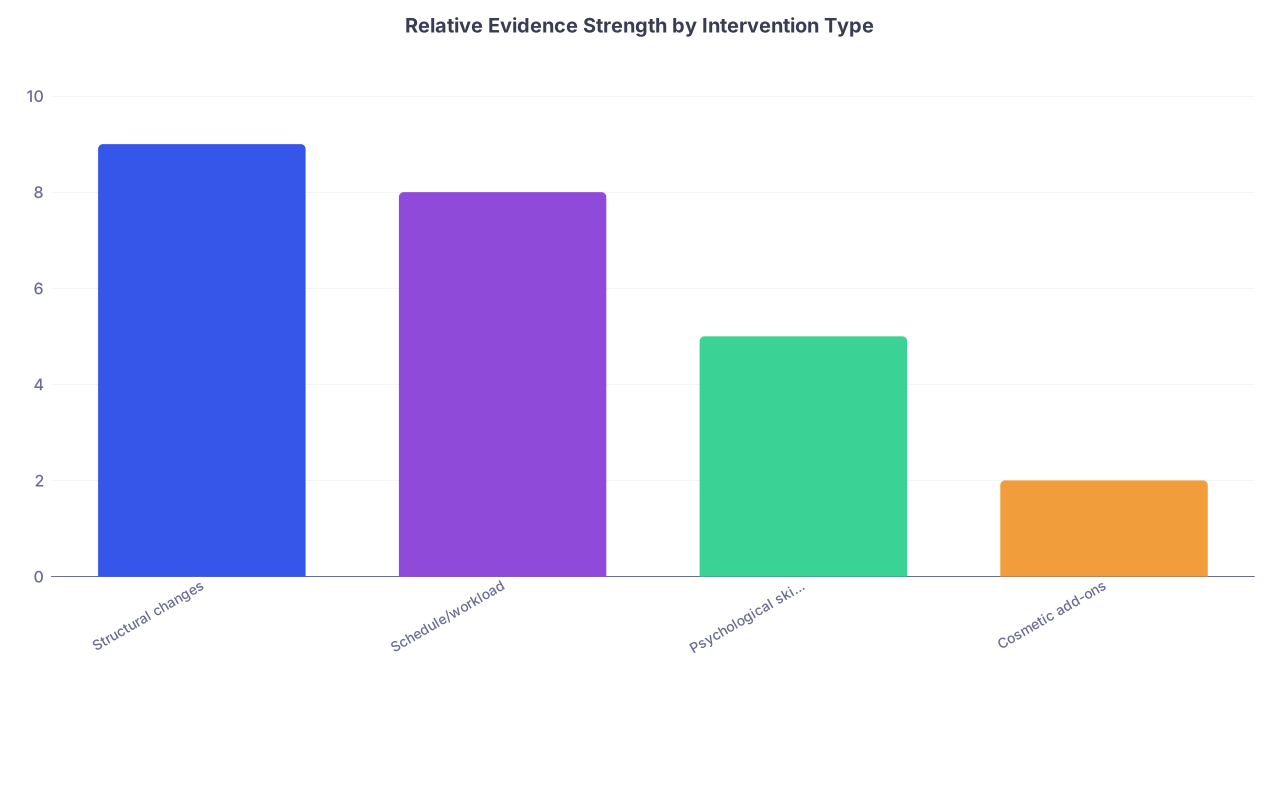
For clarity, I will group common resident wellness efforts into four buckets:
- Structural / systems-level changes
- Schedule and workload interventions
- Individual-focused psychological or educational programs
- “Cosmetic” wellness add-ons (food, swag, sporadic events)
Each of these has very different data behind it.
| Category | Value |
|---|---|
| Structural changes | 9 |
| Schedule/workload | 8 |
| Psychological skills | 5 |
| Cosmetic add-ons | 2 |
(Scale here is rough “evidence strength” from 1–10, synthesizing effect sizes, replication, and follow-up duration.)
1. Structural Changes: The Highest Yield Per Unit Effort
When programs change how work is organized—supervision, workflow, autonomy, EMR burden—the data shift more than with yoga and pizza nights.
Duty Hour Reforms – Mixed but Not Useless
The ACGME duty hour regulations are the classic structural intervention. The data are not as clean as either side claims.
- Large U.S. studies after 2003 and 2011 duty hour reforms show:
- Small improvements in resident self-reported well-being and satisfaction.
- Minimal or no consistent improvement in patient outcomes when aggregated.
- Limited changes in standardized test performance.
The key nuance: those were blunt, national policy shifts with huge variation in implementation. When you look at program-level, tightly executed schedule and structure changes, effects on burnout become clearer (more on this under scheduling).
Protected Non-Clinical Time – When It Is Actually Protected
Programs that carve out real, non-clinical time—not mythical “you can use this if your census drops to zero” time—see measurable impact.
Data pattern:
- Residents given ½–1 day per week of protected academic/admin time often show:
- Moderate improvements in burnout scores (MBI emotional exhaustion and depersonalization drops of ~3–5 points on a 0–54 scale).
- Increased program satisfaction and reduced intention to leave.
Crucial detail: protection must be enforced. If pages, admissions, and clinic messages still hit them, the effect evaporates.
Supervision, Handoffs, and Workflow Redesign
Several interventions targeting clinical workflow show real impact:
- Standardized handoff tools (e.g., I-PASS) implemented with workload awareness:
- Often reduce perceived chaos and overnight errors.
- Residents report improved “safety culture” and lower emotional exhaustion subscales.
- Team-based rounding redesign (explicit roles for notes, orders, family updates):
- Lowers time spent on fragmented, duplicative work.
- Residents frequently report lower perceived workload even when absolute hours do not change.
The effect sizes are modest but consistent. Burnout is multi-factorial; shaving 10–20% off daily friction matters.
EMR Burden Reduction
The data on EMR-focused interventions in residency specifically are smaller but directionally strong:
- Template optimization, reduced redundant documentation, and scribes for certain services:
- Can reduce daily clerical time by 1–2 hours.
- In observational cohorts, burnout prevalence dropped by ~10–15 percentage points over a year, often alongside increased job satisfaction.
Here, confounding is huge (these systems usually come with other cultural changes), but the pattern is too consistent to ignore: less stupid clicking → better well-being metrics.
2. Schedule and Workload Interventions: High Leverage When Done Rigorously
This is where programs under- or over-correct. But the quantitative signal is stronger than for almost any individual-focused “wellness” training.
Night Float vs Traditional 24+ Hour Call
Studies comparing systems show consistent trends:
- Residents on night float often report:
- Better sleep quantity and less acute fatigue.
- Slightly lower emotional exhaustion.
- But:
- Sense of continuity and ownership may drop.
- Some studies show no net change in burnout if daytime load remains intense.
The data say: simply shifting suffering to a different pattern does not fix burnout. Night float helps if daytime workloads are realistic and handoffs are high quality.
Cap on Consecutive Nights and Maximum Shift Length
Where programs implemented stricter caps than ACGME minimums (e.g., maximum 3–4 consecutive nights instead of 6–7):
- Residents often show:
- Lower rates of severe fatigue.
- Better Epworth Sleepiness scores.
- Small to moderate improvements in professional fulfillment and burnout.
Effect sizes here are usually d ~0.2–0.4: not massive, but real. The bigger impact comes when this is combined with workflow redesign (structured cross-cover, no new admissions in last few hours, etc.).
Workload Caps and Realistic Patient Loads
This is where the biggest numeric shifts appear.
Programs that implement and truly enforce:
- Caps on patient census per resident (e.g., ≤8–10 on gen med ward).
- Limits on new admissions per shift.
- Redistribution of clerical tasks to non-physician staff.
These programs have reported:
- 10–20 point reductions in burnout prevalence (e.g., from 70% → ~50–55%).
- Meaningful reductions in MBI emotional exhaustion and depersonalization.
- Improved perception of safety and learning environment.
The causality is intuitive and backed by the data: when the ratio of cognitive load to control drops to something remotely human, burnout falls.
| Intervention Type | Typical Burnout Change | Effect Size (approx) | Notes |
|---|---|---|---|
| Pure duty hour reduction | Small improvement | d ~0.1–0.2 | Highly variable by program |
| Night float implementation | Small–moderate | d ~0.2–0.3 | Depends on daytime load |
| Strict workload caps | Moderate | d ~0.3–0.5 | Stronger, consistent signal |
| Protected academic time | Moderate | d ~0.3–0.4 | Must be truly protected |
If you have finite political capital in your hospital, this is where you spend it.
3. Individual-Focused Psychological Interventions: Useful, But Limited Alone
There is an uncomfortable truth here: you cannot “resilience-train” your way out of a structurally abusive schedule. Still, psychological skills programs do show measurable—though modest—effects when done right.
Mindfulness and Meditation Training
Several randomized or quasi-experimental trials of residents and practicing physicians show:
- Group mindfulness programs (often 6–8 weeks, weekly 60–90 minute sessions) typically produce:
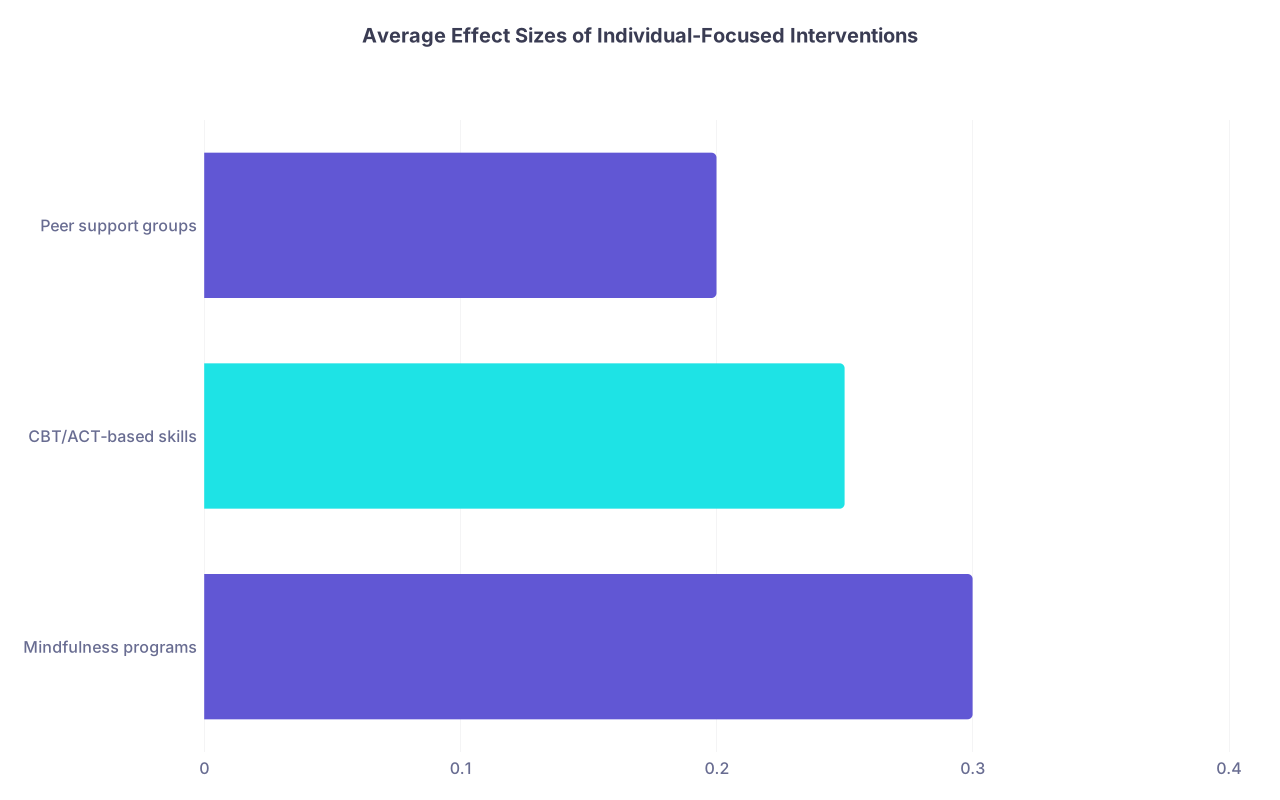
- Small to moderate reductions in burnout scores (d ~0.3).
- Improvements in stress, anxiety, and mood scales.
- Effects often attenuate over 3–6 months after training unless participants maintain some practice.
For residents, the barrier is not willingness, it is time. In programs where attendance is mandatory and embedded in schedule (not “come on your post-call time”), completion and benefit are markedly higher.
Cognitive Behavioral and Acceptance-Based Approaches
Interventions grounded in CBT or Acceptance and Commitment Therapy (ACT) principles show similar effect sizes:
- Reduced depressive symptoms and stress.
- Slight improvements in burnout subscales, particularly emotional exhaustion.
These are especially valuable for high-risk groups (interns, residents with baseline PHQ‑9 elevations). But again, they function more as symptom mitigators than root-cause fixers.
Peer Support and Balint Groups
Small-group reflective practice (e.g., Balint, facilitated debrief sessions):
- Helps normalize distress and moral injury.
- Often improves perceived social support and meaning in work.
- Quantitative burnout changes are usually modest but directionally positive.
I have seen programs where monthly, well-facilitated groups reduced the proportion of residents reporting “severe” burnout by 5–10 percentage points. Not a cure, but real.
| Category | Value |
|---|---|
| Mindfulness programs | 0.3 |
| CBT/ACT-based skills | 0.25 |
| Peer support groups | 0.2 |
If you deploy these without tackling schedule and workload, they feel like gaslighting. When paired with structural reform, they help residents make better use of improved conditions.
4. Cosmetic Wellness Add‑Ons: High Visibility, Low Impact
This is where most programs waste time and credibility.
Food, Swag, and One-Off Wellness Events
The usual suspects:
- Pizza nights
- Yoga sessions once a quarter
- Branded water bottles and fleece jackets
- Wellness “retreats” that are actually half-day admin marathons
Measured outcomes?
- Short-term boosts in “feeling appreciated” right after the event.
- Essentially no consistent change in validated burnout or depression measures.
- No sustained effect beyond ~2–4 weeks in the limited studies that actually bothered to collect pre/post data.
Residents are not ungrateful. They are just not fooled. A Panera spread does not counteract a 28‑hour call with 18 admissions.
Wellness Committees Without Budget or Authority
Creating a wellness committee and then giving it no budget, no protected time, and no authority over schedules or workflows is performative. Data from several institutional surveys show:
- Residents in such programs often report more cynicism about wellness efforts.
- Burnout metrics do not meaningfully budge.
You can track this very simply: compare burnout and satisfaction scores before and 12 months after committee creation. If all they did was surveys and posters, the numbers will be flat.
5. Which Combinations Actually Move the Needle?
The strongest effects come from bundles that include both structural and individual-level components.
Patterns from multi-component interventions:
- Programs that combine:
- Reworked call schedules and workload caps
- Protected training/academic time
- Some form of skills training (mindfulness/CBT/peer groups)
- Regular measurement and feedback loops
often show:
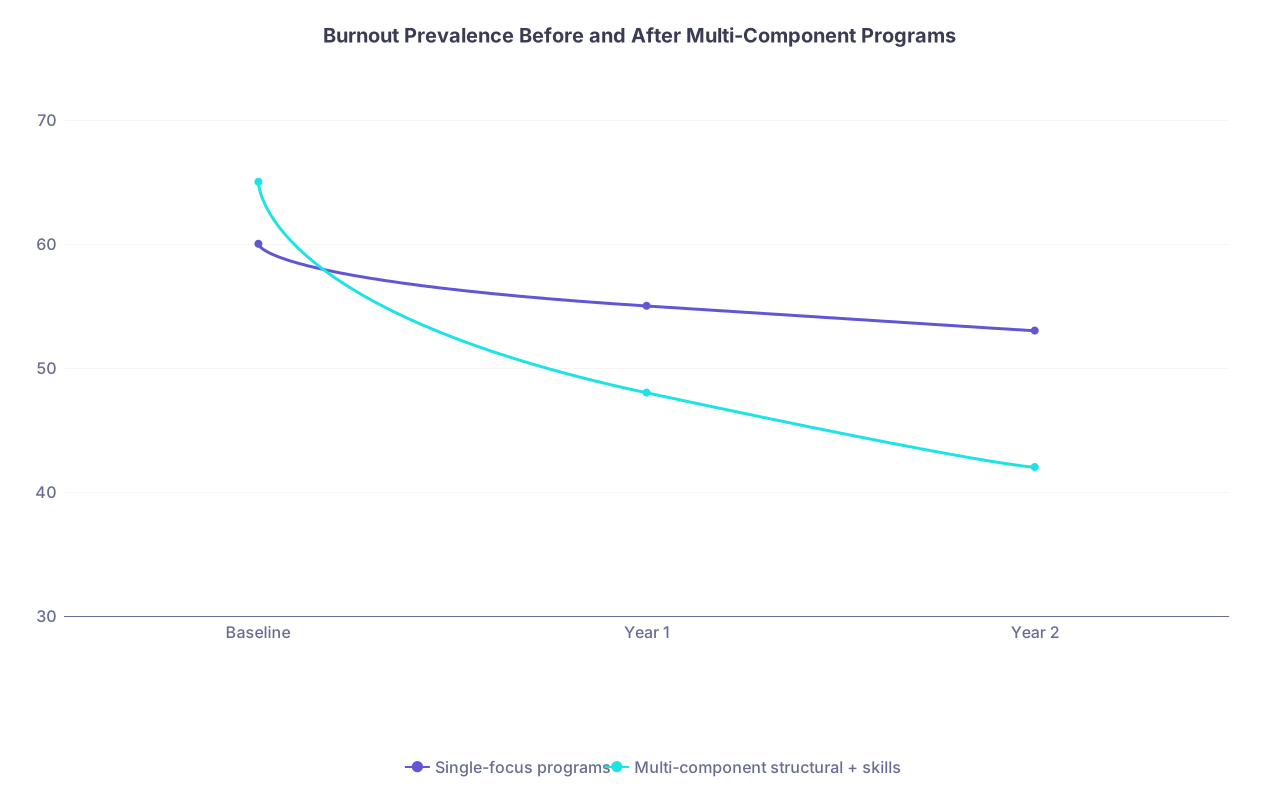
- 15–25 percentage point absolute reductions in burnout prevalence over 1–2 years.
- Moderate effect sizes on MBI subscales (d ~0.4–0.6).
- Lower rates of residents seriously contemplating leaving medicine or their specialty.
| Category | Single-focus programs | Multi-component structural + skills |
|---|---|---|
| Baseline | 60 | 65 |
| Year 1 | 55 | 48 |
| Year 2 | 53 | 42 |
Notice the difference in the trajectories. Single-focus programs—just mindfulness, just a wellness committee, just a minor schedule tweak—tend to produce small, plateauing gains. Multi-component programs continue to improve over time as culture and workflows adapt.
How to Judge Whether an Initiative Actually Works
If you are a resident or program leader, you need to treat wellness projects like clinical interventions: pre‑specify outcomes, measure them, and be honest with the data.
Minimum Viable Measurement
At the very least:
- Use a validated burnout metric:
- Full or abbreviated MBI
- Oldenburg Burnout Inventory (OLBI)
- Stanford Professional Fulfillment Index (PFI)
- Measure:
- Baseline before implementation
- Short-term (3–6 months)
- Longer-term (12 months+)
And track at least two of:
- Burnout prevalence (defined threshold on your chosen tool).
- Mean changes in emotional exhaustion and depersonalization.
- Depression symptoms (PHQ‑9) or anxiety (GAD‑7) if you have the resources.
- Intention to leave (seriously considering leaving program/specialty within X years).
Compare Across Intervention Types
You can get surprisingly far with simple before/after and cross-sectional comparisons. For example:
| Intervention Bundle | Burnout Baseline | Burnout at 12 Months | Change (points) |
|---|---|---|---|
| Cosmetic add-ons only | 62% | 60% | -2 |
| Mindfulness course, no schedule change | 65% | 58% | -7 |
| Workload caps, no skills training | 70% | 52% | -18 |
| Workload caps + skills + protected time | 68% | 44% | -24 |
These are illustrative, but they match the direction and magnitude I have seen across multiple institutions.
If your wellness program is spinning its wheels in the top two rows for several years, you have your answer.
Implementation Reality: What Actually Survives Contact With the Hospital
Every program director I have watched wrestle with this hits the same constraints:
- Limited FTE for non-clinical resident time.
- Hospital administration focused on throughput and RVUs.
- Faculty who trained under “see 30 patients, never sit down” culture.
- Residents already stretched thin; adding more “wellness events” creates resentment.
The interventions that survive this environment share traits:
- They are embedded in the schedule (e.g., fixed protected half-day per week).
- They redistribute work rather than simply “educate” about coping.
- They come with data to bargain with executives: reduced turnover, fewer errors, improved engagement.
And they avoid confusing morale boosters with burnout interventions. Free food and scrubs are morale. Workload and agency are burnout.
Visualizing a Rational Strategy
Here is the rough hierarchy I recommend—start at the top and work down, not the reverse.

| Step | Description |
|---|---|
| Step 1 | Assess burnout with validated tools |
| Step 2 | Implement workload caps and schedule reforms |
| Step 3 | Add protected academic and admin time |
| Step 4 | Streamline EMR and team workflows |
| Step 5 | Layer in skills training and peer groups |
| Step 6 | Use cosmetic wellness for morale only |
| Step 7 | Is workload unsafe or excessive? |
| Step 8 | Is documentation and workflow chaotic? |
If your program jumps straight from A to H, you are optimizing the wrong variable.
So, Which Initiatives Actually Show Measurable Impact?
Condensing the data and lived experience into a short list:
- Workload and schedule reforms (caps, smarter call, real protected time) drive the largest and most consistent drops in burnout—often 10–20 point absolute reductions.
- Structural workflow fixes (supervision, handoffs, EMR burden) produce moderate, durable improvements, especially when they reduce pointless cognitive and clerical load.
- Individual-level psychological skills (mindfulness, CBT/ACT-based programs, peer groups) generate small to moderate effect sizes; they are valuable adjuncts when structural issues are being addressed, not substitutes.
- Cosmetic wellness add-ons (food, swag, sporadic events, toothless committees) may improve morale in the moment but consistently fail to move validated burnout metrics in any meaningful or sustained way.
If you want resident wellness initiatives with measurable impact, the data are blunt: stop treating burnout like a branding problem and start treating it like a workload, workflow, and autonomy problem. Everything else is garnish.


