

The story residents tell themselves about burnout is incomplete. It is not just “long hours” or “medicine is hard.” The data shows three variables quietly doing most of the damage: call frequency, documentation time, and how those two interact with your sleep and sense of control.
Let me walk through the numbers.
What the Data Actually Says About Call and Burnout
Residency surveys are noisy, but the pattern around call frequency is remarkably consistent.
Across multiple studies of residents and early-career physicians, the prevalence of burnout typically sits in the 40–60% range. When you stratify by call frequency or overnight work, you consistently see a 10–20 percentage point jump in burnout in the heaviest call groups.
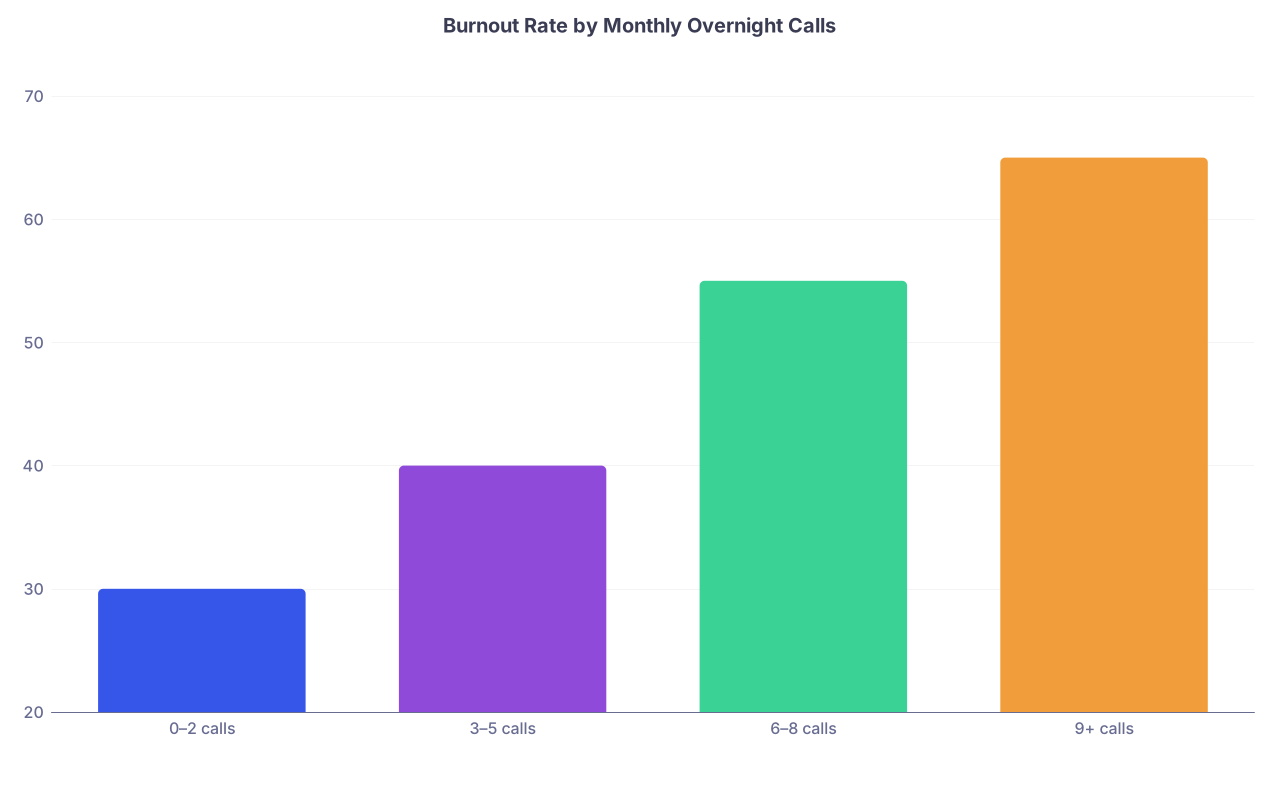
| Category | Value |
|---|---|
| 0–2 calls | 30 |
| 3–5 calls | 40 |
| 6–8 calls | 55 |
| 9+ calls | 65 |
This pattern echoes what many of us have watched unfold in real time:
- The prelim medicine intern on a q4 call MICU month: reporting complete emotional exhaustion by week three.
- The night float resident doing 6–7 nights in a row: “I am a different person by day 5. My fuse is gone.”
- The PGY-2 on an “easy” clinic month with no call: suddenly remembers they like medicine again.
The relationship is not subtle. More nights and more frequent call correlate strongly with:
- Higher emotional exhaustion scores
- Higher depersonalization (“I stop seeing patients as people”)
- Worse self-reported cognitive performance and error rates
Does this mean “any overnight call causes burnout”? No. But the slope is steep once you cross certain thresholds. Programs that run residents at 7–9+ in-house nights per month, or stack multiple heavy call months back-to-back, are essentially running a natural experiment in how fast they can drive burnout up into the 60–70% range.
You can feel this on a typical ward month. A q4 call schedule (every 4th night in-house) over a 28-day block means approximately 7 call nights. If each call night effectively destroys two calendar days (the night plus the post-call recovery day), that is almost half the month boxed out into survival mode.
And this is before we even touch documentation time.
Documentation: The Silent Time Thief
Here is the dirty secret of modern residency: residents routinely spend more hours per day documenting and clicking in the EHR than they do in direct face-to-face patient care.
Multiple time-motion studies across internal medicine, pediatrics, and surgery show roughly:
- 35–45% of work time in the EHR
- 10–20% in direct patient interaction
- The rest in communication, rounds, procedures, and… walking around trying to find a working computer
On a 12-hour shift, that can easily mean 4–5 hours staring at a screen.
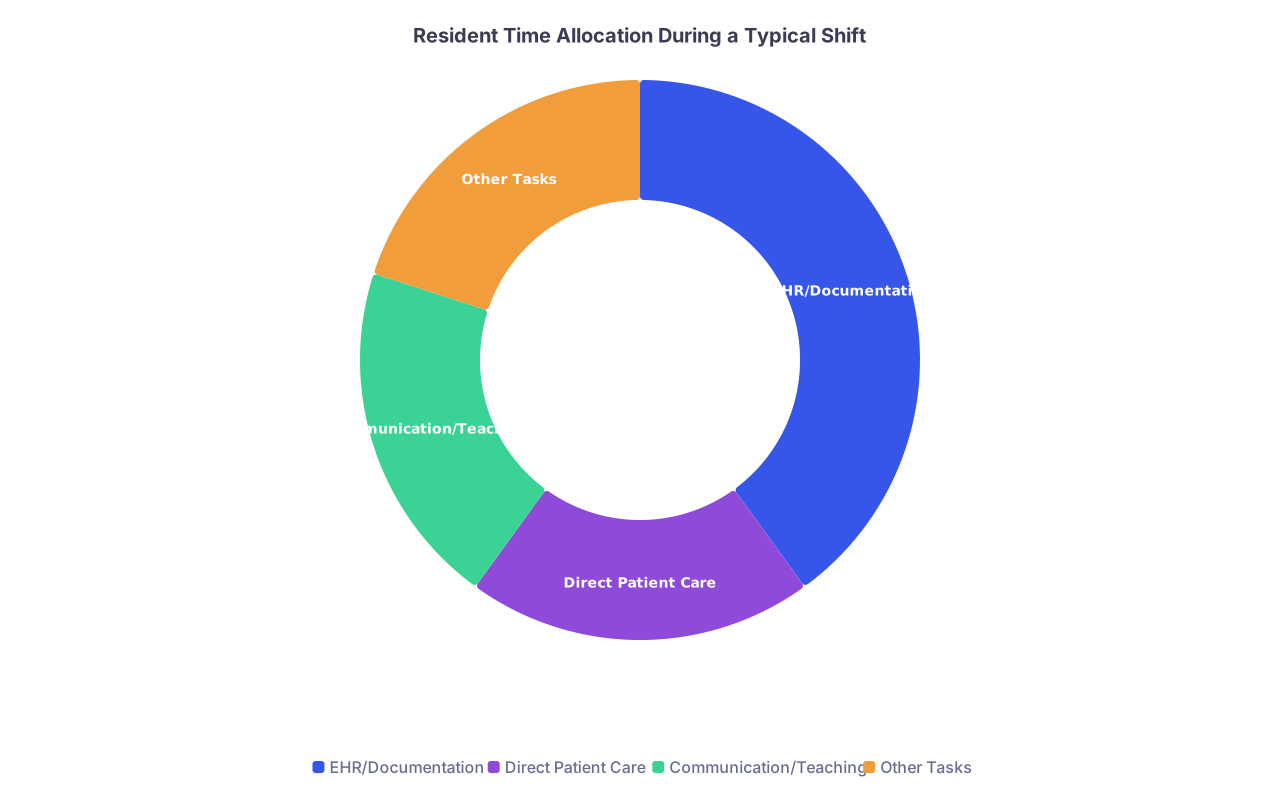
| Category | Value |
|---|---|
| EHR/Documentation | 40 |
| Direct Patient Care | 20 |
| Communication/Teaching | 20 |
| Other Tasks | 20 |
The data on documentation and burnout shows three patterns:
- Total EHR time matters: More hours per day in the EHR correlates with higher burnout scores.
- “Pajama time” is poison: Documentation done after leaving the hospital (at home, late evening) is especially toxic.
- Perceived EHR burden beats raw hours: If residents feel that clicks are excessive, duplicative, or unnecessary, burnout risk jumps even if total hours are not radically different.
In one often-cited study of attendings (the pattern translates directly to residents), each additional hour of after-hours EHR work was associated with a substantially higher odds ratio of burnout symptoms. Few residents track their “pajama time” formally. But ask around: the average is not zero. I have seen interns admit to 5–7 extra EHR hours per week, especially on busy rotations.
So combine the two:
- A heavy call month means more notes, more admissions, more cross-cover documentation.
- Night calls and cross-cover are precisely when documentation is sloppier, slower, and often duplicated.
- Post-call fatigue extends documentation time further; simple notes take twice as long.
You now have the multiplication, not just addition, of two burnout drivers: more nights + more documentation time per patient.
The Interaction That Really Hurts: Call × Documentation × Sleep
Talking about call frequency without talking about sleep is like talking about blood pressure without heart rate. They live together.
The literature is clear:
- Consistent sleep under 6 hours per 24 hours is associated with impaired cognitive performance equivalent to elevated blood alcohol levels.
- Rotating shifts, especially flipping between days and nights, disrupt circadian rhythms and amplify subjective fatigue at the same work hours.
- Sleep fragmentation (the pager that goes off every 45 minutes) can be as damaging as sleep restriction.
The problem is not just “number of hours in the hospital.” It is:
- How often your sleep is interrupted.
- How variable your sleep window is week-to-week.
- How much “recovery sleep” you actually get on post-call days.
Now overlay documentation time on that.
Here is the real-world pattern I have watched repeatedly:
- Resident has a brutal call with 10–15 admissions.
- Post-call, they spend 1–2 extra hours finishing all the notes and orders.
- They leave late, fail to nap properly, or nap so late that their nighttime sleep is destroyed.
- Next day, they are technically “off call” but cognitively depleted; EHR tasks take longer and feel more punishing.
- Repeat for multiple calls in a week.
You end up with a sleep deficit curve over a month that looks ugly.
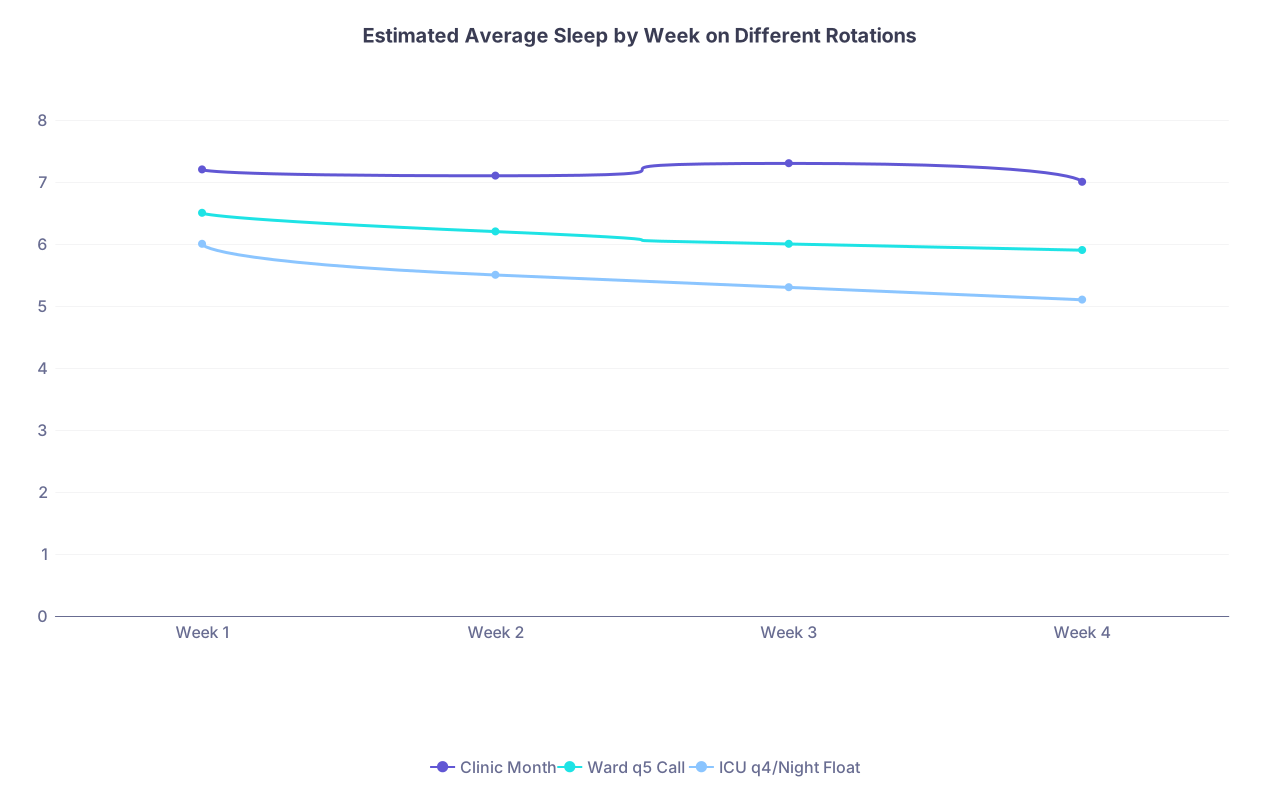
| Category | Clinic Month | Ward q5 Call | ICU q4/Night Float |
|---|---|---|---|
| Week 1 | 7.2 | 6.5 | 6 |
| Week 2 | 7.1 | 6.2 | 5.5 |
| Week 3 | 7.3 | 6 | 5.3 |
| Week 4 | 7 | 5.9 | 5.1 |
By week 3–4 of a heavy ICU or night float block, many residents are running at a chronic sleep average under 6 hours. That is the territory where burnout, cognitive lapses, and emotional volatility spike.
Documentation makes this worse because:
- Cognitive fatigue slows typing, thinking, and EHR navigation.
- Slower documentation extends time in the hospital or pushes charting into home hours.
- That eats directly into sleep time, compounding the deficit.
This is why a “reasonable” 60–65 hour week can still feel crushing if:
- You have 6–8 call nights.
- Your EHR workflow is inefficient.
- You routinely need 1–2 hours of pajama time to keep up.
Quantifying the Damage: Back-of-the-Envelope Residency Math
Let us put some rough numbers to this. I am not aiming for perfect precision; I am aiming for order-of-magnitude accuracy that matches what residents actually experience.
Take two hypothetical ward months (28 days), both at 60 work hours/week on paper.
Resident A: Moderate call, efficient documentation
- Call: q7 (4 calls/month)
- Average daily EHR time: 3.5 hours (in-hospital only)
- Pajama time: 1–2 hours/week
- Sleep: Averages about 6.75–7 hours/night across the month
Resident B: Heavy call, high documentation burden
- Call: q4 (7 calls/month)
- Average daily EHR time: 4.5–5 hours (in-hospital)
- Pajama time: 5–7 hours/week (finishing notes, messages)
- Sleep: Averages about 5.75–6 hours/night by weeks 3–4
Across the month:
- Resident A spends roughly 100–110 hours in the EHR
- Resident B spends closer to 140–160 hours in the EHR
- Resident A spends perhaps 10–15 hours at home doing charting
- Resident B may spend 20–30 hours at home doing charting
That is a 40–50 hour delta in documentation time across a single 4-week block. Essentially an extra full-time workweek of EHR labor layered on top of clinical work.
Subjectively, Resident B will feel like they never leave work. Because functionally, they do not. The body and brain do not care whether the EHR window is in a hospital workroom or on a couch at home.
Now connect that back to burnout:
- Increase call nights from 4 to 7 per month → burnout rate up by ~10–15 percentage points in most studies.
- Add 40–50 hours of extra documentation over the month, much of it at home → the probabilities climb further.
At scale, this is how you get entire residency classes where >60% meet a validated burnout threshold at least once per year.
Where Programs Go Wrong (The Structural Failures)
Residents are often told to “take care of yourself” in response to burnout. The data says that is about 20% of the solution. The other 80% is structural.
The mistakes I see over and over:
Equating “duty hours compliance” with “well-being”
A program running residents at 78–80 hours/week but “averaging” 78 so it looks fine in the spreadsheet, while completely ignoring the density of call nights and recovery time.Ignoring the EHR in scheduling decisions
Leadership focuses on numbers of admissions and caps but pays zero attention to how many notes and order sets that translates into, or how clunky the documentation workflow is.Stacking heavy rotations
ICU → wards with q4 call → nights, across 3 months straight, then acting surprised when PGY-1s crash emotionally in January.No measurement of pajama time
Programs rarely ask residents: “How many hours per week are you charting at home?” So they underestimate the real workweek by 10–20%.
Concrete Levers That Actually Work (Backed by Data and Reality)
Residents do not control everything, but they are not powerless either. And programs that are serious about burnout can make measurable progress with targeted changes.
1. Flatten the Call Curve
Programs should stop hiding behind “but we are under 80 hours.” The question is: what is the call density and what is the sleep pattern?
Reasonable guardrails, based on both evidence and lived experience:
- Aim for ≤ 5–6 in-house nights per 28-day block on typical ward rotations.
- Avoid more than 2–3 consecutive heavy-call months.
- Build protected lighter rotations (clinic, electives) immediately after the heaviest blocks.
If you are a resident and have any voice in scheduling or a committee, push for data like:
- Average call nights per block, by rotation.
- Reported average hours slept on call vs off-call nights.
Put that on a simple chart. Visualizing how one rotation runs 9 nights and another runs 3 tends to change the tone fast when presented to leadership.
| Rotation | Average Monthly Calls | Typical Weekly Hours | Resident-Reported Burnout (High %) |
|---|---|---|---|
| Medicine Wards | 7–8 | 70–75 | 65 |
| MICU | 6–7 | 75–80 | 70 |
| Night Float | 10–12 | 60–65 | 60 |
| Outpatient Clinic | 0–1 | 45–55 | 25 |
| Elective | 0–2 | 40–50 | 20 |
Numbers like these are not theoretical. Variations of this table pop up every year in internal surveys.
2. Attack Documentation Time Like a Quality Problem
Documentation burden is not a character flaw. It is a process problem. Treat it the way you would treat a chronic readmission issue.
Specific, data-backed interventions:
Smart templates and macros:
Residents using well-designed templates can cut note time by 20–30%. That is not fantasy. I have watched residents go from 15–20 minutes per admission note to 7–10 with good templates and keyboard shortcuts.Shared documentation standards:
Too many teams reinvent the wheel. One attending wants 8 paragraphs, another wants bullet points, a third wants something else. Standardizing “what is good enough” for common notes (admission, progress, discharge) reduces over-documentation.Protected documentation blocks:
A simple practice: 30–45 min protected “no pages unless life-threatening” documentation windows once or twice a day. The page volume data from several hospitals shows that when you implement structured communication and paging rules, interruptions drop without patient harm.
Residents can do their own micro-analysis:
- Track one week: how many minutes per admission note, per progress note, per discharge summary.
- Identify the outliers. Where are you losing time? Are you writing an H&P worthy of a malpractice lawsuit defense for a straightforward cellulitis admission at 3 AM?
Once you know the numbers, you can set realistic reduction goals. For example: “I want my average progress note time under 6 minutes and my discharge summaries under 12.” That mindset—treating it like a throughput metric—actually works.

3. Eliminate or Contain Pajama Time
If there is one low-hanging fruit that has outsized ROI for burnout, it is this: reduce after-hours documentation to near-zero on most rotations.
For programs:
- Explicitly set the expectation that notes should be completed in-house, with team support to make that realistic.
- Monitor self-reported pajama time in annual well-being surveys. If average is >3–4 hours/week, that is a systems red flag.
- Consider administrative or scribe support for the heaviest services, even part-time.
For residents:
- Be ruthless about finishing notes on lighter days early, so they do not pile up toward the end of the week.
- Batch low-cognition tasks (med rec cleanups, problem list updates) into short focused blocks.
- If you are routinely doing 1–2 hours of charting at home most nights, do not normalize it. Bring data to your chiefs or PD.
Again, measure it. A simple weekly log: “How many hours did I spend in the EHR after leaving the hospital?” Over one month, that number will either scare you into change or confirm you are actually okay.
Practical Micro-Strategies Residents Can Use Now
You cannot rewrite ACGME rules or the EHR architecture yourself, but you do have some leverage over your own workflow. The data and experience both support a few very concrete tactics.
Front-load and Batch
Clinical volume fluctuates. On lighter afternoons or early evenings:
- Close all admission notes before picking up another patient if safely possible.
- Finish discharges the night before whenever you know they are leaving. The readmission data does not improve with 2 paragraphs of additional discharge prose written at 6 PM.
By front-loading on lighter days, you create margin on heavy call nights. That margin often translates directly into 30–60 minutes more sleep.
Treat Documentation Time as a Measurable Skill
I have watched PGY-3s who can do an accurate, safe ICU note in under 10 minutes. That is not magic. It is workflow and practice.
Ask your co-residents who always seem done on time:
- How long are your notes on average?
- What templates/macros are you using?
- What did you stop documenting that used to waste time but did not add value?
You will find common patterns:
- Less narrative fluff, more structured data.
- Problem-based rather than system-based in many services.
- Standardized assessment and plan phrasing for common issues.

Respect Recovery Sleep Like It Is a Procedure
The data on sleep and performance is at the same level of evidence as many things we do daily in the hospital. Yet residents treat their post-call sleep like an optional hobby.
Minimum viable approach:
- On post-call days: go home as early as safely possible; set a strict window for a 90–180 minute nap, then wake up and protect a regular bedtime.
- On night float: lock in a consistent sleep window—even if imperfect—and defend it from optional obligations. Rotating day-to-night chaos is worse than a stable but slightly suboptimal schedule.
You would not casually skip DVT prophylaxis on your post-op patient. Treat your own sleep with similar protocol mentality.
Visualizing the Whole System
To pull this together, here is how these elements typically connect in the real world.

| Step | Description |
|---|---|
| Step 1 | High Call Frequency |
| Step 2 | Reduced Sleep |
| Step 3 | Slower Cognitive Processing |
| Step 4 | Longer Documentation Time |
| Step 5 | More Pajama Time |
| Step 6 | Less Time for Recovery |
| Step 7 | Emotional Exhaustion |
| Step 8 | Higher Burnout Risk |
That loop—high call → reduced sleep → slower documentation → more time charting → even less sleep—is the core vicious cycle.
Break it at any point, and you reduce the area under the burnout curve.
The Bottom Line
If you strip away the slogans and wellness posters, the numbers are blunt.
Call density and sleep disruption move burnout rates by double-digit percentages. Once you cross 6–7 in-house nights per month without protected recovery, you are in high-risk territory.
Documentation time, especially after-hours EHR work, is not secondary—it is central. Residents who spend 30–50 extra hours per month on charting are effectively adding a hidden workweek to their schedule.
Burnout is mostly structural, not personal weakness. Individual coping helps at the margins, but the real leverage is in how programs design call schedules, manage documentation burden, and protect residents’ sleep windows.
If you want less burnout in residency, stop giving generic advice and start measuring call frequency, documentation time, and pajama hours like the critical variables they are. The data is clear enough. The question is whether leadership—and residents themselves—are willing to act on it.


