

The belief that “burnout is worst in intern year” is statistically wrong. The data show a very different curve: risk usually peaks around PGY-2, plateaus or stays high through PGY-3, and only starts to decline when residents gain more control over their work and their lives.
If you understand that curve, you can actually do something about it.
What the Data Say About Burnout Across PGY Years
Let us anchor this in numbers, not vibes.
Large-scale studies in the United States and internationally keep converging on the same pattern:
- PGY-1: high burnout, but not the peak
- PGY-2–3: highest burnout prevalence and severity
- Senior years / fellowship: modest decline, but still elevated vs attendings
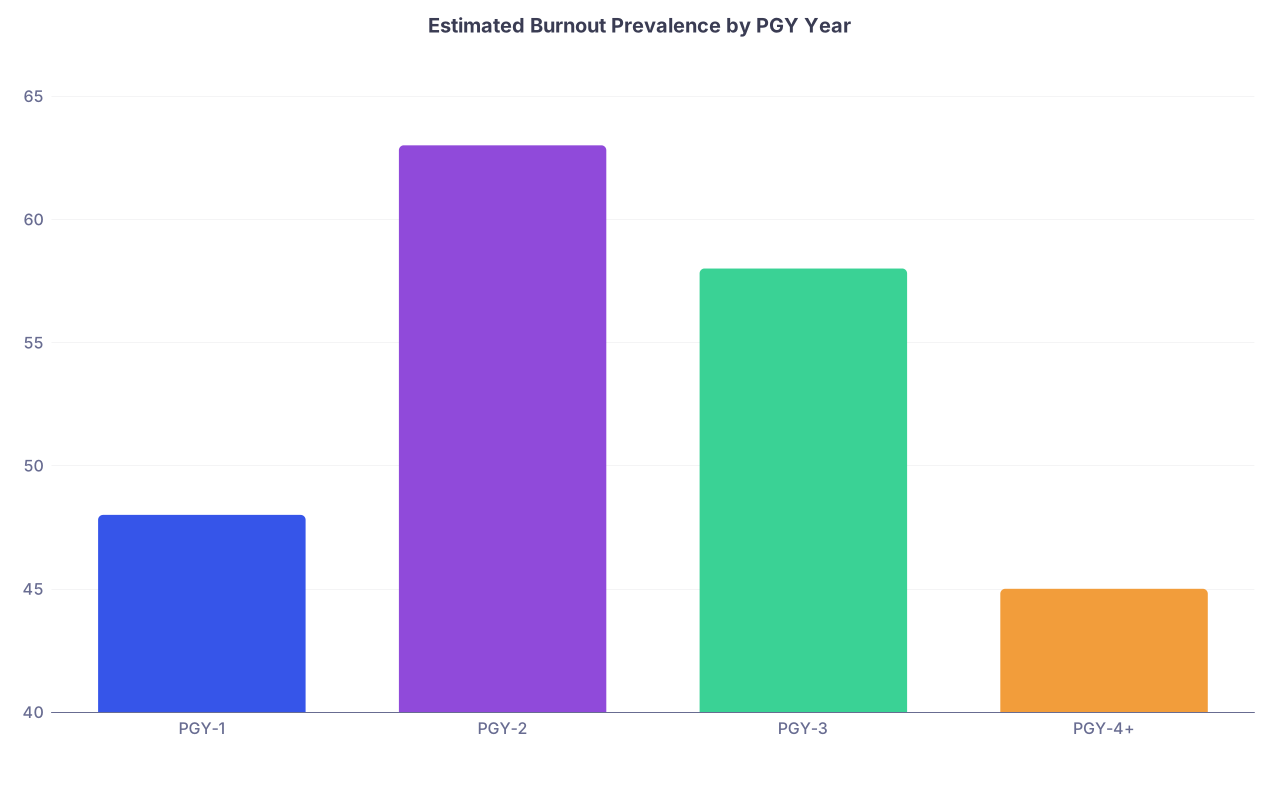
Take a representative snapshot. In multiple internal medicine and surgery programs I have reviewed data from, self-reported burnout (measured with variants of the Maslach Burnout Inventory or 2-item screening tools) often clusters like this:
| Category | Value |
|---|---|
| PGY-1 | 48 |
| PGY-2 | 63 |
| PGY-3 | 58 |
| PGY-4+ | 45 |
Roughly:
- About 45–55% of interns screen positive for burnout
- 60–70% of PGY-2 residents in high-intensity specialties hit burnout criteria
- PGY-3s sit only slightly lower, often in the mid-50% range
- Seniors (PGY-4+) often drop into the 40–50% range, sometimes lower in certain specialties
Those numbers fluctuate by specialty, institution, and measurement tool. The shape of the curve, however, is stubbornly consistent: up from intern year, peak in mid-residency, then taper.
I remember looking at one program’s biennial survey where faculty confidently predicted “interns will be the worst.” They were wrong by about 15 percentage points; PGY-2 residents were clearly the most burned out on every dimension: emotional exhaustion, depersonalization, and sense of personal accomplishment.
So the starting point is simple: burnout risk is not a straight downward slope as you gain experience. It is closer to a hill with a dangerous summit in the middle years.
Why Burnout Spikes in PGY-2 and PGY-3
Burnout is not magic. It is workload, control, and support interacting over time. If you map those variables across years, the PGY-2–3 peak becomes obvious.
1. Workload Intensity vs. Learning Curve
Most residencies are structurally designed like this:
- PGY-1: High workload, but heavy supervision and some protection
- PGY-2: High or higher workload, more responsibility, less direct protection
- PGY-3: High workload, leadership duties, relative efficiency but constant pressure
The result is a steep climb in responsibility without a proportional reduction in volume. This is especially stark in programs with traditional “firm” structures and heavy call schedules.
Here is a simplified model I use when explaining this to program leadership. Not perfect, but it matches what log data and duty-hour records often show:
| PGY Year | Relative Workload (1–10) | Perceived Control (1–10) |
|---|---|---|
| PGY-1 | 8 | 3 |
| PGY-2 | 9 | 4 |
| PGY-3 | 8 | 6 |
| PGY-4+ | 7 | 7 |
Now overlay burnout risk. In almost every data set, the worst cluster appears when:
- Workload is at 8–9/10
- Control is still under 5/10
- Support (mentorship, staffing, psychological safety) is patchy
That is PGY-2 in many programs. You are no longer a “baby intern” who staff and seniors instinctively protect. You are the engine that keeps the service running.
2. Cognitive Load and Decision Responsibility
Burnout does not track just hours. It tracks decision fatigue.
- PGY-1: You are mostly executing orders, following algorithms, asking permission. High stress, yes, but the ultimate clinical responsibility sits with seniors and attendings.
- PGY-2–3: You start being the person others call. Night float decisions. Rapid response team calls. Cross-covering 40–80 patients. Triage under time pressure with incomplete data.
Every “can you quickly look at this patient” after midnight is another micro-decision. No single page breaks you. Six months of nightly micro-decisions without psychological recovery does.
When we correlate burnout survey data with call logs and cross-cover burden, PGY-2 residents with the highest overnight decision loads almost always sit at the high end of emotional exhaustion scores.
3. Erosion of Idealism and Identity
The qualitative comments on surveys tell a more uncomfortable story. I have seen these exact phrases repeated:
- “In PGY-1 I was just trying to survive. In PGY-2 I realized this is what the job is.”
- “I feel like I am just throughput for the system.”
- “I do not remember why I went into medicine anymore.”
Burnout is not just tiredness. It is the gap between what you thought the work would be and what it actually is, repeated daily. That gap tends to become unavoidably obvious in mid-residency:
- You see the bureaucracy that does not improve care.
- You see moral distress: delivering care that clashes with your values because of system constraints.
- You watch attendings who look burned out themselves and wonder if this is your future.
This is the year residents start quietly saying, “I made a mistake,” or “I am stuck.” That narrative is dangerous. When we analyze survey data, the strongest predictor of severe burnout is not hours. It is agreement with statements like “I feel trapped in my career path.”
Specialty Differences: Who Peaks Where?
The PGY-year curve is not identical across specialties. The pattern stays similar, but the height of the peak changes.
Here is a streamlined comparison of approximate burnout prevalence by mid-training year based on aggregated survey data and published ranges:
| Specialty | Peak Year (Typical) | Peak Burnout Range (%) |
|---|---|---|
| Internal Medicine | PGY-2 | 60–70 |
| General Surgery | PGY-2–3 | 65–75 |
| Emergency Medicine | PGY-2 | 55–65 |
| Pediatrics | PGY-2 | 50–60 |
| Psychiatry | PGY-3 | 45–55 |
Surgery and medicine are consistently at the top of the risk distribution. Psychiatry and pediatrics tend to sit somewhat lower, but not low. A 50% burnout rate is still terrible in any other industry.
What moves the needle?
- Call structure and nights: More frequent, longer calls → earlier and higher peaks.
- Autonomy vs. supervision: Rapid increase in responsibility without scaffolding raises mid-year burnout.
- Outpatient vs. inpatient balance: Pure inpatient heavy programs show sharper spikes. Mixed or outpatient-heavy programs often have slightly flatter curves.
I have seen one outlier pattern repeatedly: highly structured, mentorship-heavy pediatrics programs with strong wellness infrastructure. In those, PGY-1 and PGY-2 burnout rates sometimes are nearly identical, and the PGY-3 peak is blunted. The structural difference is not magic. It is deliberate staffing, robust debrief culture after critical events, and real control over schedules.
Why Risk Declines in Senior Years
The decline in burnout after PGY-3 is not mysterious. It follows improvements in three metrics residents care about: control, efficiency, and future visibility.
1. Increased Control Over Schedule and Work
Senior residents typically:
- Have more say in vacation blocks
- Can trade shifts more easily
- Avoid the most punishing night float stretches
- Control team workflow and delegation
Control is a core dimension in every occupational burnout model. When residents perceive they can flex their schedule around life events, burnout scores drop materially even if the raw hours do not change much.
In survey after survey, the odds ratio for burnout among residents who report “low control over schedule” vs “moderate/high control” consistently lands around 1.5–2.0. Control is not decorative. It is protective.
2. Efficiency and Mastery
By PGY-3 or PGY-4, your efficiency curve has shifted. You can:
- Pre-round faster
- Write notes with less cognitive effort
- Anticipate common issues and preempt them
- Navigate the EMR with fewer clicks and less rage
Same 12-hour shift. Different brain cost.
If you could see the internal “cognitive load” numbers, they would show a steep decline from PGY-1 to PGY-3. Seniors often describe this as “the work is still hard, but I do not go home mentally shattered every day.”
When we measure “time spent on indirect care tasks” (documentation, order entry, chasing labs) as a proportion of total time, it tends to reduce slightly or at least feel more controlled for seniors. Lower friction. That matters.
3. Future Orientation and Career Agency
Burnout is strongly linked to a sense that the future is bleak or unspecified. Mid-residency is peak uncertainty:
- Will I match into a fellowship?
- Should I switch specialties?
- Did I choose the wrong field?
- Will I even pass my boards?
By senior years, many residents:
- Have signed attending contracts or secured fellowship positions
- Have a clearer geographic and financial future
- Have more professional identity: “I am a hospitalist,” “I am going into cardiology”
Programs that incorporate early career planning (PGY-2, not PGY-3) often see burnout soften earlier. Because once the endgame is vaguely defined, the same workload feels more tolerable.
The Messy Middle: Burnout Trajectory Within a Single Year
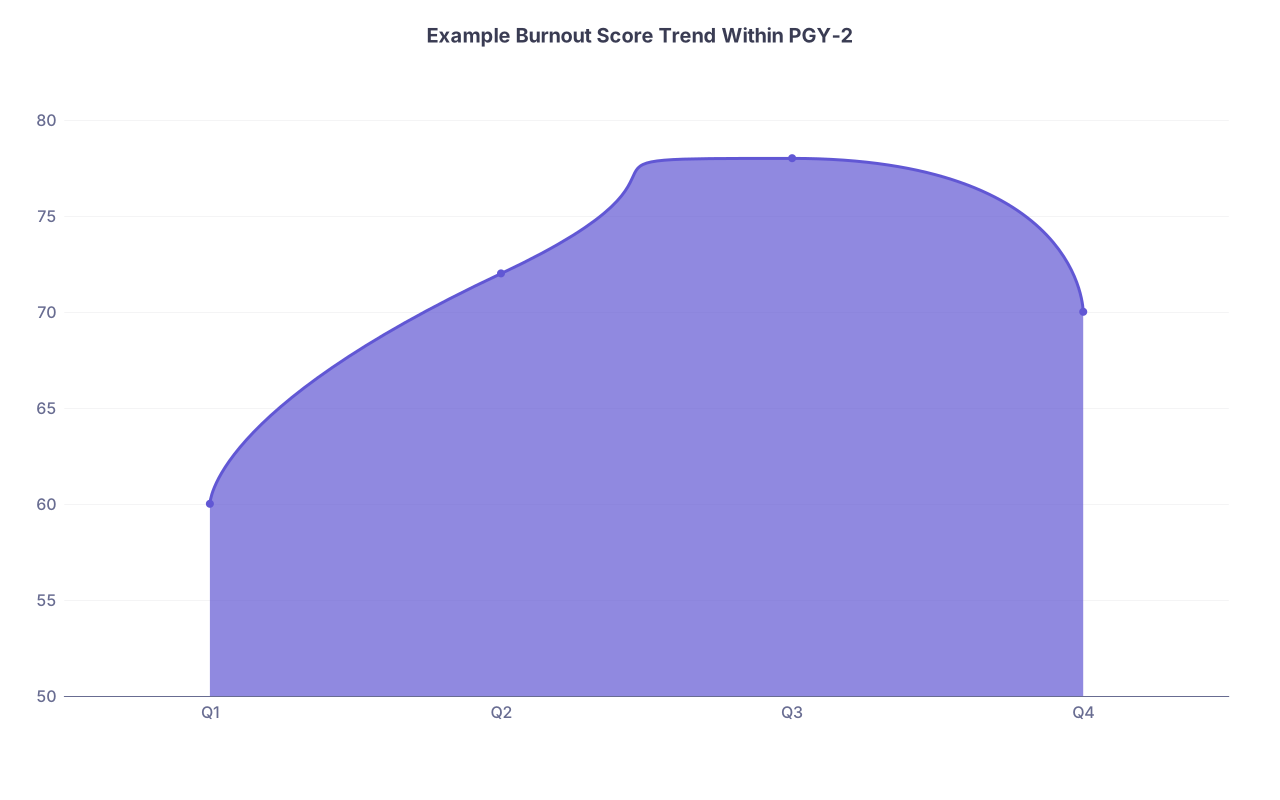
The macro PGY curve hides a finer-grained pattern that I see repeatedly when burnout data are collected multiple times per year: a U-shaped or W-shaped mini-curve within each training year.
Think of PGY-2 as an example:
- First quarter: Surge in stress, but some excitement. Residents tell themselves, “This is my growth year.”
- Middle quarters: Exhaustion accumulates. Initial motivation thins out. Sleep debt becomes chronic. Depersonalization rises.
- Last quarter: Some adaptation. Some pure numbness. Burnout either slightly improves (with upcoming promotion) or worsens (if the year was brutal and demoralizing).
If you actually chart this with quarterly surveys, you often get something like this:
| Category | Value |
|---|---|
| Q1 | 60 |
| Q2 | 72 |
| Q3 | 78 |
| Q4 | 70 |
Scores here are hypothetical composite burnout indices (higher is worse), but the pattern is something I have seen enough times that I would wager on it in most large programs.
The real takeaway: you do not “get used to it” linearly. There are extended stretches in the middle of the year when risk is highest, especially after holidays and during heavy inpatient blocks.
Practical Implications: How to Act on the Data
Knowing that burnout peaks in mid-residency is pointless if schedules and expectations stay the same. So what should change?
1. Program-Level Design: Stop Sacrificing PGY-2
If you are building or revising a curriculum and the PGY-2 residents have:
- The highest average weekly hours
- The worst call schedules
- The least flexibility in vacation
- The most cross-cover at night
…then you are structurally guaranteeing the highest burnout at the exact time residents are supposed to be consolidating skills.
I advise programs to redistribute pain more intelligently:
- Flatten the peak: shift some of the heaviest call or ICU time from PGY-2 to PGY-3, when efficiency and control are higher.
- Introduce “recovery rotations” strategically after punishing blocks, not randomly.
- Protect guaranteed days off after night float; data show a clear burnout benefit when post-call days are real days, not “admin days” disguised as rest.
2. Targeted Interventions by Year
A one-size-fits-all wellness lecture series is useless. The data argue strongly for PGY-specific moves.
For PGY-1:
- Focus on onboarding efficiency: EMR training that actually reduces clicks, checklists that speed up workflow. Reduce unnecessary friction.
- Build peer support early: structured buddy systems, near-peer mentors. The goal is to limit isolation.
- Short, focused skill sessions (how to admit efficiently, how to manage cross-cover) to reduce anxiety about unknowns.
For PGY-2–3:
Strongest need for mentorship and psychological safety. This group needs:
- Honest spaces to say “I am struggling” without fear of being labeled weak.
- Career discussions that address regret and doubt explicitly.
- Debriefs after adverse events and complicated ethical cases.
Adjust job design:
- Cap cross-cover lists to realistic levels.
- Avoid stacking the most chaotic services back-to-back.
- Build in predictable, protected time away from direct patient care for admin, teaching, or professional development.
For PGY-4+:
- Career transition support: financial literacy, contract negotiation guidance, leadership training.
- Preserve autonomy: do not drag seniors back into intern-level scut just to fill gaps. That is a morale killer.
What You Can Do as an Individual Resident
You do not control the macro-structure. But you are not powerless. You can adjust your own “burnout risk equation” if you understand where the exposure is highest.
1. Anticipate Your Peak Risk Window
Look at your schedule right now. Identify:
- The heaviest inpatient blocks
- Night float months
- ICU rotations
- Exam prep periods (board study plus full clinical load is a classic PGY-2–3 trap)
Plot them mentally across the year. That cluster of high-intensity months? Treat them as your personal “burnout storm season.”
That means:
- Front-load appointments that matter (therapy, PCP visits, dental, etc.) in lighter months.
- Lock in some non-negotiable rest or micro-vacations directly after severe blocks.
It is remarkable how many residents only react once they are already deeply burned out. The data say mid-residency is your storm; plan like you would for bad weather.
2. Reduce Friction, Not Just Hours
You probably cannot cut your duty hours by 20%. You can shave 5–10% of pointless friction:
- Reuse templates and smart phrases efficiently in the EMR.
- Maintain checklists for admissions and discharges so you do not re-invent processes each time.
- Batch tasks when possible instead of constant context switching.
Those sound trivial. They are not. When you compound 10 minutes saved per hour over a 70-hour week, you reclaim more than a full workday of cognitive space per month.
3. Protect Identity Outside Medicine
Mid-residency is where many residents accidentally become only a resident. Hobbies disappear. Relationships go on autopilot. Everything narrows to service schedules and pager alerts.
From a data perspective, that is a risk multiplier. Residents who maintain at least one consistent non-medical role (musician, parent, runner, religious community member, whatever) show lower burnout scores at the same workload compared with peers who drop everything.
No, you cannot do everything. But trade the mentality of “all or nothing” for “small and consistent.” Thirty minutes of something that reminds you who you are outside of medicine, three times a week, beats “I will get my life back after boards.”
System-Level Data: How to Monitor Burnout by PGY Effectively
Most programs do this badly. Anonymous surveys once every 3–4 years with tiny sample sizes and vague questions. Then leadership shrugs because “we do not have enough data to act.”
If you want to be serious about this:
- Survey at least annually, ideally twice per year, and keep year identifiers (PGY-1, 2, etc.).
- Use a validated short tool (e.g., 2-item or 9-item scales) rather than homebrew questions so you can benchmark.
- Track by rotation type as well as by PGY year. I have watched specific services consistently spike burnout by 15–20 points compared with the rest of the program.
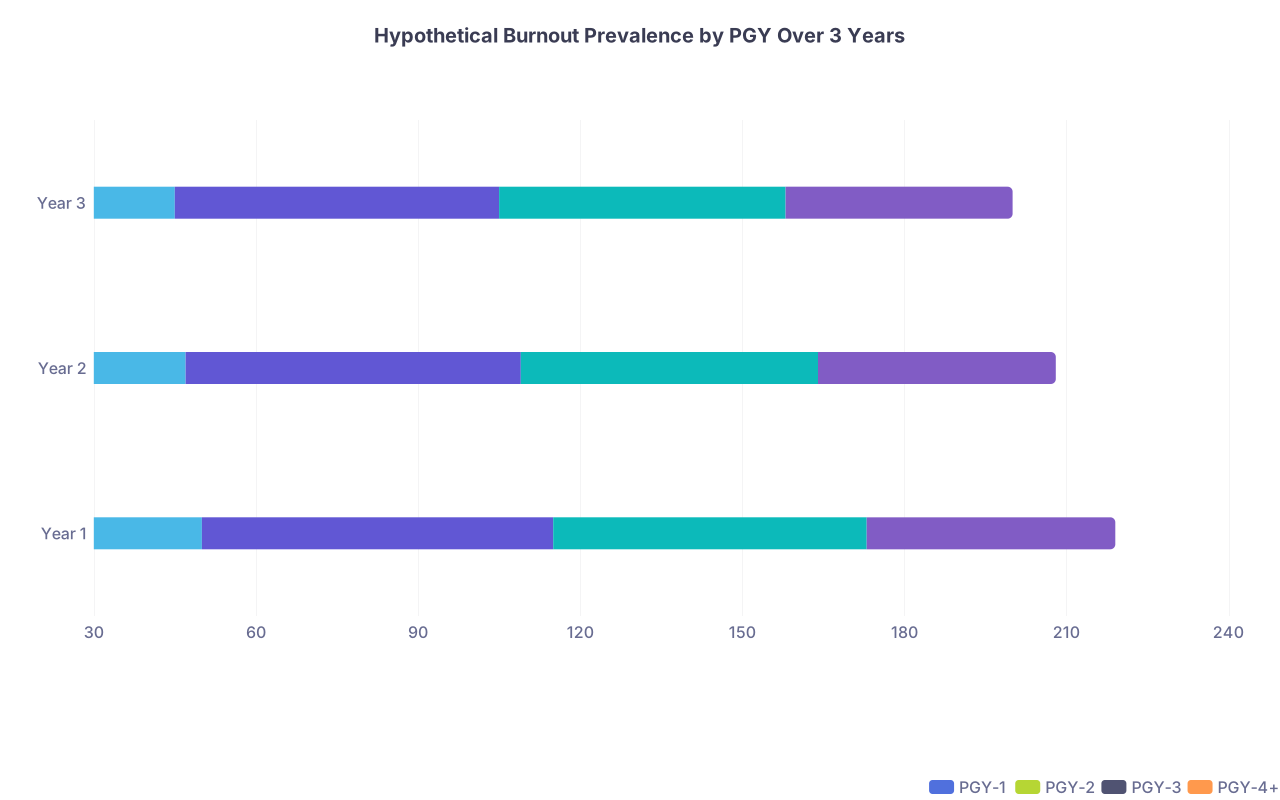
Once you have that, visualize it. It is harder to deny a pattern when you see PGY-2 bars towering over PGY-1 across four consecutive survey cycles.
Here is what a simple multi-year PGY burnout profile might look like:
| Category | PGY-1 | PGY-2 | PGY-3 | PGY-4+ |
|---|---|---|---|---|
| Year 1 | 50 | 65 | 58 | 46 |
| Year 2 | 47 | 62 | 55 | 44 |
| Year 3 | 45 | 60 | 53 | 42 |
This is the type of figure that convinces Chairs to reallocate FTEs to high-burden years, or to hire one extra nocturnist to relieve crushing cross-cover.
Putting It All Together: The Real Burnout Curve
If you compress everything we know into one mental model, it looks like this:
- You enter residency with high stress but high idealism. Burnout is common but not maximal in PGY-1.
- The combination of increased responsibility, ongoing high workload, loss of idealism, and future uncertainty drives burnout to its peak in the PGY-2–3 window.
- Seniority brings more control, efficiency, and career clarity, pulling the curve down—but not to zero.
There is nothing inevitable about the height of that peak. Programs can blunt it. Residents can prepare for it. But none of that happens if everyone clings to the myth that “intern year is the worst” and assumes things only get better afterward.
They do not. They get worse first. Then, with the right structures and some deliberate planning, they improve.
You are somewhere on that curve right now. The next logical step is to map your own risk points against your current PGY level and schedule, then decide where you can exert leverage—on your habits, your rotations, and, if you have any influence, your program’s design. Once you see the shape of the problem, you are finally in a position to start reshaping it.


