

Last year, I sat in a residency CCC meeting watching an email thread projected on the screen. A third-year resident had been “fine” all year—average evals, no real complaints. But a few short, seemingly harmless notes from nurses, one patient complaint, and two missed call shifts told a very different story. The room got quiet in that specific way that means everyone’s thinking the same thing: we’re losing this resident, and they don’t even know it yet.
If you think burnout is only flagged when someone breaks down in the call room or fails a rotation outright, you’re wrong. Programs see the smoke long before the fire—and they talk about it behind closed doors. Let me walk you through how that actually happens.
The Quiet Watchers: Who Actually Notices First
Residents think the PD is the one watching them day to day. No. The PD usually hears about you secondhand. The early radar is:
- Chief residents
- Program coordinators
- Nurses (especially the senior ones)
- A handful of attendings who actually pay attention
The chiefs are your first line of surveillance. They see the schedule trades, the last-minute “I’m not feeling well” calls, the late sign-outs. They may joke about it in the workroom, but they remember. When a chief says in a leadership meeting, “We might need to keep an eye on X,” that’s the first informal flag. Not written. Not official. But it sticks.
Program coordinators catch a different kind of data. Missed deadlines. Late duty hours. Half-completed evaluations. That one resident who “always has something going on” when a mandatory session is scheduled. They quietly mention it to the PD:
“Hey, just so you know, she’s been late with a lot of things lately. Not like her from last year.”
And then there are the nurses. If a senior night nurse says, “Doc, your intern’s not right—they look exhausted and they’re snapping at people,” believe me, that gets repeated. Usually indirectly. But it gets there.
The trend you need to understand: burnout gets flagged socially before it gets flagged formally. People talk. A narrative forms about you long before it shows up in your file.
The Behavioral Shift: What They Actually Look For
Most residents think burnout will be “diagnosed” when their performance falls off a cliff. What really triggers concern is a pattern of small, consistent changes.
Here’s what PDs and chiefs quietly track:
1. Personality Shift
This is one of the biggest red flags—and it’s almost never documented in those words.
The resident who used to be engaged, chatty, making jokes on rounds… suddenly flat. Minimal. Barely speaking beyond what’s necessary for patient care.
I’ve heard attendings say things like:
“He used to have good energy. Now he just looks… done.”
or
“She’s still doing the work, but there’s no spark. She’s checked out.”
Nobody writes “spark” in an evaluation. But they feel it. And when that feeling gets echoed by more than one person, it turns into concern.
2. Reliability Erosion
This is where the informal comment turns into a pattern.
- Showing up right on time instead of early. Then slightly late.
- Sign-out running later and later because notes aren’t done.
- Labs not followed up as quickly as before.
- Patients rounded on, but with less thoroughness.
To an outsider, this all looks like “busy resident.” To a PD who’s been watching people burn out for 15 years, this looks like someone slipping.
When chiefs start saying, “I can’t fully rely on them for a tough night anymore,” that’s quiet code for: we’re worried.
3. Emotional Edge
No, not one bad day. Everybody has those.
What they watch for is a shift in tone over a few weeks:
- More irritation in the voice during sign-out
- Terse responses to pages
- Visible frustration with EMR, consults, or nurses
- Jokes turning darker, more cynical, more hopeless
You might think your sarcasm is harmless. You might even think it’s trauma bonding. The nurses and attendings who hear it three days in a row don’t always agree.
I’ve seen an attending write, “Resident appears more frustrated than previously and interactions occasionally feel tense.” That line, buried in an otherwise average evaluation, sparked a whole CCC discussion. Because they’d already heard similar remarks from a nurse and a chief. Pattern.
The Data Trails: Your EMR and Duty Hours Tell on You
Let me be blunt: the systems you think are just annoying paperwork are often the first objective proof that you’re struggling.
Duty Hour Patterns
PDs won’t admit this out loud to you, but they absolutely scan for certain patterns:
- Sudden underreporting of hours from a resident known to stay late
- Inconsistent logging—three weeks of nothing, then a mass upload
- A resident who always logs right below the violation threshold
That last one is the classic “I’m dying and hiding it” move.
The unspoken logic in PD brains:
If you’re too overwhelmed to log duty hours consistently, you’re probably too overwhelmed in other ways too.
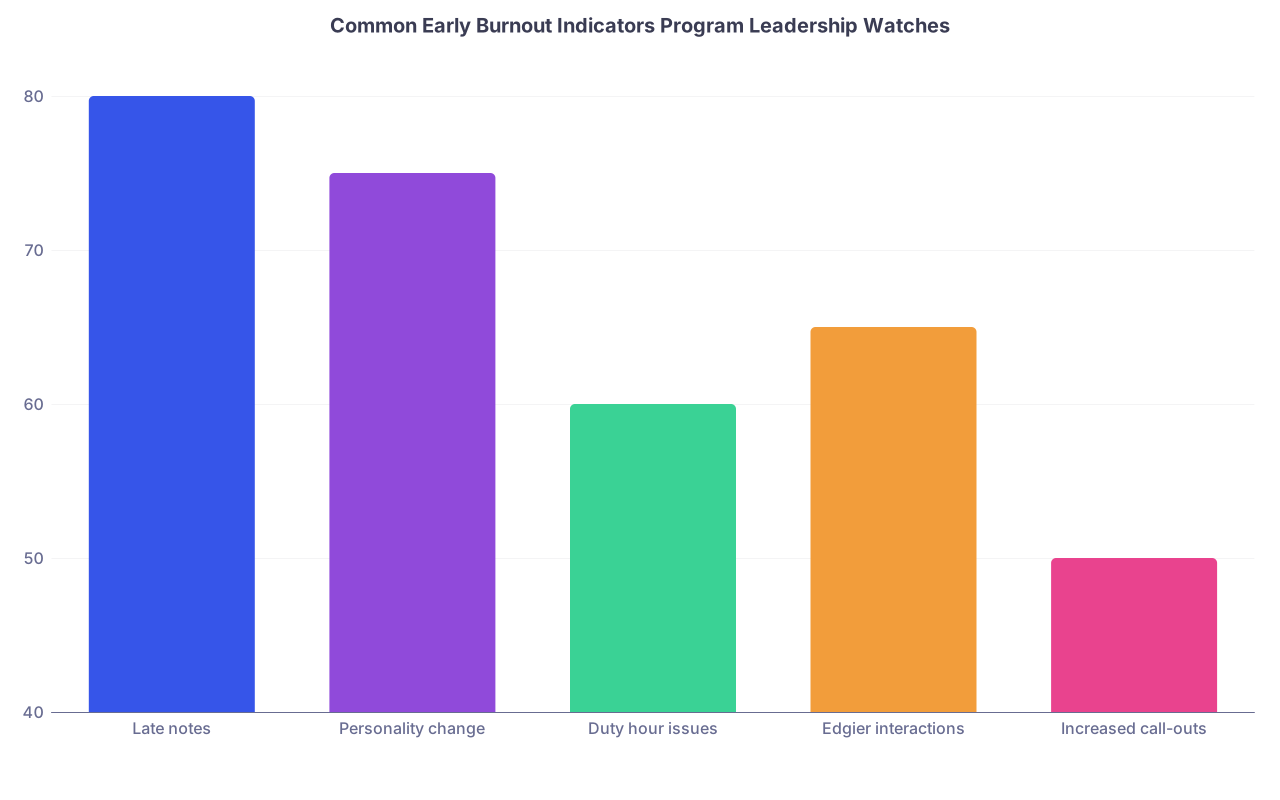
| Category | Value |
|---|---|
| Late notes | 80 |
| Personality change | 75 |
| Duty hour issues | 60 |
| Edgier interactions | 65 |
| Increased call-outs | 50 |
EMR Time Stamps and Note Patterns
This is the one residents underestimate.
Your notes show:
- Timing: If you’re finishing all your notes at 1–2 am consistently, chiefs and PDs see that pattern.
- Copy-paste overload: Suddenly your notes go from individualized to carbon copies with minor tweaks.
- Sloppy structure: Missing A/P details, repeated errors, canned phrases.
It’s not that a single bad note will “flag” you. But if attendings start writing “documentation incomplete” or “please improve clarity of plan” repeatedly, those evaluations line up with the time stamps. People connect dots.
One PD I know at a mid-sized IM program literally has their coordinator pull EMR time reports on any resident that comes up in wellness conversations. Not to punish. To see how bad the silent overwork really is.
The Meeting Where Your Name Comes Up
You need to understand what happens in that room when you are not there.
It’s not just one big “who’s in trouble” session. There are layers.
The Informal Pre-Meeting
Before the official CCC or semi-annual evaluation meeting, there’s usually a smaller conversation. Program director, associate PDs, maybe the chiefs.
Someone will say: “We should keep an eye on R3 X. People have mentioned they seem more burnt out this block.”
That sentence right there is your first real internal flag. It doesn’t go in your record. It doesn’t go in your file. But it changes how they look at every piece of data that has your name on it.
They’re no longer neutrally reading your evaluations. They’re scanning them for a story:
Is this someone just tired? Or someone breaking?
The Formal CCC Discussion
When your name comes up:
- They pull up your evaluations, milestone grid, and sometimes specific comments.
- Chiefs add color: “They’re doing the work, but… they look wiped. Offered to cover them one night and they almost cried.”
- Someone mentions schedule changes: “They’ve requested multiple clinic shifts off in the last 2 months.”
- Another person brings up emails: “They’ve asked to skip two optional events due to ‘personal reasons.’”
No single data point is damning. But 3–4 small things pointing in the same direction? That’s when they say the phrase you’ll never hear:
“Let’s watch them more closely.”
That means:
- More eyes on your performance
- Attending feedback being read more carefully
- Chiefs quietly asked for updates on how you’re doing on tough rotations
Most residents have no idea when this moment happens. But it does. Every year. For multiple people.
The Difference Between “Struggling” and “Problem Resident”
Here’s the moral calculus PDs actually run in their heads.
There are two narratives:
- This is a good resident going through a rough patch.
- This is a resident whose professionalism, reliability, or competence is gradually becoming unsafe.
Burnout lives in the space between those two stories. How you’re framed internally decides which way things tip.
What gets you framed as “good resident, rough patch”:
- Strong prior performance and reputation
- History of being reliable and decent to work with
- Clear external stressors (new baby, ill parent, major life event)
- You’re still owning mistakes, still responding to feedback
What pushes you into “problem resident” territory:
- Defensiveness when given feedback
- Blaming everyone else—nurses, consults, EMR, scheduling
- Repeatedly not following through on improvement plans
- Patterns of dismissive or rude interactions
Same level of exhaustion. Very different response from leadership.
And here’s the piece people don’t tell you: PDs want to keep you in the “good resident, rough patch” bucket. It’s way less work than remediation, and most of them actually care.
But they’re watching which direction you’re drifting.
How Flags Actually Show Up in Your Record
Residents worry a lot about being “written up.” Most burnout-related concern does not start as a formal write-up. It starts as soft language in evaluations.
You’ll see phrases like:
- “Seems more overwhelmed lately.”
- “At times appears stretched thin.”
- “Could work on maintaining composure in stressful situations.”
- “May benefit from additional support on busy services.”
These are code phrases. They’re not neutral.
Attending speak translation:
“I think this resident is overtaxed and might be headed for burnout, but I’m not sure if it’s safe to fully trust them when things get crazy.”
| Phrase on Eval | What Leadership Actually Hears |
|---|---|
| "Overwhelmed at times" | Burnout warning, watch workload |
| "Stretched thin" | Capacity problem, maybe chronic |
| "Could improve composure under stress" | Emotional strain, possible burnout |
| "May benefit from more support" | Needs help now, before things break |
| "Energy inconsistent between shifts" | Exhaustion pattern, not just a bad day |
When a PD reads one of these once, they might shrug. When they read versions of this from three different rotations in a row, you’re now on the “we need to intervene” track, whether you know it or not.
The “Wellness” Conversation That Isn’t Just Wellness
At some point, if the concern crosses a certain threshold, you’ll get invited to a “check-in” with the PD or APD.
They won’t say, “We think you’re burning out and slipping.” What you’ll hear is something like:
- “How have you been doing these last couple of months? Any stressors?”
- “We’ve noticed this rotation’s been heavy for you—how are you holding up?”
- “I’ve heard from a few folks that you seem more tired than usual. Does that track with how you feel?”
You might think it’s casual. It’s not. This is a semi-structured assessment. They’re watching:
- Do you minimize everything?
- Do you break down and say you’re drowning?
- Do you have insight into your own behavior?
- Are you open to support or hostile to it?

The PD is trying to decide:
Can we shore you up with minor adjustments—schedule tweaks, wellness resources, maybe a lighter elective—or do we need a more formal remediation or leave conversation?
The biggest mistake residents make in this meeting is performing. Saying, “I’m fine, just tired,” when they’re clearly not fine. That disconnect worries PDs more than the burnout itself. Because now they’re thinking: this person doesn’t see the problem, so it’s going to get worse.
Red Flags That Move You From Concern to Crisis
Let’s talk about the things that make PDs sit up straight and move from quiet flag to loud intervention.
These are the “we can’t ignore this anymore” triggers:
- Multiple missed pages or important calls
- A serious safety event tied to inattention or exhaustion
- A pattern of call-outs that are vaguely explained or last-minute
- Repeated complaints from nurses about rudeness, dismissal, or visible agitation
- An attending saying, “I’m worried about their ability to safely manage a full census right now.”
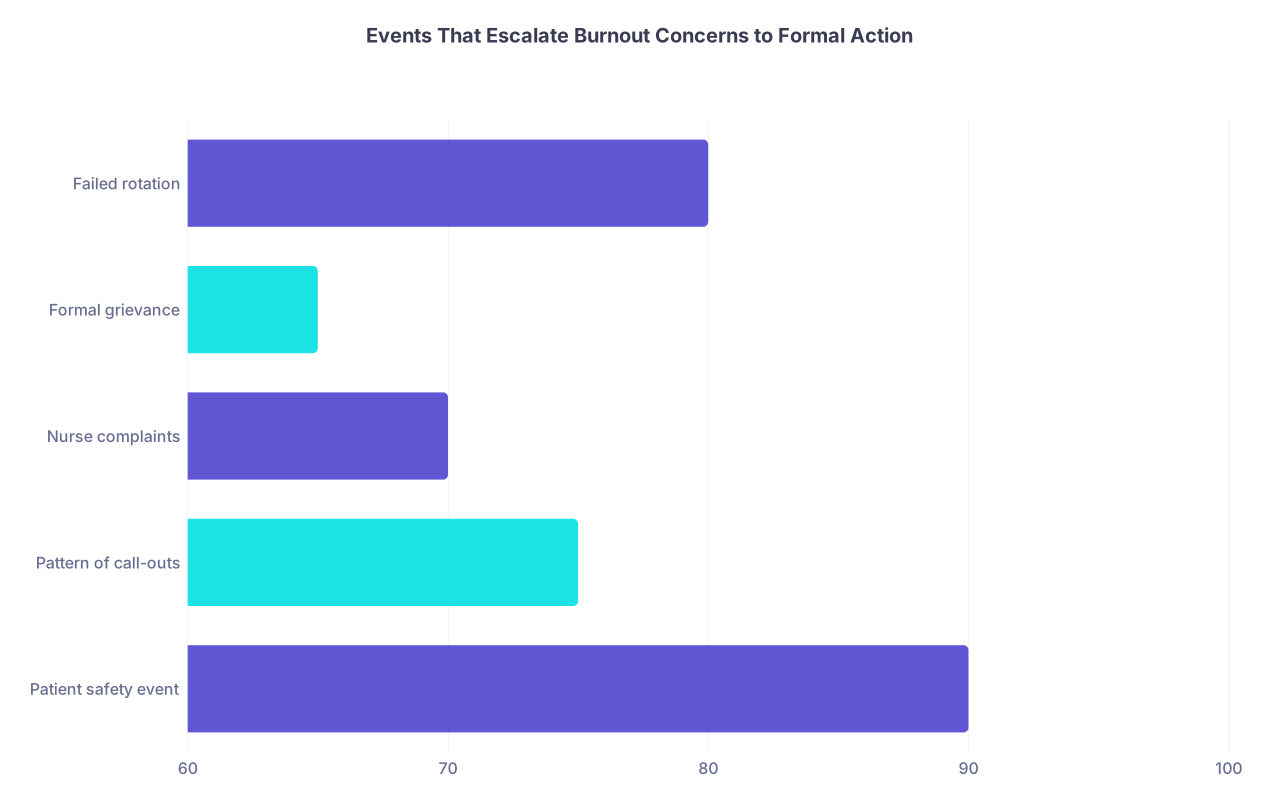
| Category | Value |
|---|---|
| Patient safety event | 90 |
| Pattern of call-outs | 75 |
| Nurse complaints | 70 |
| Formal grievance | 65 |
| Failed rotation | 80 |
If they’re already worried you’re burned out, any one of these can flip the entire story. Now it’s not: “We’re concerned about you.” It becomes: “We’re concerned about patient safety and liability.”
Once it hits that level, documentation ramps up:
- Formal letters
- Structured remediation plans
- Mandatory wellness / counseling involvement
- Stepwise follow-up with clear “if this, then that” pathways
You never want burnout to reach that stage before you acknowledge it.
How to Recognize Their Concern Before They Say It
You can usually feel when leadership has quietly flagged you—if you’re willing to look.
Here’s what it looks like from your side:
- Chiefs “checking in” more often, especially after tough shifts
- You’re suddenly on the radar for wellness events you previously ignored
- PD or APD randomly “stops by” your rotation to see how things are going
- A subtle shift in language: “Make sure you’re taking care of yourself,” “Do you have enough support?”

| Step | Description |
|---|---|
| Step 1 | Subtle changes in behavior |
| Step 2 | Informal comments from staff |
| Step 3 | Leadership aware |
| Step 4 | Quiet monitoring |
| Step 5 | Wellness check-in meeting |
| Step 6 | Support and adjustments |
| Step 7 | Escalating concern |
| Step 8 | Increased documentation |
| Step 9 | Formal remediation or leave |
| Step 10 | Resident responds honestly |
If your PD, who barely spoke to you for 18 months, suddenly takes an interest in your “overall well-being,” that’s not random. That’s surveillance plus concern, disguised as support.
You can get defensive about that. Or you can see it as an early warning light on your dashboard.
How to Use This Knowledge to Protect Yourself
Here’s the part you actually care about: what do you do with all this?
1. Notice the Narrative Forming Around You
If more than one person in a week—chief, nurse, co-resident—says some version of “You look wiped” or “You seem off lately,” do not just shrug that off.
That’s the social version of a flag. If they’re saying it to you, someone’s probably already saying it about you.
Pay attention to patterns:
- Are you suddenly snapping more than usual?
- Are you dreading shifts that you used to just tolerate?
- Are you finding yourself cutting corners you never would have before?
That’s your own internal CCC meeting. Do not wait for the real one.
2. Control the Story Before It Controls You
PDs are not robots. They respond to narrative.
If you approach them early and say something like:
“I’ve noticed I’m more exhausted and less patient than I usually am. I’m still doing the work, but I don’t like how I’m showing up. I think I need to adjust something before it becomes a bigger issue.”
You’ve just framed yourself squarely in the “good resident, rough patch” category. They will almost always work with you.
Contrast that with them coming to you first, with a list of complaints. Now you’re already behind the story.

3. Use the Quiet Flags as Early Intervention Signals
Every subtle thing you now know they’re watching—late duty hours, EMR patterns, tone shift—can become your early warning system:
- If you’re doing all notes at 1–2 am three nights in a row, something is wrong with your workflow, load, or support. Fix it or ask for help.
- If you see copy-paste creep in your own notes, you’re losing bandwidth. You’re not lazy. You’re overloaded.
- If you catch yourself dreading every shift, not just the bad ones, that’s not “normal residency misery.” That’s burnout territory.
Burnout that’s acknowledged early is usually salvageable. Burnout that’s hidden until it shows up as a major event is what ends careers.
Frequently Asked Questions
1. Will admitting I’m burned out make the program think less of me?
If you walk in and say, “I hate this place and I’m done,” yes, they’ll be worried. But coming in early with insight—“I’m not functioning at my best, and I want to fix that”—usually raises their respect for you. It signals maturity, insight, and patient-centered thinking. Remember: they already see your behavior. You admitting it just aligns their perception with yours.
2. Can I actually ask for schedule changes or lighter rotations without being punished?
You can, and many PDs are more flexible than you think—if you ask before things blow up. Swapping electives, spacing ICU months, giving you a research or ambulatory block after a brutal stretch—these are all reasonable requests when framed around sustaining safe performance, not just “I don’t like this.” The earlier you ask, the more options they have.
3. How do I know if I’m just “tired like everyone else” versus truly burning out?
Look at trajectory and identity. If you’re tired but still feel like yourself, still find small wins, still care (even if you’re annoyed), that’s residency exhaustion. When you start feeling emotionally numb, detached from patients, cynical about everything, and your behavior shifts in ways you don’t recognize, that’s burnout. When people around you start commenting on your change, that’s confirmation.
4. Can these internal flags hurt my fellowship chances?
They can, indirectly, if they evolve into documented professionalism or performance concerns. But quiet, early worries that lead to you engaging with support, stabilizing, and then finishing strong—those rarely hurt you. In fact, a PD who’s seen you hit a wall and handle it responsibly will often write more convincingly about your resilience than about someone who just coasted. The key is timing: engage early, don’t wait until the concern becomes formal.
Years from now, you won’t remember the exact wording of the evaluation that first hinted you were slipping. What will stay with you is whether you listened—to yourself, to the quiet concern in other people’s voices—and whether you had the courage to act before the system acted on you.


