

The cult of grit is quietly burning residents out.
You’ve been sold a bad story: that if you’re tough enough, driven enough, and “gritty” enough, you can simply power through residency without breaking. That burnout is a personal failure of willpower. That if you’re struggling, you just are not resilient enough.
The data say that’s nonsense.
The Grit Myth: What People Think Prevents Burnout
Somewhere between “what doesn’t kill you makes you stronger” and “see one, do one, teach one,” medicine adopted a macho religion: suffering is training. I have literally heard attendings say to interns, “This is how we separate the weak from the strong.” Another favorite: “Residency is supposed to suck. It builds character.”
This is the underlying myth:
If you are gritty enough, you will not burn out.
If you burn out, you were not gritty enough.
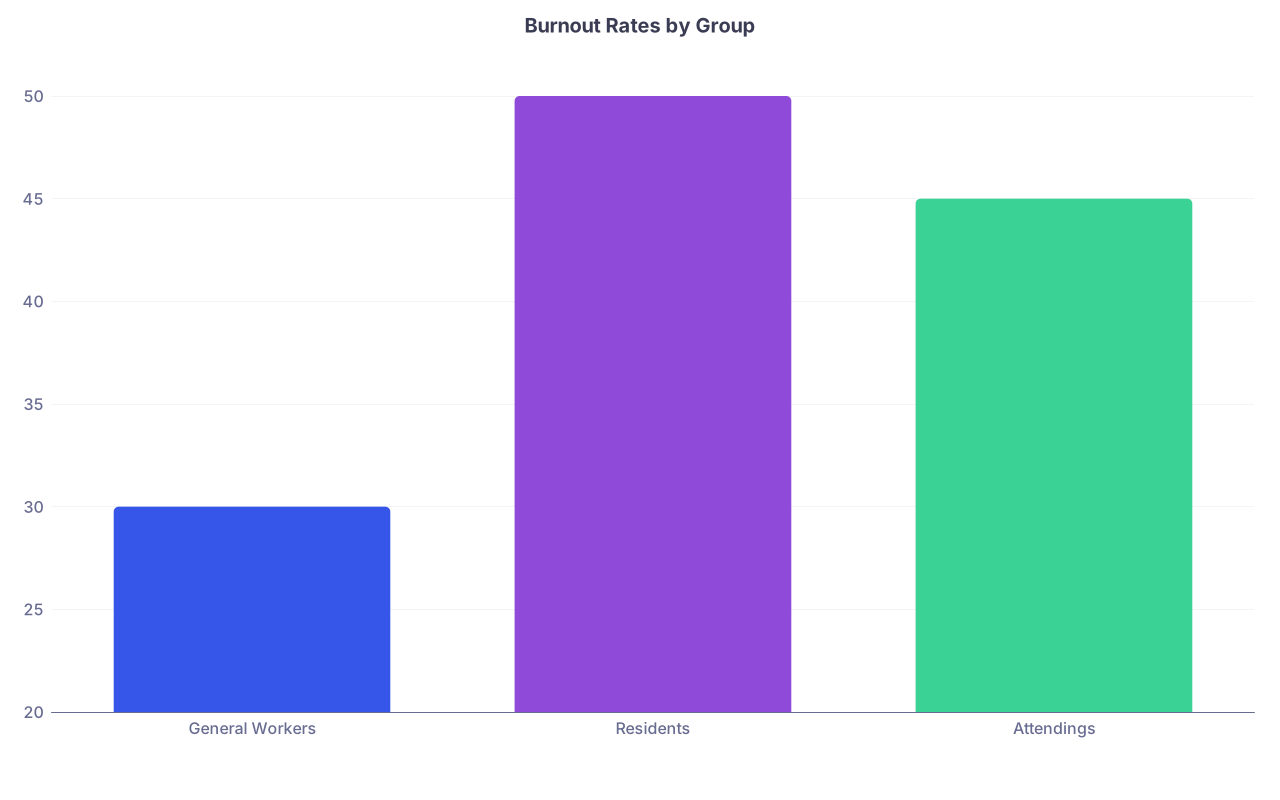
Here’s the problem. Multiple large studies show residents and physicians have high levels of grit and conscientiousness compared with the general population. Yet burnout rates are higher, not lower.
Rough numbers from various studies:
| Category | Value |
|---|---|
| General Workers | 30 |
| Residents | 50 |
| Attendings | 45 |
You’re looking at a profession that selects for grit, trains for persistence, rewards sacrifice—and then acts surprised when half the trainees hit a wall.
Grit doesn’t immunize you from burnout. Sometimes, it accelerates you toward it, because gritty people are the least likely to stop when they’re being harmed.
What Burnout Actually Is (And Is Not)
Burnout is not “being soft.” It is not “whining.” It is not the same as normal fatigue after a long week.
Clinically, burnout has three core components, backed by decades of research (Maslach, etc.):
- Emotional exhaustion – you are drained, you have nothing left to give.
- Depersonalization – you start seeing patients as tasks, problems, or annoyances.
- Reduced sense of personal accomplishment – you feel ineffective, like nothing you do matters.
None of those are solved by “trying harder.”
In fact, residents with the strongest work ethic are often the last to recognize they are burned out. They compensate longer. They stay later. They say yes to everything. They run on fumes while telling themselves they’re “fine” because they’re still functioning.
Until they’re not.
This is where the grit narrative becomes dangerous. It reframes a systemic and occupational hazard as an individual moral test. So instead of asking, “Why is the system burning so many people out?” the question becomes, “Why couldn’t you handle it?”
That’s backwards.

What the Data Actually Show Causes Burnout
Let’s strip away the motivational posters and look at real predictors of burnout in residents. Across specialties and countries, the same culprits keep showing up.
None of them are “low grit.”
Repeatedly identified risk factors:
- Excessive work hours and poor control over schedule
- High workload and patient volume
- Administrative burden and documentation overload
- Lack of autonomy and feeling micromanaged
- Poor leadership and toxic culture
- Mistreatment, harassment, and discrimination
- Sleep deprivation and chronic circadian disruption
- Moral injury—being forced to act against what you think is right due to system constraints
Residents in these environments burn out at significantly higher rates, regardless of how tough or motivated they are.
Programs that address these system-level issues show real reductions in burnout. Shorter shifts. Protected time for learning. Reasonable documentation support. A culture that actually enforces no-shame coverage for illness or mental health appointments.
Not once in those intervention studies is “increase grit training” the magic bullet.
Here’s a simple comparison.
| Factor | Evidence-Linked to Burnout? |
|---|---|
| Work hours & overnight call | Yes |
| EMR/administrative burden | Yes |
| Program leadership quality | Yes |
| Grit / conscientiousness level | Weak / inconsistent |
| Access to mental health support | Yes (protective) |
More striking: the residents who are most “gritty” are often the ones who stay late to clean up systemic messes. They carry extra weight. They absorb more of the dysfunction. That doesn’t protect them. It drains them faster.
Why Sheer Willpower Backfires
Let me walk through how this actually plays out on the ground, because I’ve seen this pattern more times than I can count.
You start residency with high motivation and identity wrapped tightly around being a “good resident.” You stay until the work is done. You never sign out “too much.” You volunteer for procedures. You pick up slack. You pride yourself on “never complaining.”
That’s grit in action.
Now add:
- 80–90 hour weeks during busy rotations
- Chronic sleep debt from q4 call or night float
- EMR inbox and note burden that bleeds into off days
- An attending who equates exhaustion with dedication
- A culture where asking for help is seen as weakness
Your “solution” to feeling behind? Push harder. Stay later. Keep saying yes. Use more willpower.
It works for a while. Then you start noticing:
- You’re snapping at nurses for small things.
- You dread certain patients the moment you see their names.
- You’re making little mistakes that are not “you.”
- You feel a weird numbness when something bad happens.
You double down again. Maybe you add a gym session on 4 hours of sleep because you’ve been told exercise cures burnout. Maybe you force yourself to “gratitude journal” at 1 am on call because some wellness lecture said so.
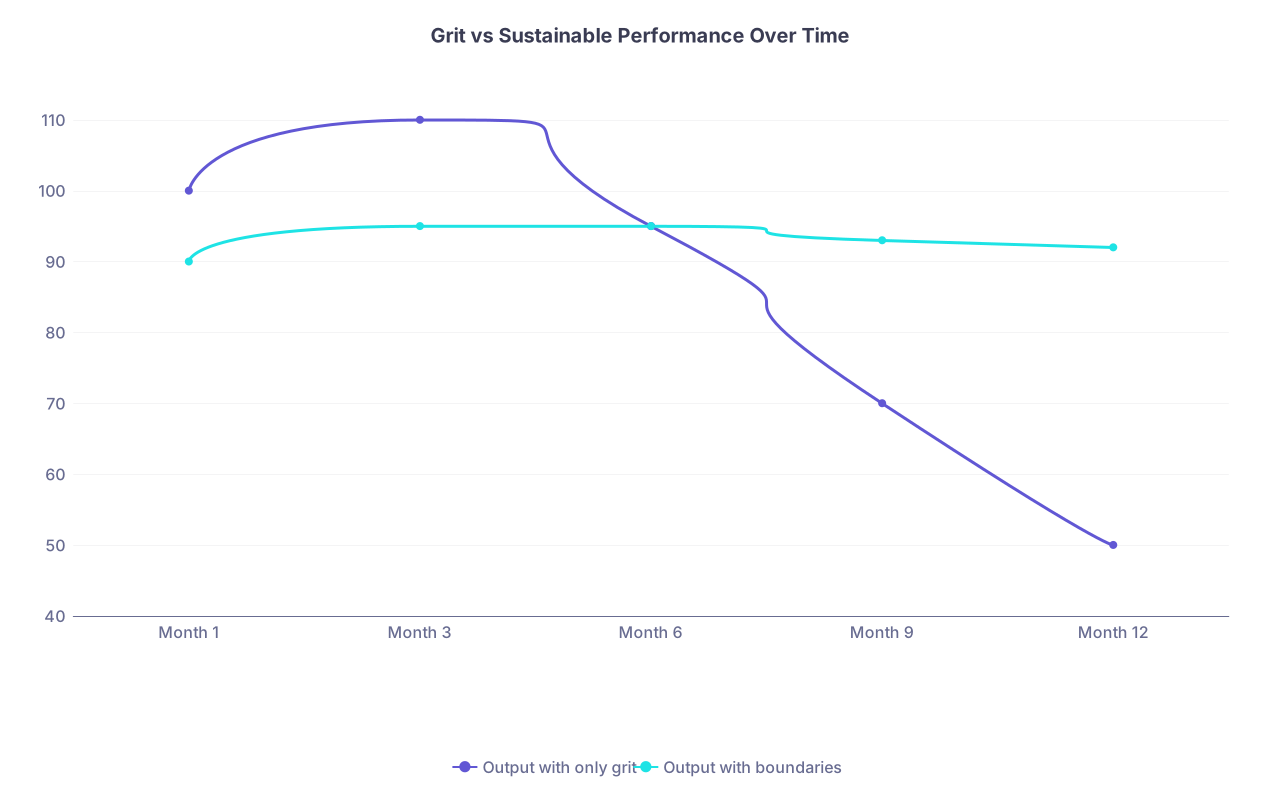
This is where grit becomes a liability. You are using the same mental muscle—push harder—to solve a problem that requires the opposite: pulling back, changing conditions, setting limits, protecting bandwidth.
| Category | Output with only grit | Output with boundaries |
|---|---|---|
| Month 1 | 100 | 90 |
| Month 3 | 110 | 95 |
| Month 6 | 95 | 95 |
| Month 9 | 70 | 93 |
| Month 12 | 50 | 92 |
That first line—the “only grit” curve—is what most residents are riding. Impressive at first. Then a slow collapse. The second is what sustainable medicine looks like. Slightly less than maximum at the start, far more stable long term.
Grit without boundaries is like flooring the gas with a slow leak in the fuel line. You go fast—until you don’t go at all.
What Actually Helps Prevent Burnout (That Isn’t Just “Try Harder”)
Here’s where I’m going to be very clear: individual strategies matter, but they’re not about willpower. They’re about tactics and structure. And they work with your limits, not against them.
1. Boundaries as a Skill, Not a Personality Flaw
Residents are conditioned to feel guilty for having limits. That’s not professionalism. That’s exploitation dressed up as virtue.
A few concrete examples of real, workable boundaries in residency:
- Using sign-out honestly. If it is 6:55 pm and you discover a massive, non-urgent task for a stable patient, it goes to night float. That is not laziness. That is the design of the system.
- Saying, “I can see the new ED admit now or staff these complicated dispo decisions with you, but I can’t do both safely at once—what do you prefer I prioritize?” You are forcing your senior or attending to choose, which is their job.
- Not doing non-urgent charting at home on post-call days by default. If the program can’t staff enough to cover documentation, that’s a program problem, not a “you should be more dedicated” problem.
Boundaries reduce burnout because they reduce chronic overextension. You are not less gritty for using them. You are just less naive.
2. Sleep Is Not Optional, It’s Equipment
Residents treat sleep like a luxury. It is equipment. Like your stethoscope or your EMR login. You function without it for short bursts; you malfunction without it long term.
Studies link chronic sleep deprivation in residents to:
- More medical errors
- Increased depression and burnout
- Impaired learning and memory
And no, “I’ve always done fine on 4–5 hours” is not evidence. That is just you being unaware of your performance drop.
You cannot willpower your way out of the cognitive and emotional effects of sleep loss. So the game becomes brutally practical:
- On night float, protect your end-of-shift sleep window like it’s a procedure. Phone off, blackout, earplugs.
- On non-call nights, stop letting documentation or “being a great team player” regularly cut into sleep time.
- If call schedules are literally unsafe, that’s a leadership issue. Document, push, and if needed, involve the GME office. That’s defensive medicine for your brain.

3. Control What You Can: Demand-Supply Matching
Burnout thrives where demands chronically exceed your internal and external resources. It is that mismatch that drives the problem, not a missing “grit gene.”
You have more levers than you think—none of them are “want it more.”
You can’t magically shrink the patient list or abolish the EMR. But you can:
- Simplify where perfectionism is secretly eating your time. Not every note needs to be a publication.
- Batch tasks instead of constantly context-switching—round, then notes, then orders, then calls, rather than ping-ponging all afternoon.
- Use the team. Let the med student pre-chart. Let the intern draft the note. Supervise instead of soloing everything forever.
- Stop volunteering reflexively for every committee, QI project, and teaching gig when you’re already underwater.
This is not “slacking.” It’s reallocating your limited cognitive and emotional budget in a place that refuses to respect limits.
4. Community Over Heroics
Lonely, “heroic” residents burn out faster. The ones who make it are usually not the toughest on paper. They’re the ones who are woven into a net.
That looks like:
- A co-intern you can text, “I’m not okay” without needing to explain.
- A senior you trust enough to say, “I need help with this list,” without fear of being labeled weak.
- A therapist or counselor who actually understands medical training—yes, even if it means using PTO or clinic time to go.
There is data to back this up: perceived social support is consistently associated with lower burnout. Isolation, especially emotional isolation, drives it up.
Sheer willpower keeps you alone with your struggle. Connection breaks that.

| Step | Description |
|---|---|
| Step 1 | High workload |
| Step 2 | Chronic exhaustion |
| Step 3 | Reduced performance |
| Step 4 | Increased self blame |
| Step 5 | More overwork to compensate |
| Step 6 | Withdraw from peers |
| Step 7 | Less support |
That loop is what you’re up against. Grit, applied blindly, strengthens the loop. Boundaries, sleep, and connection are what break it.
The System Problem You’re Not Imagining
You can do everything “right” as an individual and still burn out in the wrong environment. That’s not an excuse. That’s epidemiology.
Programs that have actually moved the needle on burnout do things like:
- Reduce non-educational service load
- Improve staffing and ancillary support
- Implement sane call schedules and actually enforce them
- Train faculty in giving constructive, non-abusive feedback
- Provide easy-access, confidential mental health care
- Involve residents meaningfully in decision-making
Notice what’s missing: “teach residents more grit.”
You still need persistence to get through residency. Of course you do. But persistence is the ignition, not the fuel tank, and definitely not the brakes. Without system changes, you’re just burning a high-octane engine hotter inside a faulty machine.

If You’re Already Burning Out
If you’re reading this and recognizing yourself, that’s not proof you lack grit. It’s proof you’ve been using it to survive a damaging setup.
Three pragmatic moves:
- Label it accurately. “I’m burned out.” Not “just tired,” not “just a bad month.”
- Loop in someone with real power: PD, chief, trusted faculty, GME. Come with specific examples of schedule, load, and impact.
- Get professional mental health support early, not after you’re contemplating walking away from medicine entirely.
And drop the shame. You are not failing a character test. You are responding normally to abnormal conditions.


