

The most honest conversations about resident burnout never happen at wellness retreats. They happen behind a closed door with the pager face-down and someone finally saying, “I can’t keep doing this.”
Let me tell you what really gets said in those rooms. Not the polished survey answers. The unfiltered stuff residents only admit when they believe it will not make it back to their program director, their CCC file, or their board eligibility.
What Burnout Actually Looks Like to Residents (Not the Textbook Version)
Programs love to quote Maslach inventories and show you tidy slides on “emotional exhaustion” and “depersonalization.” Residents don’t talk like that.
Behind closed doors, they say things like:
“I rehearse what to tell my parents if I quit.” “I had a code yesterday and all I could think was, ‘Please don’t make me write more notes.’” “I’m more scared of being judged by attendings than of hurting a patient by accident.”
That’s burnout from the inside.
It’s not just “tired.” Every resident is tired. Burnout is when some fundamental piece of you starts shutting down in self-defense.
I’ve sat in GME debriefs where faculty listen through the wall as chiefs run “wellness check-ins” with their residents. What you hear, if you know what to listen for, is this:
- Third-years in July whispering, “I feel nothing when families cry now. I fake it.”
- Interns saying, “I’m nauseous every time my pager goes off. I check it and my hands shake.”
- PGY-2s laughing too hard at dark jokes about “hoping for a sick day via car accident.”
No one says “I am burned out” first. They say “I’m just being soft,” “I should be tougher,” “Everyone else is handling it,” “I’m just behind.”
That’s the first lie.
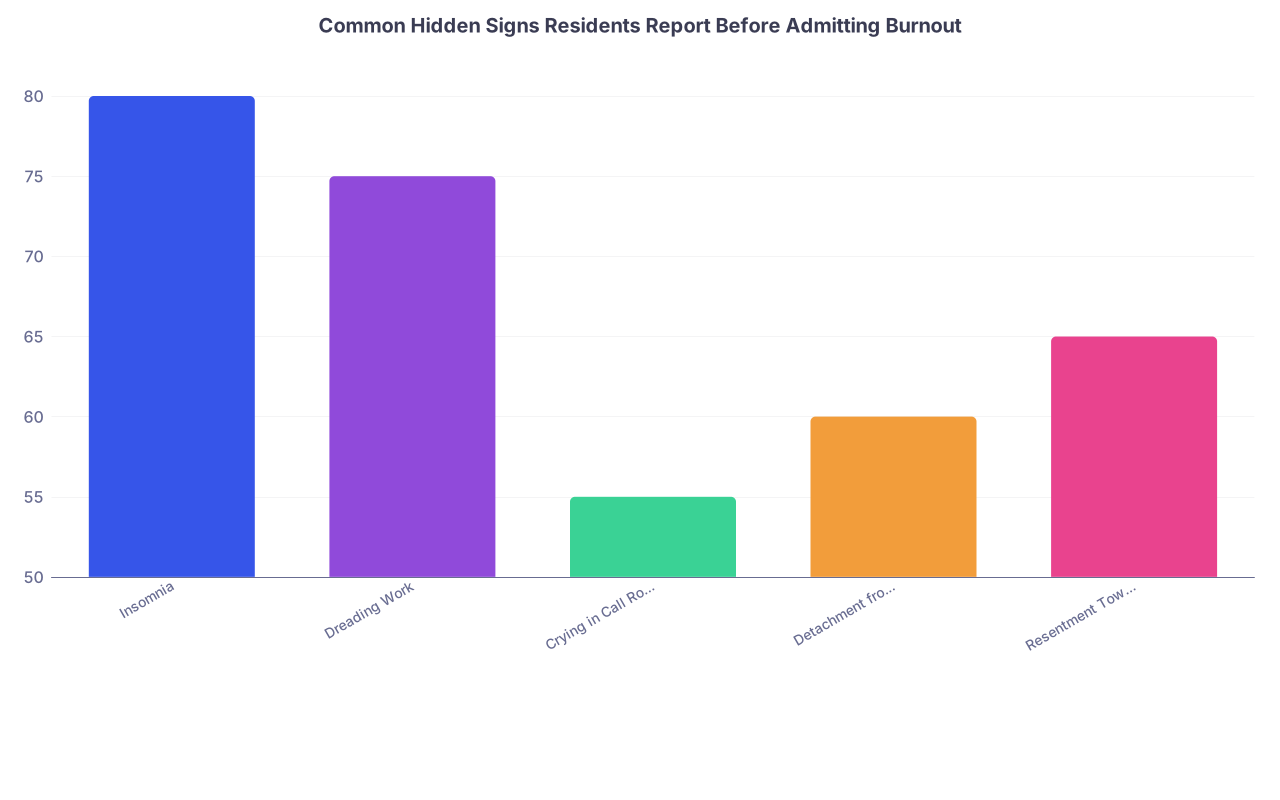
| Category | Value |
|---|---|
| Insomnia | 80 |
| Dreading Work | 75 |
| Crying in Call Room | 55 |
| Detachment from Patients | 60 |
| Resentment Toward Team | 65 |
The second lie is more dangerous: “If I talk about this, they’ll think I’m incompetent.”
And they are not entirely wrong. Some attendings do equate vulnerability with weakness. Residents learn quickly who they can break down in front of and who they must always perform for. That determines whether burnout gets treated early or allowed to rot.
What Residents Actually Say About the Job When They Feel Safe
Let me strip away the brand-safe language and show you what comes up when the door closes and the recording is off.
1. “I feel disposable.”
The most corrosive feeling I hear from residents is not exhaustion. It’s replaceability.
“When I was out sick, they didn’t ask how I was. They asked who could cover my shifts.”
“I’m a warm body that can sign orders. That’s it.”
Residents see the schedule games. They see service needs prioritized over education. When a resident breaks down and the first move is “Can you finish the shift?” that message lands hard: you are a resource, not a learner.
I’ve watched a PD say in a leadership meeting, about a resident who had just had a panic attack on nights, “We need to support her” — and then two minutes later, “But someone still has to cover those admits.”
Residents are not in that room. They only feel the second part.
2. “The culture punishes asking for help.”
You know what residents confide in small groups? They all have a mental list of attendings they will never admit ignorance to.
“I’d rather Google it in the bathroom than ask her and get torn apart.” “I’ll over-order labs rather than ask a question and look dumb.”
Every program has the “you have to survive working with him” attending. Everyone knows it. No one does anything meaningful about it. Burnout thrives in that environment, because psychological safety is zero.
Residents start hoarding their fears. Hoarding errors. Hoarding near-misses. They stop debriefing bad cases because that requires vulnerability in front of people who might write their letters.
That’s where burnout crosses into danger.
3. “I don’t recognize myself anymore.”
This one scares them the most.
Residents talk about snapping at nurses, rolling their eyes at consults, secretly hoping a patient gets downgraded or transferred so they can “get rid of them.” They hate themselves for it. They know it’s not who they were as MS4s begging for a chance to help.
“I caught myself being relieved when a patient died overnight because at least I didn’t have to preround and call the family. Who thinks that? What is wrong with me?”
Nothing is “wrong” with them. They’re in a system that grinds down empathy and then pats itself on the back for a mindfulness workshop.
But they don’t say that out loud at town halls. They say it in call rooms and therapy sessions — if they’ve even made it that far.
The Stuff Residents Will Not Put in Writing (But Say Off the Record)
Anonymous surveys are not as honest as institutions pretend. Residents do basic risk calculations: “Anything identifiable? Any free-text that sounds like me?” They sanitize their pain.
In confidential, small-group debriefs and one-on-one talks, the real patterns come out.
“I’m terrified of making a catastrophic mistake.”
Not just “I could hurt someone” — that they accept as part of the job — but:
“If I screw up, they’ll hang me out to dry.” “They’ll say they support systems thinking, but when a big error happens, they’ll find the weakest person and blame them.”
So what do residents do? They stop admitting mistakes unless they’re forced to. They also stop taking reasonable risks in learning. Burnout isn’t just emotional; it’s intellectual. Curiosity dies.
I’ve seen residents who used to pepper rounds with thoughtful questions become silent, nodding drones. That change rarely shows up on evaluations; attendings call them “more efficient” or “independent.”
No. They’re just scared.
“I can’t tell what’s normal misery and what’s a problem.”
Here’s a dirty little secret: most programs never clearly tell residents where the line is between expected stress and unacceptable suffering.
So residents guess.
“I’m crying three times a week, but everyone’s tired… so maybe this is normal?” “I drink every night when I get home, but I still show up on time, so it’s fine, right?” “I fantasize about walking out mid-shift, but I keep going, so I’m okay.”
They benchmark against other burned-out people and call that “normal.” By the time someone finally says, “This is bad,” they’re already in a deep hole.

“I’m scared to use mental health resources.”
You’ve heard the official line: “Use our Employee Assistance Program. We care about your wellness.”
Now here’s what residents whisper to each other:
“Will this be in my record?”
“Will it affect my licensing questions?”
“Did you hear about that resident whose PD found out and started ‘monitoring’ them?”
There is still profound distrust around confidentiality. Especially in smaller programs, where the therapist’s spouse plays tennis with the chair, or where the same two psychiatrists see half the hospital.
So residents confide in each other instead. The blind leading the blind. One PGY-3 who’s barely hanging on coaching an intern through panic attacks on nights.
They’ll talk about burnout in a closed wellness group long before they’ll talk to the program’s “preferred provider.”
What Actually Drives Burnout (Not Just the Pretty Slide Deck Factors)
Everyone has seen the bullet lists: workload, lack of autonomy, poor work-life balance. True, but shallow. Residents name more specific, uglier causes when they feel safe.
The hidden curriculum of self-sacrifice
The explicit message: “Take care of yourself. Your wellness matters.”
The implicit message: “Real team players do not call out sick. Real residents never say no. Real leaders stay late.”
Residents see who gets praised publicly:
“She stayed till midnight finishing her notes.”
“He picked up extra shifts to help the service.”
“She didn’t take her golden weekend because we were short.”
That is who gets held up as a model. Not the resident who sets boundaries, gets therapy, uses their PTO, and still performs well.
Residents internalize it. They trade away sleep, meals, exercise, relationships, because they think that’s the cost of being “committed.” The program reinforces it every time it rewards martyrdom and ignores sustainable behavior.
Administrative burden that crushes meaning
If you want to hear pure venom from residents, talk documentation.
“It’s not the sick patients. It’s 40 minutes of clicking nonsense for a two-minute decision.” “I spend more time hunting for buttons in the EMR than talking to families.”
The thing that actually keeps residents going is meaningful patient interaction. When 70% of their day is inboxes, forms, death by a thousand clicks, the fuel runs out.
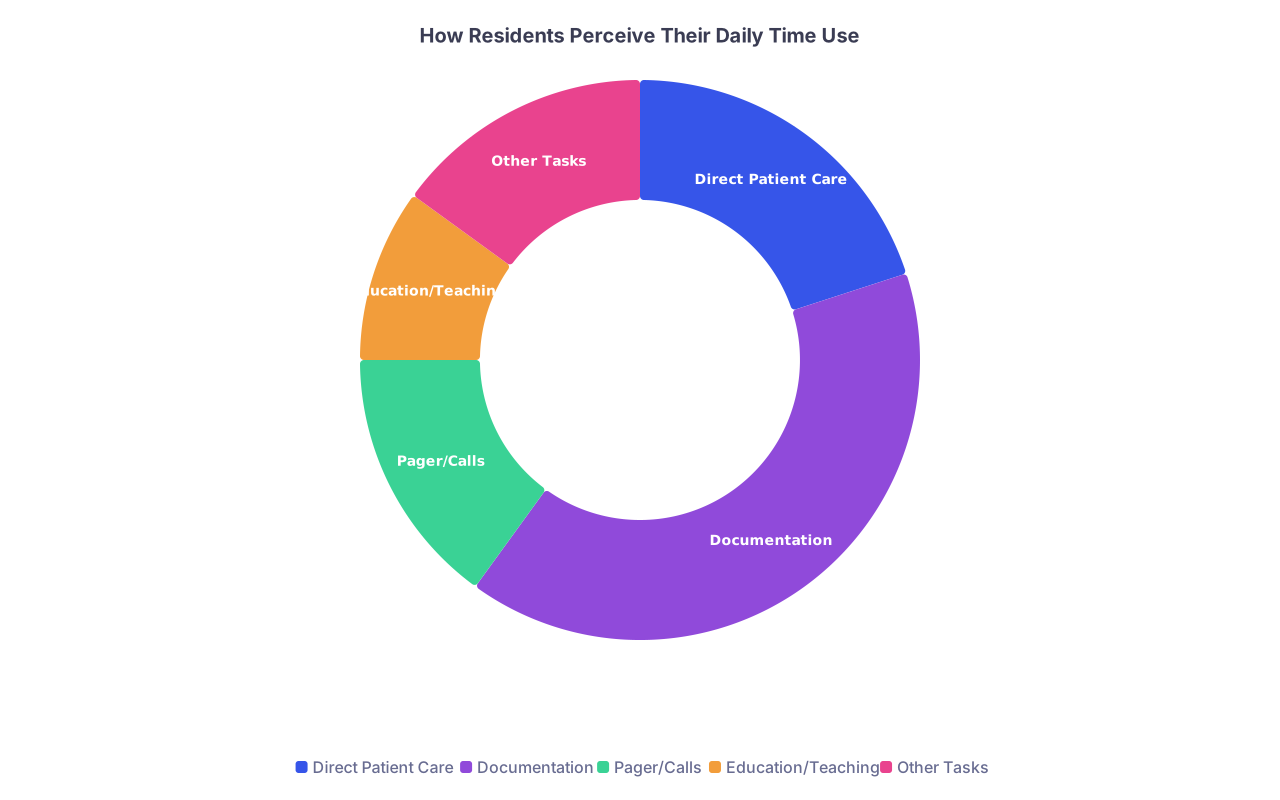
| Category | Value |
|---|---|
| Direct Patient Care | 20 |
| Documentation | 40 |
| Pager/Calls | 15 |
| Education/Teaching | 10 |
| Other Tasks | 15 |
No mindfulness app is going to fix that.
Leadership that is performatively supportive
Residents can smell inauthenticity a mile away.
When a PD gives a grand rounds on burnout and then, in the same breath, announces a new requirement that adds hours of unpaid work, residents connect the dots. When an attending preaches “work-life balance” and then belittles someone for leaving on time, the hypocrisy is obvious.
I’ve been in meetings where GME leaders explicitly say, “We need to do something visible for wellness.” Visible. Not effective. Not resident-designed. Just visible.
Residents see the yoga classes and resilience workshops for what they often are: optics.
What Residents Do That Secretly Helps (Even If They Wouldn’t Call It ‘Wellness’)
Here’s the interesting part. When you listen to burned-out residents who are still functioning, they’ve usually built quiet survival strategies that never show up on institutional wellness slides.
The micro–boundary moves
They don’t announce, “I’m setting boundaries.” They just start doing things like:
- Not answering non-urgent texts from attendings after a certain hour.
- Going to the bathroom and deliberately taking 60 seconds to breathe with the door locked.
- Letting a non-urgent note wait till morning instead of staying an extra hour to perfect it.
These are small acts of rebellion against the culture of endless availability. They’re not glamorous, but they’re often the first step out of the burnout free-fall.
Choosing their “safe people” very carefully
Most burned-out residents I’ve seen find one attending, one co-resident, and sometimes one nurse or APP who they trust completely. People they can say the unsayable to:
“I’m scared I’m going to miss something big.” “I genuinely hate coming in right now.” “I don’t know if I want to do this specialty anymore.”
They do not spread this vulnerability widely. They test, watch reactions, and then slowly open up.
If you’re smart, you’ll identify your own “safe three” early. This is one of the most protective factors I’ve seen.

Creating “off-duty” identities
Burned-out residents who survive long-term almost always have one thing external that is non-negotiable: running, D&D, church choir, weekly dinner with a partner, whatever.
They do not broadcast this to leadership as “self-care.” They just protect it:
“I’ll switch from 24-hour call to 28s if I can still make my Thursday night league.” “I can stay late tomorrow, but I’m leaving on time tonight. No discussion.”
Programs often see this as “less dedicated.” Residents who last see it as survival.
What Residents Wish They Could Say Directly to Program Leadership
In private groups — no faculty, no transcripts — residents are very clear about what would actually help them not burn out. It’s not pizza. It’s not another lecture about sleep hygiene.
Here’s the unvarnished version of what they’d tell leadership if they weren’t afraid of retaliation.
“Stop pretending this is about my resilience.”
Residents are not fooled. They know you cannot “deep-breathe” your way out of 28-hour call with 18 admissions and four ICU transfers.
They’d say:
“Fix the schedule before you fix the wellness curriculum.”
“Staff the services properly before you buy another meditation app.”
“Stop flattering yourselves that I’m burned out because I don’t know how to be mindful.”
| Programs Commonly Offer | Residents Quietly Say They Need |
|---|---|
| Mindfulness workshops | Fewer useless clicks in EMR |
| Wellness lectures | Protected, real days off |
| Pizza nights | Safe ways to call out sick |
| Yoga / meditation apps | Less abusive attendings |
| Resilience campaigns | Honest, flexible scheduling |
“Be honest about what you can’t fix.”
Residents aren’t children. They know the system is bigger than a single PD or DIO. What infuriates them is the pretense.
If leadership said plainly:
“We can’t get rid of all 28-hour calls this year. Here’s what we can do, concretely, in the next 6 months.”
They would respect that. Instead they get vague promises, committee announcements, and then nothing observable changes on the ground.
“Protect us when we speak up — don’t just ask for feedback and then do nothing.”
One of the biggest drivers of cynicism? Reprisal, direct or indirect, after someone raises real concerns.
Residents talk. They know who got mysteriously “needs-improvement” evals after filing complaints. They know whose fellowship letter cooled off after pushing back about unsafe staffing.
If you want them to talk about burnout early, you have to actually shield them. Not in policy. In practice.
The Things Residents Confide When They’re Right at the Edge
The darkest stuff only comes out when a resident is absolutely sure it’s confidential. This is where wellness pamphlets feel obscene.
“I’ve thought about crashing my car on the way to work. Not to die. Just enough to get a few days off.”
That line, or some version of it, comes up more than programs want to admit.
Residents at the edge also say:
“I’ve looked up licensing questions to see exactly how much I can say about depression without triggering an investigation.”
“I have a whole story ready to explain any gap on my CV that doesn’t involve me saying I was suicidal.”
“I know more about physician suicide statistics than my own board scores.”
If you think those thoughts are rare, you’re lying to yourself. In some high-intensity programs, nearly every third or fourth resident has at least fleeting versions of them.
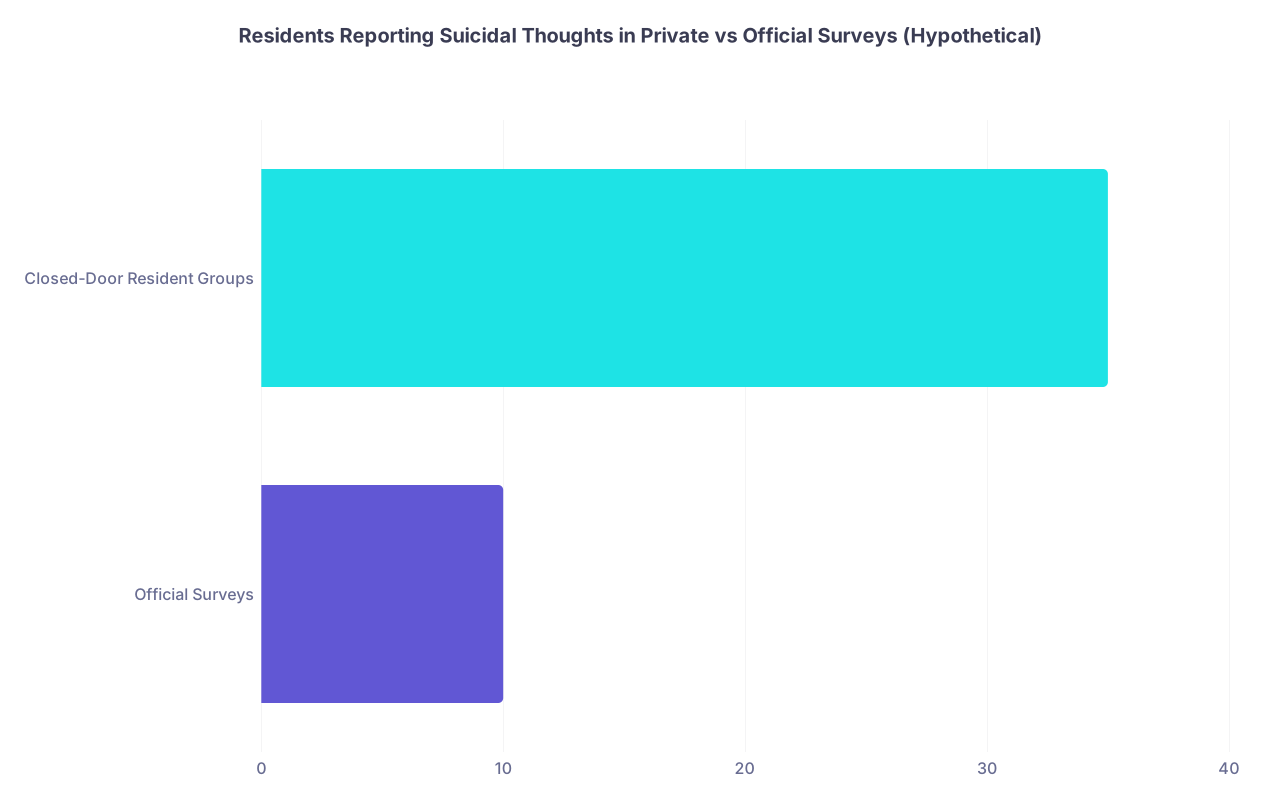
| Category | Value |
|---|---|
| Official Surveys | 10 |
| Closed-Door Resident Groups | 35 |
Late at night, in call rooms and in cars and in tiny therapy offices, residents say this:
“I am scared that if I tell the truth, medicine will spit me out.”
So they lie. On forms. To attendings. To PDs. To each other, sometimes. They say, “I’m fine, just tired.”
And behind closed doors, they tell the Insider version.
If You’re a Resident Reading This Right Now
Let me be blunt. There are three realities you have to hold in your head at the same time.
First, you are not crazy. The mismatch between responsibility and control in residency is structurally inhumane in many places. Your distress is a proportionate response, not a personal failure.
Second, no one is coming to rescue you. Systems move slowly. Committees talk. Policies get drafted. Meanwhile you’re on nights tomorrow. You cannot wait for institutional perfection to take your own risk seriously.
Third, you don’t get a second brain. Once you’re broken enough to walk away entirely, the same system that pushed you there will shrug and keep going. You are the only one with a real stake in preserving your long-term self.
So you play a dual game.
You do what you must to get through — protect your evaluations, pick your battles, learn the medicine. And in parallel, you quietly build the safeguards:
- One or two people you can be completely honest with.
- One part of your life that residency does not own.
- One professional who is legally and ethically obligated to keep your secrets.

| Step | Description |
|---|---|
| Step 1 | Feel overwhelmed |
| Step 2 | Confide in trusted co resident |
| Step 3 | Talk to supportive faculty |
| Step 4 | Seek outside therapist |
| Step 5 | Consider leave or schedule change |
| Step 6 | Maintain supports and reassess |
| Step 7 | Safe to talk at work |
| Step 8 | Still unsafe or worsening |
You don’t have to confess everything to your PD. But you do have to confess it somewhere. Because the things residents say about burnout in closed-door meetings — the car-crash fantasies, the emotional numbness, the “I don’t care if I wake up tomorrow” — those are warnings. Not quirks.
They are your brain pulling the emergency brake.
Listen to it.
The bottom line
Three truths to carry forward:
- What you’re feeling is almost certainly shared by people around you who are just as scared to say it. Burnout in residency is common, not a personal defect.
- The system is not designed to protect your well-being; you have to build your own back-channel protections — trusted people, real boundaries, and confidential help.
- Silence serves the machine, not you. The thoughts you only admit in closed-door meetings are exactly the ones that need oxygen, scrutiny, and, if needed, action before they become headlines instead of confessions.


