

You walk out of the hospital. Again, it is dark. Again, you are mentally replaying an attending’s criticism from 2 pm. Your phone buzzes—sign-out questions, a co-resident venting, a patient’s family messaging you through the portal—and your first thought is, “I have to respond right now.”
You are post-call, but you are still “on.”
That is how a hard rotation quietly mutates into full burnout: not from the hours alone, but from boundary mistakes that keep you working long after you have “left,” apologizing when you should be limiting, absorbing everyone’s anxiety because you never learned to say, “That is not mine.”
Let me be blunt: rotations will be brutal. That part is non-negotiable. But I have watched residents in the same ICU, same program, same hours—one barely tired, one broken. The difference usually comes down to boundaries. And most people learn them the hard way.
Let us not do that.
1. The “Always Available” Trap
You know this one. A senior says, half-joking, “We basically live here this month,” and you take that literally.
You start:
- Answering non-urgent texts at midnight on your one golden day off
- Logging back into Epic “just to finish a couple notes” that somehow becomes 2 hours
- Responding to every group chat ping like it is a code blue
That is not dedication. That is self-neglect dressed up as professionalism.
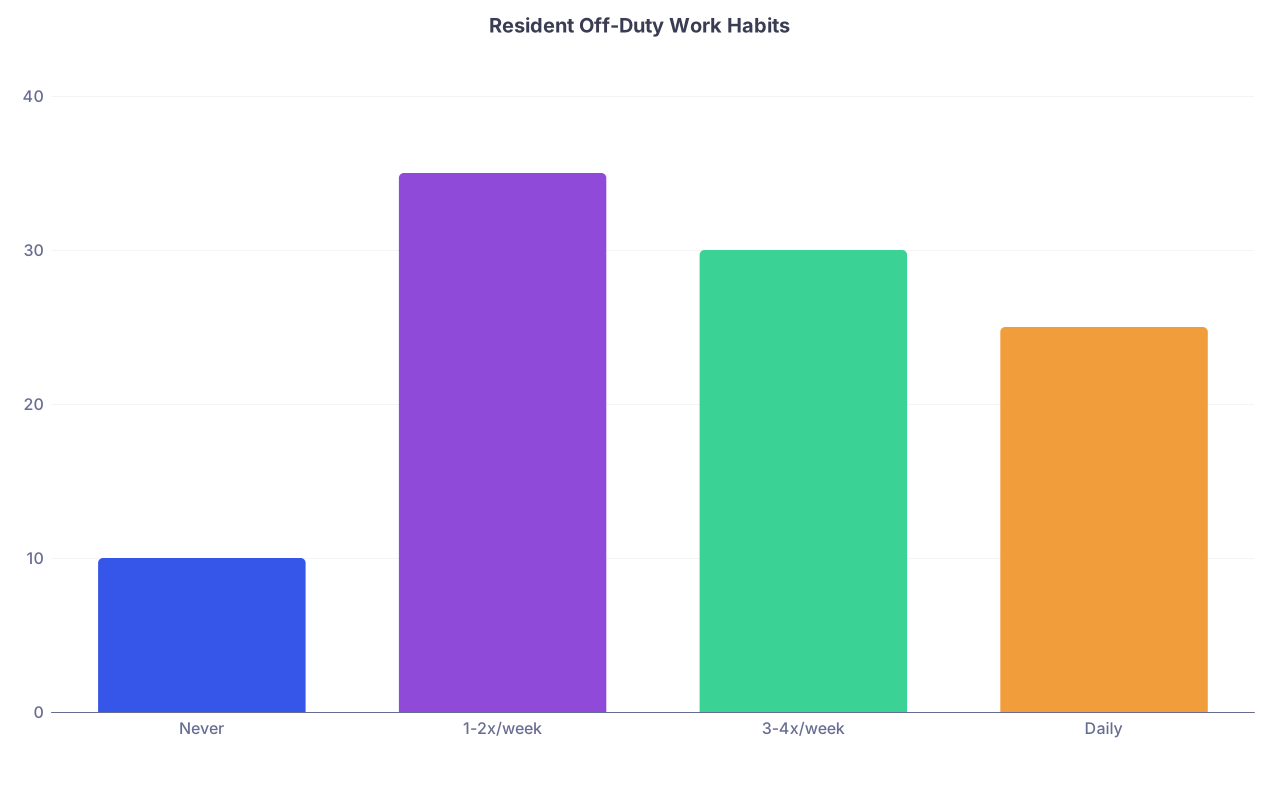
| Category | Value |
|---|---|
| Never | 10 |
| 1-2x/week | 35 |
| 3-4x/week | 30 |
| Daily | 25 |
Here is where people screw this up:
- They confuse availability with reliability.
- They assume everyone else is doing it.
- They underestimate the cumulative cognitive load of “just checking.”
I have watched interns answer non-urgent nurse calls on their post-call day “because they know the patient best.” Sounds noble. Looks noble. But what they do not see is that by month three, they jump at every page, even when they are lying in bed at home. Their nervous system never powers down.
What to avoid:
- Do not give co-residents, nurses, or even attendings the impression that you will answer clinical questions when you are not on duty, unless it is truly emergent. The rare true emergency will find you anyway. Nobody needs your opinion on a potassium of 3.4 on your day off.
- Do not normalize real-time responses to non-urgent texts. If you answer instantly every time, you teach everyone that is your standard.
What to do instead:
- Set a quiet boundary with yourself first: “When I’m off, I’m off. If it is not my patient or not my shift, I am not the doctor on record.”
- On team chats, respond at reasonable intervals, not immediately. You can be collegial without being on-call 24/7.
- If pressured, have a line ready:
“Once I sign out, I’m fully off so I don’t make tired decisions. Whoever’s on is better positioned to handle it.”
That is not dramatic. That is safe.
2. Letting Documentation Bleed Into Your Life
The hidden burnout engine: charting that follows you home.
Everyone thinks their situation is the exception:
“I just need to close two notes.”
“If I finish this discharge summary now, tomorrow will be easier.”
“I can’t leave with open orders; it stresses me out.”
Then it becomes your nightly ritual. You eat, open the laptop, and turn your living room into a satellite workroom. Your brain never associates home with recovery. Just another place to grind.

The mistake here is not needing to catch up sometimes. The mistake is treating at-home documentation as your standard operating procedure.
Common rationalizations (all terrible):
- “Our EMR is so slow, I’ll just do it later from home.”
- “Everyone does it.”
- “If I leave, I’ll forget the details.”
Here is the problem: you are trading present fatigue for future burnout. You are teaching yourself that work has permission to colonize your home, your bed, your relationships.
Fixing this means you will probably leave a bit later for a while. That is the cost. But the payoff is real mental separation.
Avoid these errors:
- Do not stay in the workroom chatting for 45 minutes then blame “no time” for notes.
- Do not agree to extra tasks 30 minutes before sign-out if your notes are not done. Say, “I can call them now, but I will not be able to complete X before I leave. Which is more important?” Put the decision back on the senior/attending.
- Do not open your EMR on your day off to “quickly check on the patient.” That is emotional chart-stalking, not care.
Set hard lines:
- “No charting at home” as a default policy. Break it only for truly abnormal situations (code, disaster, absurd admission load).
- Use protected blocks during the day where you are obnoxiously focused on notes: 30-45 minutes, headphones in, minimal chatter. You are not antisocial; you are preserving your sanity.
You will be tempted to break this boundary when everyone else is casually charting from their couch. Remember: most of them are also quietly miserable.
3. Mistaking People-Pleasing for Professionalism
This one is brutal because residency selects for people who hate disappointing others. You want seniors to like you, attendings to trust you, nurses to feel supported, patients to feel heard.
Healthy. Until it is not.
Here is how people-pleasing turns toxic:
- You say yes to every cross-cover favor (“Can you just follow this lab?”) even when your list is unsafe.
- You stay late “helping” others while your own work bleeds into the night.
- You take on tasks outside your role because you feel guilty saying, “That is not something I can do right now.”
I watched a PGY-2 in medicine quietly pre-chart for half the team because she “did not want anyone to feel behind.”
By November, she was waking up at 3 am with chest tightness. Not dramatic. Just deeply, predictably burned out.
| Situation | Healthy Response | Burnout-Fueling Response |
|---|---|---|
| Co-resident asks for help while you are swamped | “I can help after I finish my notes.” | Dropping your work to pre-round for them |
| Nurse asks for non-urgent med change when you are at sign-out | “Please page day team; I’m signing out.” | Logging back in from home to place orders |
| Attending asks for extra project on tough rotation | “Can we start this after this block?” | Agreeing immediately and doing it post-call |
Red flags you are sliding into people-pleasing burnout:
- You feel irrationally anxious saying “no” or “later.”
- You are resentful all the time but still over-functioning.
- You measure your value mostly by how “helpful” others say you are.
Here is the boundary you must not screw up: You are allowed to prioritize safe care and your own limits over being universally liked.
Safer responses you can memorize:
- “I want to help, but my list is not safe if I add more right now.”
- “I can’t do that before I leave today. If it must be done today, we may need to redistribute.”
- “I can help for ten minutes, then I need to get back to my list.”
Notice: clear, firm, not dramatic. That is professionalism. Not martyrdom.
4. Blurring Emotional Boundaries With Patients and Families
You are not a robot. You will care. You should care.
But the mistake I see over and over is residents absorbing patients’ crises as their own, as if they are personally failing every time a conversation becomes painful.
Common emotional boundary errors:
- Giving out your personal number or communicating outside approved channels. Mutually destructive.
- Encouraging patients/families to see you as “their” doctor, even when you switch services weekly.
- Staying in family meetings way past the point you are helpful, just because it feels wrong to leave when people are crying.
You leave the hospital carrying their stories in your chest like weights, replaying phrases like:
“Doctor, you’re the only one who listens.”
“Please, can you just be the one to take care of him?”
That sounds flattering. It is actually a trap if you are not careful.
, Patient/Family Emotion, Team Conflict](https://cdn.residencyadvisor.com/images/articles_svg/chart-emotional-exhaustion-sources-in-residency-6085.svg "Emotional Exhaustion Sources in Residency")
| Category | Value |
|---|---|
| Workload | 30 |
| Documentation | 15 |
| [Sleep Deprivation](https://residencyadvisor.com/resources/residency-burnout-prevention/the-sleep-trade-off-errors-residents-make-that-lead-to-burnout) | 20 |
| Patient/Family Emotion | 20 |
| Team Conflict | 15 |
Lines you must not cross:
- Your personal phone is not a clinical tool. Use official channels. It exists so you can have some part of your life that is not chart-adjacent.
- You are not morally obligated to be the only consistent face in a broken system. That structure is the problem, not your boundary.
- You are not the emotional container for every family’s grief. You are part of their care team, not their personal coping mechanism.
Healthier framing:
- “I am responsible to my patients, not for their outcomes.”
- “I can be fully present during my shift and then allow myself to step away.”
- “Their suffering is real. That does not mean I must carry it 24/7.”
Practically:
- When a family is leaning on you heavily, loop in social work, palliative, chaplain—early. That is not “dumping.” That is using resources.
- Give clear expectations: “I’m on this service for 2 weeks. After that, another doctor will take excellent care of you.” Say it early so you are not ripping off an attachment bandage later.
- When you leave a room, actually leave. Do not loiter outside replaying the conversation. If you need to process, debrief with a peer, not your own rumination loop.
5. Surrendering All Control of Your Time
Yes, residency schedules are rigid. But many residents make it worse by treating themselves as completely powerless.
You see it in how they talk:
“I have no control over anything.”
“There’s zero time for myself.”
“This rotation owns me.”
Some of that is exhaustion talking. Some of that is a boundary problem.
The boundary mistake: handing over every minute of your day to the chaos instead of fiercely guarding the micro-chunks you do control.
Patterns that predict burnout:
- Skipping every break “because there is always more to do.” There will always be more to do. That is the job.
- Working through lunch every single day, as if eating is optional.
- Never requesting specific days off because “they’ll just say no,” without even trying.

| Step | Description |
|---|---|
| Step 1 | Start of Day |
| Step 2 | Block 20 mins for notes |
| Step 3 | Anticipate discharges |
| Step 4 | Ask senior to triage |
| Step 5 | Protect break time |
| Step 6 | Take 10 min break |
| Step 7 | Return to work with clear plan |
| Step 8 | Non urgent tasks pending? |
| Step 9 | Page interruptions? |
You might not control:
- Which patients arrive
- Which attending you get
- When codes happen
You do control:
- Whether you take a 7-minute bathroom / water / hallway reset once or twice a shift
- Whether you eat something with actual calories instead of running purely on coffee
- Whether you spend your one day off hate-scrolling or doing one thing that feels remotely human
Boundary to enforce: “Emergencies override everything. Urgency does not.”
Concrete mistakes to avoid:
- Answering every page immediately, without triage. Many can safely wait 5–10 minutes while you finish a critical order or thought process.
- Letting your day get hijacked by constantly reacting instead of creating small, intentional structures (e.g., “First hour = discharges and critical labs. Next hour = notes for sickest patients.”).
- Saying yes to every schedule swap without asking, “What does this do to my rest pattern?”
You are allowed to treat your time as a limited clinical resource. Because it is.
6. Pretending You “Don’t Need” Support
This is the silent killer.
Residents on the edge of burnout usually do at least one of the following:
- Avoid talking honestly with co-residents because “everyone else seems fine.”
- Refuse to use institutional resources (counseling, resident wellness services) because that feels like failure.
- Downplay symptoms: “I’m just tired,” when they have not slept properly or felt joy in weeks.
They treat asking for help like a character flaw. That is not strength. That is stubbornness, and it burns people out completely.
You are not special enough to be the one human who can run on chronic sleep deficit, emotional overload, and perfectionism without consequences.
Red flags that your internal boundaries are shot:
- You feel nothing after bad outcomes. Not resilience. Numbness.
- You cry in the call room, wipe your face, and tell no one. Repeatedly.
- You snap at nurses, students, or patients out of proportion to the situation. Then feel ashamed.
You should not wait until you are in absolute crisis to pull the alarm.
Protective moves that people avoid (mistakenly):
- Booking a counseling session early in a known-tough rotation, not after you fall apart.
- Telling your PD or chief, “This service is pushing me past sustainable. I need help adjusting something.” Delivered calmly, with examples.
- Leaning on co-residents not just for gossip and complaining, but for specific support: “I need you to tell me if you think I’m not myself this month.”

Your boundary here: you will not be your own sole mental health provider. That is absurd under these conditions.
FAQ (Exactly 4 Questions)
1. How do I set boundaries without getting labeled as “lazy” or “not a team player”?
You do it by tying every boundary to patient safety and consistency, not comfort.
“I leave on time because after 14 hours I am not safe to keep making decisions.”
“I cannot take on that extra task right now without delaying critical care for my current patients.”
Use calm language, offer alternatives (“I can help after X”), and be consistent. Residents who are clear, reliable, and honest rarely get labeled lazy for having boundaries. The ones who disappear, avoid work, and are passive-aggressive do.
2. What if my seniors or attendings routinely ignore boundaries and expect constant availability?
Then you need layered protection. First, set personal limits: no charting at home, no off-hours non-urgent clinical advice. Second, use the system: involve chiefs, program leadership, or a trusted faculty mentor and describe specific patterns, not vague complaints.
“I’m being texted about non-urgent labs on my post-call day every week. When I don’t respond, I’m criticized on rounds.”
That is a systems issue, not a personal failing. If your program punishes basic boundaries, that is not a healthy culture. You still need them.
3. How can I tell if I am just “tired” versus actually burned out?
Tired resolves with rest. Burnout does not. If you get a real day off—sleep, food, zero charting—and you still feel empty, hopeless, or indifferent to everything, that is not standard fatigue. Also watch for personality drift: you stop caring about things you used to enjoy, you feel detached from patients, you are irritable with everyone. Those are burnout signs. Waiting for it to “just get better” while repeating the same boundary mistakes is how people end up in real danger.
4. Is it realistic to protect boundaries on certain brutal rotations (ICU, trauma, surgery) or is this all theory?
It is harder. Not impossible. The boundaries look different: maybe you cannot control your hours, but you can control whether you chart at home, whether you inhale one actual meal, whether you carry every family’s grief home with you, whether you answer non-urgent messages off-duty. I have seen residents get destroyed on ICU and others come out exhausted but intact. The difference was not their virtue or toughness. It was how aggressively they defended the few boundaries that were still in their power.
Two things to keep in front of you.
First: the system will always ask for more. It will not stop at “enough.” Your boundaries are the only thing standing between hard work and full collapse.
Second: you are allowed to be a good doctor and a person with limits at the same time. In fact, if you want to still be practicing ten years from now, you had better be both.


