

What if that “I’ll just push through this call” mindset is the reason you quietly slide into full-blown burnout six months from now?
Let me be blunt: “Just powering through” fatigue is not toughness. It is one of the most common, most dangerous mistakes residents make. I have watched smart, committed people crater their residency—and their health—because they could not let go of this one toxic belief.
You are not lazy. You are not weak. But if you keep treating fatigue like a minor annoyance instead of an alarm system, you are setting yourself up for a crash.
Let us walk through the traps, the red flags, and what to do before you end up in that “how did it get this bad?” meeting with your program director.
The Biggest Lie in Residency: “Everyone’s Just Tired. I’m Fine.”
The most dangerous part is not that you are tired. It is that residency culture convinces you that your fatigue is normal, expected, and not worth acting on.
You know the lines:
- “We’re all exhausted. Welcome to residency.”
- “You can rest on your day off.”
- “I did 36-hour calls every third night and survived.”
This is how people talk themselves out of taking fatigue seriously—right up until they:
- Miss a critical lab trend
- Snap at a nurse
- Chart something wrong at 4 a.m.
- Drive home post-night shift and nearly drift off the road
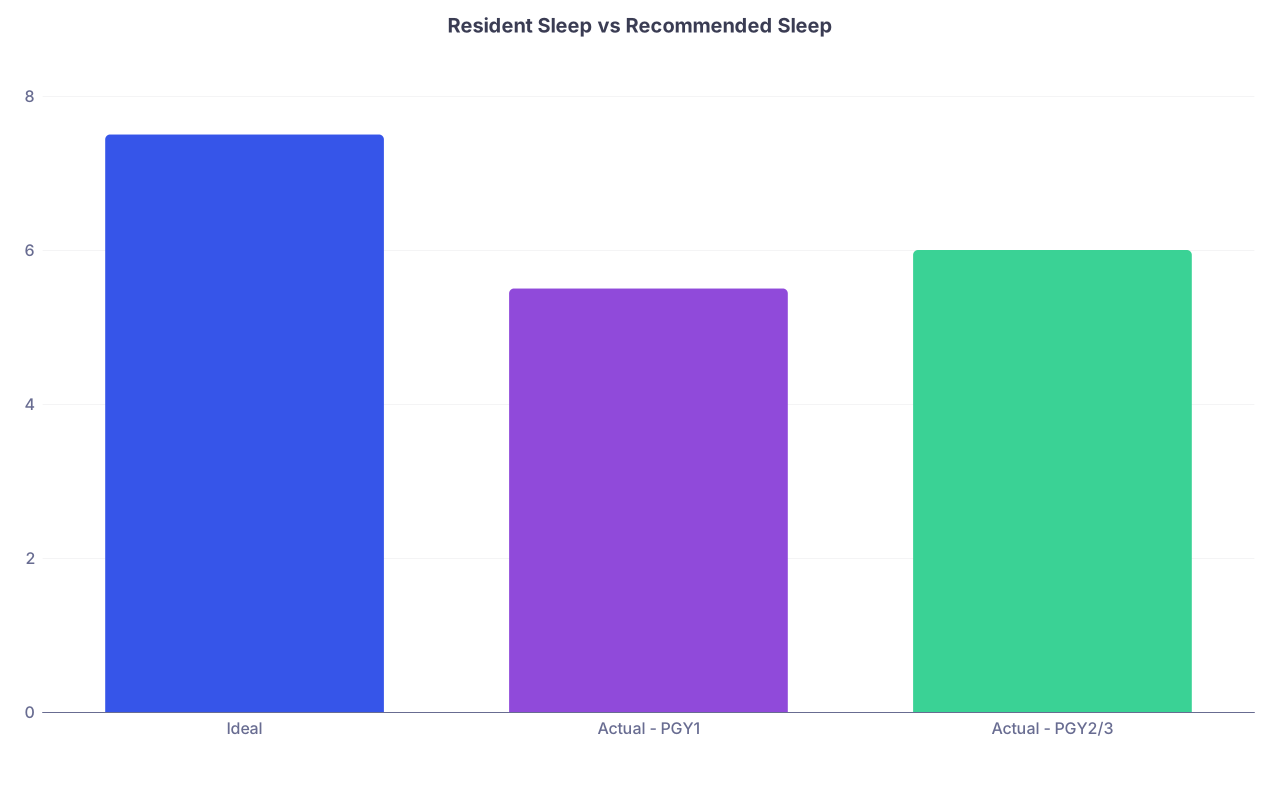
| Category | Value |
|---|---|
| Ideal | 7.5 |
| Actual - PGY1 | 5.5 |
| Actual - PGY2/3 | 6 |
Here is the mistake: you compare yourself to what is “normal” for residency instead of what is safe, sustainable, and humane for an actual human body and brain.
Residency “normal” is not the benchmark. It is the baseline dysfunction.
The Hidden Costs of Powering Through: What You Don’t See Until Too Late
You think fatigue is just about feeling tired. It is not. It quietly poisons everything.
1. Your Clinical Judgment Starts Slipping Before You Notice
Sleep deprivation wrecks executive function. Long before you feel “dangerously tired,” your brain is already cutting corners.
I have watched this play out:
- PGY-2 on nights, 03:30. Febrile neutropenic patient. Resident scrolls note for 10 seconds, sees normal vitals, and almost clicks “sign” on a low-risk plan—missing the ANC of 100 and subtle rigors documented earlier. Nurse calls. That saves it. Resident shrugs it off as “brain fog.”
That is not a personality flaw. That is physiology.

And no, being “high-functioning” does not protect you. It just delays when you feel the impact, not when it starts.
2. You Become Someone You Don’t Recognize
Chronic fatigue warps your behavior:
- You are suddenly short with nurses you like
- You snap at med students for perfectly reasonable questions
- You find yourself hoping for “no admissions” not because it is slow, but because you cannot think straight
Then comes the shame spiral:
- “I am being a jerk.”
- “I am not cut out for this.”
- “Everyone else handles this better.”
No. You are a human being running on fumes. Personality changes are an early burnout symptom. Waving them off as “just tired” is how people end up deeply depressed before they realize something is wrong.
3. You Start Making Risky Personal-Life Choices
This part gets ignored in most “wellness” talks.
Residents power through fatigue by:
- Driving home after 27–28 hours awake because “Uber is expensive”
- Using caffeine like a drug instead of a tool—5 pm coffee before a 24h call, then wondering why they cannot sleep post-call
- Drinking “just to relax” on post-call evenings because their nervous system is too amped to settle
Every one of those is a setup:
- Post-call car accidents are not rare. You are functionally drunk at the wheel.
- Chaos caffeine wrecks whatever fragile sleep you could get.
- Alcohol + chronic sleep deprivation = mood instability and numbing that hides how bad you actually feel.
The Culture Problem: Why Residents Ignore Fatigue Until It Breaks Them
You are not failing. You are in a system that rewards self-neglect and labels it professionalism.
Here are the big cultural traps.
Trap 1: Confusing Suffering with Commitment
Too many programs silently equate “pushing through” with being dedicated.
You see:
- The PGY-3 who brags about never calling in sick
- The attending who tells war stories about residency “before duty hours”
- The subtle eye roll when someone leaves right at the end of their shift
So you internalize:
“If I ask for help, I am weak.”
“If I admit I am exhausted, I am not residency material.”
That belief is poison. It is also wrong. The best physicians I know are aggressive about protecting their sleep and bandwidth because they understand they are managing risk—not looking for comfort.
Trap 2: The Fear of Being “That Resident”
I have heard this word-for-word:
- “I don’t want to be the resident everyone thinks is fragile.”
- “If I say I’m burned out, what if they think I can’t handle fellowship?”
So you keep quiet.
You “power through”:
- Panic attacks you call “just stress”
- Nightly crying in the parking garage you call “just a phase”
- Waking up already exhausted you call “just this month”
You are not avoiding weakness. You are avoiding early intervention. And you pay later, with interest.
The Red Flags You Must Not Ignore
Here is where I want you to be extremely honest.
If you see these patterns and still insist on powering through, you are in the burnout setup zone.
| Area | Normal Tiredness | Burnout Setup Red Flag |
|---|---|---|
| Sleep | Tired after call, recover on days off | Never feel rested, even after full nights of sleep |
| Mood | Irritable occasionally post-call | Persistent numbness, cynicism, or daily dread |
| Cognitive | Occasional slow thinking at 3 a.m. | Frequent forgetfulness, missing obvious details |
| Behavior | Want rest after busy week | Withdrawing from friends, skipping basic self-care |
| Work Thoughts | “This is hard but important” | “Nothing I do matters / I do not care anymore” |
If more than two of those “red flag” columns feel accurate for the past month, powering through is no longer “resilience.” It is denial.
What Actually Happens When You Keep Powering Through
Let us spell out the common trajectory I have seen far too many times.

| Step | Description |
|---|---|
| Step 1 | Chronic Fatigue |
| Step 2 | Power Through Mindset |
| Step 3 | Performance Decline |
| Step 4 | Shame and Self Blame |
| Step 5 | Emotional Numbing |
| Step 6 | Major Burnout or Depression |
| Step 7 | Leave or Remediate |
Stage 1: Chronic Fatigue Becomes the New Normal
You stop expecting to feel rested. Ever.
You say things like:
- “I am just a low-energy person now.”
- “I guess this is adulthood.”
No. It is pathology masquerading as personality.
Stage 2: Small Performance Declines
Nothing catastrophic at first.
- Slower notes
- Needing to re-read imaging reports
- Forgetting to place a non-urgent order or two
You label it “I just need to be more organized.”
Then the mistakes get a little bigger:
- Almost missing a critical lab
- Transcribing an order incorrectly (caught by pharmacy, if you are lucky)
- Forgetting to follow up on a page
You call it “being distracted.” It is fatigue eroding your bandwidth.
Stage 3: Shame and Self-Blame
Instead of seeing a system problem, you internalize it.
“Everyone is tired. Why am I struggling?”
“I am just not cut out for this.”
So you double down.
You “fix” it by:
- Studying more on your post-call days
- Staying later to compensate
- Taking on more tasks to prove you can handle it
You are trying to outrun a physiologic problem with psychological effort. That never works.
Stage 4: Emotional Numbing and Disconnection
This is where it gets scary.
You notice:
- You do not feel much, even when things are sad or meaningful
- You detach from patients because caring feels too heavy
- You stop feeling proud of anything, even when you do good work
That classic burnout triad—exhaustion, cynicism, and reduced sense of accomplishment—does not show up overnight. It grows in the cracks created by chronic fatigue.
Stage 5: Crash
Eventually something gives:
- You break down in rounds
- You need a leave of absence
- You fail a rotation or exam you were more than capable of passing
- You start having thoughts like, “If I got in a minor car accident, I could rest for a while”
This is what “just powering through” buys you.
Smart Residents Do This Differently: Specific Behaviors to Copy
You do not need a yoga retreat and an app subscription. You need sharper boundaries and earlier course correction.
Here is what residents who avoid burnout actually do differently.
1. They Treat Sleep as Non-Negotiable Risk Management
Not a luxury. Not self-care fluff. Risk management.
They:
- Protect 7+ hours on non-call nights like it is a consult from the chief
- Use caffeine strategically: early in the shift, not late
- Stop screen-scrolling in bed because they have learned the hard way that 45 minutes of doomscrolling = wrecked next day
They also refuse certain traps:
- No “just one episode” of TV at midnight before a 5 a.m. wake-up
- No heroic back-to-back late social events on their only days off
Is it fun? Not always. Is it survival? Yes.
2. They Build a Simple, Ruthless Triage System for Their Own Fatigue
They do not wait until they are destroyed to act.
They notice patterns:
- Three days in a row of trouble concentrating?
- Snapping at people twice in one shift?
- Feeling dread before every workday?
That triggers action:
- Swapping a shift if possible
- Asking co-residents for help with scut so they can think (not so they can relax—so they can function)
- Emailing chief residents: “I am noticing X, Y, Z. I want to address this early before it affects my performance. Can we talk?”
That is not weakness. That is professionalism.
3. They Use the System Instead of Silently Sinking
Every program has some resources. Not all are great, but ignoring them is just pride dressed up as stoicism.
Smart residents:
- Know their institution’s mental health access route
- Know which attendings are actually safe to talk to about struggling
- Use occupational health/sick days early—before they are non-functional
And when they see a colleague clearly falling apart from fatigue, they do not romanticize it.
They say things like:
- “You are not okay. Let us go talk to the senior.”
- “I will cover your pages for 20 minutes. Eat. Now.”
Dangerous Myths About Fatigue You Need to Drop Now
These common beliefs are quietly wrecking residents. If you catch yourself saying them, red flag.
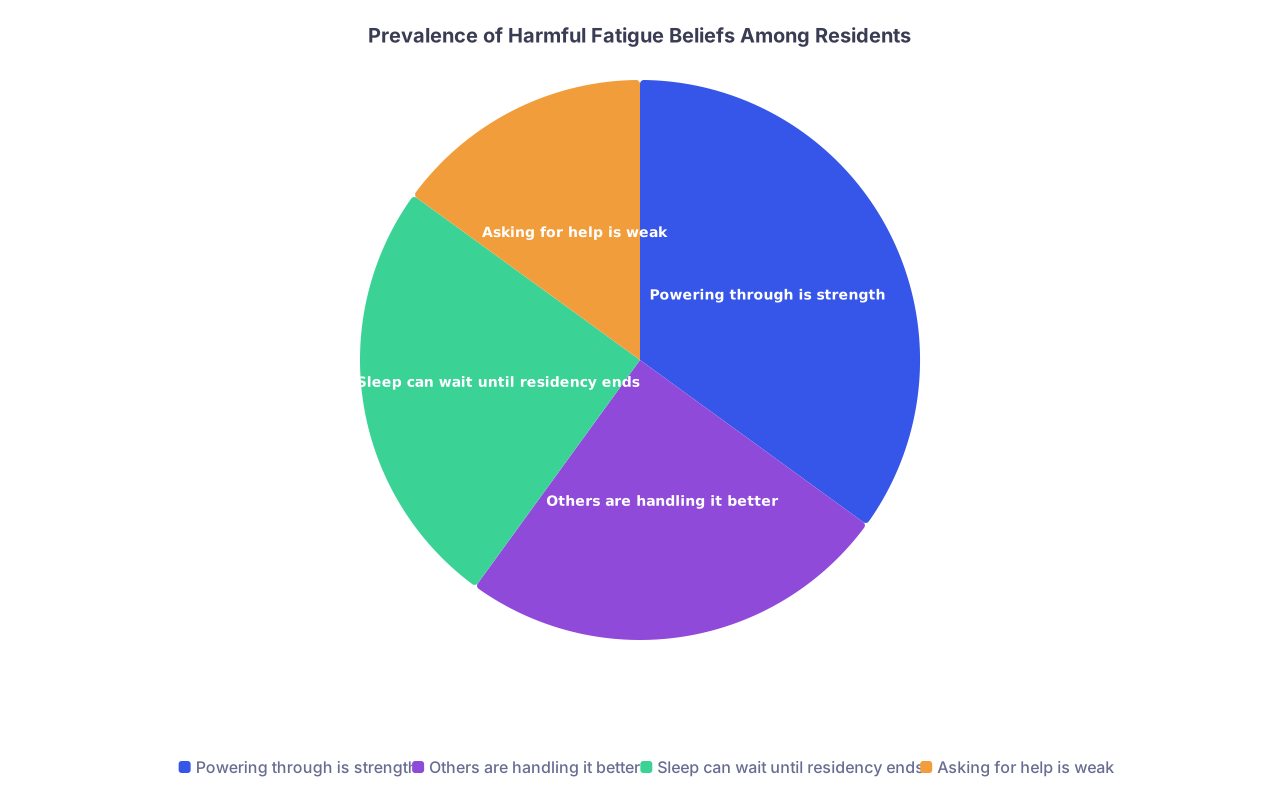
| Category | Value |
|---|---|
| Powering through is strength | 35 |
| Others are handling it better | 25 |
| Sleep can wait until residency ends | 25 |
| Asking for help is weak | 15 |
Myth 1: “It Will Get Better After Intern Year”
Not if you build terrible habits now.
Whatever you normalize as a PGY-1, you carry into PGY-2 and beyond. More responsibility. More emotional load. Sometimes more call.
Residents who survive better as seniors are not just “used to it.” They learned, early, where their limits are and what happens when they ignore them.
Myth 2: “If I Just Get Through This Rotation, I’ll Be Fine”
I have heard this on:
- ICU
- Nights
- Surgical services
- OB/GYN blocks
Then the next hard block comes. And the next. Residency is a string of “if I just get through this” phases.
You cannot treat each rotation as an exception. That is how exceptional stress becomes standard practice.
Myth 3: “Everyone Else Is Doing Fine”
No, they are not.
You are seeing:
- Curated faces on rounds
- Filtered versions at conference
- Highlight reels on group chats
The resident who looks “fine” may be crying in the parking structure. The one joking during night float may have chest pain every afternoon and be ignoring it.
Stop comparing your interior to other people’s exteriors. It is a rigged game you cannot win.
How to Stop Powering Through and Start Protecting Yourself
Let us get practical. Here is a simple framework: Recognize → Respond → Reinforce.
1. Recognize: Name the State, Not Just the Symptom
Instead of “I am tired,” get specific:
- “My brain is not retaining information.”
- “I am starting to resent patients.”
- “I am driving home and not remembering the last five minutes.”
Those are not “tired.” Those are “unsafe” or “burnout early signs.”
Once you label it accurately, it is much harder to dismiss.
2. Respond: Take One Concrete, Uncomfortable Action
Notice I said “uncomfortable.” If the response feels easy, it is probably not enough.
Examples:
- Tell your senior: “I am more fatigued than I should be and I am worried about missing something. Can we redistribute a bit so I can think clearly about these sick patients?”
- Email chief: “I need a check-in this week. My fatigue is starting to affect my mood and work.”
- Cancel a social plan so you can sleep. Yes, even the “but this is my only fun thing this week” one if you are clearly crashing.
And yes, sometimes this will feel embarrassing. Do it anyway. The price of avoiding a moment of discomfort now is avoiding a disaster later.
3. Reinforce: Build Micro-Habits That Protect Your Future Self
This is not about spa days. It is about boring, protective routines.
Examples that actually work for residents:
- Post-call autopilot plan: You go straight home, eat something basic, shower, phone in another room, dark room, earplugs, sleep. No decisions.
- Hard stop time: Pick a time most days when you absolutely stop charting/reading and start wind-down. Even if you are “behind.”
- Weekly check: 5 minutes each week: “On a scale 1–10, how exhausted am I? How irritable? How much dread?” If those numbers climb and stay there for 2–3 weeks, you escalate.
None of this looks heroic on Instagram. It just keeps you in the game.
FAQs
1. How do I know when fatigue is bad enough that I should say something to my program?
You do not wait for collapse. You act when fatigue:
- Persists for more than 2–3 weeks despite you trying reasonable fixes (sleep prioritization, better caffeine timing, basic boundaries)
- Starts affecting patient care in any way—missed details, slower thinking, repeated near-misses
- Is clearly changing your personality (numbness, daily dread, uncharacteristic anger)
If you are asking “Is it bad enough?” that is usually your sign to at least talk to a trusted senior, chief, or faculty member. Early conversations are almost always easier than crisis repairs.
2. Won’t I look weak or unprofessional if I admit I’m struggling with fatigue?
You will look more unprofessional if your fatigue leads to:
- A serious error
- Noticeable attitude problems
- Failing a rotation or exam
A resident who says, “I am noticing X, Y, Z and I want to address this before it affects my performance” looks self-aware and accountable. The myth that good residents never struggle is exactly that—a myth. Good residents manage their struggle early.
3. What if my program culture discourages talking about burnout or fatigue?
Then you get strategic, not silent.
- Identify individuals who are safe, not “the program” in general—often a younger attending, a chief, or a prior resident you trust
- Use language focused on patient safety and performance: “I want to make sure I am functioning at the level expected” rather than “I am burned out”
- Use institutional resources that are confidential (employee assistance programs, mental health services) even if you never utter the word “burnout” at work
You cannot fix a bad culture single-handedly. You can refuse to sacrifice your health to it.
4. What is one small change I can make this week that will actually help?
Set a post-call rule and stick to it for the next three post-call days:
- No errands
- No studying
- No “just a quick hangout”
- Home, food, shower, phone out of reach, sleep
Treat that like a medical order for yourself. You will be shocked how much even this one boundary reduces that “I am permanently destroyed” feeling over a month.
Open your calendar for the next 7 days right now and mark your next post-call or lighter day. Block 6–8 hours as “Non-negotiable sleep/recovery” and protect it like you would an OR case or family emergency. That single act—refusing to “power through” that window—may be the difference between bending and breaking this year.


