

The myth about burnout in residency is that someone will catch you before you fall apart. They usually don’t. And when they finally do, it’s almost always a chief resident who sees it first—often long before anyone says the word “burnout” out loud.
Let me tell you what actually happens when you’re crashing and everyone pretends they don’t see it… and what the good chiefs really do behind the scenes.
How Chiefs Really Notice You’re Crashing
You think you’re hiding it. You’re not.
Chiefs see the pattern before your PD, before wellness committee, before GME. They catch it in three places: sign-out, schedule spreadsheets, and the call room.
Here’s how it really looks on our side:
We see the notes getting shorter and sloppier. The intern who used to add thoughtful plans suddenly writes “continue current management” on every patient. The senior who used to own the list now forgets to pend discharge meds until 5:55 pm… three days in a row.
We hear the change in sign-out. The resident who was crisp and organized now gives rambling, disorganized, anxious sign-outs. Or the reverse: they get oddly flat and detached. Less nuance, more “they’re fine” when they’re clearly not.
We watch the schedule data. Chiefs live in Google Sheets and Amion more than they live in their apartments. We see who’s doubled up on tough rotations, who just did four straight months of nights, who took no real vacation “because of Step 3” or “research deadlines.” That stuff doesn’t lie.
We start getting small signals from multiple directions:
- A nurse quietly tells us, “Hey, your PGY-2 on 6 West seems off—more snappy than usual.”
- An attending mentions, “She’s still performing, but she looks wrecked. I’m a little worried.”
- Another resident jokes, “He’s living here now,” but they’re not really joking.
None of that triggers a formal intervention. Not yet. But the good chiefs start watching more closely. And they start quietly asking around about you.
What Happens the Week You Really Start to Crash
There’s always a week where it changes from “tired resident” to “this is not sustainable.”
On our side, it usually crystallizes like this:
We see you crying in a stairwell at 2 am. Or in the med room. Or in your car on the call lot camera replay (yes, security sometimes mentions “one of your residents looked rough in the lot at 3 am”).
You send us a 3 am WhatsApp message: “Sorry to bother you… this cross-cover is impossible.” The content isn’t the issue; it’s the timing, the desperation in the tone. Chiefs recognize it.
We see chart lag creep from 0-1 notes to 10-15 notes behind. We're getting Epic messages from coders: “Your resident has multiple incomplete notes approaching deadline.” That’s a big tell.
An attending emails the chiefs directly:
“Hey, I’m a bit concerned about [your name]. Good doc, but I think they’re burning out. Not sure if it’s schedule-related or something else. Just flagging.”
What happens next is what you’re never told in orientation, because it’s messy and political and human.
The First Quiet Intervention: Off-the-Record Triage
Let me be blunt: the first move is almost never a formal “wellness” process. It’s a back-channel, quiet, face-saving triage.
Here’s how it usually goes at a functional program:
One or two chiefs talk about you after morning report. Not performatively. Just concerned.
They’ll do three things almost every time:
Pull your schedule.
They look at your last 6–9 months: ICU back-to-back? Nights stacked with ED? Did coverage shifts or sick calls land on you repeatedly? This isn’t theoretical. We literally count shifts.Ask one trusted co-resident.
Not a gossip. Someone known to be honest and discreet.
“Hey, how’s [your name] really doing? I’ve noticed they look wiped.”
We’re listening for: overwhelmed but coping vs. not okay.Decide if this is urgent or emergent.
Emergent = patient safety, suicidal thoughts, showing up impaired.
Urgent = you’re clearly burning out but still holding it together enough to be safe.
If it’s emergent, everything below gets skipped and it goes straight to PD / GME / on-call psych. No one plays games with that.
But most burnout crashes aren’t a single moment. They’re a slow bleed we finally admit is happening. That’s where the chiefs start their real work.
The First Real Move: That “Random” Check-in
Here’s a secret: that “hey, got a second to chat?” from your chief is almost never random.
We pick the time carefully. Not pre-rounds. Not mid-code. Usually post-call afternoon, or right after sign-out. Private room, door mostly closed, one chief (sometimes two if we suspect it’ll be heavy).
There’s a script most of us use, because trial and error taught us what works:
We don’t start with “Are you burned out?” We start with something that lets you save face.
“I’ve noticed you’ve been on some brutal rotations back-to-back. How are you holding up? Really.”
Then we shut up. Silence is deliberate. Residents eventually fill it.
Most of you try to brush it off.
“I’m fine. Just tired. It’s been a busy week.”
We don’t push yet. We reflect what we see.
“You look more than routine tired. And I’m seeing your notes backing up and you texted me at 3 am. That’s not like you. I’m not here to judge, I’m here because I’m worried.”
This is the moment people usually crack a little. Micro-tears. Deep sigh. Or just a flat “Yeah… I’m not okay.”
On our side, that’s when the “informal chief plan” starts.
What Chiefs Actually Change Behind the Scenes
You think your schedule is fixed. It isn’t as rigid as they pretend. Chiefs bend more than anyone admits.
Here’s the stuff we actually do when you’re crashing, none of which shows up in glossy residency brochures.
We reshuffle call. Quietly.
Your “golden weekend” that disappeared three times due to coverage suddenly comes back. The Hard Call Night gets swapped to someone more rested, and you get an easier one. We tell them, “I owe you one,” and we remember.
We pull you from the worst elective and into something survivable.
Example: I’ve seen chiefs pull a resident out of a malignant-oncology service and slide them into outpatient endocrine for a month with a one-line justification to the PD:
“Service overstaffed; outpatient rotation will help them meet ambulatory requirements.”
Translation: “They’re cooked. They need air.”
We shield you from extra “opportunities.”
That committee the PD wants residents on? We say you’re already committed. The extra QI project? We redirect it to the eager PGY-1. We stop funneling “hey can your residents help with…” to you.
We quietly adjust expectations with attendings.
Good chiefs will email an attending they trust:
“Just a heads up, [your name] has had a string of tough rotations and is really stretched. They’re solid but tired. Would appreciate if you could keep that in mind this month.”
This is code for: don’t eat them alive; check in on them.
We manipulate team assignments.
At some programs, chiefs circle which seniors can anchor “heavier” interns and which interns need a kinder senior. When you’re burning out, we try to put you with the attending who teaches hard but doesn’t humiliate, and the co-resident who will quietly help you with notes.
And we do one more thing you almost never see: we document. For you.
We keep mental—or sometimes literal—notes:
- “July–October: 3 high-acuity rotations, 1 month nights, covered 2 sick calls.”
- “Reported trouble sleeping, tearful in check-in, open to therapy.” Because if there’s a blow-up later—patient complaint, attending blasting you in an eval—that context can be your lifeline.
When Chiefs Escalate to the PD (And What They Actually Say)
Here’s the part programs never advertise: chiefs have a political calculus when they decide to bring your situation to the PD.
They ask themselves:
- Is this resident safe but exhausted? Or unsafe?
- Is the PD someone who responds constructively or punitively?
- Will this help the resident or put a target on their back?
Strong PDs make this easier. Weak or punitive PDs force chiefs into shadow work—fixing things under the radar because we don’t trust leadership to handle it well.
When we do go to the PD, we rarely lead with “burnout.” We lead with schedule and systems:
“[Your name] has had no true break in months. ICU → nights → gen med AEK. Notes backing up, tearful in check-in. I’m concerned they’re at risk of real burnout and potentially mistakes. We need to lighten their next 1–2 blocks.”
It’s not about feelings. It’s about risk. PDs listen to risk.
Depending on your program culture, outcomes look like:
- Approved switch to a lighter rotation
- Protected half-day for therapy or medical appointments
- Pulling you off nights for a bit
- Temporary reduction in non-clinical extras
And yes, sometimes PDs say no. Then chiefs get more creative. We swap days within rotations. We leverage “coverage needs” to get you a sane post-call buffer. It’s messy, but it’s real.
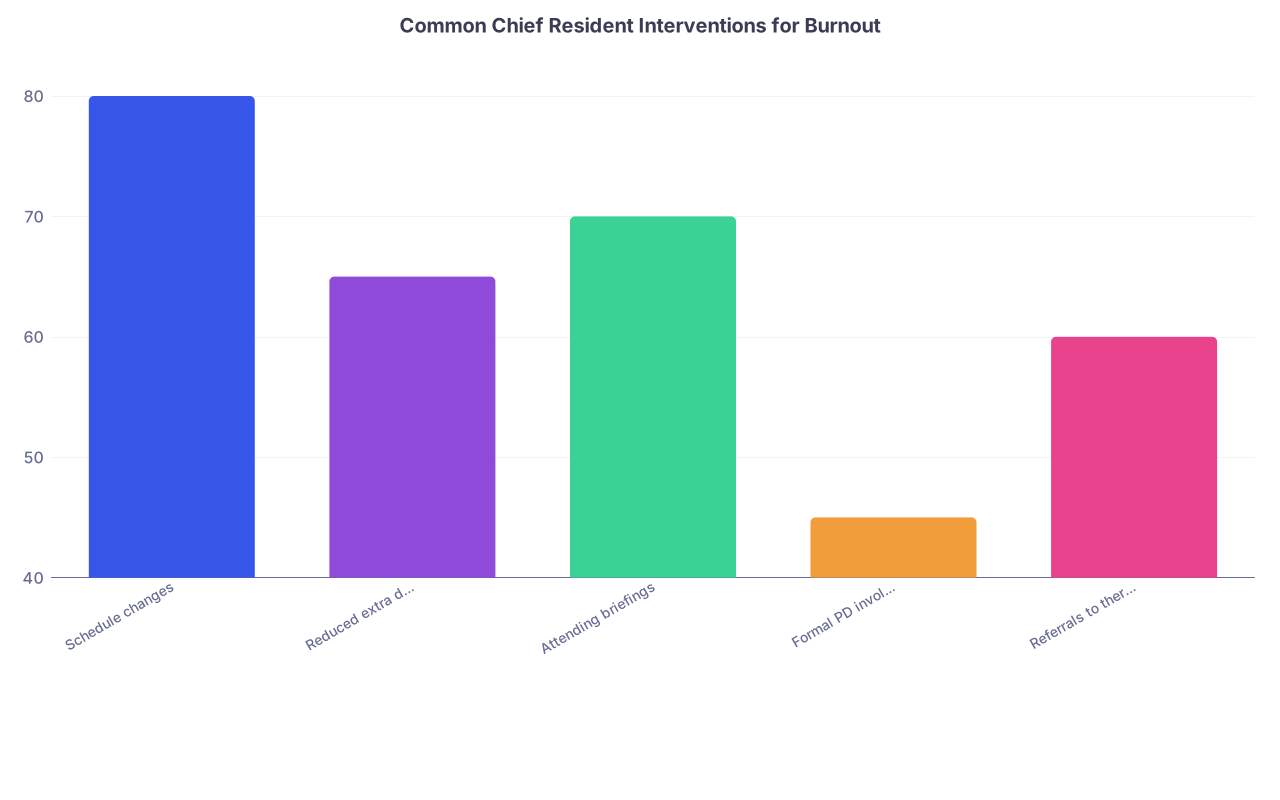
| Category | Value |
|---|---|
| Schedule changes | 80 |
| Reduced extra duties | 65 |
| Attending briefings | 70 |
| Formal PD involvement | 45 |
| Referrals to therapy | 60 |
What Chiefs Wish You’d Tell Us Earlier
Let me flip this on you. There’s a point before you’re truly crashing where chiefs could do more with less fallout—for you and for patient care.
We’re not mind readers. We’re pattern readers. If you want us to act before your life implodes, you need to give us something. Not a therapy-level disclosure. Just enough signal.
Concrete things that actually help us help you:
“I can do hard rotations, but I can’t do three brutal ones back-to-back again. That almost broke me.”
We can cluster schedulers, we can move vacation, we can trade blocks between residents.
“I’m not sleeping. I’m laying in bed with my heart racing thinking about work.”
That changes our urgency. Insomnia plus residency plus constant stress is a straight path to crash.
“I’m making more small mistakes. Nothing serious yet, but it scares me.”
Chiefs will move mountains when patient safety is even remotely at risk. It gives us strong leverage with leadership.
“I’m open to talking to someone but I don’t know where to start.”
We know the decent therapists who actually understand residents. We know which in-house resources are performative and which are real.
You don’t have to present a polished narrative. We just need to not be guessing.
What Chiefs See When Burnout Goes Ignored
Let me be blunt again: when burnout is ignored long enough, things break. I’ve watched that movie more than once.
The quiet, perfectionistic resident stops asking questions. They start cutting corners in documentation, then in exams. One day, a bad miss happens—a DKA not rechecked, a sepsis patient whose lactate never got repeated. No disaster, but close enough to scare everyone.
Or the usually kind resident becomes chronically irritable. Snaps at nurses. Gets labeled “unprofessional.” Their evals tank. No one connects it to the fact that they haven’t had a real day mentally off in six months.
Worst case, it reaches self-harm territory. Chiefs get pulled into 11 pm calls:
“Your resident is in the ED for suicidal ideation.”
By that point, all the “we should have seen this coming” guilt hits everyone.
This is why the better chiefs are a little nosy and a little intrusive. We’ve seen what happens when we’re not.
What You Can Do During a Burnout Spiral (That Actually Helps)
Let’s talk about you now, not the chiefs doing damage control.
You’re crashing. You feel trapped. You can’t “take two months off and go to Bali.” You need a plan that works inside the insanity.
I’ll give you the moves I’ve seen actually help residents in the middle of a spiral—not theoretical wellness fluff.
Shrink your target.
Stop trying to “be back to my old self.” Your new target is: safely get through the next 2–4 weeks while we adjust your environment. That mindset change matters. Survival mode is valid in a crisis.
Tell one person the unedited truth.
Not a vague “I’m tired.” The actual line:
“I’m not okay. I’m at the point where I’m afraid I’m going to hurt someone or myself if this keeps going.”
Say that to your chief, your PD, or a faculty you deeply trust. That level of honesty is the only thing that reliably triggers real intervention.
Strip your life down ruthlessly.
This is not the month to be the class social chair, lead three research projects, and tutor MS2s. When you’re crashing, the only priorities are: show up safe, do core clinical work, eat something, sleep some, get help.
Get one outside anchor.
Therapist, coach, older resident at another program, whoever. Someone not in your direct chain. You need at least one person who isn’t also drowning in your same pond.
And if you’re too far gone to do any of that without help, say just this to your chief:
“I need you to quarterback this because I can’t.”
Good chiefs will. They’ll arrange the PD meeting, they’ll help you email wellness, they’ll help you script what to say.

What Happens When Chiefs Think You’re Truly Unsafe
Here’s where the gloves come off.
When a chief believes you’re beyond burnout and into real risk—practicing unsafely, expressing suicidal thoughts, or showing up impaired—your autonomy shrinks fast.
Moves you’ll see in that situation:
You’re pulled from clinical duties.
Usually framed as “we’re giving you a break for health reasons,” but it’s really risk management. Charts get reassigned. You may be sent home or to employee health.
You get routed through official channels fast.
Employee assistance program, urgent psych consult, GME office. Chiefs are suddenly less your peers and more part of a protective wall between you and disaster.
Documentation ramps up.
Not to punish you. To protect you—and the program. Emails get sent. Encounters get logged. “We recognized the problem and acted” is the institutional defense if something goes very wrong.
Schedule gets torn up and rewritten.
Rotations deferred, research time swapped in, LOA discussed. Chiefs spend hours undoing the puzzle they spent months building. No one advertises that part.
You might feel betrayed. Like things escalated too fast. But from the chief’s seat, once you cross a certain threshold, there’s no “keep this quiet” option anymore. We’ve all seen what happens when people hesitate in that moment. None of it is good.

| Step | Description |
|---|---|
| Step 1 | Early signs of burnout |
| Step 2 | Quiet chief check in |
| Step 3 | Schedule tweaks and support |
| Step 4 | Monitor closely |
| Step 5 | Urgent chief action |
| Step 6 | Pull from duties |
| Step 7 | Notify PD and GME |
| Step 8 | Formal evaluation and support |
| Step 9 | Safe to continue? |
What Strong Programs Let Chiefs Do (And What Weak Ones Don’t)
You can tell a lot about a program by how much room chiefs get to actually protect residents.
In strong programs, chiefs can:
- Reassign call without begging for permission each time
- Rebalance service loads when someone is at their limit
- Block obviously toxic combinations (surgical nights after ICU, etc.)
- Be honest with PDs without residents being labeled “weak”
In weak programs, chiefs are glorified schedulers and enforcers. They can’t meaningfully intervene, only patch tiny holes:
- Every requested change requires three emails and a committee
- Any mention of burnout is framed as “resilience issue” rather than schedule/structure problem
- Residents who speak up get fewer fellowships and weaker letters
If your chiefs are honest with you, they’ll tell you which kind of place you’re in. If they’re scared to be honest, that also tells you something.
| Program Culture | Chief Autonomy Level | Typical Response to Burnout |
|---|---|---|
| Strong, resident-first | High | Proactive schedule changes, PD support |
| Middle of the road | Moderate | Case-by-case fixes, variable PD responses |
| Malignant / image-first | Low | Blame resident, minimal structural change |
How to Use Your Chiefs Before You Reach the Cliff
Here’s the part you can actually control.
Use your chiefs early. Use them smartly. And understand what they can and can’t do.
They can:
- See patterns in the schedule you don’t realize are killing you
- Advocate for you in rooms you’ll never be invited into
- Help you phrase things to PDs in a way that gets action, not judgment
- Quietly protect your reputation when you’re struggling but still good
They can’t:
- Magically fix a malignant culture alone
- Override every attending or PD
- Read your mind if you insist on pretending everything is fine
- Carry you indefinitely if you’re not doing any work on your end
The residents who come out less damaged aren’t the ones who “toughed it out silently.” They’re the ones who treated chiefs like allies, not administrators.

The Quiet Truth: Chiefs Remember the Crashes
One last thing no one tells you.
Chiefs remember the burnouts, the near-misses, the residents who crashed and the ones who barely pulled up. Those stories shape how they advocate for you long after that crisis month.
When fellowship directors call and ask, “How is she under stress?” chiefs think of that ICU month where you were falling apart—and whether you were honest, whether you did the work to get help, whether you were safe even when you were exhausted.
When PDs design next year’s schedule, chiefs bring up, “We broke [your name] last year with that ICU → nights → wards stretch. We can’t repeat that pattern.” Your suffering, unfair as it feels, sometimes improves life for the class behind you.
You’re not weak for breaking in a system designed to grind you down. The real question is whether you reach for the few levers that actually exist—chiefs being the biggest one you’ll actually see in your day-to-day life.
Use them. Before you’re in the stairwell at 2 am crying into your badge.
With this picture of what really happens behind closed doors, you’re better positioned to see burnout coming, call it by its name, and pull your chiefs into the fight early. The next step in your journey is learning how to survive the rest of residency with your core intact—shaping your identity as a physician, not just a cog in the system. But that’s a story for another day.


