

The way most residents “trade” sleep for productivity is broken—and it is driving burnout harder than any single difficult rotation.
You are not burning out because residency is hard. Residency has always been hard. You are burning out because you are making specific, predictable sleep trade-off errors that compound into cognitive decline, emotional blunting, and health damage. I have watched smart, capable residents do this to themselves and then blame everything except the core problem: chronic, self-inflicted sleep debt.
Let me walk you through the mistakes I see repeatedly—and how to stop making them before you hit the wall.
1. The “I Can Function on 4–5 Hours” Delusion
This is the foundational error. If you do not kill this belief, nothing else you try will work.
Most residents secretly think one of the following:
- “I am just built different. I do fine on 5 hours.”
- “Once I am used to call, my body adjusts.”
- “I did this in med school. I can do it again.”
No, you cannot. And you are not the exception.
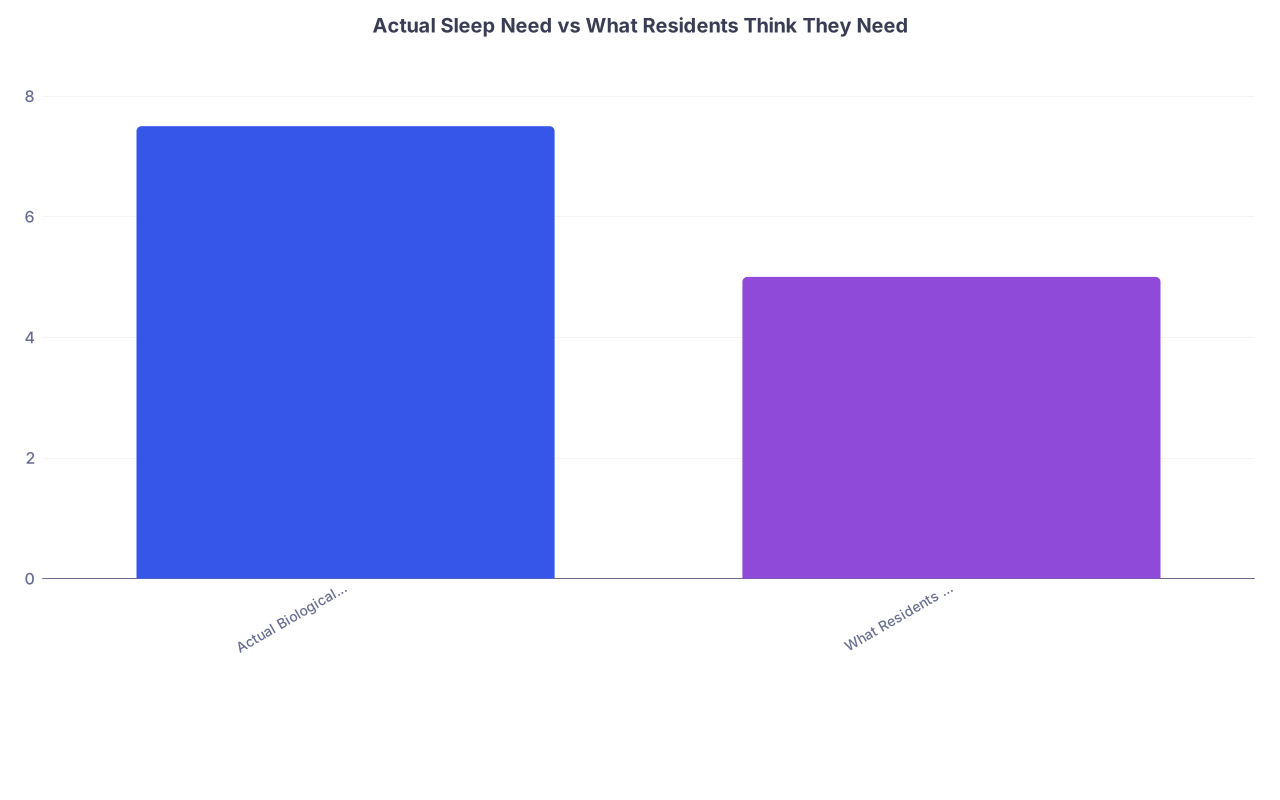
| Category | Value |
|---|---|
| Actual Biological Need | 7.5 |
| What Residents Commonly Claim | 5 |
Here is the hard truth:
- Long-term, fewer than 1% of people can function normally on under 6 hours of sleep per night.
- You are probably not in that 1%. Statistically, you have a better chance of being struck by lightning than being truly short-sleep–tolerant.
What actually happens when you live on 4–5 hours:
- Your reaction time slows.
- Your working memory shrinks.
- Your emotional reactivity skyrockets.
- Your self-awareness of impairment declines.
That last one is the killer. The more sleep-deprived you are, the less accurate you are at judging how impaired you are. You feel “fine enough,” but your performance data (errors, near-misses, forgetting simple tasks) says otherwise.
- Week 1 of wards: sleep 7 hours → feel tired but sharp.
- Week 3 of wards: sleep 5 hours consistently → feel “about the same.”
- Objectively: more order entry errors, more sign-out omissions, more snappy responses to nurses, more “I forgot to follow up that lab.”
You think you adapted. You did not. You just lost your ability to feel how impaired you are.
Set a personal red-line:
“Below 6 hours sleep for more than 2 consecutive nights = I am impaired. Not optional. Not negotiable.”Track actual, not perceived, performance:
- Notice: Are you rereading notes multiple times?
- Are attendings correcting you on details you used to catch?
- Are you forgetting simple tasks you never used to drop?
Treat sleep loss like being slightly intoxicated:
- Would you trust yourself with a complex procedure if you had two drinks? That is roughly what chronic sleep restriction does to your brain.
Stop telling yourself a story about being tough. Being tough is not impressive if it comes at the cost of patient safety and your long-term health.
2. The “I’ll Catch Up On My Day Off” Lie
This one feels rational. You grind all week, then tell yourself:
- “I will fix my sleep on Sunday.”
- “Post-call I will just sleep 12 hours and reset.”
- “I just need one good night.”
No. That is not how sleep debt works.

| Step | Description |
|---|---|
| Step 1 | Chronic 5 hour nights |
| Step 2 | Build large sleep debt |
| Step 3 | Try to fix with 1 long sleep |
| Step 4 | Partial recovery only |
| Step 5 | Back to short sleep |
Why this is a trap:
Sleep debt is only partially reversible:
- One long night helps you feel less wrecked.
- It does not fully restore cognitive performance after a week of deprivation.
“Recovery” sleep often wrecks your next few nights:
- You sleep in until noon post-call.
- You cannot fall asleep until 2 a.m. that night.
- You start the next workday already short again.
Your brain needs consistency more than the occasional 10-hour crash.
Telltale signs you are in this pattern:
- You feel like a different person on your day off—funny, social, patient—and then hollowed out again by midweek.
- You are constantly saying, “I just need to make it to Saturday.”
- You dread switching from nights to days because your schedule is already chaos.
How to avoid the “catch-up” error:
- On post-call days:
- Sleep a planned nap: 2–4 hours max, then wake up.
- Go to bed that night at roughly your target “normal” bedtime (even if you do not feel tired).
- On days off:
- Let yourself sleep in slightly (1–2 hours max).
- Do not flip your schedule so much that Monday feels like jet lag.
The real correction is boring: protect medium-consistent sleep every single possible night, not heroic catch-up marathons once a week.
3. Trading Sleep for Studying: The Silent Score Killer
This one is brutal because it feels virtuous. You are preparing for Step 3, in‑service exams, boards, fellowship apps. The internal monologue:
- “I do not have time during the day; I will study 10 p.m.–1 a.m.”
- “Everyone else is grinding. I cannot fall behind.”
- “It is just for a few months.”
I have watched residents do this before every high‑stakes exam. They cut sleep to gain study hours and then underperform despite “working harder.”
What you are missing:
Studying tired is not neutral. It is actively inefficient and sometimes worthless.
| Sleep Night | Study Hours | Retention Quality |
|---|---|---|
| 7–8 hours | 1–2 hours | High |
| 6 hours | 2–3 hours | Medium |
| 4–5 hours | 3–4 hours | Low |
You are making these errors:
- Confusing time spent with material learned.
- Re-reading Instead of encoding new information.
- Memorizing short term with zero consolidation during deep sleep.
You think: “At least I got through 150 Anki cards.”
Reality: You saw 150 cards; you retained ~50 meaningfully, and you weakened tomorrow’s performance on rounds.
Better trade-off rules:
Non-negotiable floor:
If you are consistently getting under 6 hours, you do not earn the right to add late-night study blocks. Fix that first.Reallocate, do not extend:
- Use micro-blocks during downtime: 10–15 minutes between patients, while waiting for lab calls, on shuttle rides.
- Protect early evening for short, high-quality blocks: 30–45 minutes max, then stop.
Pre-sleep study cutoff:
- No cognitively heavy material within 30–60 minutes of bedtime.
- Trying to cram right before bed often pushes your sleep later and makes it harder to fall asleep because your brain is spinning.
If you are trading an hour of sleep for an hour of studying, you are often losing more on the exam end than you gain. Chronic fatigue drops processing speed and working memory, which are exactly what you need for board-style questions.
4. Trading Sleep for “Reclaiming My Life” Time
This one is emotionally complicated. And very common.
You come home destroyed after 12–14 hours. You finally sit down at 9 or 10 p.m.
And then you refuse to go to bed.
You scroll. You watch shows. You online shop. You call friends. You sit there doing nothing, fully aware you should sleep, but you do not move.
That is not laziness. That is revenge bedtime procrastination: sacrificing sleep to reclaim a sense of control over your day.
Residents say this to me:
- “If I go straight to sleep, it feels like my life is only work.”
- “Those late-night hours are the only time that feels like mine.”
- “I know I will be more tired tomorrow. I just do not care in the moment.”
I believe you. But this strategy will break you.
Why this trade is so destructive:
- You are trading tomorrow’s functional brain for tonight’s low-quality numbness.
- Late-night “me time” is usually passive, dopamine-heavy, and not truly restorative.
- The more exhausted you are, the more you crave exactly the behaviors that will worsen your exhaustion.
Red flags your “me time” is actually hurting you:
- You regularly stay up 1–3 hours past a reasonable bedtime.
- The activities you choose do not actually make you feel better—just less empty.
- You dread the alarm and swear you will sleep earlier tonight… and then you repeat it.
You do need non-work life. You just cannot afford to buy it with sleep every night.
A safer way to reclaim your life:
Time-box your revenge window:
- Decide: “I will give myself 30–45 minutes after getting home. Hard stop.”
- Set an actual timer. When it goes off, you move toward bed no matter how you feel.
Upgrade the quality of that time:
- Quick call with someone who gets you.
- 10 minutes of stretching with music you like.
- Reading a few pages of a non-medical book.
- Anything that makes you feel human instead of just distracted.
Schedule real life into lighter days:
- Put one meaningful thing on a day off or lighter clinic day—brunch, workout class, walk with a friend.
- That reduces the pressure to squeeze all of your “existence” into 11 p.m.–1 a.m. on heavy days.
You do not have to surrender your humanity to residency. But if the main way you claim it is by chronically deleting sleep, burnout is guaranteed.
5. Trading Sleep for “Being a Good Team Player”
This is the sneaky, socially reinforced trap.
You see seniors or co-residents doing this:
- Staying 1–2 hours after sign-out “to help the team.”
- Volunteering for extra notes, extra admits, extra procedures.
- Answering pages and messages late into the night from home.
And you internalize:
“Good residents do not prioritize themselves. They just get it done.”
So you start trading sleep for:
- Writing notes at home until midnight.
- Pre-charting labs or imaging in the middle of the night.
- Answering non-urgent messages instead of sleeping.
Let me be direct: This is unsustainable martyrdom, not professionalism.
The key error here:
You treat sleep as “self-care,” something optional and selfish.
In reality, sleep is core patient safety infrastructure. Just like hand hygiene, double-checking meds, or proper sign-out.
Would you skip a patient’s vitals to help another team “just this once”? Of course not.
But you will skip your own sleep, which directly affects 100% of your patient interactions the next day.
How to avoid this guilt-driven mistake:
Redefine “good team player”:
- Shows up on time.
- Is mentally present.
- Makes fewer errors.
- Is stable enough emotionally not to meltdown on the nurse at 3 a.m.
Draw lines you do not cross:
- “I do not write notes from bed.”
Either they get done at work or I ask for help before I drown. - “I do not answer non-urgent texts/emails after [time].”
If it can wait, it will wait.
- “I do not write notes from bed.”
Anticipate pushback—internally and externally:
- Some colleagues will brag about staying later.
- Some attendings subtly reward visible overwork.
- You will feel like you are “slacking” if you leave on time and go sleep.
You are not weak for protecting sleep. You are responsible.
Burnout often hides behind phrases like “being a team player” and “going the extra mile.” Do not confuse self-endangerment with professionalism.
6. Trading Sleep for Stimulants and Sedatives
You already know this one exists. You may not realize how quickly it snowballs.
Common pattern:
- You are exhausted on nights → more coffee, energy drinks, maybe nicotine.
- You are wired when you get home → add melatonin, diphenhydramine, alcohol, or prescription sedatives.
- Your sleep quality tanks → you wake up less restored → you need more stimulants.
And the cycle tightens.
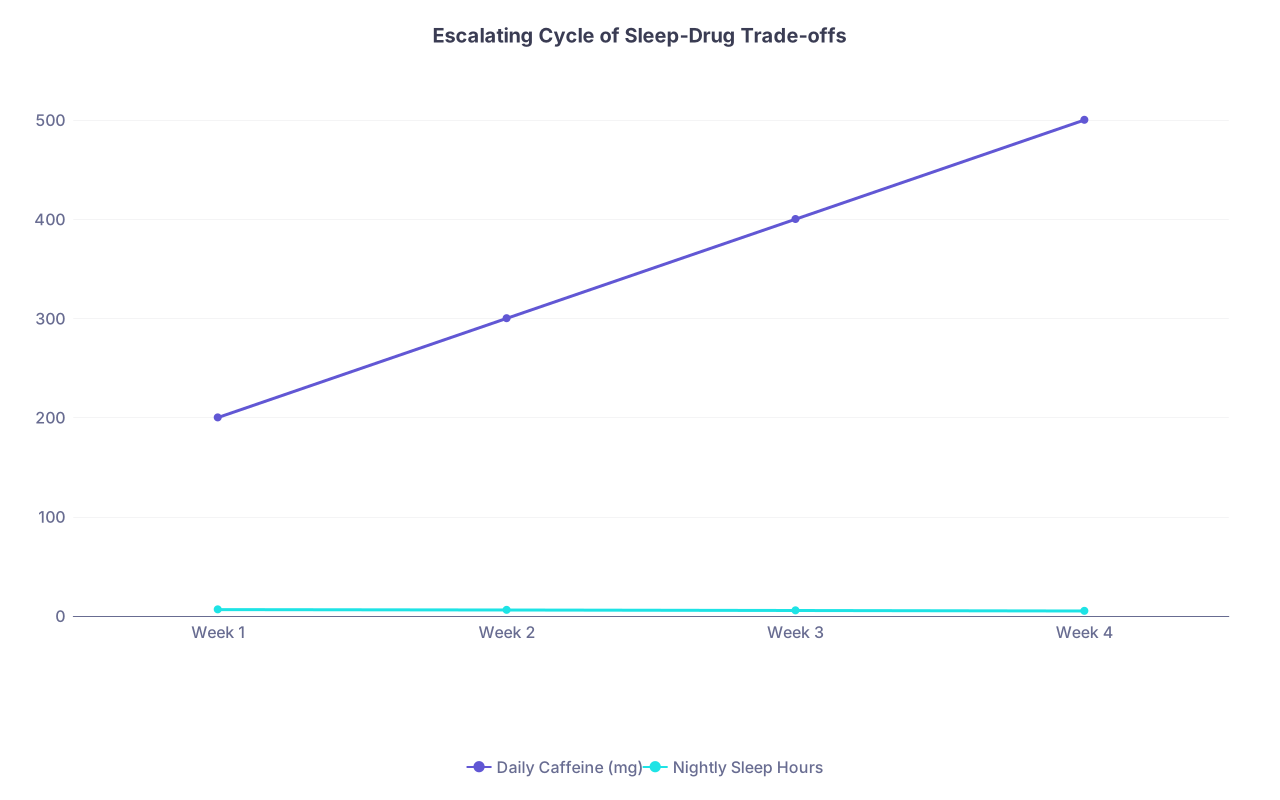
| Category | Daily Caffeine (mg) | Nightly Sleep Hours |
|---|---|---|
| Week 1 | 200 | 6.5 |
| Week 2 | 300 | 6 |
| Week 3 | 400 | 5.5 |
| Week 4 | 500 | 5 |
Core mistakes in this cycle:
- Using caffeine after ~2 p.m. on day shifts and after the first half of night shifts.
- Using alcohol or sedating meds as your primary sleep strategy after call.
- Assuming “I slept 8 hours with meds” equals quality sleep. It does not.
You may be unconscious for 8 hours. That does not guarantee restorative deep and REM sleep.
Warning signs this trade is hurting you:
- You need caffeine to feel baseline human in the morning, not just “more awake.”
- You cannot fall asleep without something on board (pill, drink, gummy).
- Your dreams are fragmented or absent, and you wake feeling unrefreshed even after long sleep.
Safer boundaries:
Caffeine:
- No caffeine in the last 6–8 hours before planned sleep (day or night schedule).
- On nights: front-load caffeine early in the shift, then switch to non-caffeinated fluids.
Sleep aids:
- Occasional, strategic use of melatonin or short-acting meds during brutal rotations can be reasonable.
- Daily reliance is a red flag. You are likely masking a deeper schedule, stress, or behavior issue.
Fix the underlying sleep trade-off errors first. Do not let your residency become one long chemistry experiment on your nervous system.
7. The Trade You Actually Need To Make
You cannot always get 8 hours. Some rotations will break every ideal rule. Night float, 28-hour calls, trauma, ICU—it is not a wellness retreat.
But you can decide which corners you refuse to cut and which sacrifices you stop making unconsciously.
Here is the trade that prevents burnout:
- Trade some non-essential tasks for sleep.
- Trade some fake productivity for real rest.
- Trade some “looking good to others” for “functioning well in reality.”
People who survive residency intact do not just have better coping skills. They make fewer stupid trades with their sleep.
Ask yourself, honestly:
- Where am I sacrificing sleep for something that is not truly essential?
- What am I trying to “buy” with that lost sleep—status, scores, control, escape?
- What would it look like to defend 30–60 more minutes of sleep most nights?
Protecting those small increments consistently matters more than the occasional perfect 8‑hour night.
FAQ (Exactly 4 Questions)
1. Is burnout really about sleep, or is this just one piece of the puzzle?
Burnout has multiple drivers—system issues, workload, toxic culture, moral distress. But chronic sleep debt is the force multiplier that makes all of that unmanageable. With adequate sleep, the same workload feels hard but survivable. With chronic sleep loss, normal stressors feel impossible. I have seen residents do the same rotation twice—first time sleep-deprived, second time with better sleep protection—and describe them as completely different experiences.
2. How much sleep should residents realistically aim for on heavy rotations?
Ideal is still 7–8 hours. Realistically, on brutal services, aiming for a consistent 6–7 beats swinging between 4 and 9. The key is minimizing nights under 6 hours and avoiding self-inflicted cuts (scrolling, late studying, unnecessary charting at home). If the schedule physically limits you to 5 hours on certain days, you compensate by protecting sleep ruthlessly on the days when you do have control.
3. What if my program culture glorifies overwork and shames people who leave on time?
Then you are in a high-risk environment for burnout, and you need to be even more deliberate. You will probably not change the culture as a PGY‑1 or PGY‑2. But you can quietly protect personal boundaries: finish your work efficiently, avoid needless hanging around, stop volunteering for every extra task, and normalize going home when your job is done. Find allies—there is almost always at least one senior or attending who models sane behavior. Learn from them, not from the loudest martyr in the room.
4. What is one concrete change I can make this week to improve my sleep without overhauling my life?
Pick a sleep cutoff time and honor it 5 nights in a row. For example: “At 11:00 p.m., whatever I am doing—phone, Netflix, notes, studying—stops. I start a wind-down routine and aim to be in bed within 15–20 minutes.” Do not negotiate with yourself in the moment. Decide once, act five times. Then see how your mood, patience, and cognitive sharpness feel at the end of the week.
Open your calendar for the next 7 days right now and choose one specific night where you will protect an extra 60 minutes of sleep—no screens, no studying, no “just one more episode.” Put it in writing like any other commitment, and treat it with the same seriousness you give to a scheduled case.


