

The burnout policies that actually protect residents are rarely in the handbook—and almost never explained out loud.
You’re told about “wellness initiatives,” free pizza, maybe a mindfulness app code. What no one walks you through are the quiet, informal safety nets that PDs, chiefs, and attendings use behind the scenes to keep residents from breaking. Because if they talked about them openly, half the class would try to game the system, and the other half would panic that they’re already supposed to be using them.
Let me tell you what really exists in most programs, what’s only on paper, and what’s available to you if you know how to ask without setting off alarms.
The Quiet Red-Flag System You Never See
Every half-decent program has an internal “something’s wrong” radar. You just never see the dashboard.
Here’s what’s happening behind closed doors: once a month (sometimes more), the PD, APDs, chief residents, and maybe a program coordinator sit in a room and go through every resident by name. This isn’t conspiracy theory—I’ve been in those rooms.
It sounds like this:
“Who’s worried about anyone?”
“How’s R3 night float morale?”
“Is J doing okay after that patient death?”
“Why is M’s charting still 2 days behind?”
There’s no formal rubric. It’s pattern recognition and gossip with consequences. Serious consequences sometimes.
Every program runs their own version, but there are common “silent red flags” that trigger extra attention, often without you ever knowing:
- Repeated sick calls on call days or heavy rotations
- Sudden drop in conference attendance after being solid for months
- Noticeable attitude shift: previously engaged → now flat, sarcastic, withdrawn
- Consistent delays in notes, orders, or sign-out quality
- Subtle complaints from nurses: “He seems off,” “She’s snapping a lot lately”
- A resident who starts getting mentioned by multiple attendings as “not themselves”
No one tells you this, but once your name gets brought up more than twice in these meetings, you’re on what I’d call the “soft watch list.” Not formally. Nobody slaps a label on your file. But the chiefs and PD start watching.
And here’s the secret: this can be a safety net if you do not fight it.
When a PD thinks you might be burning out, most of them are not trying to punish you. They’re trying to prevent a crash: patient harm, a breakdown, a resignation, a board failure. The problem is that residents are so used to hiding distress that they interpret any extra attention as a threat.
If your PD or chief suddenly:
- Starts asking “Are you sleeping?” more than usual
- “Randomly” offers to switch a heavier rotation
- Suggests you take a “mental health day” and not worry about coverage
- Wants to “check in” 1:1 after a bad event
…you’re probably already on their internal radar. That’s not the time to say, “I’m totally fine, thanks.” That’s the time to admit, at minimum, “Things have been harder lately than I thought they’d be,” and let them open a door.
Because that door? Often leads to safety nets you’ve never heard described clearly.
Schedule Manipulation: The “Invisible” Accommodation
Programs will swear their block schedule is fixed. It isn’t. Not completely.
Behind the scenes, chiefs rewire rotations constantly: maternity leave, injuries, people quitting, visa issues, fellowship interviews. Sliding a resident out of a malignant block or buffer-loading lighter rotations around a rough period is not unusual. They just don’t advertise it as a burnout strategy.
You’ll never see it written this way, but schedule accommodation is one of the most powerful unspoken safety nets.
Here’s how it silently plays out:
A PGY-2 in IM starts making more med errors on nights. Vulnerable, teary in feedback. Chiefs “coincidentally” shift her next block from MICU to a lighter elective, put a strong co-resident on nights with her next time, and quietly shorten her stretch of consecutive calls.
A surgery resident loses a parent. Program can’t change case minimums, but they can: move them off trauma nights for a couple months, pull them from the most emotionally brutal services, cluster clinic days instead of stacked OR marathons.
A psych resident keeps getting into conflicts with a specific attending. Without fanfare, chiefs move that resident’s next scheduled time with that attending to a different supervisor “due to coverage changes.”
This is intentionally hidden under “coverage needs” so other residents don’t start demanding custom blocks. But make no mistake: PDs absolutely use schedule tweaks as burnout control.
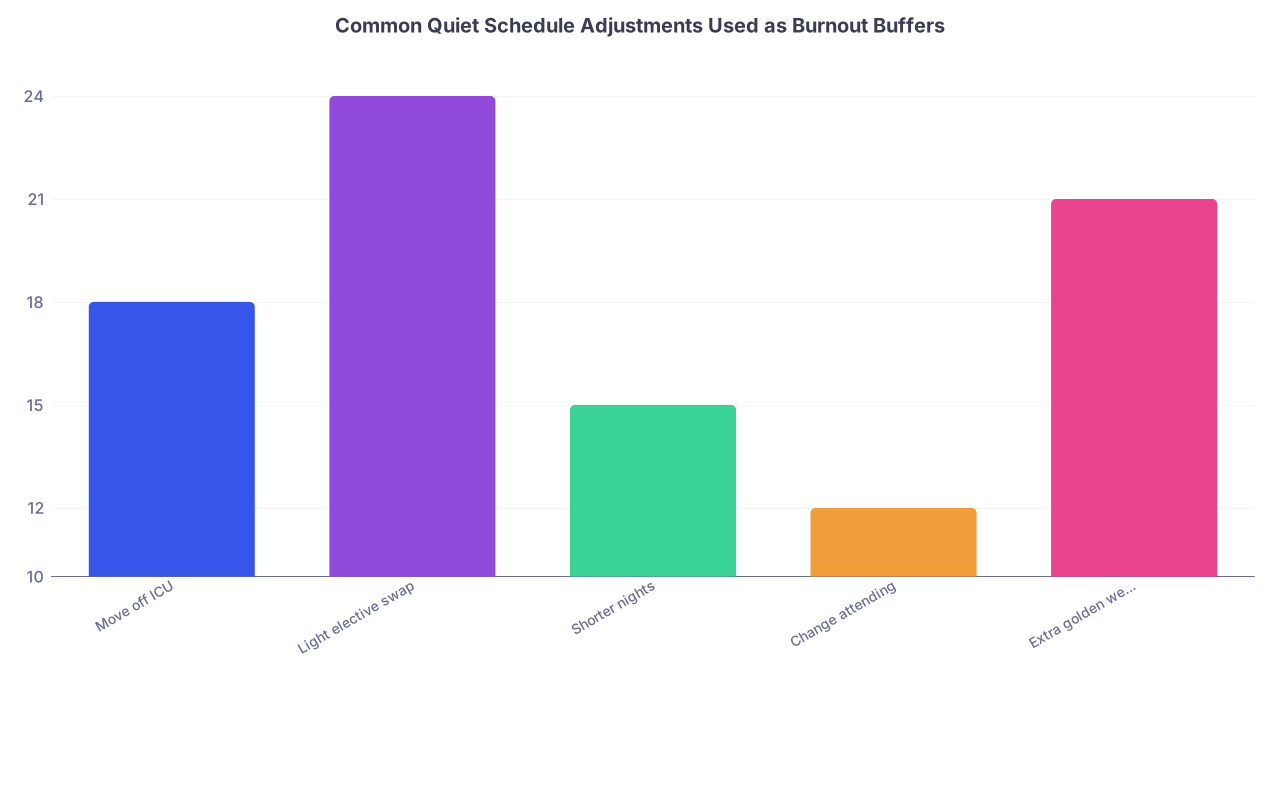
| Category | Value |
|---|---|
| Move off ICU | 18 |
| Light elective swap | 24 |
| Shorter nights | 15 |
| Change attending | 12 |
| Extra golden weekend | 21 |
If you are drowning, what you want is not, “I can’t do this rotation.” That sounds like refusal. It triggers professionalism concerns.
What you say is something like:
“I’m functioning, but I’m not at my best. I’m worried that if I go straight from nights into MICU, I’m going to start missing things. Is there any flexibility in my near-term schedule to build in a lighter block or an elective before that?”
You’re speaking their language: patient safety, functioning, insight, foresight. That’s how you unlock schedule manipulation without sounding like you’re opting out.
Most residents never even try.
The Shadow Mental Health Pathways (That Aren’t in the Brochure)
On orientation, you heard about:
- Employee Assistance Program
- Counseling center
- Anonymous hotline
And you mentally filed it under “PR box-checking” and never thought about it again.
Here’s the part they do not explain:
Most PDs have specific therapists, psychiatrists, and clinics they’ve quietly curated over the years. Providers who:
- Know residency culture
- Understand call schedules and 28-hour shifts
- Are used to working around board exams
- Know how to chart in a way that doesn’t nuke a future credentialing form
I’ve literally heard PDs say in closed meetings: “If J says yes to help, we’ll get her in with Dr. X—he’s good with surgery residents and confidentiality.”
There are usually two tiers:
- The public-facing, generic wellness blurb everyone gets.
- The real curated list shared selectively with residents they’re genuinely worried about or those brave enough to ask directly.
The second list moves faster. If your PD really wants you seen, they make it happen within days, sometimes 24–48 hours, because they’ve been feeding that provider referrals for years.
The trick: you have to cross the line from vague to concrete.
Weak approach:
“Yeah, I’ve been stressed, but it’s just residency.”
Stronger, unlocks help:
“I’m not doing well. I’m not at risk of hurting myself, but I need professional help. Do you have someone you trust who understands residents?”
That phrasing does three things:
- Signals insight, not drama.
- Reduces their fear you’re an immediate safety issue they must report.
- Opens the door for them to connect you to the “quiet list” and feel like they’re doing their job.
Do not underestimate how much PDs hate losing residents to suicide, psych hospitalizations, or dropping out. They remember every name. They will often go further for you than you think—once you make it clear you’re serious and not just venting.
The “Protected Struggle” Year No One Advertises
Lots of programs use an unofficial concept I’d label the “protected struggle year.” They just call it something else in meetings.
It works like this: leadership expects every resident to have one really bad year—because the R2 ICU year, or the first surgical chief year, or that brutal peds winter is predictably horrible. Not because you’re weak. Because the structure is insane.
So some PDs mentally budget: “Everyone gets one year where we don’t freak out if they’re borderline.”
What this looks like from the outside:
- You fail an in-service exam once → serious talk, maybe light remediation, but no one panics.
- You get a couple of borderline evals on a hell rotation → put on a “development plan” that’s mostly check-ins and feedback.
- You’re late with notes through one block → reminders, guidance, maybe a stern email, but not probation.
The safety net here is that if you’re transparent and engaged—show up to meetings, respond to feedback, actually try—you can have a bad year without it killing your career.
The dark side: if you burn that “struggle year” acting like everything’s fine, hiding errors, blowing off feedback, or going quiet and resentful, then when you really hit a wall later, people have much less patience. They already “used” their one-time grace on you.
I’ve seen this play out. Resident A: burns out in R2, admits they’re overwhelmed, accepts help, small remediation, improved in R3. Graduated, solid job.
Resident B: coasts, denies issues, accumulates low-key complaints. Finally crashes in R3. By then, trust is gone. Same objective performance, totally different outcome.
Use your bad year honestly. That’s the safety net.
Adjacent Transitions: Quietly Changing Tracks Without Exploding Your Career
Here’s one nobody tells you exists until someone in your program uses it: the “sideways transition.”
Residents who are burning out hard sometimes don’t need therapy. They need a different job.
PDs know when someone’s soul is never going to survive their chosen specialty. The surgery resident who cries after every complication and physically recoils from the culture. The EM resident who dreads every shift like a prison sentence. The OB resident who’s clearly a better fit for outpatient continuity than the L&D trenches.
Most programs have an unofficial playbook for this:
- Quietly talk with the resident: “Have you ever thought about X instead?”
- Reach out to friendly PDs in IM, FM, psych, anesthesia, pathology—whatever fits.
- Arrange a “visiting elective” or rotation framed as “exploring interests” rather than fleeing.
- Slide them into an off-cycle PGY-2 or PGY-3 spot that opened because someone else left.
You don’t see this on websites. You see it at 7 p.m. in the PD office with the door closed and a resident on the edge of quitting medicine entirely.
If you’re deeply misaligned with your field and it’s destroying you, the magic words are not:
“I hate this, I want out.”
It’s closer to:
“I’m realizing the parts of this specialty that energize most people aren’t doing that for me. I’m committed to training responsibly, but I’m seriously wondering if I’d be better suited for [X]. Is that something we could at least explore?”
That gives the PD cover. They’re not “losing” you. They’re “helping you find a better fit within medicine.” And if you’re even halfway competent and not a professionalism disaster, another program often is interested.
The safety net here is career redirection before complete collapse. But you have to be willing to let go of the sunk cost fantasy that your first specialty must be forever.
The “We’ll Cover You” Culture: When Colleagues Quietly Save You
Not every safety net is official. Some are cultural. And honestly, these are the ones that keep more residents from breaking than any formal policy.
In some programs, there’s an unspoken rule: if someone is clearly falling apart, you protect them without making a show of it. You see this in:
- Co-residents who quietly pre-chart the worst patients for the exhausted intern.
- A senior who “takes the tough family meeting” because they can tell you’re too raw after a bad outcome.
- A co-intern who swaps one of your 24s because your relationship just imploded and they remember their own version from last year.
In strong programs, the chiefs actively model this.
I’ve watched a chief walk into sign-out, look at a PGY-1’s face after three codes in a night, and say: “You are not going to the ED today. You’ll stay upstairs, handle calls, no new admits. We’ve got you.” Later in the leadership meeting they framed it as “optimizing team function,” but everyone on the team knew what just happened.

The flip side: in malignant or brittle programs, anyone asking for help is silently labeled “weak” or “not resilient.” Those programs often have more patient safety issues, more quiet leave-of-absence stories, and more off-cycle resignations… but less open conversation.
You can’t fully control culture, but you can test it:
- Mention to a co-resident that you’re not okay and see if they respond with support or judgment.
- Watch how they treat the resident who takes a leave of absence. Is it empathy or gossip?
- Notice what happens when someone has a family emergency. Are schedule moves framed as supportive or as burdens?
If you’re lucky enough to be in a program where “we’ve got you” exists—even inconsistently—use it. Take the help. Don’t be the martyr who refuses coverage because you “don’t want to burden anyone.” That’s how people break.
The “Confidential” Leave of Absence That’s Not as Career-Ending as You Think
One of the most misrepresented safety nets: short-term leave.
Residents think: “If I take a LOA, I’m toast. Fellowship gone. Job offers dead. PD will hate me. I’ll be branded forever.”
Reality from the leadership side is very different.
Most PDs have already had 1–3 residents, minimum, take some form of:
- Medical leave (physical illness, surgery, pregnancy complications)
- Mental health leave (depression, anxiety, PTSD after events)
- Family crisis leave (death, caregiving)
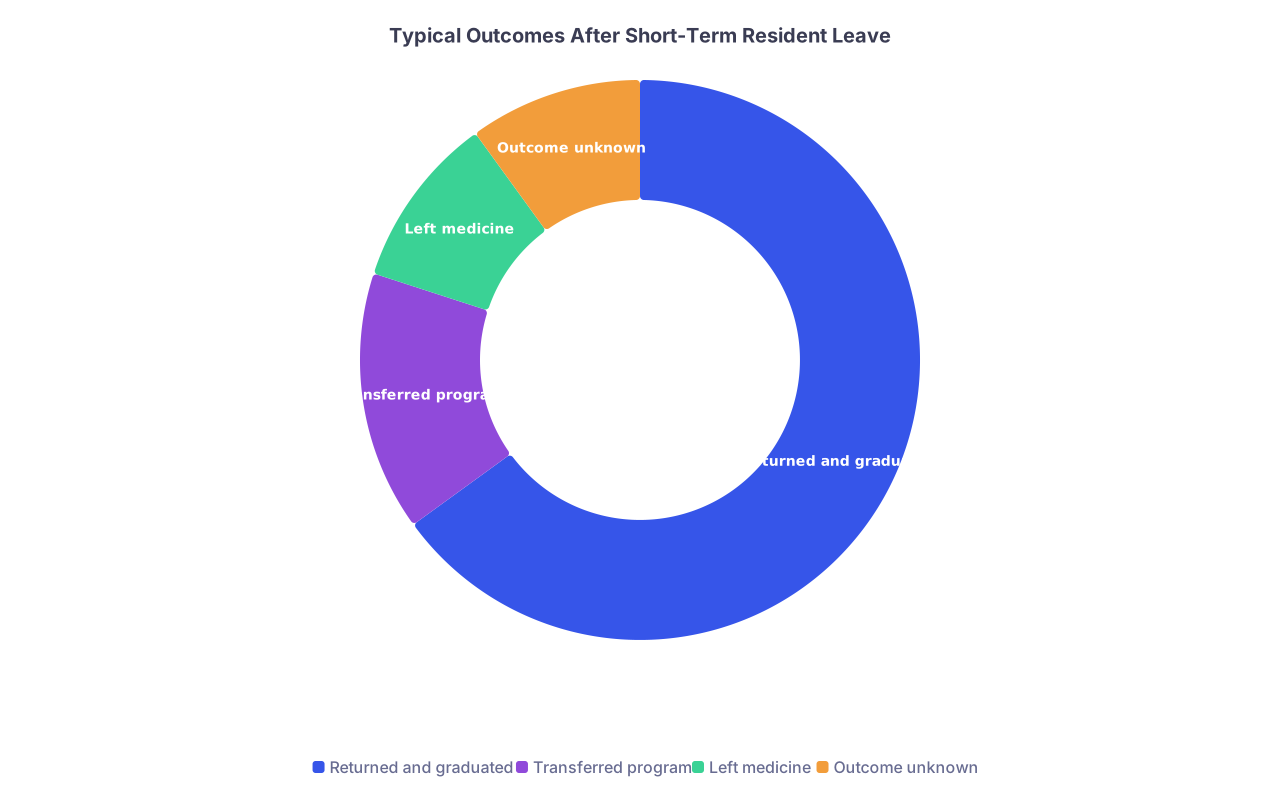
The unspoken truth is that most of those residents came back and finished.
| Category | Value |
|---|---|
| Returned and graduated | 65 |
| Transferred program | 15 |
| Left medicine | 10 |
| Outcome unknown | 10 |
What actually happens when it’s done well:
- PD and GME quietly file it as medical leave, not disciplinary.
- Your co-residents are told as little as possible: “X is on leave, coverage plan is…”
- Your return is staged: maybe start back on a lighter rotation, sometimes part-time at first.
- In board and credentialing paperwork later, it’s simply listed as “approved medical leave” with dates. That’s it.
Every PD knows this line by heart for future employers/fellowships:
“Dr. ___ took a brief, approved leave during training for personal health reasons, returned, and successfully completed the program without further issues.”
I’ve literally heard PDs rehearse that sentence before reference calls. It’s code for: “There was something, it’s private, it was handled, they’re safe now.”
But you don’t get that version if you push yourself until you:
- Start making dangerous errors
- Have an on-shift breakdown that triggers emergency eval
- Or disappear into silence and force them to hunt you down
Controlled leave looks far better than uncontrolled collapse.
If you need time away, go in with clarity:
“I’m at the point where I can’t function safely. I need a defined leave—likely on the order of X weeks—to get intensive help and get back to being safe for patients. I want to return, and I want to do it the right way.”
That frames you as responsible, not flaky. PDs can work with that.
The Evaluation Language That Signals You’re on Thin Ice (Or Being Protected)
You’ve probably skimmed your evals for the numeric scores and ignored the language. That’s a mistake.
Program leadership reads evaluations like coded messages.
There are stock phrases that mean very specific things to us:
“Requires more supervision than peers”
Translation: we do not fully trust them alone. Potential patient safety concern.“Improved with feedback over the course of the rotation”
Translation: struggling but coachable; we’re giving grace.“At times appeared overwhelmed, though remained professional”
Translation: we see the burnout. We’re documenting it in case we need to justify support.“Continues to develop consistency in clinical decision making”
Translation: not where they should be yet. Now we’re tracking a pattern.
But there’s one specific type of language that quietly protects you:
“Responded appropriately to feedback, demonstrated insight into limitations, and sought help when needed.”
That sentence shows up when attendings are trying to help you, not sink you. It’s leadership gold because if something goes wrong later, they can say, “Look, this resident has insight and help-seeking behavior; they were not reckless.”
So if an attending ever says, “You’re struggling but you have good insight,” do not roll your eyes. That’s them telegraphing: “I can stick my neck out to defend you if I have to.”
Leaning into that narrative—being the resident who seeks help early and often—is its own burnout safety net.
You don’t have to be the rock. You have to be the one who doesn’t pretend you’re granite when you’re already cracking.
How to Actually Use These Safety Nets Without Wrecking Yourself
Let me strip this down to what matters.
The hidden safety nets in residency are real:
- Quiet schedule manipulation
- Curated mental health access
- Protected struggle periods
- Sideways transitions to other specialties
- Cultural “we’ve got you” moments from peers and chiefs
- Controlled, non-career-ending leaves
Your program may never sit you down and admit to any of this. Officially, you get the polished handbook, the ACGME compliance slides, and some awkward wellness lecture.
Unofficially, here’s what you can do:
First, stop trying to be invisible when you’re drowning. Leadership can’t help what they can’t see, and they’re much less afraid of the resident who comes in early with, “I’m slipping,” than the one they find at rock bottom.
Second, speak the language PDs and chiefs respond to: patient safety, functioning, insight, and concrete asks. Not vague misery, not martyrdom, not ultimata.
Third, accept that using a safety net is not failure; it’s part of how adult physicians survive a broken system. The residents who last aren’t always the toughest. They’re the ones who know when to take the hand that’s quietly being offered.
Three key truths to leave you with:
- Most programs would rather bend quietly to keep you safe than watch you crash publicly.
- The best safety nets are unlocked by honesty and insight, not by stoicism.
- You are allowed—actually expected—to struggle. What matters is whether you let people help before it costs you more than it has to.


