

What’s the worst that could actually happen if you just “push through” your burnout and keep your mouth shut?
That’s not a rhetorical question. The answer is: a lot. Patient harm, career damage, wrecked relationships, and sometimes things you can’t walk back.
The most dangerous part isn’t the burnout itself. It’s the silence. The decision—conscious or not—to tell no one, to keep performing, to hide how bad it’s getting because “everyone else is coping,” “I don’t want to be the weak one,” or “I’ll deal with it after this rotation.”
Let me be blunt: not telling anyone you’re burning out is one of the highest‑risk choices you can make in residency. And residents make it all the time.
You’re not just risking your feelings; you’re gambling with:
- Patient safety
- Your license and future job prospects
- Your health—mental and physical
- Your ability to finish training at all
This isn’t melodrama. I’ve watched people quietly slide from “tired and irritable” to “missing major findings and contemplating quitting medicine” while insisting they were “fine.” They weren’t. Everyone around them could see it long before they admitted it.
Let’s walk through the specific mistakes residents make when they stay silent—and how to avoid burning your life down while you’re trying to be “resilient.”
Mistake #1: Treating Burnout Like a Private Character Flaw
Burnout is not a personality defect. But residency will convince you it is if you’re not careful.
Here’s the script I hear over and over:
- “Other interns are doing the same hours; it must just be me.”
- “If I were really cut out for surgery/peds/EM, this wouldn’t be so hard.”
- “I should be able to handle this—I’m just not tough enough.”
That mindset does three dangerous things:
It makes you hide symptoms.
You start acting, not living. Smiling on rounds, saying “no worries, I’ve got it” when you’re running on fumes.It delays any intervention until crisis.
Because you don’t want to “bother” anyone until it’s undeniably bad. By the time it’s undeniable, damage is already done.It turns a system problem into a shame problem.
Instead of saying “this schedule is inhumane,” you say “I’m weak.” Shame is paralytic; it keeps you stuck and quiet.
Here’s what I mean by burnout not being a character flaw:
| Aspect | Burnout | Being "Weak" (Myth) |
|---|---|---|
| Cause | Chronic overload + lack of control | Personal failure |
| Common in residency? | Extremely | Overused label |
| Fix | System + support + boundaries | Not relevant |
| Confidential help available? | Yes | N/A |
| Should be hidden? | No | N/A |
If you mislabel burnout as weakness, you’ll hide it. And hidden burnout doesn’t quietly resolve—it compounds.
Mistake #2: Ignoring the Early Warning Signs Because “This Is Just Residency”
There’s normal residency tired. Then there’s the other thing.
You know the difference. So does every senior who’s watched an intern cross that line.
Here’s the trap: residents normalize things that are absolutely not normal because “everyone’s miserable.” Danger zone.
Common signs that are not just “being a resident”:
- You feel dread every single day, even on lighter rotations.
- You’re emotionally flat with patients or, worse, secretly resent them.
- You catch yourself thinking: “If I got into a minor car accident and had to be out a few weeks, that might be a relief.”
- You’re making more near-misses, small errors, or getting subtle feedback like “You seem off lately” from nurses or co-residents.
- You scroll your phone for an hour in the call room instead of seeing the new consult because you can’t make yourself move.
- You cry in the bathroom between pages and then walk out like nothing happened.
If you’re seeing more than a couple of these, that’s not just “rough month” territory anymore.
Here’s what usually happens when someone stays silent:
They downplay it to themselves.
“I’m just on nights.”
“It’ll get better after this rotation.”
“Everyone feels like this sometimes.”They rationalize risky behavior.
Skipping meals, skipping sleep, skipping their own appointments.
Saying yes to everything because “I don’t want to be the problem intern.”Their baseline continues to drop.
What felt awful two months ago now feels “normal,” and they only notice when they crash.
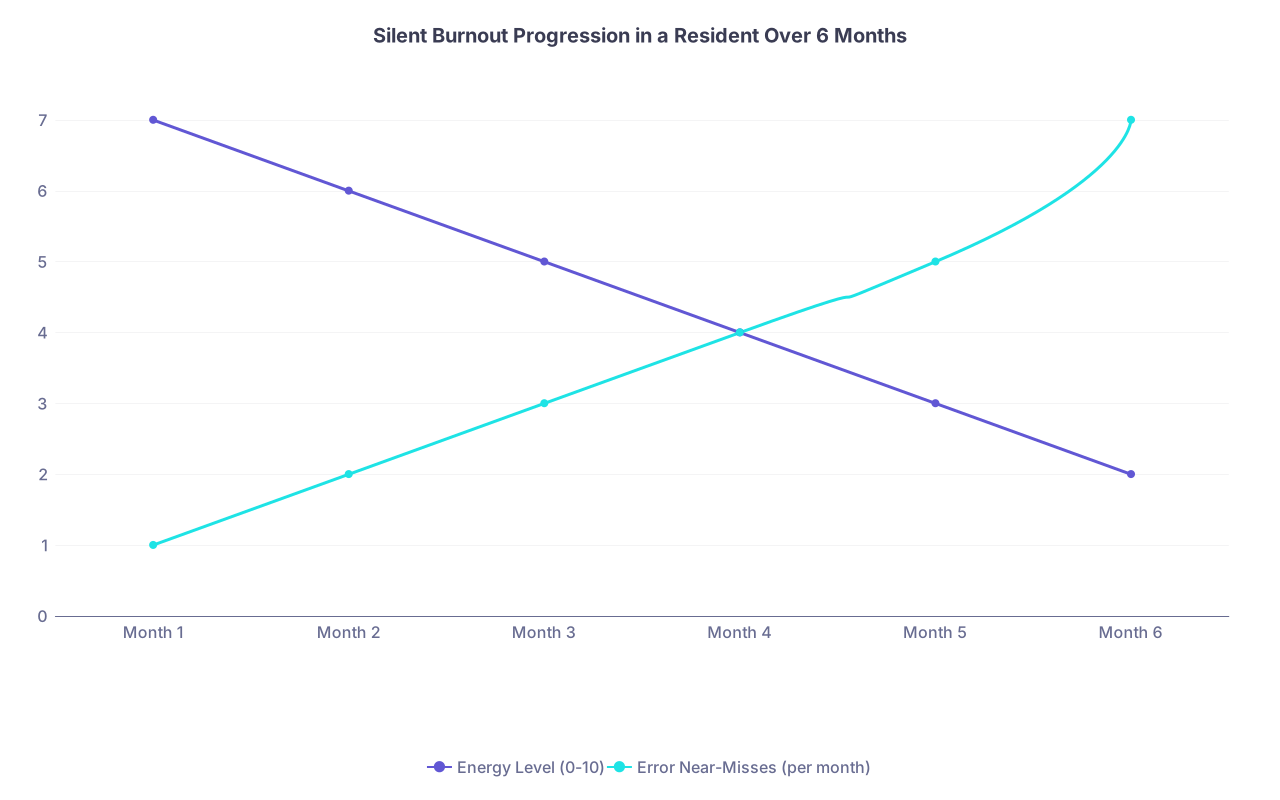
To make this concrete, let’s look at a very typical slide:
| Category | Energy Level (0-10) | Error Near-Misses (per month) |
|---|---|---|
| Month 1 | 7 | 1 |
| Month 2 | 6 | 2 |
| Month 3 | 5 | 3 |
| Month 4 | 4 | 4 |
| Month 5 | 3 | 5 |
| Month 6 | 2 | 7 |
They don’t explode overnight. They erode slowly. And everyone tells themselves, “I just need to push a little longer.”
That “little longer” is exactly where bad things happen.
Mistake #3: Believing Disclosure Will Automatically Destroy Your Career
This is the big fear:
“If I tell anyone I’m burning out, they’ll think I can’t hack it, I’ll get labeled, maybe even pushed out.”
Sometimes programs do mishandle this. Let’s not lie. There are toxic environments and tone-deaf PDs who equate vulnerability with incompetence.
But here’s the harsh comparison:
- Risk of career impact from smart, strategic disclosure: Variable. Often low to moderate if handled well.
- Risk of career impact from undisclosed advanced burnout: High. And not hypothetical.
What actually torpedoes careers?
- Serious, documented patient care errors tied to fatigue, distraction, or emotional exhaustion.
- Unprofessional behavior: snapping at staff, disappearing, chronic lateness, charting disasters.
- Substance use issues that spiral precisely because they’re hidden and untreated.
- Sudden meltdown: walking off service, not showing up, or saying something in a breakdown that gets escalated straight to leadership.
Almost every resident who ended up on the PD’s radar in the worst possible way had someone—nurse, senior, co-resident—who’d been worried about them for weeks or months. But no one had enough information or permission to intervene properly because the resident kept everything locked down.
The real calculation isn’t “Talk vs. no consequences.”
It’s:
- Option A: Controlled disclosure, with documentation and support that can protect you if something happens.
- Option B: No disclosure, no documentation, no support—and then hoping nothing catastrophic happens while you’re practicing at 40% capacity.
Guess which one I’d pick for my license.
Mistake #4: Confiding Only in People Who Can’t Actually Help
Talking isn’t enough if you talk to the wrong people only.
This is another subtle mistake:
You vent constantly to your co-interns at 2 am in the call room, but you never tell anyone who has actual authority or resources to help you.
So what happens?
- Your co-residents get worried, but they feel stuck.
- They may try to “cover” for you, quietly taking your tasks, which hides how bad it’s getting from faculty.
- Nobody documents anything, nobody modifies your schedule, nobody connects you with therapy or adjustments.
And you continue to slide.
There are three tiers of “telling someone,” and you need to use more than one:
Lateral support (peers, co-residents, friends).
- Good for: validation, emotional support, “you’re not crazy, this is hard.”
- Not enough for: schedule changes, formal accommodations, protected time.
Program/Institutional support.
Examples: chief resident, program director, associate PD, GME office, wellness officer.- Good for: adjusting rotations, call, clinic load; arranging leave; formal performance support plans that don’t automatically equal punishment.
Confidential clinical support.
Examples: therapist, psychiatrist, employee assistance program (EAP), outside mental health provider.- Good for: safe space, diagnosis, treatment, documentation that can protect you.
You don’t have to broadcast your situation. But if you’re only talking sideways and never up or outside, you’re basically choosing support without power.
That’s a mistake.
Mistake #5: Underestimating the Patient Safety Risk of Your Silence
This one’s non-negotiable.
Burnout isn’t just about you being sad and tired. It directly affects patient care.
When you’re burned out and say nothing, a few predictable things happen:
- You cut cognitive corners. You skim notes. You half-listen to consults.
- You delay tasks because you’re overwhelmed, then forget they exist.
- You miss subtle but critical changes because your brain is juggling too many incomplete threads.
- Your empathy drops, so you’re less likely to fully hear that “something’s not right” from a patient or nurse.
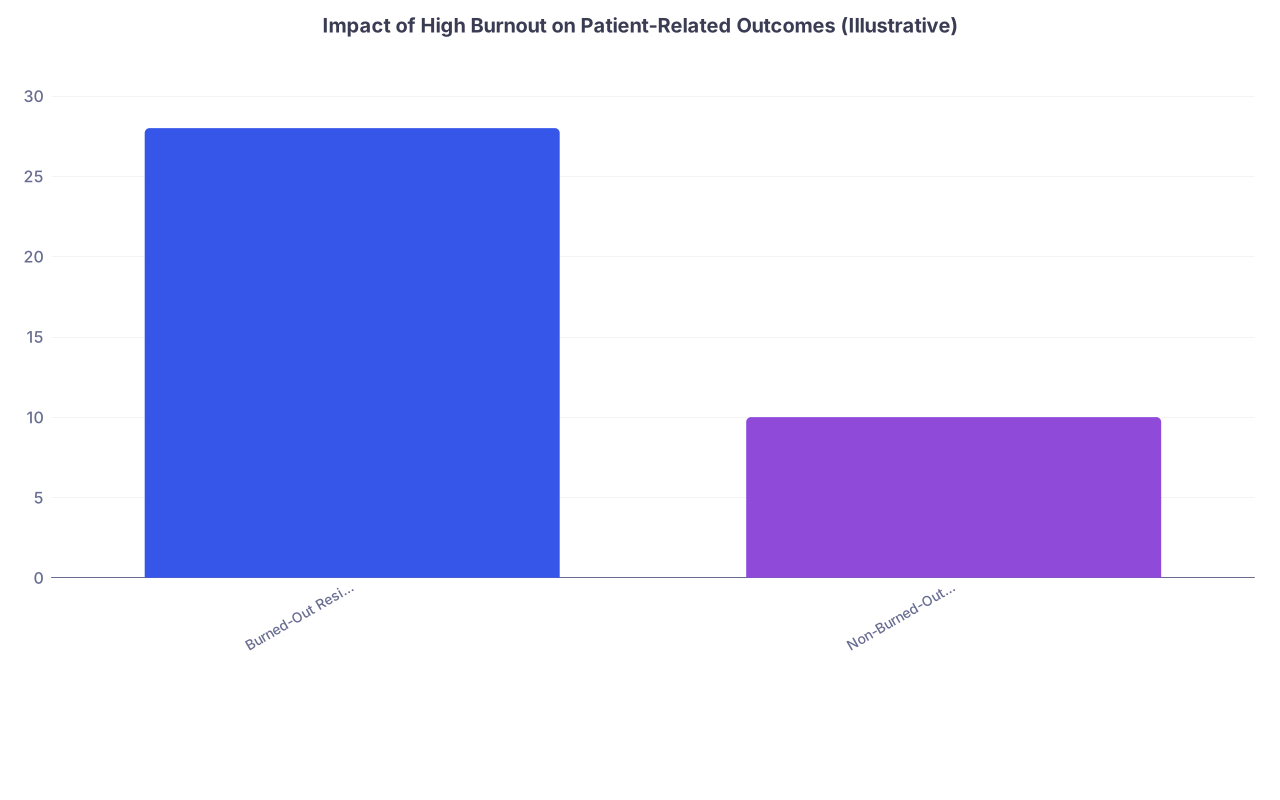
Let’s put some numbers against the intuition:
| Category | Value |
|---|---|
| Burned-Out Residents | 28 |
| Non-Burned-Out Residents | 10 |
Imagine that bar labeled “burned-out residents” isn’t abstract. It’s you on your seventh 80-hour week, pretending you’re fine.
The mistake isn’t just being burned out. It’s being burned out, saying nothing, and continuing to function as if you’re at full capacity in a job that literally holds people’s lives.
If that sounds dramatic, good. It should.
Mistake #6: Thinking You Have to Have a “Plan” Before You Speak Up
I hear this a lot:
- “I’ll say something once I figure out what I need.”
- “I don’t want to dump this on my PD without offering solutions.”
- “I should wait until I know whether I want to take leave, switch programs, or just get therapy.”
No. That’s backward.
You’re trying to crisis-manage and be your own residency admin and be your own therapist. While burned out. That’s how you end up paralyzed and silent.
You do not need a perfect plan.
You need a clear, honest first message.
Something like:
- “I’m not okay, and it’s starting to affect my work. I don’t yet know exactly what I need, but I know I need help figuring it out.”
- “I’m worried about my level of exhaustion and how it’s impacting my focus. I want to talk about options before anything serious happens.”
- “I’m experiencing significant burnout symptoms. I’m in therapy / planning to start, and I also need to discuss whether my schedule or responsibilities can be adjusted.”
Your job in that first conversation isn’t to arrive with solutions. It’s to:
- Flag that there’s a real issue.
- Signal that you care about patient safety.
- Ask explicitly for help figuring next steps.
Run that play early, not when you’re already fantasizing about disappearing.
Mistake #7: Waiting Until You’re in True Crisis to Tell the Truth
There’s a pattern you start to recognize if you’ve been around residency long enough:
- Resident is vaguely “off” for weeks. People notice, but no one is sure how bad it is.
- Performance slips. Feedback is given, but resident says, “I’m just tired—got it.”
- Then something breaks:
- They blow up at a nurse.
- They miss a critical lab.
- They don’t show up for a shift.
- They disclose suicidal thoughts only after someone corners them.
Now everything happens on emergency terms.
- Documentation starts piling up, but it’s all attached to crisis behavior, not early symptoms.
- The program is in risk-management mode instead of collaborative-support mode.
- You lose control of the narrative; everyone is playing catch-up, including you.
I’ve seen residents almost lose their spot not because they had burnout or depression—but because they hid it until the fallout was impossible to ignore.
Contrast that with:
- A resident who says, early: “I’m starting to notice concerning thoughts and fatigue; I want to address this now.”
- They get connected with mental health support.
- Their schedule or rotation order is modified.
- If something does happen (missed week, leave of absence), there’s a documented trail showing responsibility and proactive behavior.
Same internal struggle. Very different external story.
Put bluntly:
Early disclosure looks responsible. Late disclosure can look like an excuse.
That shouldn’t be true, but it often is.
Mistake #8: Not Knowing Which Doors Are Actually Safe to Knock On
Part of the silence problem is that residents honestly don’t know who’s “safe” to talk to.
Here’s a more realistic, risk-aware map of where to start.
Lower-Risk, High-Value First Steps
Confidential therapist or psychiatrist (outside your hospital if you’re worried about gossip).
- You control what’s documented and what’s shared.
- You get real clinical help, not just sympathy.
Employee Assistance Program (EAP).
- Often free, short-term, and confidential.
- Can be a bridge to longer-term care.
Trusted senior resident or chief who has a track record of discretion.
- They know local culture and can tell you which attendings/PDs actually walk the walk.

Higher-Stakes but Necessary Conversations
Program Director / Associate Program Director
- Yes, there is risk. But they also control schedule changes, leave approvals, remediation plans.
- You want them hearing things from you, not from incident reports.
GME / Wellness / Occupational Health
- These entities often know federal/state rules, institutional policies, and what has worked for residents before.
- They can sometimes shield certain details from your direct evaluators.
If you’re afraid of saying the wrong thing, write it out first. Literally script it in your notes app:
- 3–4 bullet points on how you’re feeling.
- 2 concrete examples of how it’s affected work.
- 1 clear ask: “I’d like help figuring out next steps to keep me and patients safe.”
You’re not trying to be perfect. You’re trying to be clear.
Mistake #9: Assuming Silence Is “Protecting” Your Co-Residents
This is the twisted logic:
“I don’t want to dump on my team. If I say I’m burned out, they’ll have to cover more. I’ll just suck it up.”
Look closely at what that really does.
- Your co-residents end up compensating anyway—chasing your orders, fixing your incomplete notes, double-checking your work—but without context.
- Nurses stop calling you first because you’re slow or snappy, and they workaround by going to your senior.
- People start quietly labeling you as “checked out” or “lazy” when the reality is you’re drowning.
If you’re actually protecting them, you:
- Tell them early: “I’m not at my best right now; if you see me miss something, please flag it.”
- Loop in someone with authority to adjust your workload before your team is doing two jobs.
- Accept temporary help or redistribution with the explicit goal of returning to full function safely.
It’s not heroic to drag yourself half-conscious through 28 hours and then drop mistakes on everyone else. That’s martyrdom cosplay. It just spreads the pain around and hides the root cause.
Mistake #10: Forgetting That Residency Is a Phase, Not a Life Sentence
Burnout lies. It tells you:
- “This is just how medicine is.”
- “You’ll feel like this forever.”
- “You don’t deserve help if you chose this path.”
Residency is brutal, yes. But it’s also a finite training period inside a very specific culture that often confuses suffering with strength.
Your future practice does not have to look like this.
But you only get to that future if you survive residency with your health and license intact.
That requires you to treat burnout like:
- A clinical condition that deserves evaluation and treatment.
- A workplace safety issue that affects patients and colleagues.
- A signal, not a verdict, that something has to change.
Your silence doesn’t make you stronger. It makes you more breakable.

| Step | Description |
|---|---|
| Step 1 | Notice burnout signs |
| Step 2 | Keep silent |
| Step 3 | Performance declines |
| Step 4 | Emergency intervention |
| Step 5 | Confide in support |
| Step 6 | Get clinical help |
| Step 7 | Discuss with leadership |
| Step 8 | Adjust schedule or duties |
| Step 9 | Stabilize and recover |
| Step 10 | Tell someone? |
| Step 11 | Error or crisis? |
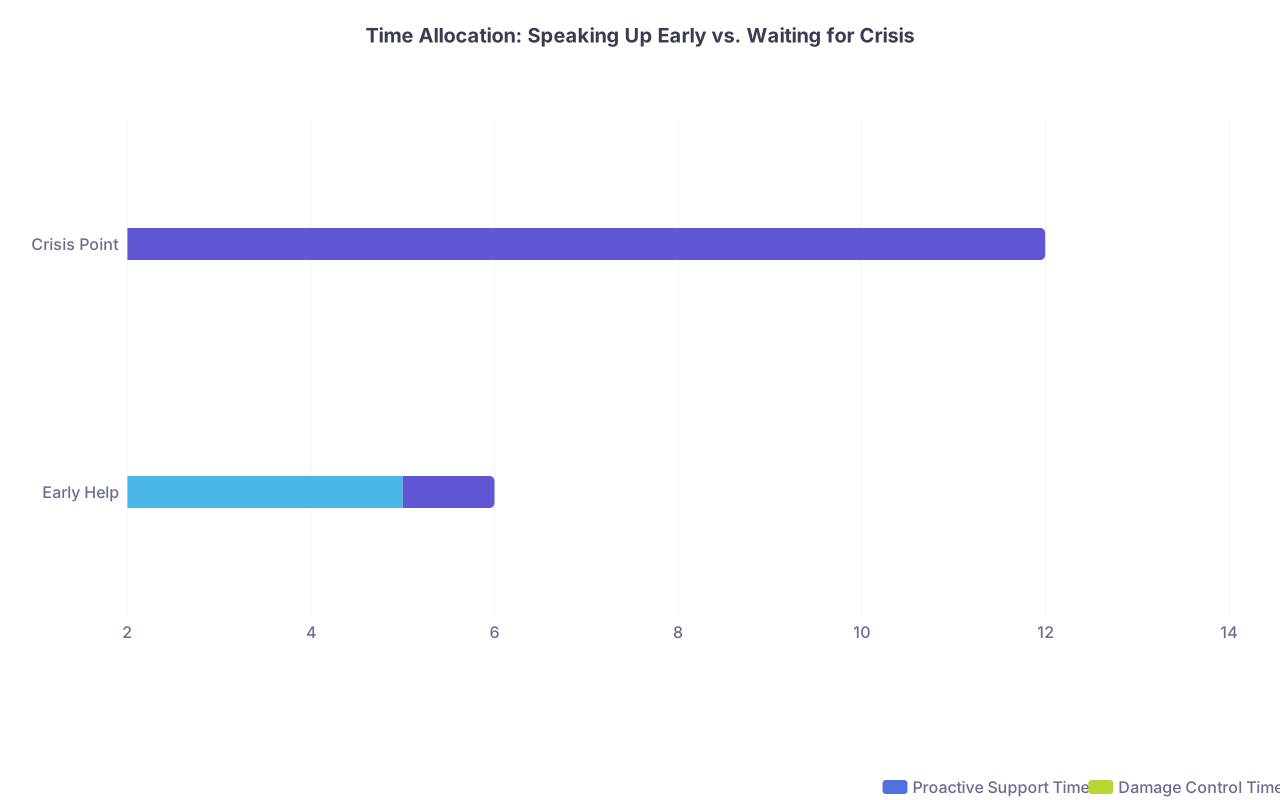
You get to choose which branch you’re on.

| Category | Proactive Support Time | Damage Control Time |
|---|---|---|
| Early Help | 5 | 1 |
| Crisis Point | 2 | 10 |
How to Avoid the “Dangerous Silence” Trap
Let’s translate all this into actions that actually keep you out of the ditch.
Name it early—at least to yourself.
Stop calling it “just tired” if it’s been weeks of dread, numbness, or active thoughts of escape. Use the word burnout or depression if that’s what fits.Tell at least two kinds of people.
- One peer/senior you trust.
- One professional helper (therapist, EAP, or wellness person).
Add your PD or APD when you’re ready—or sooner if patient care is already affected.
Tie your disclosure to patient safety.
Make it clear you’re speaking up because you care about doing your job safely, not because you want a lighter life.Document for yourself.
Short notes on: when symptoms started, big work-impact moments, who you talked to and when. If things escalate, that record can protect you.Accept that you’re not special enough to be immune to collapse.
You are not the first “high-functioning, high-achieving” resident who thought they could outrun burnout by sheer force of will. That story ends badly more often than you’d like.

The Bottom Line
Three points, and then you can get back to your life:
Burnout isn’t the biggest threat. Your silence is.
Untreated, hidden burnout is what leads to errors, explosions, and career damage.Telling the right people early protects you more than it hurts you.
Strategic disclosure—with peers, professionals, and eventually leadership—creates options and safety nets.You’re not proving strength by hiding how bad it is.
You’re just making it more likely that you and your patients will pay a higher price later.
Do not make the mistake of suffering quietly until the system “notices.” By the time it does, it’s usually because something has already gone wrong.


