

The fastest route to resident burnout is saying yes to every research and leadership opportunity.
Not bad luck. Not “the wrong program.” Not magically worse patients or heavier call. The real accelerant is your inability to say no when someone dangles “CV gold” in front of you.
I have watched smart, driven residents wreck their sleep, relationships, and confidence because they believed one dangerous lie: “If I do not stack research and leadership now, my career is over.” That belief is what you must fight, not just the hours on your schedule.
Let’s dissect the mistakes that quietly turn “ambitious” into “miserable.”
The Hidden Trap: When Good Opportunities Become Bad Decisions
Research and leadership are not the problem. Overcommitting to them is.
You know the script:
- You are already at 60–70 clinical hours a week.
- An attending says, “This would be a great opportunity for you.”
- A chief mentions, “We really need someone on this committee; it will look fantastic for fellowship.”
- You hear your co-resident just added “QIPS project lead” and “curriculum committee member” to their CV.
You say yes. Because:
- You do not want to disappoint anyone.
- You are scared of being “behind.”
- You think everyone else is doing it.
- You tell yourself, “It is just temporary.”
That last line is the most common self-deception in residency. “Temporary” steadily becomes your new baseline.
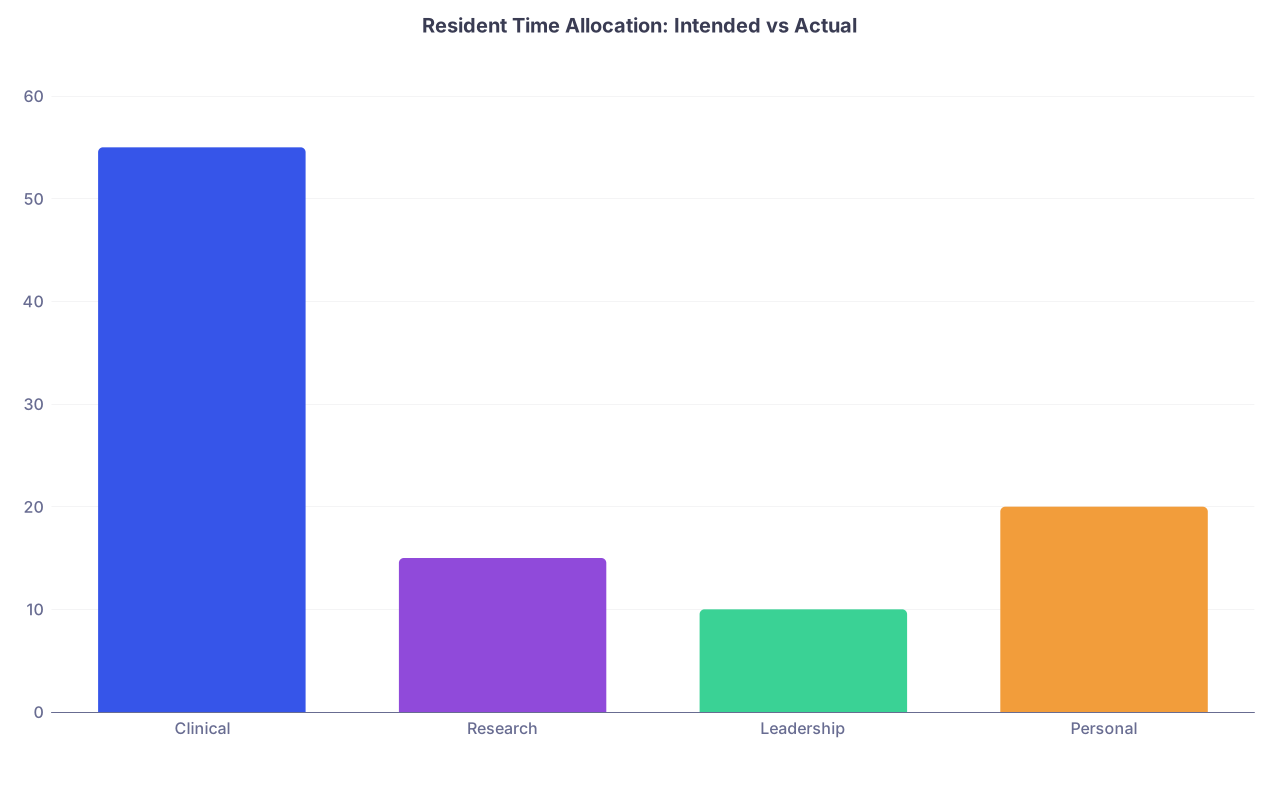
| Category | Value |
|---|---|
| Clinical | 55 |
| Research | 15 |
| Leadership | 10 |
| Personal | 20 |
Those numbers look reasonable on paper. In real life, that “personal” slice disappears first. You keep the clinical. You keep the research. You keep the leadership. You cut sleep, exercise, therapy, family, and actual rest.
And then you wonder why you feel hollow six months later.
Mistake #1: Treating Research Like a Moral Obligation
Residents burn out fast when they act like research is mandatory for everyone and right now.
Let me be blunt:
- Not every resident needs 10+ publications.
- Not every specialty treats research the same way.
- Not every year of residency is equally safe for adding projects.
Yet residents behave like:
- No research = career suicide
- One paper = nothing
- Saying no = “not dedicated enough”
Here is what actually ruins people:
Signing onto too many projects at once
You agree to:- A retrospective chart review
- A case report
- A QI initiative
- A review paper with someone you barely know
Then they all stall in the same month. Deadlines collide. Now you are staying after call to “finish data extraction” while your brain is mush.
Joining projects with zero structure
Red flags you ignore because you are flattered:- No clear first author
- No timeline
- “We will figure out IRB later”
- No one actually writing, just “meeting to discuss”
These projects drain time and mental bandwidth and rarely produce anything concrete. You burn energy for the illusion of progress.
Choosing the wrong mentor
You underestimate how much a chaotic mentor can cost you:- The “big name” who is always traveling and never answers emails
- The micromanager who rewrites every sentence and demands “one more analysis” forever
- The eternal starter who has 20 half-built projects and zero completions
You are not just choosing a project. You are choosing a stress level.
| Factor | High-Risk Sign | Lower-Risk Sign |
|---|---|---|
| Role | “We will see authorship later” | Clear author order at start |
| Timeline | “We will do it when we can” | Specific deadlines, shared calendar |
| Mentor responsiveness | Takes weeks to reply | Replies within a few days |
| Scope | Multicenter, vague question | Narrow, well-defined question |
| Infrastructure | No data, no IRB, no plan | IRB ready or straightforward process |
Mistake to avoid: Saying yes to research because you are scared, not because it is strategically valuable and realistically manageable.
Ask yourself a ruthless question: If this never gets published, would the process itself be worth my time and sanity? If the answer is no, that project is a bad risk when you are already stretched.
Mistake #2: Confusing Leadership with Chronic Self-Sacrifice
Leadership in residency can be very useful. Chief resident, committee work, curriculum development—these can all help.
They also burn people down when they become unpaid emotional labor with no boundaries.
Common leadership traps:
Becoming the program’s unpaid problem sponge
You say yes to:- Wellness committee
- Recruitment committee
- Scheduling input group
- DEI task force
- Morale subcommittee
Translation: You are now the resident everyone vents to and the one administration expects to “fix culture” without real power or time.
Thinking you must be available 24/7
I have seen chiefs:- Answer resident texts at 2 a.m. on their only post-call day
- Take on schedule emergencies that the program coordinator should handle
- Sit in 4-hour meetings “representing residents” instead of sleeping
That is not leadership. That is exploitation dressed in nice language.
Taking roles that are all politics, no growth
Some committees:- Exist mainly so the program can say, “We involve residents.”
- Never implement anything meaningful.
- Burn hours with meetings and zero skill development.
If you walk away after a year and the only thing you gained is frustration and a line on your CV, you paid too high a price.

Key test: If the role cannot clearly answer, “What authority do I have, and what support do I get?” you are volunteering to be a buffer, not a leader.
Mistake #3: Destroying Your Recovery Windows
Burnout in residency is not just about total hours. It is about where those hours land.
The most dangerous pattern I see:
- Use evenings for research
- Use “admin time” for leadership tasks
- Use weekends for catching up on both
So when exactly do you recover?
Think through this scenario. You:
- Work 12-day stretch on the wards
- Have “golden weekend” technically off
- Spend Saturday “just catching up” on data and meeting notes
- Spend Sunday on emails, revisions, and slide prep
You come back Monday “off service” but already depleted. Yet on paper, you had days off.
Your program cannot see this. You barely notice it yourself until 3–4 months later when your body makes the issue obvious: insomnia, chest tightness, irritability, dread before every shift.
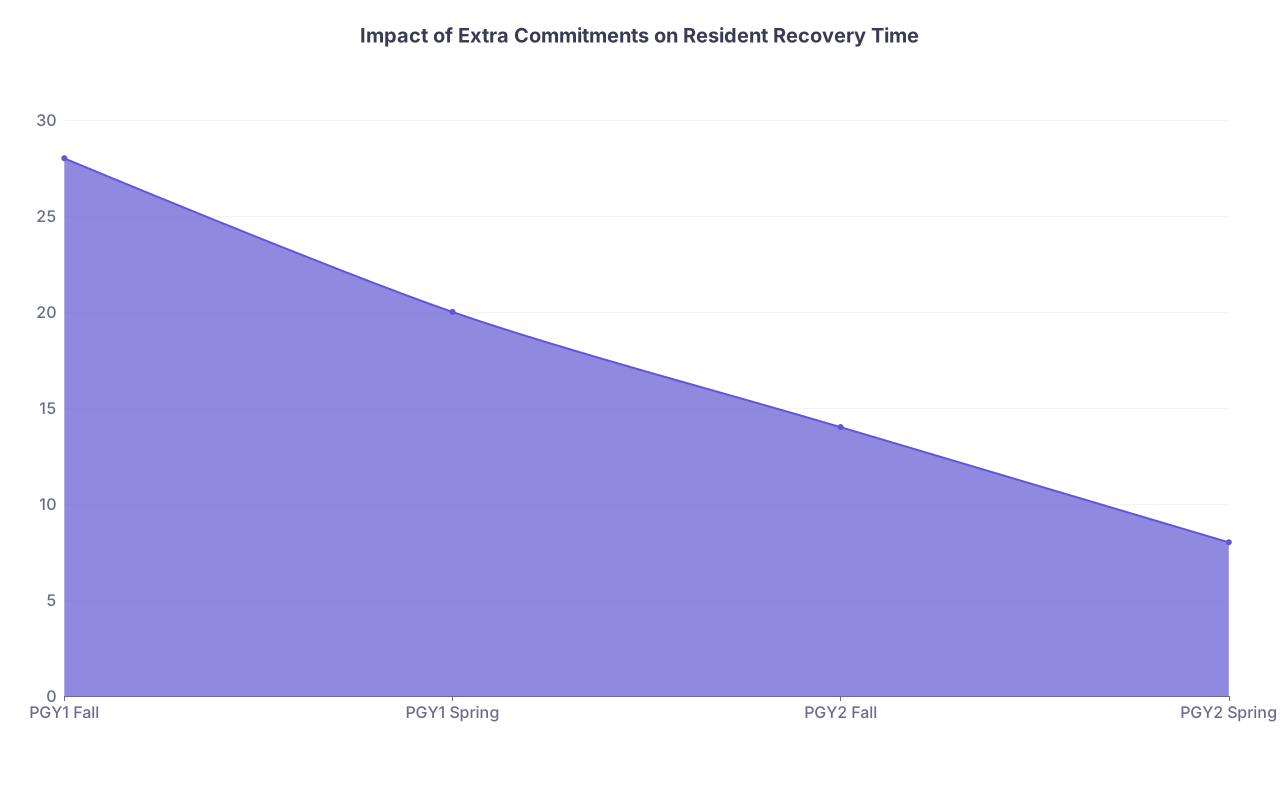
| Category | Value |
|---|---|
| PGY1 Fall | 28 |
| PGY1 Spring | 20 |
| PGY2 Fall | 14 |
| PGY2 Spring | 8 |
(Think of those numbers as true non-work hours per week. They bleed away as you pile on projects.)
Your nervous system does not care that you label it “research” or “leadership.” To your brain, you are in work mode. Problem-solving. Communicating. Performing.
That is why the resident who “just uses evenings for writing” can feel more burnt out than the one on a busier service who actually rests at home.
Red-flag behaviors you should treat like alarms:
- Bringing your laptop on post-call days “just to review a dataset”
- Joining Zoom meetings on your days off every week
- Answering non-urgent project or committee messages at night
- Feeling guilty when you are not working on something “productive”
Those are not habits of a high performer. Those are habits of someone slowly boiling themselves.
Mistake #4: Copying Someone Else’s CV Strategy
You see the superstar senior with:
- 15 publications
- National presentations
- Chief role
- Three committees
- Perfect hair somehow
You assume you must imitate that to match competitively. This is wrong in three different ways.
You do not see the cost behind their CV
You do not see:- Their partner doing 90% of home logistics
- Their chronic insomnia
- The panic attacks they hide
- The resentments they will feel five years from now
“Successful on paper” and “mentally intact” are not synonyms.
You ignore your specialty’s actual expectations
Different fields weigh research and leadership very differently. For many, a targeted, sane portfolio beats a bloated one.
| Specialty | Research Weight | Leadership Weight | Typical Expectation |
|---|---|---|---|
| Cardiology | High | Moderate | Several projects, few pubs |
| Hem-Onc | High | Moderate | Strong research focus |
| GI | Moderate | Moderate | Some research, good letters |
| Hospital Medicine | Low–Moderate | Moderate | QI/leadership more valuable |
| Community IM | Low | Low–Moderate | Solid clinical performance |
Residents in community-focused careers routinely torture themselves with academic-level expectations that do not even apply.
You forget your life context
Are you:- A parent?
- Supporting family financially?
- Managing your own health issues?
- An IMG with extra exams or visa demands?
Then your bandwidth is not the same. Pretending it is will not impress anyone. It will just break you.
Better rule: Aim for coherent output, not maximal output. A few projects and roles that make sense together and that you can talk about with genuine ownership beat a scattered list of half-hearted lines.
Mistake #5: Not Setting Hard Rules Before You Say Yes
Residents get trapped because they “decide” on a case-by-case basis, always under pressure, always in front of someone they want to impress.
You need rules you create in advance, when you are clear-headed, not flattered or afraid.
Some examples that protect people:
- “One major research project at a time as first author. One additional as minor contributor. Nothing else.”
- “No recurring meetings on my post-call days. Ever.”
- “No new roles during my ICU, nights, or ED blocks.”
- “If I join a committee, it must have a clear end date or term limit.”
- “I will not be on more than two committees at once.”

| Step | Description |
|---|---|
| Step 1 | New Opportunity |
| Step 2 | Say No |
| Step 3 | Say Yes With Boundaries |
| Step 4 | Aligned with long term goal |
| Step 5 | Time Capacity This Block |
| Step 6 | Clear Role and Timeline |
You are not just deciding “Is this good?” You are deciding “Is this good relative to everything else I have already committed to?”
Ask:
- What am I willing to give up for this? Sleep? Exercise? Therapy? Time with my kids?
- Would I still say yes if this never shows up on my CV?
- What is the exit strategy if it becomes toxic?
If you cannot answer those, your default should be no.
Mistake #6: Letting Guilt and Fear Drive Your Calendar
Most residents do not overcommit because they are greedy. They overcommit because they are scared.
The usual fears:
- “My PD will think I am lazy.”
- “This attending will never support me again.”
- “Everyone else is doing more.”
- “I already said I was interested; I cannot back out now.”
You need to recognize those as emotional reflexes, not obligations.
Here is the reality most people learn too late:
- Good mentors respect boundaries.
- Programs would rather have a functioning resident than a burnt-out one with another poster.
- The person who pressures you relentlessly to take on more is showing you they care more about their output than your health.
You are allowed to protect yourself.
Concrete phrases that work and do not burn bridges:
- “I really appreciate you thinking of me. I am at capacity this block and cannot take this on without compromising existing commitments.”
- “This aligns with my interests, but I have promised myself not to add new projects until I finish my current one.”
- “I want to do strong work if I commit. Right now I would not be able to give this project the attention it deserves.”
- “Given my current schedule and wellbeing, the responsible choice for me is to decline.”
If someone reacts badly to that, they are confirming you made the right decision.
How to Pursue Ambition Without Burning Out
You do not need to abandon research and leadership. You need to stop treating them like emergencies.
Here is a safer framework:
Pick a primary lane
Decide your main non-clinical identity for now:- Research-focused
- QI/systems-focused
- Education-focused
- Administration/leadership-focused
You can sample others lightly. But go deep in one lane. Scattershot is burnout fuel.
Cap your active commitments
For most residents, a sane upper limit looks like:- 1–2 substantial research/QI projects
- 1 meaningful leadership or committee role
- Maybe 1 “light lift” thing (a case report, small teaching project)
Above that, your returns drop and your burnout risk explodes.
Build protected time that is actually protected
If you have:- Research electives
- Academic half-days
- Admin blocks
Use them for that work so you can actually rest on off days. Do not treat them as “bonus” time that lets you add more and more.
Schedule recovery like a requirement, not a luxury
Put non-negotiables on your calendar:- Sleep windows
- Therapy or coaching sessions
- Weekly non-medical social time
- Movement, even 20 minutes
If you only do these “when there is time,” you will almost never do them.
Re-evaluate every 3–6 months
Ask:- What can I drop?
- What is not moving?
- What is draining and not teaching me anything?
It is better to exit a misfit project or role cleanly than to drag it like a dead weight for two years.
FAQs
1. Do I need research and leadership to get a competitive fellowship?
You need enough research and leadership to show engagement and potential, not maximal involvement. Most fellowship programs care more about:
- Strong clinical performance
- Solid letters from people who actually know you
- A coherent academic narrative (e.g., a few related projects)
A handful of meaningful projects and one or two real leadership roles are far better than a long list of shallow, last-minute, or half-finished commitments.
2. How do I know if I am already burning out from overcommitment?
Warning signs I see repeatedly:
- You feel dread, not excitement, when you see research or committee emails.
- You start resenting colleagues or patients for “stealing your time.”
- You cannot remember your last real day off that did not involve email or writing.
- Your sleep, mood, or physical health has obviously deteriorated in the last 3–6 months.
If that sounds familiar, you are already paying too high a price for your commitments.
3. Is it ever okay to quit a project or step down from a leadership role?
Yes. Residents wait too long to do this. It is acceptable to say:
- “My clinical responsibilities and existing commitments are greater than I anticipated. I need to step back so the project can move forward effectively.”
Give some notice, offer a clean handoff, and be honest without oversharing. Protecting your health and your core duties is not unprofessional. Pretending you can do everything and then disappearing is unprofessional.
4. How many hours per week should I realistically spend on research and leadership in residency?
For most people, an average of 3–6 focused hours a week is sustainable during heavier rotations, and maybe 6–10 on lighter or elective blocks. Once you cross into 10–15 hours every week on top of full-time clinical work, you are playing with burnout. The exact number is less important than this: if those hours are regularly stealing sleep, recovery, or basic life maintenance, it is too much.
Key points to leave with:
- Overcommitting to research and leadership does not make you impressive; it makes you vulnerable to burnout and mediocrity in everything.
- You must set hard limits and choose fewer, higher-quality commitments that align with your goals and your actual bandwidth.
- Any opportunity that costs your basic recovery and mental health is not an opportunity—it is a liability dressed as prestige.


