

It is early July. You badge into the hospital, same building, same ID, but it feels different. Yesterday you were the intern people “protected.” Today you are the PGY‑2 who is supposed to know what they are doing. The night float texts: “Hey, admit in bed 12 is kinda sick, can you go see them first?” Your phone has already started ringing. No one asked how you are doing.
You are at the PGY‑2 cliff. And this is exactly where burnout spikes.
Let me break down why PGY‑2 is such a pressure cooker, what patterns I have seen over and over, and what actually buffers people from crashing during this transition.
Why PGY‑2 Is Uniquely Brutal (And Not Just “More of the Same”)
Everyone tells you “intern year is the hardest.” That is only half‑true. Intern year is visibly hard: hours, scut, constant pages. PGY‑2 is insidiously hard: less obvious support, more invisible expectations, more cognitive load, a quieter pressure to perform.
There are a few specific structural reasons this year hits so many people.
1. Role Shift: From “Protected Learner” to Default Leader
As an intern, the culture frames you as:
- Still learning
- Expected to ask “too many” questions
- Focused on survival and task completion
As a PGY‑2, that frame flips—often overnight.
Colleagues and attendings begin to treat you as:
- A default resource for interns (“Can you help them with that admission?”)
- A junior decision‑maker (“What is your plan?” asked with more seriousness)
- A small‑team leader (on wards, ICU, nights, ED)
No one sits you down and says, “Here are your new expectations.” They just increase. Implicitly.
Common internal monologue I hear from PGY‑2s in July/August:
- “Wait, I am the one people are asking for a plan now?”
- “I am supervising someone who is only 11 months ‘behind’ me… I am not ready for that.”
- “They told me to ‘staff this with the intern’ like I am some kind of mini‑attending.”
That identity mismatch—still feeling like an intern inside, being treated like a supervisor outside—creates a constant sense of fraud. Chronic imposter syndrome is rocket fuel for burnout.
2. Cognitive Load Explosion
Intern year: you are mostly executing. Yes, you think about the plan, but much of your time is tasks:
- Pages
- Orders
- Discharges
- Note‑writing
PGY‑2: the type of thinking changes. Now you are:
- Synthesizing messy data from multiple patients
- Anticipating decompensations
- Filtering interns’ questions and deciding what is urgent vs can wait
- Running or at least co‑running rounds
- Teaching on the fly
The number of decisions goes way up. Decision fatigue is real. If you are supervising a busy intern and carrying your own patients, you can easily make 200+ small to medium decisions in a shift. That drains your battery far more than just “more notes.”
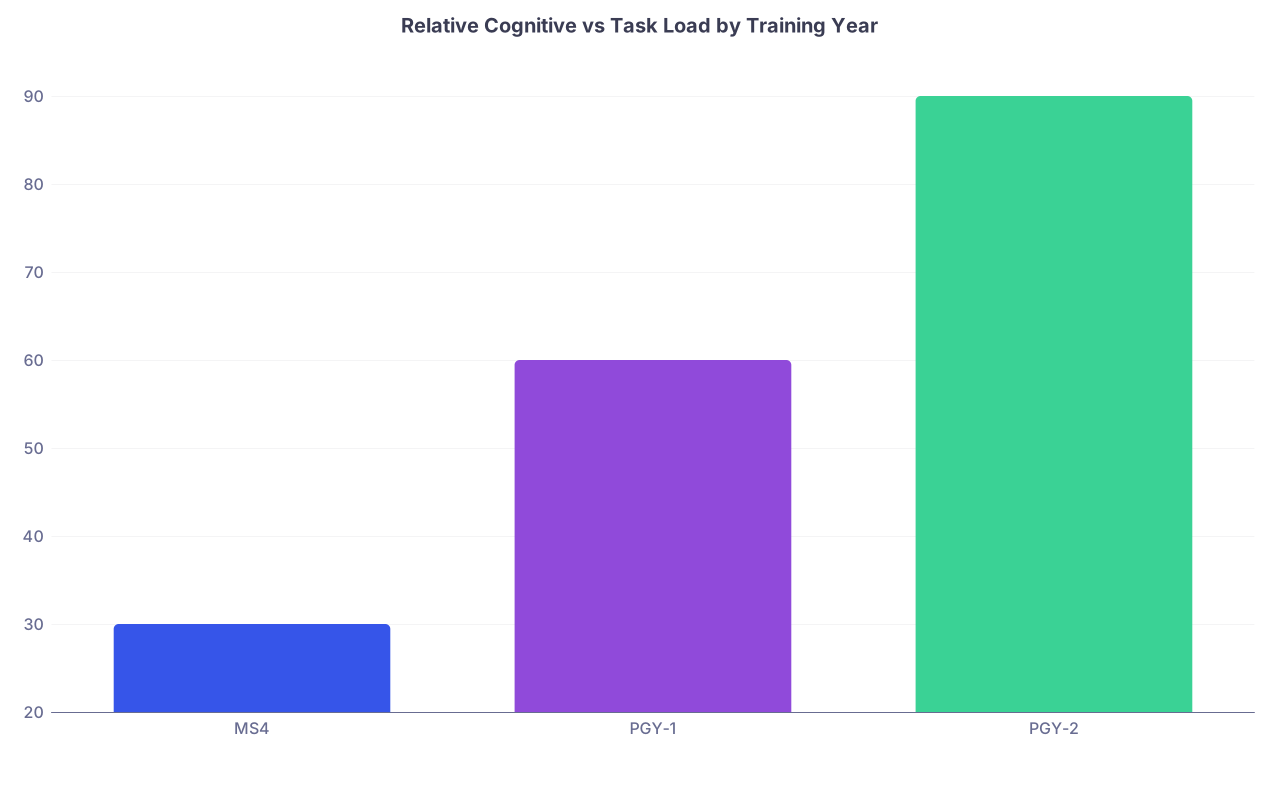
| Category | Value |
|---|---|
| MS4 | 30 |
| PGY-1 | 60 |
| PGY-2 | 90 |
Think of it this way: PGY‑2 is the first time your primary job is not just “do the work” but “decide what work needs to be done, by whom, and when.” That supervisory bandwidth is exactly what no one trains you for.
3. Responsibility Without Full Control
This is one of the most psychologically toxic combinations in medicine: high responsibility, low autonomy.
As a PGY‑2 you are:
- Responsible for interns’ mistakes
- Responsible for the flow of the team
- A key voice in overnight decisions
- The one nurses call when something is “not right”
Yet you still:
- Have to run everything by attendings
- Have schedules and rotations you did not pick
- Cannot control staffing shortages, bed availability, or ancillary support
- Have limited power to change dysfunctional systems
That mismatch breeds helplessness. Learned helplessness + chronic stress = classic burnout trajectory.
4. The “Invisible” Second Year: Less Overt Support
Program structures often over‑resource PGY‑1:
- Formal intern orientations
- Extra attending presence on early rotations
- Built‑in check‑ins: “How are the new interns doing?”
PGY‑2s get far less of that. The assumption is: “You know the system now, you are good.”
So stress rises while explicit support drops. Interns complain openly; PGY‑2s feel they “should not.” I have watched residents apologize mid‑breakdown: “I know PGY‑2 is supposed to be easier than intern year; I do not know why I am struggling so much.”
You are not imagining that drop‑off.
5. Personal Life Colliding With “Mid‑Residency Reality”
By PGY‑2:
- The novelty of residency is gone. Fatigue is cumulative.
- Loans, partners, kids, aging parents—life responsibilities intensify.
- Fellowship anxiety starts. Others are talking about research, mentors, away rotations.
So now your bandwidth is being pulled from both ends: more professional responsibility and more adult‑life responsibility. There is almost no slack in the system.
Why Burnout Peaks: The Psychology Behind PGY‑2 Collapse
Burnout is not “being weak” or “not tough enough.” It is a predictable outcome when demands exceed resources in a sustained way. PGY‑2 has a very specific pattern of demand/resource mismatch.
1. The Three Classic Burnout Components in PGY‑2
Let’s map Maslach’s three dimensions of burnout directly onto what you are living.
Emotional Exhaustion
PGY‑2 often brings:
- More emotionally intense conversations (breaking bad news, goals of care)
- Being the “buffer” between angry families and overtaxed attendings
- Decompensating patients that you are now partially responsible for anticipating
You end up doing more emotional labor:
- Calming interns who are overwhelmed
- Supporting nurses who are furious about staffing
- Absorbing attendings’ frustration when the team is behind
This drains the same “emotional battery” that you need for empathy and presence with patients.
Depersonalization (Cynicism)
You will know you are sliding here when your internal voice sounds like:
- “Another ‘chest pain’ at 3 a.m., great.”
- “Of course they left AMA, what did we expect.”
- “They want palliative but also everything done, impossible.”
Detachment is a defense mechanism. Your brain is trying to protect you. The problem is, medicine rewards this pattern: people praise your “efficiency” when you stop getting upset. You can look high‑functioning on the outside and be deeply burned out inside.
Reduced Sense of Personal Accomplishment
PGY‑2 is when you start to ask:
- “Am I actually any good at this?”
- “Why do I still feel unsure after 14 months?”
- “Everyone else seems more confident.”
The metrics change too. As an intern, you could feel accomplished by:
- Getting all notes done
- Finishing sign‑out
- Not missing pages
As a PGY‑2, the bar shifts to:
- “Did I anticipate that deterioration early enough?”
- “Did I teach the intern anything meaningful?”
- “Did I manage that code/rapid appropriately?”
Those are fuzzier outcomes. Much harder to feel “done” or “good.” If your program also does not give meaningful, specific feedback, this dimension tanks even faster.
2. Identity Dissonance
You came into medicine with a story about yourself: competent, caring, useful. PGY‑2 exposes all the ways that story feels untrue in the moment:
- You supervise and correct an intern on something you still doubt yourself.
- An attending publicly questions your decision in front of the team.
- A patient outcome goes badly and you replay your contributions nightly.
Each of these events chips at your professional identity. “Maybe I am not cut out for this” shows up way more frequently in PGY‑2 narratives than people admit.
3. Chronic Sleep Debt and Circadian Chaos
You already accumulated a year of bad sleep. PGY‑2 often adds:
- More frequent nights or more intense night responsibilities
- Less time “protected” post‑call because you are supervising sign‑out or debrief
- Worse sleep quality due to anticipatory anxiety and second‑guessing decisions
Chronic partial sleep deprivation amplifies:
- Negative affect
- Irritability
- Catastrophizing
- Slower executive functioning
So the very cognitive skills you need to manage PGY‑2 complexity are the ones eroded by the conditions of PGY‑2. Vicious cycle.
Where PGY‑2 Stress Hits Hardest: High‑Risk Scenarios
Not every PGY‑2 rotation is equally toxic. There are certain contexts where I repeatedly see residents hit a wall.

1. First Time as “Senior on Nights”
Classic pattern:
- July PGY‑2. You are senior on nights for the first time.
- You are supervising two interns you have never worked with.
- The cross‑cover list is 60+ patients.
- Attendings are “available by phone” but often grumpy and half‑awake.
The stress cocktail:
- Fear of missing something subtle but catastrophic
- Reluctance to wake attendings, internalized from PGY‑1 culture
- Pressure to answer intern questions quickly to “not look lost”
This combination is a top trigger for panic attacks, derealization, and that hollowed‑out dread going into each shift.
2. ICU Step-Up in Responsibility
In many programs, PGY‑2 equals your first time:
- Running codes (or at least directing compressions and meds)
- Presenting complex ventilator patients to critical care attendings
- Leading family meetings about mortality and morbidity
ICU as a PGY‑1: you are executing orders.
ICU as a PGY‑2: you are expected to have a plan before you present.
Residents who get hammered here often say:
- “I felt constantly behind.”
- “Every time I left the unit I was afraid someone would crash.”
- “I stopped sleeping because I kept replaying my vent settings in my head.”
3. Wards with Weak Faculty Backup
The most burnout‑provoking setups:
- Attendings who micromanage documentation but disappear for clinical decisions
- “Educational” teams used as workhorses for hospital throughput
- High census with minimal ancillary support (no phlebotomy, limited PT, etc.)
As PGY‑2, you sit in the line of fire:
- Interns look to you for help.
- Nurses look to you for orders and clarification.
- Attendings look to you to keep them from being “bothered unnecessarily.”
You become the pressure valve for everyone’s needs, without the formal authority to fix the underlying system problems. That is textbook moral injury.
4. When Life Outside the Hospital Blows Up
PGY‑2 is when I most frequently see:
- Breakups/divorces
- New babies with sleep‑obliterating schedules
- Sick parents requiring travel and emotional energy
- Major financial stressors (house, loans coming out of deferment, etc.)
Your schedule is still brutal, but your life is no longer in “monk mode” the way it might have been during intern year. You are split—and residency is not designed for split attention.
How to Buffer PGY‑2 Stress: Internal Strategies That Actually Work
I am not going to say “self‑care” and walk away. You do not need bubble baths; you need tactical moves that fit inside a 70–80 hour week and the reality of hospital culture.
1. Redefine “Competence” Early
The biggest cognitive trap PGY‑2s fall into is thinking competence = having all the answers. That belief will destroy you.
PGY‑2 competence is:
- Recognizing when something is outside your expertise
- Knowing how to escalate and who to loop in
- Keeping the team psychologically safe to ask for help
So, before you start a new PGY‑2 block, set explicit rules for yourself:
- “If a patient is sicker than I can manage with two mental steps, I will call my attending.”
- “If I am thinking about a patient three times after sign‑out, I will run the case by someone.”
- “If an intern looks overwhelmed, I will redistribute tasks instead of lecturing them on efficiency.”
You are not scored on “how little help you asked for.” That is a myth residents absorb from insecure seniors.
2. Use Micro‑Boundaries, Not Fantasy Ones
No, you are not getting a consistent 3‑hour afternoon off to “reset.” But you can build small habits that create psychological breathing room.
Examples that actually fit:
- On nights: 30‑second deliberate pauses at the workstation after a rapid or code. Breathe, label what just happened (“that was intense”), and only then move on. Interrupts the “just keep going” dissociation.
- On wards: 5‑minute no‑pager window during critical tasks (drafting a complex note, writing admission orders). Ask the intern to be the point person for those 5 minutes unless a code/rapid is called.
- Pre‑shift: 60‑second anchoring routine. Some residents use the same song before walking into the hospital, others a single breath pattern. Sounds trivial; it is not. Repetition wires safety.
These micro‑boundaries help your nervous system stop living in red‑alert mode 24/7.
3. Shift from Perfection to Prioritization
The PGY‑2 year is where people crash if they keep trying to do everything well.
You need a ruthless triage mindset for your own performance:
- Patient safety and major clinical decisions: non‑negotiable.
- Notes formatting, academic‑level teaching every day, inbox zero: negotiable.
A quick exercise: on a post‑call day off, write a PGY‑2 “Good Enough” list:
- “Good enough attending communication = I page them with any change in vitals needing new drips, any code, any transfer to ICU, any serious family conflict, any time I am stuck between two plans.”
- “Good enough teaching = 5‑minute teaching point twice a day, not a full chalk talk.”
- “Good enough charting = accurate, succinct, no obsession over perfect phrasing.”
And then hold yourself to that “good enough.” That is how you conserve energy for when it actually matters.
System‑Level Buffers: What Programs and Teams Can Do (And How You Nudge Them)
You as a PGY‑2 cannot redesign your residency. But you are not powerless either. There are some levers you can pull without painting a target on your back.

1. Ask for Explicit Role Definition at the Start of Rotations
Vague expectations create avoidable stress. At the start of each block, ask the attending or chief, very plainly:
- “As PGY‑2 on this service, what are your top three expectations of me?”
- “When do you absolutely want to be called overnight?”
Write their answers down. Then you are aligned. There is less mental gymnastics about “will they be mad if I call about this?”
If they say something absurd like “Only call me if the patient is being intubated,” you have clear evidence the expectation is unsafe, and you can loop in a chief later if needed.
2. Normalize PGY‑2 Debrief and Feedback
If your program does not already build PGY‑2‑specific check‑ins, you can help nudge:
- Ask your chief or PD for a 10–15 minute mid‑block check‑in, framed around “I want to make sure I am meeting expectations as a new PGY‑2.”
- After a difficult code, family meeting, or bad outcome, say directly to the attending: “Could I get 5 minutes at the end of the day to debrief? I am trying to improve my performance in these situations.”
Most decent attendings will say yes. And if they do not, that is information too.
3. Use Peer Mentors Strategically
Not “support group forever” but very targeted, high‑yield conversations with a PGY‑3 who survived what you are starting.
Ask them concrete questions:
- “When you were a new senior on nights, what were your red‑flag criteria for calling attending?”
- “What were the 2–3 things that made ICU manageable for you?”
- “What did you stop trying to be perfect at in PGY‑2 that freed up bandwidth?”
This is how you shortcut trial‑and‑error and borrow someone else’s hard‑won mental models.
4. Name Moral Injury When It Happens
Some of what you are calling “burnout” is actually moral injury: being forced to act in ways that conflict with your values because of system constraints.
Examples:
- Discharging patients you know will bounce back because of insurance rules.
- Watching unsafe ratios in ICU and being told to “just manage.”
- Being reprimanded for “slow throughput” when you are handling three critical patients.
When you feel that sick, angry exhaustion, label it: “This is moral injury.” Then:
- Talk about it with a trusted attending or chief who gets it.
- Document patterns (for example, number of ICU patients per senior) for later advocacy.
- Separate “I am broken” from “The system is broken and I am reacting normally.”
That framing halves the shame load.
Practical, Daily‑Level PGY‑2 Survival Tactics
This is the part most people ask for first. I put it after the context on purpose. If you do not understand why you feel like you do, none of these will stick.
| Domain | High-Yield Tactic |
|---|---|
| Clinical | Standardize when to call for help |
| Cognitive | Pre-plan “if–then” escalation rules |
| Emotional | Scheduled micro-debriefs weekly |
| Physical | Non-negotiable sleep recovery blocks |
| Social | One non-medical interaction per week |
1. Write Your “Call for Help” Rules on Day 1
Example rules you might adopt:
- I will call my attending for: new pressors, intubations, unclear hypotension, chest pain in high‑risk patients, unanticipated transfer to higher level of care, and any time I feel my gut saying “I am in over my head.”
- I will call a senior or fellow if available when: I am stuck between two management pathways for more than 10 minutes; I have written and rewritten an order set three times; or I have lingering unease about a patient after sign‑out.
You can literally keep this as a note on your badge or in your phone. It offloads cognitive load.
2. Build a Fast Mental Model Library
You do not have hours to read. But you can build pattern recognition.
Pick a few core scenarios that repeatedly spike your anxiety:
- Undifferentiated hypotension overnight
- New O2 requirement on the floor
- Hyponatremia with confusion
- Chest pain with negative initial workup
For each, create a one‑page algorithm (bullet points, not essays). Keep it on your phone or in your pocket. Review during quiet minutes. This makes your response more automatic when you are tired.
3. Protect 1–2 Sleep “Anchors” per Week
You cannot fix residency hours. But you can choose 1–2 time periods per week that are sacred sleep anchors. For example:
- Post‑call: absolutely no social plans, no errands, no “just checking email.” Sleep. Full stop.
- Pre‑night block: a 3–4 hour sleep block every afternoon before the first night shift, treated like a procedure—do not schedule over it.
People underestimate how much even slightly better‑structured sleep buffers emotional volatility.
4. Use 5‑Minute Emotional Maintenance, Not “Someday Rest”
Waiting for a golden weekend is like waiting for a unicorn.
Instead, embed 5‑minute maintenance windows:
- In the car/bus home: one forced check‑in. Ask, “What is one thing that went okay today?” It sounds corny. It nudges your attention away from pure negativity bias.
- Before bed: a 2‑minute physical down‑regulation (for example, long exhale breathing, or any brief body scan).
- Once a week: text a non‑medical friend with something not about residency. Preserve at least one non‑doctor identity.
These are small, but they stop the slow erosion of your sense of self.
5. Decide In Advance What You Will Not Care About
You have finite emotional currency. Spend it deliberately.
Things you are allowed to consciously deprioritize as a PGY‑2:
- Perfect notes that read like textbooks
- Impressing every attending; focus on learning from a chosen few
- Going to every optional event, lecture, or social gathering out of guilt
Pick 2–3 “I will not care about this this year” items and say them out loud to someone you trust. Then actually follow through.
PGY‑2 Is Not a Personality Test. It Is a Design Problem.
If you are struggling, it does not mean you are weak, uncommitted, or “not cut out for this.” It usually means:
- You are in a year where demands outstrip support.
- You are being evaluated against invisible and shifting standards.
- You are taking on responsibility without commensurate control.
That combination would break almost any human system.
You cannot fix everything, but you can:
- Make expectations visible instead of guessing.
- Consciously lower perfection in low‑stakes domains to protect high‑stakes functioning.
- Anchor yourself with tiny, repeatable routines that signal safety to your nervous system.
- Refuse to interpret moral injury as personal failure.
PGY‑2 is a crucible year. Many residents look back and say some version of, “That was the year I nearly quit or nearly broke, and also the year I finally understood the kind of physician I wanted to be.”
You do not get extra points for suffering silently.
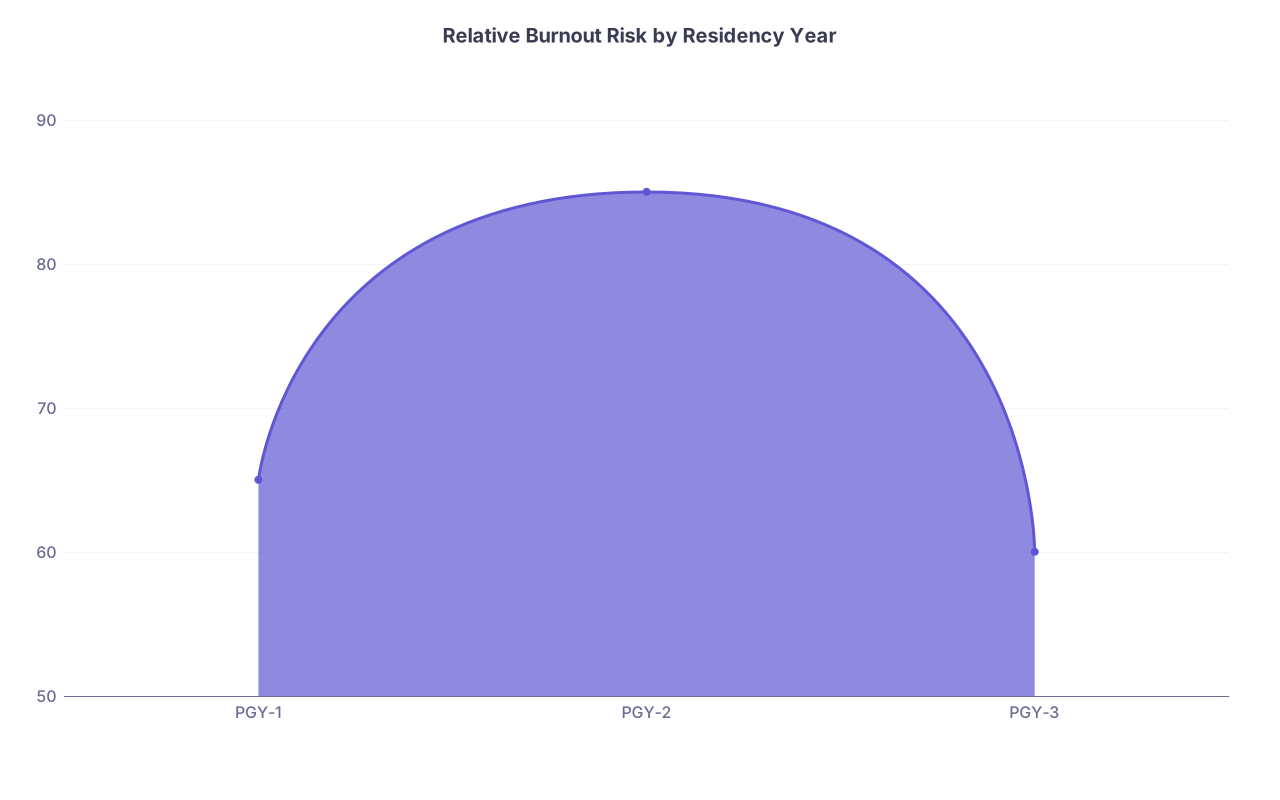
| Category | Value |
|---|---|
| PGY-1 | 65 |
| PGY-2 | 85 |
| PGY-3 | 60 |


| Step | Description |
|---|---|
| Step 1 | PGY-2 Role Shift |
| Step 2 | Increased Responsibility |
| Step 3 | Higher Cognitive Load |
| Step 4 | Emotional Exhaustion |
| Step 5 | Burnout Risk Peak |
| Step 6 | Set Clear Expectations |
| Step 7 | Use Algorithms and Rules |
| Step 8 | Micro Boundaries |
| Step 9 | Lower Burnout Risk |
FAQ (Exactly 5 Questions)
1. How do I know if what I am feeling is “normal stress” versus true burnout in PGY‑2?
Watch for three things over a few weeks, not just one bad shift:
- Persistent emotional exhaustion that does not improve even after a legitimate rest opportunity.
- Cynicism or detachment becoming your default, not just an occasional shield.
- A steady drop in your sense of accomplishment, where even good feedback does not land.
If all three are present and worsening, you are not just “stressed”; you are likely burning out and need to treat it as a clinical problem, not a personality flaw.
2. Is it a red flag for my career if I ask for help or admit I am overwhelmed as a new PGY‑2?
No. Residents who burn out silently, make serious errors, or quit suddenly cause far more disruption than those who ask for support early. Frame your ask around performance and patient safety: “I want to be sure I am functioning at the level you expect for PGY‑2, and right now X and Y are making that difficult.” Good programs respect that. If your program punishes honesty, the problem is them, not you.
3. What if my attending is intimidating and I am scared to call them overnight?
Use a simple rule: if you would want to know about this problem if you were the attending, you call. Document once (mentally or literally) when you considered calling and did not, and how that turned out. You will quickly see that calling is safer for you and the patient. You can also say on the phone, “I apologize for the late call, but as a new PGY‑2 I did not want to miss anything important.” Most attendings back down their edge when you frame it like that.
4. How can I support interns without burning myself out even more?
You are not their therapist or savior. Your primary jobs are: protect patient safety, create a learning environment where they can ask questions, and help them prioritize. Practical moves: give them 1–2 clear expectations for each shift, check in briefly at a set time (for example, 11 a.m. and 4 p.m.), and model asking for help yourself. You do not need to be emotionally available 24/7 to be a good senior.
5. At what point should I consider formal help (therapy, occupational health, or talking to the PD)?
If your sleep is chronically disrupted by anxiety or rumination; if you are having recurrent thoughts of quitting medicine, self‑harm, or feeling that others would be better off without you; or if colleagues have commented that you “do not seem like yourself,” that is the threshold. Start with the least threatening option for you—often a confidential therapist outside the hospital or your institution’s mental health services. If functioning at work is clearly affected, looping in a trusted chief or PD early creates more options than waiting until you are in crisis.
Key takeaways:
PGY‑2 is a structurally high‑risk year for burnout because responsibility, cognitive load, and emotional labor spike while explicit support and control drop. You buffer this not by “being tougher” but by making expectations visible, lowering perfection where it does not matter, building small but consistent recovery habits, and refusing to confuse moral injury with personal inadequacy.


