

The biggest mistake residents make about burnout is pretending all programs are the same battlefield. They are not. Academic and community programs burn you out in different ways—and if you do not see that clearly, you will keep solving the wrong problem.
Let me break this down specifically.
The Core Reality: Same Diagnosis, Different Disease Mechanisms
Burnout is burnout—emotional exhaustion, depersonalization, and feeling like you are not accomplishing anything. Fine. You know that part.
What matters for you is mechanism. What drives it looks very different at:
- A large academic powerhouse (think MGH, UCSF, Duke, Hopkins), versus
- A high-volume community program (county hospital, private-system community program, hybrid “unopposed” community sites)
If you train in an academic center and think, “If I could just be in a chill community program, I would be fine,” you will be disappointed. And if you are drowning in a community job thinking, “Academia is more structured and academic, that would fix this,” also wrong.
You are trading one pressure profile for another.
Structural Differences That Shape Burnout
Before we talk feelings, we talk structure. Because your schedule, supervision, and expectations are not random. They are baked into the type of program you chose.
| Feature | Academic Program | Community Program |
|---|---|---|
| Research Expectations | High to moderate | Low to minimal |
| Patient Volume | Moderate to high | High, often higher |
| Case Complexity | Higher subspecialty mix | High bread-and-butter, some complex |
| Autonomy Level | Lower early, more later | Higher earlier, variable |
| Faculty Availability | Many subspecialists | Fewer, more generalists |
Academic Programs: The “Exposure + Expectations” Model
Academic programs load you with:
- Teaching responsibilities (students, juniors, interprofessional staff)
- Research / QI / scholarly activity
- Subspecialty services with complex patients and politics
- A culture that glorifies “being known” and “building a CV”
Burnout there is often about pressure to be more than a clinician. You are supposed to be a mini-attending, a junior scientist, a teacher, a leader. All while working 60–80 hours a week and charting in an EHR that hates you.
Community Programs: The “Volume + Service” Model
Community programs hit you with:
- Crippling patient volume (ED holds, full wards, short-staffed nights)
- Limited ancillary support (depending on system: transport, phlebotomy, case management)
- Higher early autonomy (good for learning, bad if unsupported)
- Strong pressure from administration and local politics around productivity, throughput, and patient satisfaction
Burnout there is usually about being treated like a service engine. Less “where are your publications?” and more “why are there still 12 patients waiting for admission?”
Both can wreck you. For different reasons.
Distinct Burnout Pressures in Academic Programs
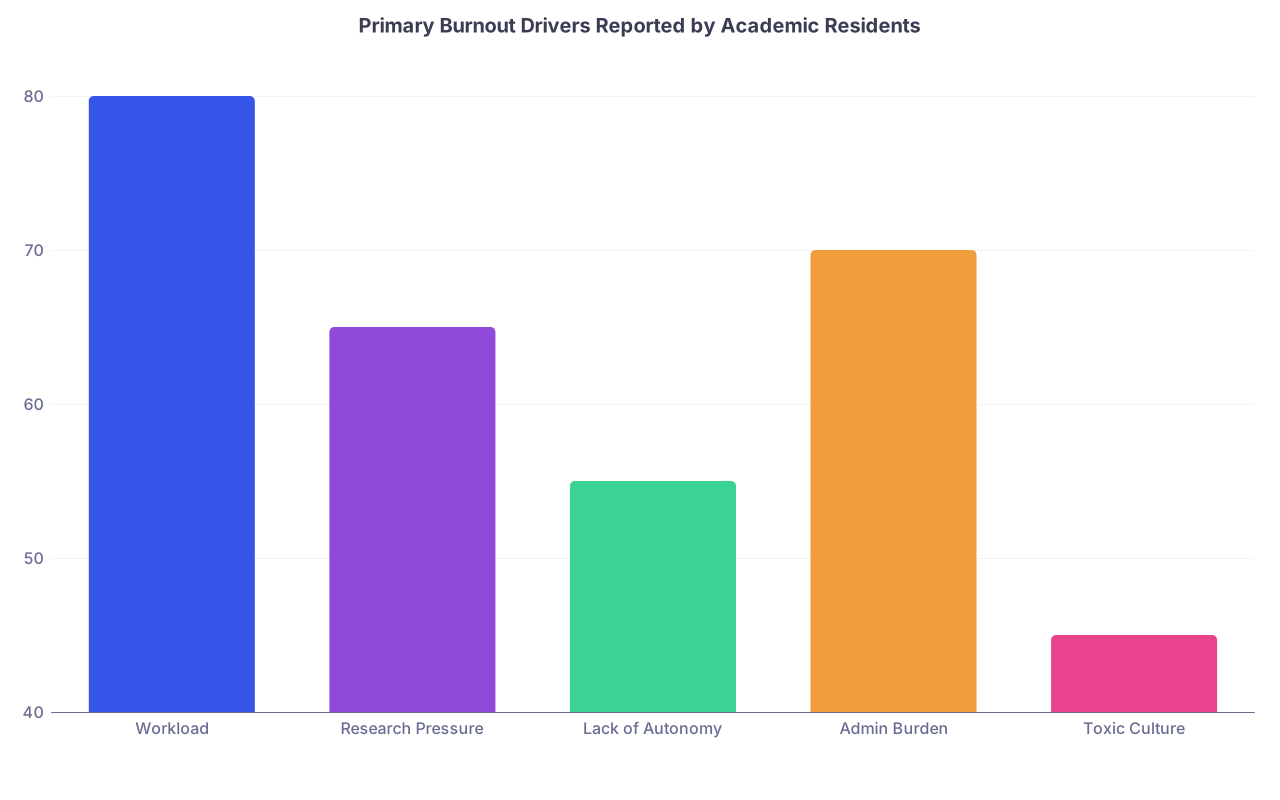
| Category | Value |
|---|---|
| Workload | 80 |
| Research Pressure | 65 |
| Lack of Autonomy | 55 |
| Admin Burden | 70 |
| Toxic Culture | 45 |
Let me spell out what I repeatedly see at academic centers.
1. The CV Arms Race
You are not just working; you are performing potential.
Conversations you actually hear:
- “How many abstracts do you have this year?”
- “She already has three first-author papers in PGY-2.”
- “Did you submit anything for the national meeting?”
Burnout mechanism:
- Chronic feeling of being behind
- Guilt when you are not working on something “scholarly” in your few off hours
- Saying yes to projects you do not care about because you fear being invisible
This is not hypothetical. I have watched residents:
- Run a full ICU month
- Come home post-call and immediately join a 5 p.m. Zoom to “work on the methods section”
- Then beat themselves up for not being “productive enough”
You know exactly what I am talking about if you are at a big-name center.
Prevention here is not just “do less.” It is being ruthlessly selective:
- One meaningful project you can see through > six half-dead side projects that bleed your weekends dry.
- Saying “I am currently at capacity with existing projects” is not career suicide. It is boundary-setting.
2. Too Many Bosses, Too Little Control
In academics, you answer to:
- Your PD and APDs
- Rotating attendings on each subspecialty service
- Fellows who may or may not remember they are not technically your boss
- Chiefs enforcing “program culture”
- Sometimes even service line administrators monitoring metrics
Burnout mechanism:
- Decision fatigue from constantly shifting expectations
- Emotional whiplash: one attending wants micromanagement, the next wants full autonomy
- Fear of “bad evals” that feel subjective and political
Classic internal monologue: “I cannot just do the job; I have to constantly read the room and calibrate how ‘independent’ is safe.”
This erodes your sense of professional identity. You start feeling like a shape-shifter, not a doctor.
3. The Hidden Curriculum of Prestige
Academic culture quietly teaches:
- Research is more valued than clinical excellence
- Subspecialty is “better” than generalist
- Big-name fellowships define your worth
Burnout mechanism:
- You like actual patient care, but you feel “less than” if you are not planning a fellowship
- You enjoy bread-and-butter internal medicine or general surgery but sense subtle disdain for “just being a hospitalist”
So you live in chronic misalignment. What you genuinely enjoy does not match what your environment praises.
That mismatch—between what you value and what you feel forced to value—is a huge burnout driver in academic settings.
4. Constant Teaching Load
Academic residents are expected to:
- Teach medical students (who often rotate only at your site)
- Present at noon conferences, journal clubs, M&M
- Provide mini-teaching moments on rounds for interns and students
This can be a protective factor if you like teaching. But at 2 a.m., when a student wants to “scrub into everything,” it is not protective at all. It is one more role.
Burnout mechanism:
- No time that feels like “just doing the job”
- Guilt when you cut corners on teaching to survive the day
- Feeling like you are failing as both clinician and educator
You need explicit rules for yourself, like:
- Post-midnight, teaching is “see one, do one, go home.” No long anatomy lectures in the OR.
- On brutal call days, you do micro-teaching (1–2 focused takeaways) instead of formal sit-downs.

Distinct Burnout Pressures in Community Programs
Now let us flip it.
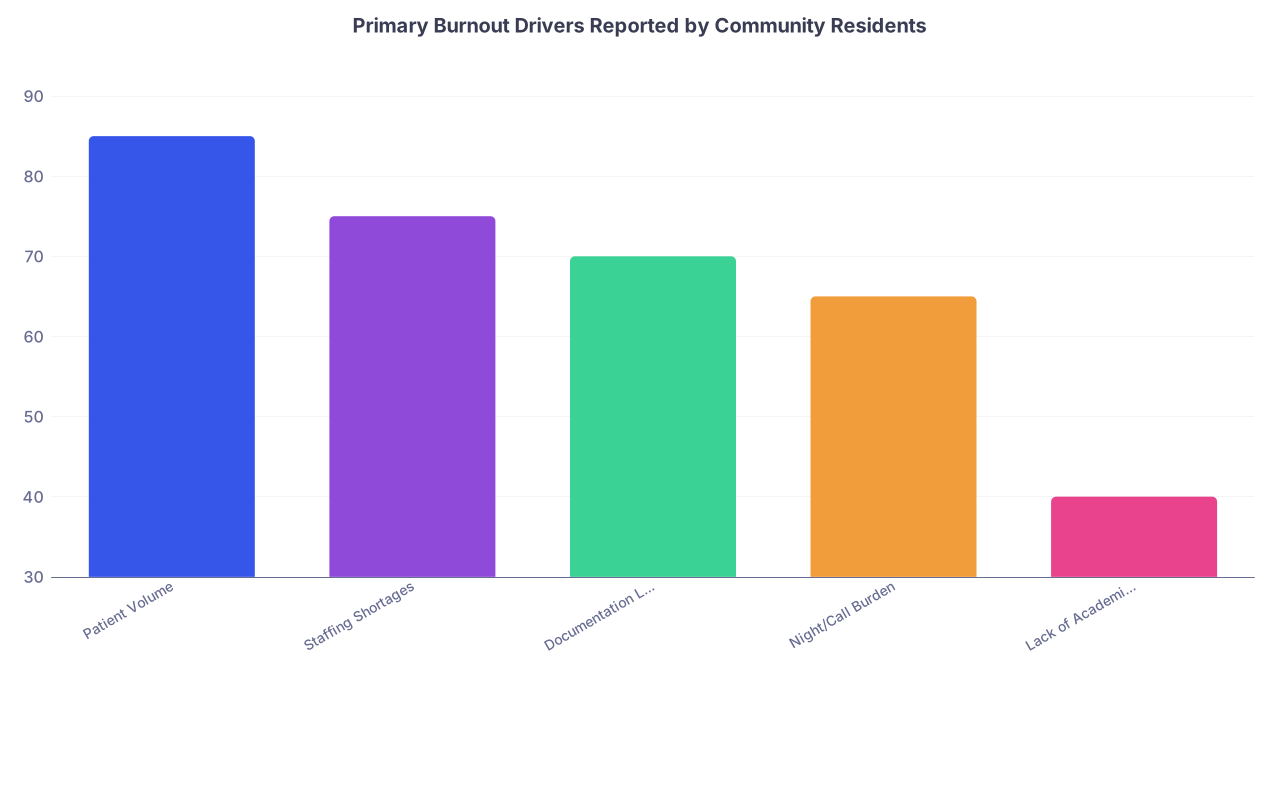
| Category | Value |
|---|---|
| Patient Volume | 85 |
| Staffing Shortages | 75 |
| Documentation Load | 70 |
| Night/Call Burden | 65 |
| Lack of Academic Support | 40 |
1. Sheer Volume and Throughput Pressure
Community EDs and wards are where health systems dump reality:
- ED boarding is worse
- Outpatient access is limited, so admit thresholds are low
- Transfers from smaller facilities land on your lap
Day-to-day reality:
- You are carrying 18–24 inpatients as a PGY-2 or PGY-3
- New admits keep coming because “we have no obs beds”
- You are charting late into the night just to keep up
Burnout mechanism:
- Emotional exhaustion from never finishing the to-do list
- Loss of any sense of mastery; you are in “task rabbit mode” all the time
- Cynicism toward system-level problems you cannot touch
Your buffer here is micro-structure. Community residents who survive long-term:
- Batch tasks (e.g., call all families in a 60–90 minute block rather than randomly all day)
- Use tight note templates unapologetically
- Standardize as much as possible (admission ordersets, discharge instructions, phrase expanders)
If you are writing every note from scratch in a high-volume community program, you are burning hours you cannot afford.
2. Early, Sometimes Unsafe, Autonomy
This one is a double-edged sword. Community programs often give you more autonomy, earlier. Great for confidence. Potentially awful for stress.
Typical scenario:
- Night float PGY-2 cross-covering the entire medicine service
- Limited in-house subspecialists at night
- Tired attending at home, covering several services by phone
Burnout mechanism:
- Chronic anxiety: “Am I missing something?”
- Moral distress when you feel you did not have the backup you needed on a sick patient
- Isolation—no big team rounds to decompress and learn from errors in a structured way
You protect yourself by:
- Having very low thresholds for escalation, and not apologizing for it
- Creating “personal protocols” (e.g., my default on any borderline sepsis at 2 a.m. is this fluid, this pressor call, this lab set)
- Doing brief, ruthless post-mortems with attendings: “On that hypotensive GI bleed last night, what would you have done differently?” One question. Two minutes.
3. Administrative and Productivity Pressures
Community hospitals live and die on:
- Throughput
- Patient satisfaction
- Length of stay
- Readmission rates
Residents feel that, directly or indirectly:
- “Why is this patient still here?” (said at 8:15 a.m. before staffing)
- “Can you discharge at least three before noon?”
- “Try to avoid admitting to medicine; we’re at capacity.”
Burnout mechanism:
- Feeling like a pawn of hospital finances
- Rage when clinical judgment is second-guessed because of bed pressure
- Pressure to discharge even when follow-up is shaky
You need your own internal red-line rules:
- If a discharge does not meet your minimum safety criteria, you do not sign it. Full stop.
- You document your reasoning explicitly: “Discharge deferred due to X, Y, Z safety concerns.” This protects your license and your conscience.

4. Limited Academic and Mentorship Infrastructure
Community programs vary widely here. Some are essentially academic-lite. Others are “you get CME once a year; good luck.”
Common patterns:
- Less protected time for research or QI
- Few faculty doing active scholarship
- Limited subspecialty teaching rounds
- Less culture around conferences and board-style learning
Burnout mechanism:
- Feeling like you are only a worker, not a trainee
- Anxiety about competitiveness for fellowship if you change your mind later
- Intellectual stagnation—nobody is pushing you to grow beyond service needs
You have to build your own academic spine:
- Use free or low-cost board review resources consistently (e.g., MKSAP, TrueLearn, OnlineMedEd, etc. depending on specialty)
- Identify one faculty member, even if off-site, to be your “academic anchor” for letters and career talks
- Join regional or national specialty societies early; they can give you research and mentorship pathways that your hospital does not.
Overlapping Burnout Themes—but Expressed Differently
Some pressures are shared, but they manifest differently depending on environment.
Documentation and EHR Hell
Academic:
- Heavy emphasis on coding for teaching hospitals, complicated notes, multiple attestation layers
- Extra documentation burden for research registries, quality projects, and teaching logs
Community:
- Volume-based documentation fatigue
- Productivity metrics tied to your chart completion times
- Documentation for multiple entities (hospital, private groups, SNF forms, home health)
In academics, the EHR can feel like bureaucracy. In community, it feels like survival. You still fix both with:
- Aggressive template optimization
- Standardized dot phrases for common scenarios
- Saying “no” to being the unofficial “documentation champion” unless you truly care about it
Night Float and Call
Academic:
- Call often structured, but with many pages from different services, consults, and cross-cover
- Sometimes more backup, given larger teams and fellows in-house
Community:
- Night shifts can be more solitary, more cross-cover, and more responsibility per person
- Less easy access to in-house subspecialists
Same intervention: non-negotiable recovery rituals. Residents who last do not “see how they feel.” They:
- Have fixed cutoffs for caffeine
- Use physical signals (same shower, same snack, same blackout routine) to force sleep
- Guard post-night days from social pressure
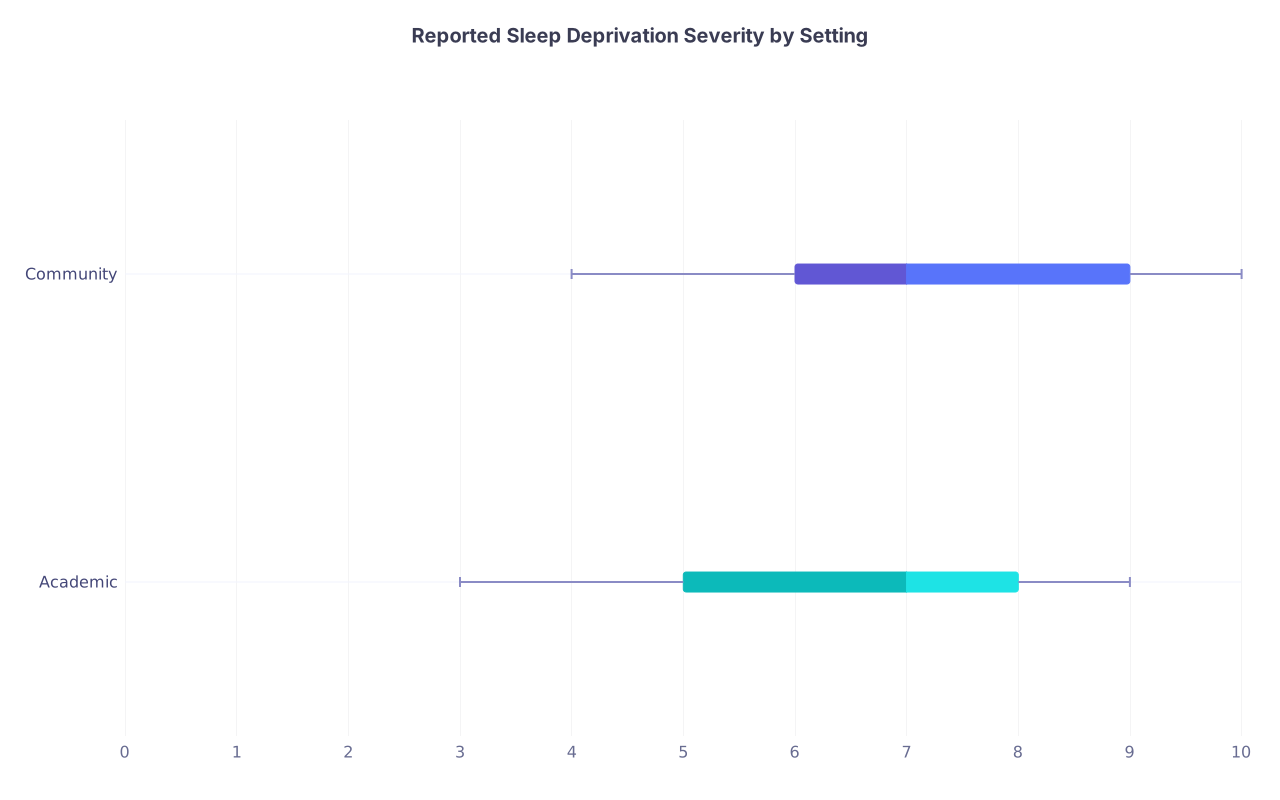
| Category | Min | Q1 | Median | Q3 | Max |
|---|---|---|---|---|---|
| Academic | 3 | 5 | 7 | 8 | 9 |
| Community | 4 | 6 | 7 | 9 | 10 |
(Scale 0–10; community programs often show a slightly higher upper range in self-reported sleep deprivation.)
How to Match Your Personality to Burnout Risk
Let us be blunt. Your resilience is not generic. It depends on fit.
If you are in med school or very early residency and still choosing paths, here is how I advise people.
| Personality / Preference | Better Fit (Usually) |
|---|---|
| Loves research and teaching | Academic |
| Craves high autonomy early | Community |
| Wants structured learning | Academic |
| Values efficiency over prestige | Community |
| Needs strong mentorship network | Academic (or hybrid) |
If you are already in residency, your question is not “Did I choose wrong?” It is:
“How do I practice in a way that compensates for my program’s specific burnout profile?”
If You Are Burning Out in an Academic Program
Your high-yield levers:
Slash unnecessary projects.
- Drop or delegate dead-end research.
- Ask: “Which 1–2 projects will actually change my future?” Most of the rest is noise.
Redefine success metrics.
- One solid attending who respects your clinical judgment > five strangers who saw your poster.
- You are not a failure if you finish with a strong clinical skill set and zero R01 pipeline.
Limit identity diffusion.
- You are primarily a physician-in-training. Teaching, research, leadership—these are roles, not your core worth.
- When you are overwhelmed, strip back to the core: take good care of patients, learn medicine, protect sleep.
If You Are Burning Out in a Community Program
Your high-yield levers:
Get ruthless with operational efficiency.
- Auto-texts, smart phrases, pre-built order sets, call-batching.
- Protect 15–20 minutes per shift to update lists and re-prioritize. It feels like a luxury; it is not.
Rebuild a sense of training, not just service.
- Schedule your own “academic hour” weekly with a trusted attending, even by phone: 1 case, 3 learning points.
- Use national resources (podcasts, virtual grand rounds, online case conferences) to stimulate the part of your brain not fed by volume.
Negotiate for micro-changes, not miracles.
- Asking for “better staffing” is vague and usually ignored.
- Asking for “no new admissions after 6:30 p.m. on clinic days” or “hard cap of X patients per team, with overflow to hospitalists” sometimes works.
- Concrete, measurable, and annoying to say no to—that is the sweet spot.
What Both Types of Programs Consistently Get Wrong
I will say the quiet parts out loud.
They overestimate resilience and underestimate chronic load.
Residents are not burning out because they are “weak.” They are burning out because they are doing 1.5–2 FTE of work under constant evaluation, with zero slack in the system.They confuse wellness with optics.
Wellness lectures, online modules, pizza nights—fine. Harmless. But when schedules and expectations stay abusive, that is not wellness, that is PR.They rarely train people in practical self-protection.
I almost never see formal teaching on:- How to say no to projects without burning bridges
- How to structure your note-writing to save 60–90 minutes a day
- How to escalate safety issues without being labeled “difficult”
The programs that actually reduce burnout are the ones that change workflows, caps, call structure, and documentation demands. Everything else is noise.
You cannot fix the system alone. But you can be very intentional about how you operate inside it.
FAQs
1. Is burnout generally worse in academic or community residency programs?
There is no universal winner. At big academic centers, burnout tends to come from role overload and constant performance pressure (research, teaching, prestige). At busy community programs, it is driven more by volume, staffing shortages, and service demands. Which feels worse depends on your personality: some people are crushed by expectations; others are crushed by endless tasks and under-support.
2. I am in an academic program and feel guilty not doing research. Is that a burnout red flag?
Yes. Chronic guilt about not doing “extra” is a classic academic-burnout marker. If the thought of opening your data set makes you tired or resentful, you are at or past your limit. Focus on one meaningful project and explicitly drop the rest. Your mental health and clinical performance matter more than padding your CV with projects you hate.
3. I am in a community program and feel like a service worker, not a trainee. What can I actually do?
Three concrete moves:
- Carve out protected personal academic time weekly (even 45–60 minutes) with good resources.
- Identify one attending as your “education ally” and ask for brief, structured teaching off busy shifts.
- Push for specific operational changes (patient caps, re-distribution of admits, documentation help) rather than vague cries for “more wellness.”
4. Does switching from academic to community or vice versa fix burnout?
Sometimes it helps; often it just trades one set of problems for another. If your burnout is mainly from misaligned values (you hate research but are at a research monster), a switch can help. If your burnout is from chronic overwork, poor boundaries, and lack of sleep, those will follow you. Fix your habits and expectations before assuming a change of institution will solve everything.
5. How do I know if my burnout risk is from the program type or from medicine itself?
Ask yourself this: If you had a reasonable schedule, decent sleep, and a team that respected your limits, would you still want to practice your specialty?
- If the answer is yes, your issue is mostly system/program structure.
- If the answer is no, and the content of the work drains you even in good weeks, then you are facing a deeper career-fit problem that will not be solved by switching from academic to community or back.
Take-home points:
- Academic and community programs burn residents out through different primary mechanisms—role overload versus volume/service pressure.
- You protect yourself by matching your personality to your environment and then aggressively optimizing how you work inside that specific system.
- System change is slow, so your most immediate leverage is in boundaries, workflow efficiency, and choosing which expectations you will accept—and which you quietly refuse.


